HS Code for Generators: Classification Guide for Importers
Generating sets sit in heading 8502, split by engine type and, for diesel sets, by output. This classification guide works through each 8502 line, the UK and EU extensions, and how to confirm the code before filing.
Short answer
Generating sets sit in heading 8502. Diesel or semi-diesel sets take 8502.11, 8502.12 or 8502.13 by output, spark-ignition sets take 8502.20, wind-powered sets take 8502.31, other sets take 8502.39, and rotary converters take 8502.40. Only the first six digits are shared worldwide, so confirm the full United States, European Union or United Kingdom code for each exact set before filing.
On this page
Key takeaways
A diesel set is classified by output: 8502.11 up to 75 kVA, 8502.12 above 75 up to 375 kVA, and 8502.13 above 375 kVA, with the boundary read exactly as written.
Spark-ignition sets share 8502.20 at six digits with no output split, while wind-powered sets sit apart at 8502.31 and other sets at 8502.39.
Parts shipped on their own fall outside the generating-set lines, and a rotary converter takes 8502.40 even though it sits in the same heading.
National codes diverge after six digits: the United States and the United Kingdom use ten-digit codes and the European Union uses eight-digit Combined Nomenclature codes, so never copy a national suffix across countries.
For a borderline set, check published rulings and apply for a binding decision before shipping, with a separate application per product type in the European Union.
A buyer ordering two diesel sets in one shipment can still need two different customs codes: a 60 kVA set and a 400 kVA set look alike on a quotation, but the tariff splits diesel sets by output, and a petrol set beside them sits on a different line again. This guide covers classification only: how to read heading 8502, which factor moves a set from one line to another, and how to confirm the full national code before filing. The ordering steps are in how to import generators from Bangladesh and the inspection points in the generators quality control checklist.
The Harmonized System is a multipurpose international product nomenclature developed by the World Customs Organization (WCO), comprising more than 5,000 commodity groups, each identified by a six-digit code, and used by more than 200 countries and economies as a basis for their customs tariffs.1 Generating sets are classified inside that system, not by a product name.
Quick answer: indicative HS heading (with verify note)
Generating sets sit in heading 8502, electric generating sets and rotary converters.2 Treat every line below as indicative until it is confirmed for the exact set, its engine type and its output, in the destination tariff for the entry date.
Set | Indicative six-digit line | Why |
|---|---|---|
Diesel or semi-diesel set, output not exceeding 75 kVA | 8502.11 | Lowest diesel band |
Diesel or semi-diesel set, output exceeding 75 kVA but not exceeding 375 kVA | 8502.12 | Middle diesel band |
Diesel or semi-diesel set, output exceeding 375 kVA | 8502.13 | Highest diesel band |
Petrol or other spark-ignition set | 8502.20 | No output split at six digits |
Wind-powered generating set | 8502.31 | Other generating sets, wind-powered |
Other generating set, neither diesel, spark-ignition nor wind-powered | 8502.39 | Other |
Electric rotary converter | 8502.40 | Not a generating set |
The United States schedule and the United Kingdom tariff state the diesel bands in the same words.2 3 Read the boundary as written: exactly 75 kVA is 8502.11, exactly 375 kVA is 8502.12, and only above 375 kVA is 8502.13.
How HS codes are structured (2-4-6 digits)
The Harmonized System is organised by sections, chapters at two digits, headings at four digits and sub-headings at six digits.4 For a generating set the build is chapter 85, heading 8502, then a six-digit subheading such as 8502.11. Countries then subdivide the six-digit categories into national subheadings, and the Combined Nomenclature of the European Union uses eight-digit codes.4 The current version is HS 2022.4 See the 6-digit HS code guide for more on the structure.
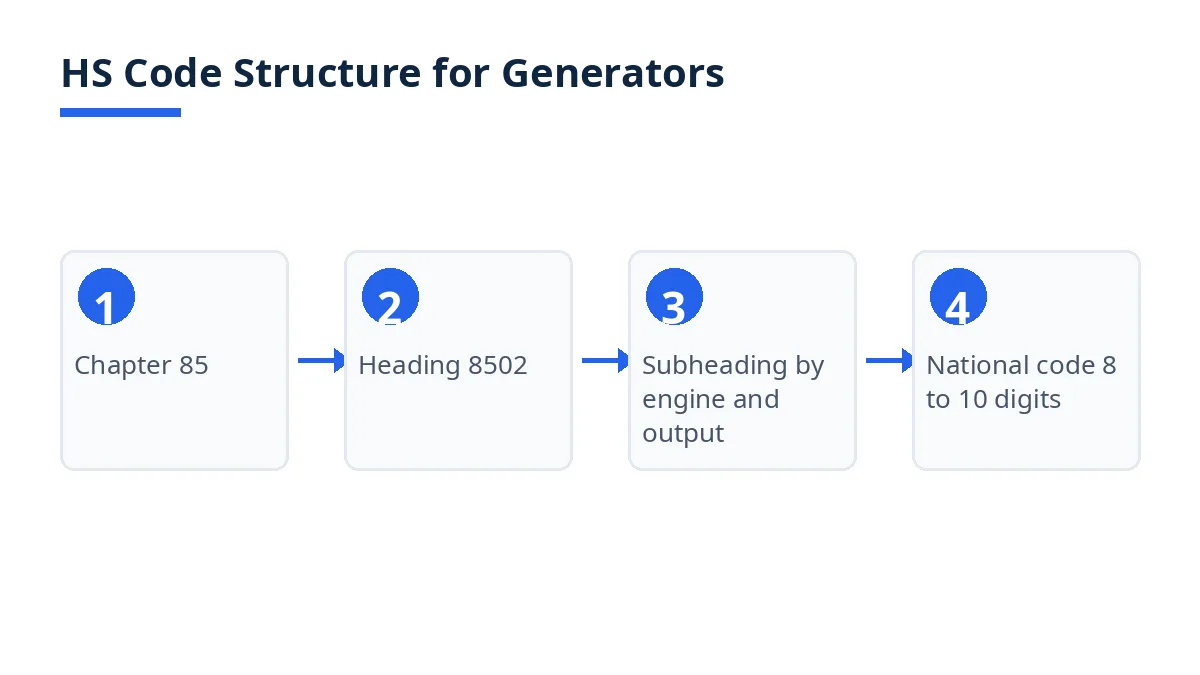
Only the first six digits are shared worldwide, so a code copied from another destination is not confirmed for your entry. The harmonized system explainer and the guide to classifying a product give the background to this system.
Factors that decide the code for generators
Engine ignition type comes first. Heading 8502 separates generating sets with compression-ignition internal combustion piston engines, described as diesel or semi-diesel engines, from generating sets with spark-ignition internal combustion piston engines.2 A diesel set therefore starts on the 8502.11 to 8502.13 branch, while a petrol set starts on 8502.20. For a gas set, check the ignition type on the specification rather than the fuel name alone.
Output decides the diesel line, and only the diesel line. At six digits, output bands apply to compression-ignition sets only. A spark-ignition set has no output split at six digits, so a small portable petrol set and a large spark-ignition set share 8502.20 until the national extension splits them further. The diesel bands in both schedules are stated in kVA,2 3 so keep the rating-plate output in kVA beside the code.
Wind-powered sets leave the engine branches entirely. Both schedules place wind-powered sets at 8502.31 under other generating sets, separate from both engine branches.2 3 A wind-powered set is therefore neither a diesel set nor a spark-ignition set.
The 8502.39 remainder covers the rest, including turbo-generators. In the United Kingdom tariff, the other branch splits at eight digits into turbo-generators at 8502 3920 and other sets at 8502 3980.3 In the United States schedule, the statistical detail under 8502.39.00 separates steam-turbine sets from other sets.2 Name the driving method on the specification.
A complete set, a bare machine and a part are three different tests. Heading 8502 covers a set: an engine combined with a generator. A part shipped on its own is tested separately, and the United States schedule places parts suitable for use solely or principally with the machines of heading 8501 or 8502 in heading 8503.2 Do not file a spare alternator, engine or control panel on the set line. An electric rotary converter sits in the same heading at 8502.40 but is not a generating set,2 3 so it takes its own line.
Classify each model separately. A 60 kVA diesel set, a 400 kVA diesel set and a petrol set on one invoice need three lines. Keep each model on its own invoice line with its engine type, output and confirmed code.
National codes: US HTS, EU CN/TARIC, UK commodity code
United States: HTS, ten digits. Diesel sets appear as 8502.11.00, 8502.12.00 and 8502.13.00, with a further statistical split above 375 kVA into 375 to 1,000 kVA and above 1,000 kVA.2 Spark-ignition sets appear as 8502.20.00, wind-powered sets as 8502.31.00, other sets as 8502.39.00 and rotary converters as 8502.40.00.2 Read the full ten-digit line for each model.
European Union: CN at eight digits, TARIC for measures. The Combined Nomenclature of the European Union uses eight-digit codes, built on the six-digit HS lines with EU subdivisions.4 For an EU import, the TARIC digits that follow the eight-digit code carry additional detail: in the United Kingdom Customs Declaration Service guidance, TARIC is digits 9 and 10 of the commodity code, which can affect the duty due and the measures applied.5 Read the confirmed line in the EU tariff for the entry date and for origin Bangladesh.
United Kingdom: commodity code to ten digits. Diesel sets split at eight digits into 8502 1120 for output not exceeding 7.5 kVA and 8502 1180 for output above 7.5 kVA up to 75 kVA, then 8502 1200 for the middle band and 8502 1320, 8502 1340 and 8502 1380 for the bands above 375 kVA.3 Spark-ignition sets split into 8502 2020, 8502 2040, 8502 2060 and 8502 2080.3 At ten digits, many lines split again between goods for use in civil aircraft and other goods, so a standard industrial set takes the other line.3
Do not compare national codes across countries. The HS classification is uniform for all countries only through the first six digits, and any country may break the six-digit classification down further.6 The same eight-digit class can represent different products in different countries, so compare nomenclatures only on the six-digit level.6
How to confirm the code officially
Write a description: engine ignition type and fuel, rated output in kVA, complete set or parts, driving method for a non-engine set, and any civil-aircraft use.
Start from the official tariff for the destination and read the heading text and the lines under it, rather than a supplier code or a code from an earlier entry.
Check published rulings for similar sets. For the United States, the USITC advises traders to use the Customs Rulings Online Search Service (CROSS), because the correct classification of many items can be found there.7
For a borderline set, apply for a binding decision before you ship. In the European Union, a Binding Tariff Information decision needs a separate application for each type of product and a detailed description.8 In the United Kingdom, a legally binding decision is generally valid for 3 years, through an Advance Tariff Ruling.9 In the United States, if the merchandise is not described in any ruling on CROSS, you may request a binding ruling from United States Customs and Border Protection, which can take up to 30 days if all of the necessary information is submitted.7
Give your broker the description and confirmed code for each model, and use the same codes throughout the entry, invoice and origin evidence.
Common classification mistakes
Filing the whole order under one code. A mixed order of diesel, spark-ignition and wind-powered sets needs separate lines.2
Filing a diesel set on the spark-ignition line, or the reverse. The first split in heading 8502 is ignition type, not size or fuel brand.2
Reading a boundary the wrong way. The diesel wording is not exceeding 75 kVA and not exceeding 375 kVA.2 Rounding a 76 kVA set down to 75, or a 380 kVA set down to 375, moves it to the wrong line.
Filing a part or a converter as a generating set. Parts for the machines of heading 8501 or 8502 sit in heading 8503,2 and rotary converters sit at 8502.40.2
Copying an eight- or ten-digit code from another country. The classification is uniform only through the first six digits.6 A United States suffix or a United Kingdom code does not transfer to an EU entry.
Filing a wind-powered set on an engine line. Wind-powered sets sit at 8502.31 under other generating sets, outside both engine branches.2 3
Using a code from an old entry after the set changed. A different engine, output or driving method can move the line, so re-check the code when the specification changes.
Related duties and documents
This guide states no duty rates: the code decides which duty line customs applies, and a rate on one diesel band does not carry to another band or line. Read the rate beside your confirmed code for your origin and entry date, and check what proof of origin a preference claim requires. Import VAT and other taxes are separate from duty.
The code also shapes the declaration: in the United Kingdom guidance, it can change which data elements must be used, which declaration categories are used, and whether permits or approvals are needed in advance.5 Keep the description, engine type, output, confirmed codes, any binding decision and origin evidence together in the shipment file, with each model on its own invoice line.
FAQs
What is the HS code for generators?
There is no single code for every generator. Generating sets sit in heading 8502: diesel sets take 8502.11, 8502.12 or 8502.13 by output, spark-ignition sets take 8502.20, wind-powered sets take 8502.31, other sets take 8502.39 and rotary converters take 8502.40.2 3 Confirm the full national code for the exact set before filing.
Is the HS code the same in every country?
Only the first six digits are the same: any country may break the six-digit classification down further for its own tariff.6 The European Union extends the code to eight digits,4 and the United States and the United Kingdom use ten-digit codes.2 3
How do I confirm the correct code?
Describe the set, read the destination tariff, and check published rulings such as CROSS for the United States.7 For a borderline set, apply for a binding decision before shipping: a Binding Tariff Information decision in the European Union,8 an Advance Tariff Ruling in the United Kingdom,9 or a binding ruling from United States Customs and Border Protection.7
What happens if I use the wrong code?
Duty, measures and documentary requirements follow the code on the declaration. In the United Kingdom guidance, an incorrect declaration may result in a penalty, the declaration being rejected, and the loss of reliefs, suspensions or simplifications.5 A binding decision in advance helps you calculate the duties and restrictions that will apply.9
Next steps on Exportain
Browse Bangladeshi suppliers on Exportain and post a free RFQ at Exportain RFQs with the engine type, output and confirmed code stated for each model. For the buying process, read how to import generators from Bangladesh. Exportain is not a party to the goods contract and does not inspect goods, book freight or clear customs.
Sources
- What is the Harmonized System (HS)?. World Customs Organization (accessed )
- Harmonized Tariff Schedule of the United States, Chapter 85: Electrical machinery and equipment and parts thereof (Revision 15, 2026). United States International Trade Commission (accessed )
- Electric generating sets and rotary converters - UK Integrated Online Tariff. GOV.UK, HM Revenue and Customs (accessed )
- Harmonised System. European Commission (accessed )
- Using commodity codes and related additional codes in the Customs Declaration Service. GOV.UK (accessed )
- FAQs list page. European Commission, Access2Markets (accessed )
- MTB 2019: Get Out Ahead of the Pack with a Binding Ruling from CBP. U.S. International Trade Commission (accessed )
- European Binding Tariff Information (EBTI). European Commission, Taxation and Customs Union, (accessed )
- Check what you'll need to get a legally binding decision on a commodity code. GOV.UK, HM Revenue and Customs (accessed )
About the author
Sourcing from Bangladesh?
Post a request for quotation and suppliers on Exportain can send you their quotes directly.
Post an RFQ