Quality Control Checklist for Generators From Bangladesh
A numbered QC checklist for generators from Bangladesh: rating class, engine, electrical output, load tests, controls, safety, appearance, labels and packing, with fixes for common failures.
Short answer
Use this generators quality control checklist to check the rating class, engine, alternator, electrical output under stepped load, controls, protections, safety, appearance, labels and packing on generators from Bangladesh before shipment. Agree the rating, test plan and acceptance numbers in the purchase order.
On this page
Key takeaways
Agree the rating class, test plan and acceptance numbers before inspection, and draw the sample randomly across the lot.
Check the nameplate rating first: a pass at one rating class is not a pass at another, so standby, prime, limited-time and continuous duty must not be mixed.
Test under stepped load and record voltage, frequency and recovery at each step, rather than judging the set on a no-load reading alone.
Test start, stop, emergency stop and each named protection, and check appearance, labels, spares and packing before the set is crated.
If you buy a generator from Bangladesh, this generators quality control checklist gives you a practical way to check the set before it ships. A set that starts cleanly at no load can still fail on voltage stability, frequency recovery, or a safety control once a real load is applied. Use an agreed sampling plan, not units the factory selects. ISO 2859-1 specifies an acceptance sampling system for inspection by attributes, indexed in terms of the acceptance quality limit (AQL), applicable to end items.1
Why this checklist matters
A generating set combines an engine, alternator, control system, fuel system, and canopy or frame, and a fault in any one part can stop the whole set. Rating errors are expensive: a set bought for standby duty and then run daily as a main supply is used outside the duty it was sold for. Under ISO 8528-1:2018, Emergency Standby Power (ESP) is the maximum power available during a variable load sequence in a utility outage or under test conditions for up to 200 hours per year, with a 24-hour average load factor of 70 percent and no overload permitted.2 Prime Power (PRP) is available for unlimited hours per year at variable load, with a 24-hour average load factor not exceeding 70 percent and a 10 percent overload permitted for 1 hour in 12 hours.2 Limited-Time Running Power (LTP) is available for up to 500 hours per year at a 100 percent average load factor.2 Check the nameplate rating against the order before any other test, because every later check depends on it.
A written checklist removes interpretation. Each point is checked against the sample or specification, the order, and the rating plate, and recorded as pass, fail, or not applicable, with acceptance numbers per defect class set in the order.1 See the AQL acceptance quality limit explainer.
Before you start
Do not begin until the references are complete: the order and specification, the approved sample where one exists, rating plate data, wiring and control diagrams, the agreed test plan, and the packing specification. Agree the sampling plan in advance,1 and draw the sample randomly across the lot.
Confirm which standards the order names. ISO 8528-5 specifies design and performance criteria for an engine and alternating current generator operating as a unit, for land and marine use, excluding sets used on aircraft or to propel land vehicles and locomotives, and covers frequency and voltage characteristics, load acceptance, starting, rating plates, noise, and vibration.3 ISO 8528-13 specifies safety requirements for such sets, including starting, stopping, emergency stopping, guarding, hot surfaces, fire protection, electrical equipment, and marking.4
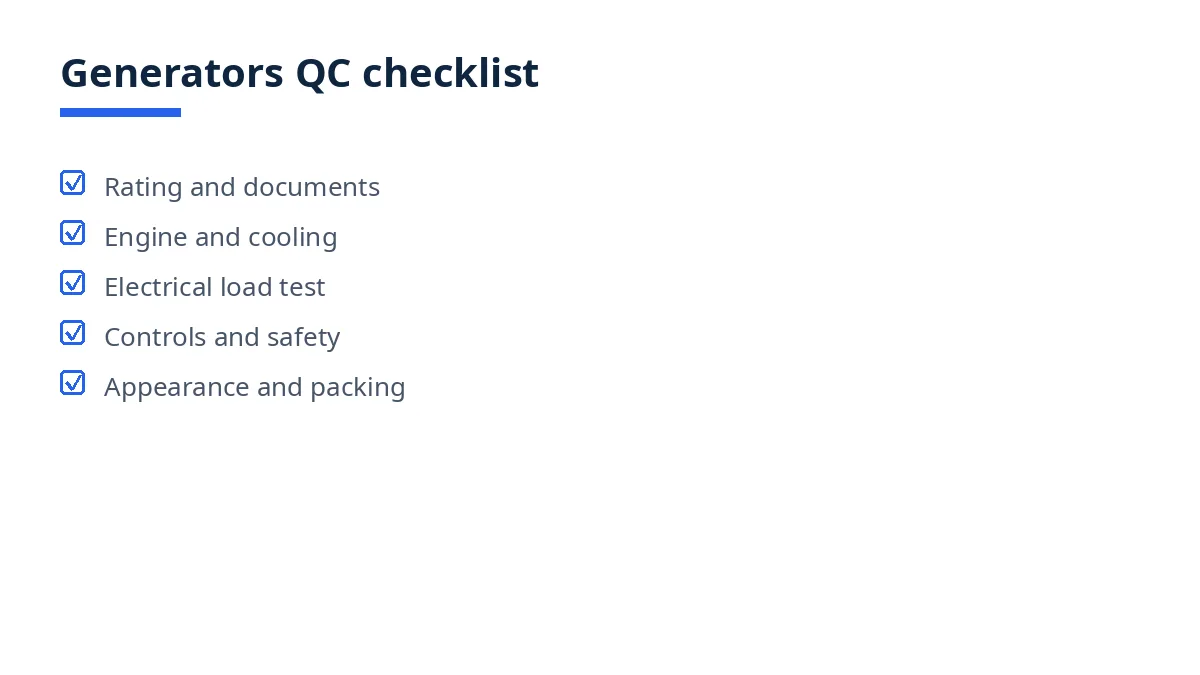
The full checklist (numbered, printable)
Rating, documents and identity
Confirm the nameplate matches the order: rating class (ESP, PRP, LTP, COP), kW, kVA, voltage, frequency, phase, power factor.
Confirm engine, alternator, and control panel models match the specification, and record serial numbers per sampled unit.
Check the rating plate is present, legible, and readable without removing guards. ISO 8528-5 covers rating plates.3
Check manuals, wiring diagram, and test certificates named in the order, each naming the model and serial number of its set.
Confirm destination requirements in the order: voltage, frequency, and any certification or marking required.
Engine, fuel and cooling
Check for oil, fuel, and coolant leaks at joints, hoses, filters, and drains, before starting and again after a run.
Check oil, coolant, and fuel levels against the marks, and confirm the fuel type in the manual matches the fuel used.
Check hoses, belts, and clamps for fit, tightness, chafing, and routing away from hot and moving parts.
Check the air filter housing is closed, the exhaust is complete and fixed, and no joint shows soot staining from a leak.
Check cooling: radiator fins clean and undamaged, fan guard fixed, coolant hoses free of bulging, cracking, or loose clips.
Check the battery: terminals clean and tight, cables routed and secured, type and capacity as specified.
Alternator and electrical output
Check alternator terminals, covers, and cable entries are secure, with no loose conductors, damaged insulation, or missing covers.
Check the main breaker and output terminals are rated and labelled as specified, with covers fitted before any load test.
Start the set and record no-load voltage and frequency against the order figures, checking each phase on three-phase sets.
Apply load in the steps in the agreed test plan, recording voltage, frequency, and recovery after each change, not only the steady reading. ISO 8528-5 covers load acceptance and voltage and frequency characteristics.3
Check the set carries the full agreed load for the duration in the test plan without tripping, overheating, or abnormal noise, recording any shutdown.
Controls, protection and safety
Test start and stop from the panel, confirming the set starts by the method in the specification: key, push-button, or automatic start.
Test the emergency stop and confirm it stops the set and the panel shows the stop condition. ISO 8528-13 covers emergency stopping.4
Test each protection named in the specification, such as low oil pressure, high temperature, overspeed, and overvoltage or undervoltage shutdown, recording how each responded.
Check guards over rotating parts, belts, and fans are fixed and complete, and hot surfaces carry required warnings. ISO 8528-13 covers guarding and hot surfaces.4
Check fire protection provisions in the specification, such as fuel shut-off and routing fuel lines away from hot surfaces. ISO 8528-13 covers fire protection.4
Check panel display and alarms: readings legible, warning lamps and alarms working, and running hours, voltage, frequency, and specified fault codes shown.
Noise, vibration and running behaviour
Listen and feel for abnormal vibration, knocking, misfiring, or belt squeal, and check mountings and fixings before and after the test. ISO 8528-5 covers vibration.3
Check exhaust smoke at start, at no load, and under load, recording persistent heavy smoke as a failure for investigation.
After shutdown, re-check for leaks, loose fixings, and heat damage, and confirm the set restarts.
Appearance, canopy and finish
Check the canopy or frame for dents, scratches, bent panels, and damaged doors, and confirm doors and latches open, close, and lock.
Check paint and coating for peeling, rust, missed areas, and overspray on labels, terminals, and plates.
Check fixings, hinges, locks, and lifting points are present and secure, with no loose part inside the canopy.
Check cable entries, vents, and drains are fitted as specified, with no opening admitting water or debris into electrical parts.
Labels, manuals and spares
Check safety and warning labels and operating instructions are present, legible, and in the language named. ISO 8528-13 covers marking and information for use.4
Check spares and accessories named in the order: tools, filters, keys, and remote-start or paralleling accessories, counted against the packing list.
Confirm the warranty names the set model and serial number, the rating class, and the agreed warranty start condition.
Packing and cartons
Check each set is protected as specified: canopy and panel covered, loose parts bagged and fixed, no part free to move in transit.
Check packing marks, serial numbers, and crate counts against the packing list, and confirm required handling and stacking marks.
Common failures and how to fix them
The most frequent failure is a rating mismatch: the set is sound, but the nameplate rating class does not match the buyer's duty. Stop, compare rating class and rated power against the order, and confirm in writing whether the set is sold for standby, prime, limited-time, or continuous duty before the load test continues: a pass at one rating is not a pass at another.
Next is unstable voltage or frequency under load, usually tracing to the governor, the voltage regulator, or a load step larger than the agreed test plan allows. Re-run the test in the agreed steps, recording voltage and frequency at each step. A set that trips on protection needs the fault identified first: check which protection operated and record the cause, rather than resetting and re-running until it passes.
Leaks found after a run point to a joint, hose, or seal: tighten or replace the part, re-run, and re-check after shutdown. Canopy damage and missing spares are most often found last, when the set is already crated, so check appearance and spares before packing.
Above the agreed acceptance level, options are re-inspection after repair, documented partial acceptance, or rejection.
Downloadable template / summary table
Copy the checklist into your inspection sheet, add the rating class, test plan, and acceptance numbers, and record results per set.
Section | Checks | Evidence |
|---|---|---|
Rating and documents | Rating, models, plate | Nameplate photos, serials |
Engine and cooling | Leaks, fluids, battery | Pre-run, post-run checks |
Electrical output | No-load, stepped load | Voltage, frequency records |
Controls and safety | Start, stop, protections | Results per protection |
Noise and vibration | Running behaviour | Report per set |
Appearance and canopy | Panels, paint, fixings | Photos |
Labels and spares | Labels, spares | Count vs packing list |
Packing | Protection, marks | Packing list |
How Exportain helps
Exportain is a B2B marketplace connecting buyers with Bangladeshi suppliers of generators and industrial equipment, so the specifications behind this checklist can be agreed at enquiry stage. Browse suppliers, and use inspection services when you plan the check. Supplier profiles show which document and photo checks have been recorded, not factory inspections. Exportain is not a party to the goods contract and does not inspect goods.
FAQs
When should this checklist be used?
Use it at final inspection, when sets are complete, tested, and packed. For larger and first orders, also use it in production, while wiring, control, and canopy faults can still be fixed.
Who should complete it?
The buyer, a local agent, or an independent inspector can complete it, using the order, rating plate data, and a randomly drawn sample.
What are the most common failures?
A rating class that does not match the buyer's duty, unstable voltage or frequency under load, protection trips, leaks, canopy damage, and missing spares are found most often.
Can a third party do it?
Yes, if you share the order, rating class, agreed test plan, and acceptance levels first.
Next steps on Exportain
Before production starts, agree your rating class, test plan, acceptance numbers, and label wording, then read the AQL acceptance quality limit explainer and the pre-shipment inspection guide, and plan the check with inspection services. You can also post a free RFQ via RFQs and compare quotes from suppliers.
Sources
- ISO 2859-1:1999 - Sampling procedures for inspection by attributes — Part 1: Sampling schemes indexed by acceptance quality limit (AQL) for lot-by-lot inspection. International Organization for Standardization (accessed )
- What is Standby and Prime Power?. AJ Power, (accessed )
- ISO 8528-5 - Reciprocating internal combustion engine driven alternating current generating sets — Part 5: Generating sets. International Organization for Standardization (accessed )
- ISO/FDIS 8528-13 - Safety for RIC Engine Driven AC Generating Sets. International Organization for Standardization (accessed )
About the author
Sourcing from Bangladesh?
Post a request for quotation and suppliers on Exportain can send you their quotes directly.
Post an RFQ