HS Code for Batteries: Classification Guide for Importers
Primary batteries sit in heading 8506 and rechargeable accumulators in heading 8507, split by chemistry such as lead-acid and lithium-ion, with national codes to 8-10 digits.
Short answer
Batteries have no single HS code. Non-rechargeable primary cells and primary batteries sit in heading 8506, split by chemistry. Rechargeable electric accumulators sit in heading 8507, including lead-acid at 8507.10 and 8507.20, nickel-cadmium at 8507.30, nickel-metal hydride at 8507.50 and lithium-ion at 8507.60. Confirm the full national code before filing.
On this page
Key takeaways
Batteries have no single code: primary cells and primary batteries sit in heading 8506 and rechargeable electric accumulators in heading 8507, so rechargeability decides the heading before chemistry decides the line.
Inside 8507, lead-acid splits by use at 8507.10 for starting piston engines and 8507.20 for other lead-acid, while nickel-cadmium is 8507.30, nickel-metal hydride is 8507.50 and lithium-ion is 8507.60.
A lithium primary cell takes 8506.50, not the lithium-ion line 8507.60: the shared word lithium does not make a primary cell and an accumulator interchangeable.
Spent batteries leave 8506 and 8507: heading 8549 covers electrical and electronic waste and scrap, including spent cells, batteries and accumulators that cannot be recharged.
Only the first six digits are shared worldwide: the EU extends to eight digits and the United States and United Kingdom to ten, so confirm the full national code per model.
If you import batteries for vehicles, solar storage or consumer devices, the hs code for batteries is the line your customs entry and origin claim depend on. The Harmonized System is a multipurpose international product nomenclature developed by the World Customs Organization (WCO), comprising more than 5,000 commodity groups, each identified by a six-digit code, and used by more than 200 countries and economies as a basis for their customs tariffs.1 For batteries, the code turns on whether the battery can be recharged and on its chemistry, not on the device it powers. This guide covers classification only; the ordering steps are in how to import batteries from Bangladesh and the inspection points in the batteries quality control checklist.
Quick answer: indicative HS heading (with verify note)
Batteries do not take one heading. Non-rechargeable primary cells and primary batteries sit in heading 8506, and rechargeable electric accumulators, called electric storage batteries in the United States schedule, sit in heading 8507.2 The Harmonised System organises its approximately 5,000 six-digit product categories by sections, chapters (2 digits), headings (4 digits) and sub-headings (6 digits).3 Both battery headings sit in Chapter 85, which covers electrical machinery and equipment and parts thereof.2
Battery type | Indicative code territory | Why |
|---|---|---|
Primary cells and primary batteries, not rechargeable | Heading 8506 | The heading text covers primary cells and primary batteries and their parts |
Electric accumulators, rechargeable, including separators | Heading 8507 | The heading text covers electric accumulators, including separators, whether or not rectangular, and their parts |
Spent batteries and battery waste and scrap | Heading 8549 | Heading 8549 covers electrical and electronic waste and scrap |
Verify the battery, not the label. Inside 8506, the split runs by chemistry: 8506.10 manganese dioxide, 8506.30 mercuric oxide, 8506.40 silver oxide, 8506.50 lithium, 8506.60 air-zinc and 8506.80 other, with parts at 8506.90.2 Inside 8507: 8507.10 lead-acid for starting piston engines, 8507.20 other lead-acid, 8507.30 nickel-cadmium, 8507.50 nickel-metal hydride, 8507.60 lithium-ion and 8507.80 other accumulators, with parts at 8507.90.2 4 Treat both headings as indicative and confirm the full national code before filing. See the HS code harmonized system explainer.
How HS codes are structured (2-4-6 digits)
Each pair of digits narrows the category: chapter 85 for electrical machinery and equipment, heading 8507 for electric accumulators, then a six-digit subheading by chemistry, for example 8507.60 for lithium-ion accumulators, and a national extension of 8 to 10 digits.3
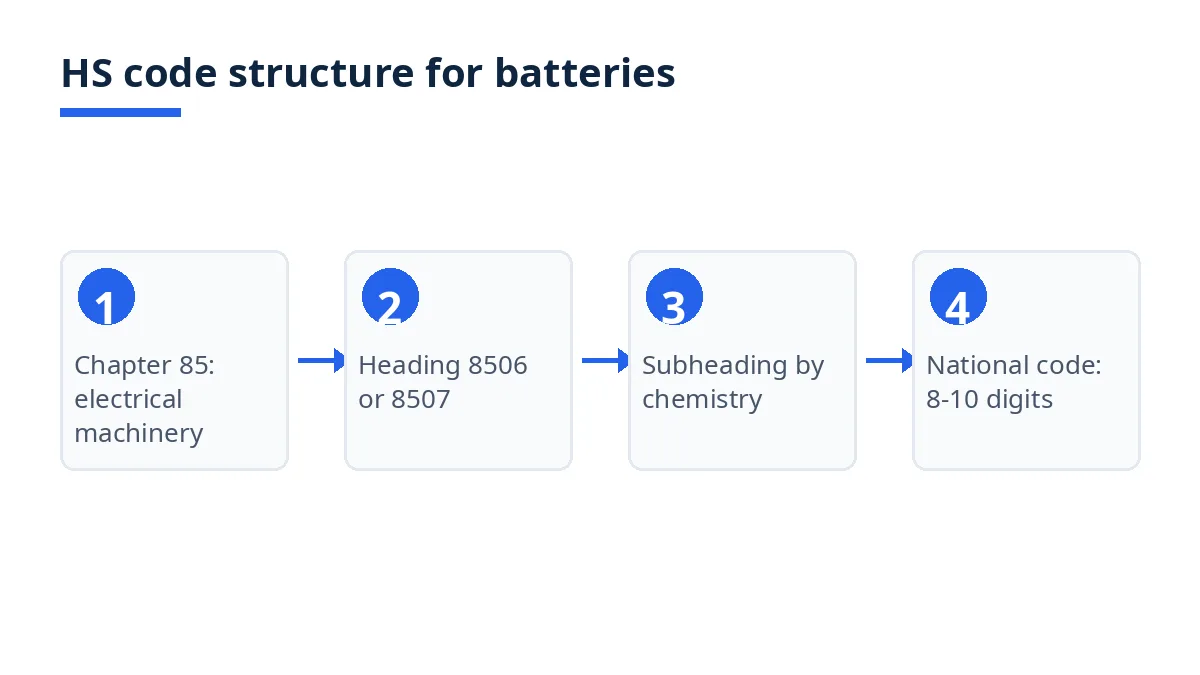
Countries subdivide the six-digit categories into national subheadings for their tariffs and statistics.3 The current version is HS 2022.3 Only the first six digits are shared worldwide, so the same battery can share 8507.60 and still carry different full codes in the United States, the European Union and the United Kingdom. Read the guide to classifying your product for the general method.
Factors that decide the code for batteries
Rechargeable or not is the first test. Heading 8506 covers primary cells and primary batteries, and heading 8507 covers electric accumulators.2 A single-use alkaline or lithium primary cell belongs in 8506, even if it powers the same device as a rechargeable pack. A battery built to be charged and discharged repeatedly belongs in 8507. If the supplier description does not state whether the battery is rechargeable, ask for the specification sheet first: that one fact decides the heading.
Chemistry decides the six-digit line. Inside 8506, lithium primary cells take 8506.50, while manganese dioxide cells take 8506.10 and air-zinc cells take 8506.60.2 Inside 8507, chemistry separates lead-acid at 8507.10 and 8507.20 from nickel-cadmium at 8507.30, nickel-metal hydride at 8507.50 and lithium-ion at 8507.60.2 4 Record the exact chemistry for every model.
Use splits the lead-acid lines. Heading 8507 separates lead-acid accumulators of a kind used for starting piston engines at 8507.10 from other lead-acid accumulators at 8507.20.2 A starter battery and a deep-cycle lead-acid battery for solar storage therefore take different lines. State the intended use in the description you give your broker.
Ancillary components presented with an accumulator stay with it. Chapter 85 note 3 provides that electric accumulators includes accumulators presented with ancillary components which contribute to storing and supplying energy or protect the accumulator from damage, such as electrical connectors, temperature control devices and circuit protection devices.2 A battery management board or connector supplied as part of the accumulator does not by itself move the pack to a different heading.
Parts take the parts lines, and spent batteries leave 8506 and 8507. Parts sit at 8506.90 and 8507.90.2 4 Heading 8549 covers electrical and electronic waste and scrap, including waste and scrap of lead-acid accumulators and spent cells, batteries and accumulators, defined as those neither usable as such because of breakage, cutting-up, wear or other reasons, nor capable of being recharged.2 Do not file spent batteries on a new-battery line.
National codes: US HTS, EU CN/TARIC, UK commodity code
United States: HTS, ten digits. The United States schedule keeps the six-digit lines and adds statistical suffixes. Under 8507.60.00 for lithium-ion batteries, the suffixes separate batteries of a kind used as the primary source of electrical power for electrically powered vehicles from battery energy storage systems and from other batteries.2 Under 8507.20, the schedule separates batteries for electrically powered vehicles at 8507.20.40 from other batteries at 8507.20.80.2 Read the full ten-digit line for each model.
European Union: CN at eight digits, TARIC for measures. The Combined Nomenclature integrates the HS and adds EU subdivisions, producing eight-digit codes, and traders read the confirmed line in TARIC for the entry date, the measures that apply and the origin rules behind any preference claim.3 At eight digits, heading 8507 keeps the chemistry split, with further lines for civil aircraft use and for defined technical specifications.4 Take the eight-digit CN code first, then check TARIC for any additional code.
United Kingdom: commodity code. The UK builds its commodity code on the same first six digits, with its own extension after them.3 The UK tariff page for heading 8507 lists the full ten-digit codes under each six-digit line, including the split of lithium-ion at 8507 60 into lines for civil aircraft use, for defined types such as modules for electric bicycles, and a residual other line at 8507 6000 90.4 Take the full code from the UK Trade Tariff for your battery and entry date, rather than copying an EU code.
How to confirm the code officially
Write a precise description: rechargeable or primary, exact chemistry, form as cells, modules or packs, intended use, and whether the goods are new, used or spent.
Start from the official tariff for the destination: the USITC HTS, TARIC or the UK Trade Tariff, and read the heading text and the Chapter 85 notes, including note 3 on accumulators presented with ancillary components.2
Check published rulings for similar batteries. For the United States, the USITC advises traders to use the Customs Rulings Online Search Service (CROSS), because the correct classification of many items can be found there.5
For a borderline product, such as a pack with a built-in management system, apply for a binding decision before you ship. In the EU, a Binding Tariff Information (BTI) application needs a separate application for each type of product and a detailed description.6 In the United Kingdom, a legally binding decision is generally valid for 3 years, through an Advance Tariff Ruling.7 In the United States, if the merchandise is not described in any ruling on CROSS, you may request a binding ruling from U.S. Customs and Border Protection.5
Give your broker the description and the confirmed code for each model, and use the same codes on the invoice, the packing list and the entry.
Common classification mistakes
Filing every battery under 8507. Primary cells and primary batteries sit in 8506.2 A shipment of single-use cells filed as accumulators takes the wrong heading and the wrong duty line.
Filing a lithium primary cell as lithium-ion. Lithium primary cells take 8506.50, while lithium-ion accumulators take 8507.60.2 4 The shared word lithium does not make the products interchangeable: rechargeability decides the heading first, then chemistry decides the line.
Filing a starter battery and a storage battery on one line. Lead-acid accumulators for starting piston engines take 8507.10, and other lead-acid accumulators take 8507.20.2 Keep vehicle starter batteries and solar or backup-power batteries as separate invoice lines with separate codes.
Copying a code from another country. The EU extends the six digits to eight,3 and the United States and the United Kingdom split the 8507 lines further.2 4 A code copied from a supplier invoice for a different destination is a starting point for checking, not a code to file.
Filing spent batteries as new. Spent primary cells, spent primary batteries and spent electric accumulators that are not usable as such and not capable of being recharged fall under heading 8549 for electrical and electronic waste and scrap, not under 8506 or 8507.2 State the condition of the goods in the description.
Ignoring parts and separators. Parts of accumulators take 8507.90, and parts of primary cells and batteries take 8506.90.2 4 A mixed shipment needs both lines checked.
Related duties and documents
This guide states no duty rates: the code decides which duty line customs applies, and a rate on a lead-acid line does not carry to a lithium-ion line. Read the rate beside your confirmed code for your origin and entry date, and check what proof of origin a preference claim requires.
Keep transport and product documents aligned with the classification. The commercial invoice and packing list should state the chemistry, whether each battery is rechargeable, the model and the confirmed code per line. Confirm the current carrier requirements for your battery type and packing before booking, and keep any binding decision, the specification sheet and the origin evidence together in the shipment file. Where a shipment includes spent batteries, keep the waste documentation separate, because heading 8549 goods follow a different entry treatment from goods under 8506 and 8507.2
FAQs
What is the HS code for batteries?
There is no single six-digit code for batteries. Primary cells and primary batteries sit in heading 8506, split by chemistry at lines such as 8506.10 for manganese dioxide and 8506.50 for lithium, and rechargeable electric accumulators sit in heading 8507, at 8507.10 and 8507.20 for lead-acid, 8507.30 for nickel-cadmium, 8507.50 for nickel-metal hydride and 8507.60 for lithium-ion.2 4
Is the HS code the same in every country?
Only the first six digits are harmonised. Beyond six digits, each country adds its own lines: eight digits in the EU Combined Nomenclature,3 and ten in the United States and the United Kingdom, where the 8507 lines split further by use and specification.2 4
How do I confirm the correct code?
Describe each battery precisely, read the heading text and chapter notes in the destination tariff, and check published rulings, such as CROSS for the United States.5 For a borderline product, apply for a binding decision before shipping: a BTI in the EU,6 an Advance Tariff Ruling in the United Kingdom,7 or a CBP binding ruling in the United States.5
What happens if I use the wrong code?
Duty, licensing and quota treatment are worked out from the code on the declaration, so a wrong code brings the wrong treatment. A binding decision in advance helps you calculate the duties and restrictions that will apply.7
Next steps on Exportain
Browse Bangladeshi suppliers on Exportain, a B2B marketplace where supplier profiles carry document and photo review badges, and post a free RFQ at Exportain RFQs with the confirmed code stated per battery model. For product background, browse electronics, electrical and solar categories and keep the batteries quality control checklist with the shipment file. Exportain is not a party to the goods contract and does not inspect goods, book freight or clear customs, so keep your broker and your binding decision at the centre of the entry.
Sources
- What is the Harmonized System (HS)?. World Customs Organization (accessed )
- Harmonized Tariff Schedule of the United States, Chapter 85: Electrical machinery and equipment and parts thereof (Revision 9, 2026). United States International Trade Commission (accessed )
- Harmonised System. European Commission (accessed )
- Electric accumulators, including separators therefor, whether or not rectangular (including square): UK Integrated Online Tariff, heading 8507. GOV.UK, HM Revenue and Customs (accessed )
- MTB 2019: Get Out Ahead of the Pack with a Binding Ruling from CBP. U.S. International Trade Commission (accessed )
- European Binding Tariff Information (EBTI). European Commission, Taxation and Customs Union, (accessed )
- Check what you'll need to get a legally binding decision on a commodity code. GOV.UK, HM Revenue and Customs (accessed )
About the author
Sourcing from Bangladesh?
Post a request for quotation and suppliers on Exportain can send you their quotes directly.
Post an RFQ