Quality Control Checklist for Batteries From Bangladesh
A numbered QC checklist for batteries from Bangladesh: identity and dimensions, marking, open-circuit voltage and rated capacity, IEC safety and UN 38.3 transport evidence, labels and packing, with fixes for common failures.
Short answer
Use this batteries quality control checklist to check identity, dimensions and case condition, marking and labels, open-circuit voltage, rated capacity and internal resistance, IEC safety test evidence, UN 38.3 transport evidence for lithium batteries, and packing on batteries from Bangladesh before shipment. Agree the standards, tolerances and acceptance numbers in the purchase order first.

On this page
Key takeaways
Agree the chemistry, model, standards, tolerances and acceptance numbers before inspection, and draw the sample randomly across models, production dates and cartons.
Treat a swollen, leaking or hot unit as a critical safety failure: segregate it and ask for test evidence, rather than sorting it at the packing table.
Check marking against the standard for the chemistry: IEC 61960-3 for secondary lithium, IEC 60086-1 for primary batteries, and the CE rules in Regulation (EU) 2023/1542 for the EU.
For lithium batteries, hold the shipment until the UN 38.3 test summary for that design type is in hand, because carriers ask for it at booking.
If you import batteries, this batteries quality control checklist gives you a practical way to check a shipment before it leaves Bangladesh. A swollen case, a capacity short of the rating, or a missing transport test summary can stop the order after it ships. Use an agreed sampling plan rather than units the factory selects. ISO 2859-1 specifies an acceptance sampling system for inspection by attributes, indexed in terms of the acceptance quality limit (AQL), applicable to end items.1
Why this checklist matters
Batteries combine performance risk and safety risk. Dimensions and terminals decide whether the battery fits and connects, voltage and capacity decide whether it does the work, and case damage, leakage or swelling can be a safety problem, not a cosmetic one. Rules also differ by chemistry and destination.
A written checklist removes interpretation. Each point is checked against the approved specification, the test reports for that model and the pack, and recorded as pass, fail or not applicable. Set acceptance numbers per defect class in the purchase order.1 For the European Union, Regulation (EU) 2023/1542 lays down requirements on sustainability, safety, labelling, marking and information, and applies to all categories of batteries regardless of shape, volume, weight, design, material composition, chemistry, use or purpose.2 See the AQL acceptance quality limit explainer.
Before you start
Do not begin until the references are complete: specification sheet per model, purchase order, approved sample where one exists, and packing specification. The specification must name chemistry, model, nominal voltage, rated capacity, dimensions, weight, and the standards the model was tested to. Agree the sampling plan in advance,1 and draw the sample randomly across models, production dates and cartons.
Confirm which standards apply first. IEC 62133-1 specifies safety requirements and tests for portable sealed secondary nickel systems, for safe operation under intended use and reasonably foreseeable misuse.3 IEC 62133-2 covers lithium systems.4 IEC 61960-3 specifies performance tests, designations, markings and dimensions for prismatic and cylindrical secondary lithium cells and batteries for portable applications.5 Primary batteries are covered by IEC 60086-1,6 and stationary valve regulated lead-acid batteries by IEC 60896-21, for float charge applications such as telecom, uninterruptible power supply (UPS), utility switching and emergency power.7
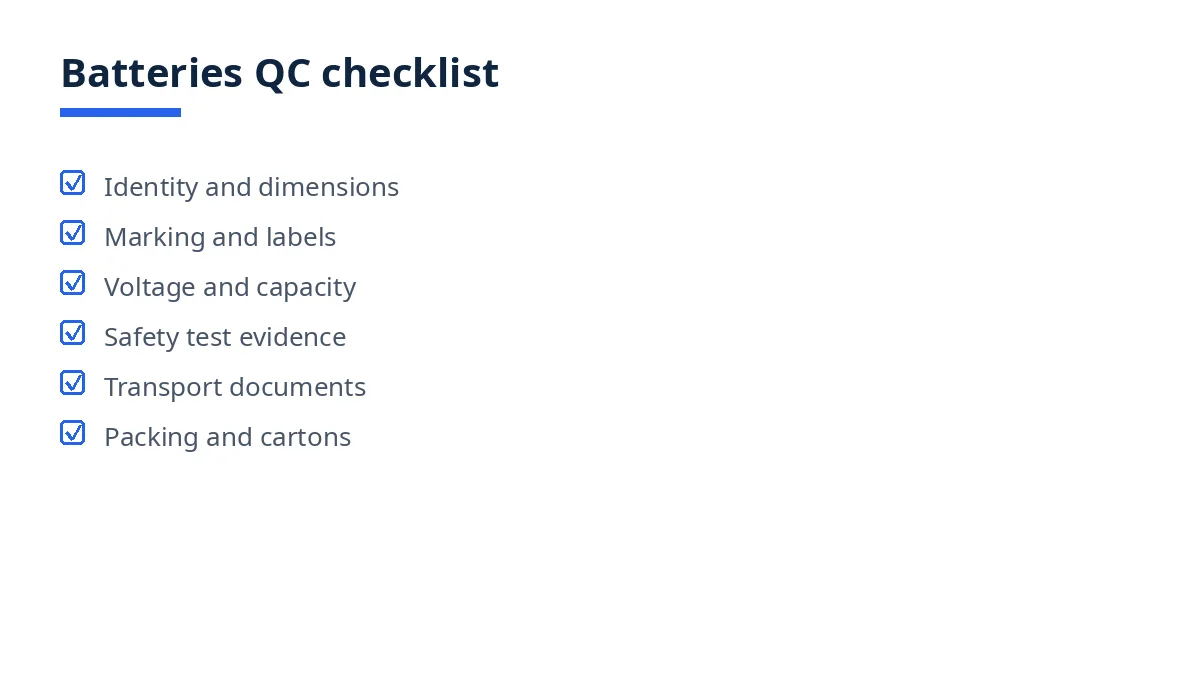
The full checklist (numbered, printable)
Identity, dimensions and case condition
Check model, designation and chemistry on each sampled unit against the specification and purchase order. Record any substitution in bulk as a failure.
Measure length, width, height or diameter, terminal layout and weight on sampled units, against the specification tolerance.
Check the case for cracks, dents, swelling and deformation, by eye and by hand, on every face. Segregate any swollen unit at once.
Check for leakage, electrolyte traces, corrosion and damaged seals at terminals and vents. Record any leaking unit as a critical failure.
Check terminals for correct type, clean contact surfaces, firm fixing and no bent or recessed contacts.
For valve regulated lead-acid units, check the valve area and case. IEC 60896-21 groups stationary lead-acid checks into safe operation, performance and durability characteristics, including valve operation and the content and durability of required markings.7
Marking and labels
For secondary lithium units, check marking against IEC 61960-3: clear and durable markings, including secondary (rechargeable) Li or Li-ion, designation, polarity, date of manufacture, manufacturer or supplier identification, rated capacity and nominal voltage.5
For primary batteries, check marking against IEC 60086-1: designation, expiration of a recommended usage period or year and month or week of manufacture, polarity of the positive terminal, nominal voltage, manufacturer or supplier name or trade mark, and cautionary advice.6
Check polarity marking is present and correct, and test one unit in the intended holder or device where fit matters.
Check printed nominal voltage, rated capacity, model and date code match the specification sheet and carton label exactly.
For the European Union, check the CE marking: under Regulation (EU) 2023/1542 it shall be affixed visibly, legibly and indelibly to the battery, or, where that is not possible or not warranted, to the packaging and accompanying documents.2
Check cautionary advice and any separate-collection marking required by the destination are present, legible, and not covered by a later sticker.
Voltage, capacity and electrical checks
Measure open-circuit voltage on every sampled unit with a calibrated meter and record actual values, against the specification range for that model and state of charge.
Check rated capacity evidence. Under IEC 61960-3, the discharge test at 20 °C discharges at 0,2 It to the specified final voltage, and capacity delivered shall be not less than 100 % of the rated capacity declared by the manufacturer.5
Confirm every capacity report names model, lot or date code and test conditions, and matches the model in production.
Where internal resistance is specified, check the report method. IEC 61960-3 determines internal resistance by either the AC or the DC method, and the internal AC resistance shall be not greater than the value declared by the manufacturer.5
For stationary lead-acid orders, review discharge capacity and charge retention evidence. IEC 60896-21 lists discharge capacity, charge retention during storage and recharge behaviour among the performance characteristics for valve regulated types.7
Run one sampled unit per model through a normal charge and discharge cycle where equipment is available. Record abnormal heating, swelling or early cut-off as a failure.
Safety and transport evidence
Match the safety report to the exact model, chemistry and manufacturer ordered. IEC 62133-1 covers portable sealed secondary nickel systems3 and IEC 62133-2 covers lithium systems,4 each for safe operation under intended use and foreseeable misuse.
Read the acceptance criteria, not the summary alone. In IEC 62133-1, the low pressure test holds each fully charged cell at 11,6 kPa or less for 6 h, with criteria of no fire, no explosion and no leakage.3
Do not repeat destructive safety tests at final inspection. Confirm the type test report covers this model and that production units match the tested design.
Record any unit found hot, swollen, leaking or venting as a critical failure, remove it from the lot, and follow the supplier safety procedure for damaged batteries.
For lithium units, ask for the UN 38.3 test summary before shipment. The tests sit in the UN Manual of Tests and Criteria, Part III, sub-section 38.3: eight tests, T1 to T8, covering altitude, thermal, vibration, shock, external short circuit, impact or crush, overcharge and forced discharge.8
Check the results line. Cells and batteries are generally considered to have passed UN 38.3 if they show no rupture, leakage, venting, disassembly, fire, or significant voltage drop when all tests are completed.8
Confirm the summary covers each design type shipped. Each design type must pass the tests, distributors and suppliers must provide a test summary, and even minor modifications to a tested design may require the tests to be run again.8
Packing and cartons
Check each unit is packed as specified, with separators or inner packaging that keep terminals apart, protect against short circuit, and prevent movement.
Check carton markings show model, quantity, gross weight and handling marks, and match the packing list and transport documents.
Weigh and measure sample cartons, and check the carton count against the packing list.
Check stock rotation for primary batteries: cartons show dates that let the oldest stock ship first, following the packaging, shipment and storage code of practice in IEC 60086-1.6
Confirm no damaged, swollen or returned units are mixed into export cartons, and photograph cartons before sealing.
Common failures and how to fix them
The most serious failure is a swollen, leaking or hot unit. Stop packing that model, segregate the affected group, and treat it as a safety issue for the supplier to explain with test evidence, not a sorting task.
Next is capacity below the rating. Check whether the report used the standard method: under IEC 61960-3 the rated capacity test discharges at 0,2 It at 20 °C, and delivered capacity shall be not less than 100 % of the declared rating.5 A report at a different rate or on a different model does not clear this lot. Marking mismatches are also common, usually because two production runs were packed together: re-sort by model and date code, then re-check a fresh sample.
A missing UN 38.3 summary for a lithium model holds the shipment, because carriers ask for it at booking.8 Above the agreed acceptance level, options are re-inspection after sorting or rework, documented partial acceptance, or rejection.
Downloadable template / summary table
Copy the checklist into your inspection sheet, add specification, tolerances and acceptance numbers, and record a result per model.
Section | Checks | Evidence |
|---|---|---|
Identity and dimensions | Model, chemistry, size, case, terminals | Measurements, photos |
Marking and labels | Designation, polarity, capacity, CE | Marking check per standard |
Electrical | Voltage, capacity, resistance | Meter readings, test reports |
Safety evidence | IEC 62133 report for the design | Type test report |
Transport | UN 38.3 summary, terminal protection | Test summary document |
Packing | Separation, cartons, dates | Packing list |
How Exportain helps
Exportain is a B2B marketplace connecting buyers with Bangladeshi suppliers of batteries and electrical goods, so the specification, standards and test evidence behind this checklist can be agreed at the enquiry stage. Read the sibling guide on how to import batteries from Bangladesh, browse suppliers and use inspection services when you plan the check. Supplier profiles show document and photo checks recorded, not factory inspections. Exportain is not a party to the goods contract and does not inspect goods.
FAQs
When should this checklist be used?
Use it at final inspection, when goods are finished and largely packed, and again at booking for transport documents. For first orders, also check test evidence at sample stage.
Who should complete it?
The buyer, a local agent or an independent inspector can complete it, using the specification sheet, the test reports and a randomly drawn sample.
What are the most common failures?
Swollen or leaking units, capacity below the rating, marking that disagrees with the specification, mixed models or date codes in one carton, and a missing UN 38.3 summary for lithium models.
Can a third party do it?
Yes, if you share the specification, applicable standards, test reports and acceptance levels first.
Next steps on Exportain
Before production starts, agree the specification, applicable IEC standards, test evidence and acceptance numbers, then read the guide on how to import batteries from Bangladesh and the pre-shipment inspection guide, and plan the check with inspection services. You can also post a free RFQ via RFQs.
Sources
- ISO 2859-1:1999 - Sampling procedures for inspection by attributes — Part 1: Sampling schemes indexed by acceptance quality limit (AQL) for lot-by-lot inspection. International Organization for Standardization (accessed )
- Regulation (EU) 2023/1542 of 12 July 2023 concerning batteries and waste batteries. European Union, (accessed )
- IEC 62133-1:2017 - Secondary cells and batteries containing alkaline or other non-acid electrolytes — Safety requirements for portable sealed secondary cells, and for batteries made from them, for use in portable applications — Part 1: Nickel systems. International Electrotechnical Commission (accessed )
- CSA C22.2 No. 62133-2:20 (R2024) - Secondary cells and batteries containing alkaline or other non-acid electrolytes — Safety requirements for portable sealed secondary cells, and for batteries made from them, for use in portable applications — Part 2: Lithium systems (based on IEC 62133-2:2017). CSA Group (accessed )
- IEC 61960-3:2017 - Secondary cells and batteries containing alkaline or other non-acid electrolytes — Secondary lithium cells and batteries for portable applications — Part 3: Prismatic and cylindrical lithium secondary cells, and batteries made from them. International Electrotechnical Commission (accessed )
- IEC 60086-1:2021 - Primary batteries — Part 1: General. International Electrotechnical Commission (accessed )
- IEC 60896-21:2004 - Stationary lead-acid batteries — Part 21: Valve regulated types — Methods of test. International Electrotechnical Commission (accessed )
- Understanding Lithium Battery Test Requirements — UN 38.3 testing in the UN Manual of Tests and Criteria, Part III, sub-section 38.3. CHEMTREC, (accessed )
About the author
Sourcing from Bangladesh?
Post a request for quotation and suppliers on Exportain can send you their quotes directly.
Post an RFQ