How to Import Sneakers From Bangladesh in 2026: Complete Buyer Guide
A 3,000-pair order of knit-upper trainers at 9.80 dollars FOB lands in Rotterdam at 10.82 dollars a pair excluding VAT. This guide covers HS 6404 classification, sneaker construction, sizing, inspection and duty.
Short answer
To import sneakers from Bangladesh, fix the shoe first: a textile upper puts it under HS 6404, with the sole build, size run and test list written into the purchase order. Approve samples in stages, inspect at AQL Level II, and check duty before costing. The EU is duty-free under Everything But Arms with proof of origin, while the United States charged 30 percent as of 16 November 2026. A 3,000-pair example lands at 10.82 dollars a pair excluding VAT.
On this page
Key takeaways
Textile-upper sneakers fall under HS 6404, usually 6404.11 or 6404.19; the upper material by area decides the heading.
Most sneaker failures start at the sole bond, so put the peel test and the ISO 17707 flex test in the purchase order.
Inspect at AQL Level II with zero tolerance for critical defects, 2.5 for major defects and 4.0 for minor defects.
The EU is duty-free under Everything But Arms with proof of origin; the United States charged 30 percent in total as of 16 November 2026.
A first sneaker order from Bangladesh works when the buyer fixes the shoe on paper before asking for a price: the upper material, the sole build, the size run and the test list. This guide walks through each decision in that order.
Why sneakers from Bangladesh are worth a first order
Non-leather footwear is the fastest-moving part of the Bangladesh shoe trade. Export Promotion Bureau data put non-leather footwear exports at 522.59 million dollars in fiscal year 2024-25, up 25.37 percent on the year before.1 The same series shows only 19.5 million dollars of that 520 million going to the United States.2
United States buyers imported 25 billion dollars of footwear that year, 12 billion dollars of it non-leather shoes, with China, Vietnam, Indonesia, Cambodia, India, Thailand and Bangladesh as the seven largest suppliers.2 Bangladesh sits at the small end of that list.2
What counts as a sneaker for customs
A sneaker is classified by its materials, not by its brand name or retail label. Heading 6404 covers footwear with rubber, plastic, leather or composition leather soles and textile uppers.3 Inside that heading, subheading 6404.11 covers sports footwear and training shoes, while 6404.19 covers other textile-upper footwear with rubber or plastic soles.3
The chapter notes decide most borderline cases: the upper counts as the material that covers the most of its outside, leaving out trims and reinforcements.3 A knit upper with leather overlays is still a textile upper if textile covers the largest area. The outer sole counts as the material that touches the ground over the largest area.3 The expression sports footwear in subheading 6404.11 applies only to footwear designed for a sporting activity with provision for spikes, sprigs, stops, clips or bars, and to ski boots, snowboard boots, wrestling boots, boxing boots and cycling shoes.3 A general training shoe without those features usually falls under 6404.19, and that single digit changes the duty line. A leather upper moves the shoe to heading 6403, and rubber or plastic uppers move it to heading 6402. Ask the factory to state the proposed six-digit code in writing.
Which sneaker should you order first
Start with the use your customers already buy for. A court sneaker has a flat rubber cupsole and suits everyday retail. A running shoe has a foamed midsole and a mesh or knit upper, and it suits sports buyers. A canvas casual sneaker has a textile upper and a thin rubber sole, and it suits volume orders. A knit slip-on has a one-piece knitted upper and suits buyers who want a light fit.
A knitted upper replaces many cut and stitched parts with one machine-made piece.4 But a knit upper also stretches, so fix the stretch direction and the reinforcement at the heel and toe in the specification.
How a sneaker is put together
A sneaker has three layers made three different ways and bonded together in a fourth operation: upper, midsole and outsole.5
Engineered mesh moves air, knit uppers give a close fit, canvas is cheap to dye, and synthetic leather adds structure at the toe and heel. Test the exact roll the factory will cut from, not a showroom swatch. EVA foam is light and cheap to process, and it dominates casual and entry-level running shoes.5 Compression-molded EVA, often called Phylon, is crosslinked under pressure for better rebound than injection-molded EVA.5 Direct-injected polyurethane bonds chemically to the upper with no adhesive line.5 Compression-molded rubber is vulcanized at about 160 to 180 degrees Celsius, and outsoles usually sit at Shore A 55 to 70.5
Construction | How the sole joins the upper | Best for sneakers |
|---|---|---|
Cemented | Upper is roughed, primed and glued to the sole unit | Athletic and casual sneakers |
Strobel | Upper is stitched to an insole board, then the sole is cemented on | Running and training shoes |
Direct injection | Polyurethane sole is injected onto the lasted upper | High-volume basics |
Vulcanized | Rubber foxing and sole are applied, then the shoe is cured | Court and skate shoes |
Cemented construction is the most flexible for design changes, but a factory that skips buffing or rushes the adhesive dry-off produces shoes that come apart months later.5
What does the size run look like
The last is the foot-shaped form the upper is stretched around, and each size needs its own last.4 Molds are size-specific too, so a run of 13 sizes needs 13 sets of sole tooling.5 Launch with five or six sizes. Size by foot length in millimeters, not by the number on the box. Ask the factory for the finished length and width for each size on its last.
Foot length | US men | UK men | EU |
|---|---|---|---|
25.5 cm | 7.5 | 7 | 41 |
26.5 cm | 8.5 | 8 | 42 |
27.5 cm | 9.5 | 9 | 43 |
Agree the split of pairs across the run before production: a 1,000-pair minimum usually means 1,000 pairs of one style in one color, split across the sizes you name. Our sneakers MOQ guide explains how the split is negotiated.
How do you check quality before bulk
Approve the sample in stages, in writing, never on a photograph. The stages are the proto sample, the size-set sample, and the pre-production sample in bulk materials. Wear-test the size-set sample for a full week, and check the bond line after every day of wear.
ISO 17707:2005 sets the flex test for outsoles, measuring cut growth as the sole is flexed, and it applies to outsoles with a maximum longitudinal rigidity of 30 N.6 Put the test list and pass limits in the purchase order, and ask for the lab report on the bulk lot.
For athletic shoes, AQL General Inspection Level II with single sampling is typically used, with the usual acceptance levels: critical defects stop the shipment, major defects are capped at two and a half per hundred sampled, and minor defects at four per hundred.7 The seven-step inspection runs from counting and carton marks through packaging, style, appearance, measurement and testing.7 Delamination and exposed sharp metal are critical; wrong sizing and open seams are major; stains and loose threads are minor.7
What chemicals must stay out of the shoe
Chemical rules are set by the destination, not by the factory's home market. Under REACH Annex XVII entry 72, which took effect on 1 November 2020, 33 substances classified as carcinogenic, mutagenic or toxic for reproduction are restricted in clothing and footwear, and footwear is named in the scope.8
The limits that matter most are formaldehyde at 75 mg/kg in textiles, five phthalate plasticizers at 1,000 mg/kg individually or in combination, and eight polycyclic aromatic hydrocarbons at 1 mg/kg.8 Azo colorants that release listed aromatic amines are restricted where the dyed textile touches the skin, with the limit at 30 mg/kg.8 Rubber and polymeric sole units fall inside the entry 72 scope.8 Ask for a chemical test report on the finished shoe from the bulk lot.
What does a pair pay at the border
For the United States, sports footwear valued over 12 dollars a pair under HTS 6404.11.90 carries a general rate of 20 percent.9 As of 16 November 2026, shipments from Bangladesh paid 30 percent in total on that line: the 20 percent base rate plus a 10 percent Section 301 forced-labor line.9 Confirm the live total with a licensed customs broker before you cost the order.
Europe is the cheaper lane while least-developed-country preferences last. Under the Everything But Arms scheme, the EU gives duty-free and quota-free access to all products except arms and ammunition from eligible least-developed countries.10 Bangladeshi exports worth around 19 billion euros benefited from the scheme in 2024, with 96 percent utilization, according to the European Commission.10 Bangladesh is set to graduate from least-developed-country status on 24 November 2029, and a transition period will keep the preferences for a limited time.10 Import VAT is charged on the customs value plus duty, so a duty-free shipment still pays VAT on the CIF value.
What do MOQ, sampling and price per pair look like
A sneaker factory sets its price per pair, for the size run and for the construction. The figures below are example figures, not quotations.
Sneaker | Construction | Example FOB per pair | MOQ |
|---|---|---|---|
Canvas casual sneaker | Cemented, rubber outsole | 7.50 to 9.50 dollars | 1,200 pairs |
Knit-upper trainer | Strobel, EVA midsole | 9.50 to 13.00 dollars | 1,000 pairs |
Court sneaker | Vulcanized, rubber foxing | 11.00 to 15.00 dollars | 800 pairs |
Minimums are set per style and color, then split across the size run, and they are driven by material lots, sole molds and component minimums. A new mold or last adds tooling that the factory recovers across quantity, so a buyer who accepts the factory's existing sole and last pays less. Our sneakers price guide breaks down the FOB build-up.
How do you pack and ship 3,000 pairs
Every pair travels in its own shoe box, with tissue and stuffing that hold the shape of the upper. Export cartons then take 12 pairs each, marked with the style, color, size range and pair count. Check that the style number, size and barcode agree across the shoe box, the hangtag and the tongue label.7 One 20-foot box takes about 2,400 to 3,000 pairs of boxed adult sneakers, so 3,000 pairs make a sensible single load.
Worked example: 3,000 knit-upper trainers to Rotterdam
A buyer in the Netherlands orders 3,000 pairs of knit-upper trainers from a Dhaka factory at 9.80 dollars FOB per pair. The figures below are example figures. Goods cost 29,400 dollars at FOB, and freight and insurance add 2,100 dollars, giving a CIF value of 31,500 dollars. Duty is zero under Everything But Arms.10 Dutch import VAT at 21 percent adds 6,615 dollars, and brokerage, handling and delivery add 950 dollars. Total cash outlay is 39,065 dollars; net cost excluding VAT is 32,450 dollars. That is 13.02 dollars per pair in cash terms and 10.82 dollars excluding VAT.
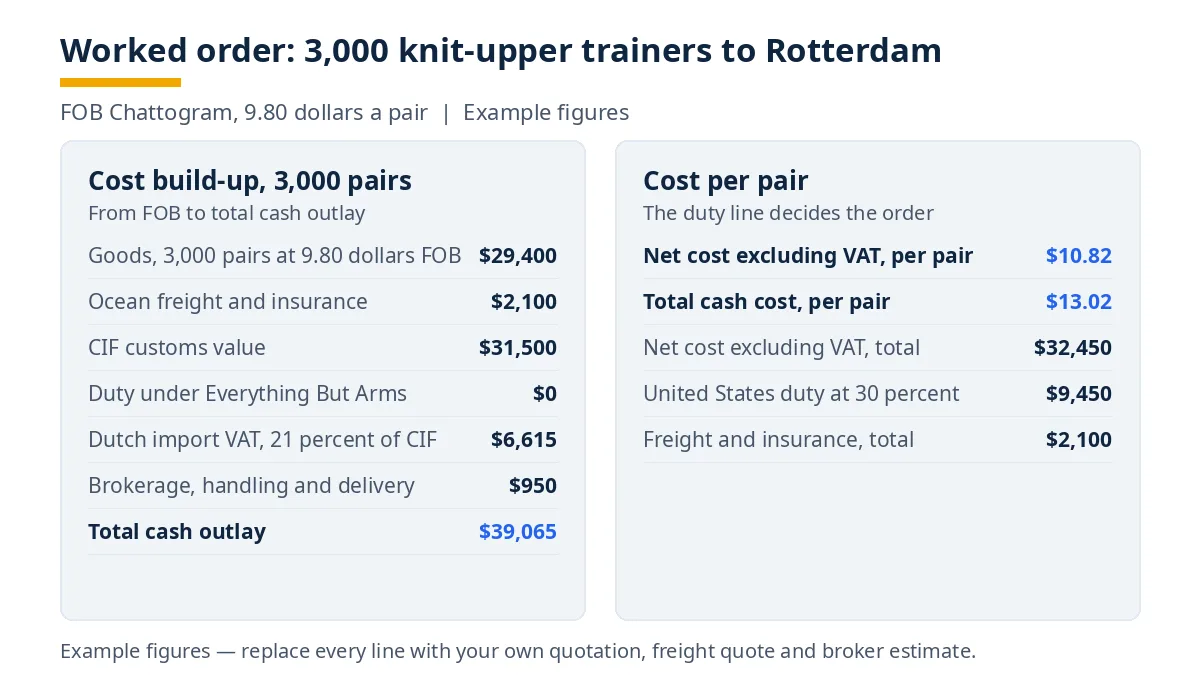
A 30 percent United States duty would add 9,450 dollars, more than four times the freight and insurance together. Price the destination before you price the shoe.
What documents travel with the shipment
Four documents carry most sneaker shipments. The commercial invoice states the style and value. The packing list states the pairs per carton and the size split. Origin is shown by the certificate or statement of origin, which supports the tariff-free claim under Everything But Arms.10 The inspection report, with the flex, bond and chemical results for the bulk lot, supports the quality claim.6 7 8
Five mistakes that cost sneaker buyers money
The costly errors in a sneaker order are errors of specification, not of price. Ordering by the number on the box instead of by foot length in millimeters gives you a size run that fits nobody well. If the sample is approved in one upper material and bulk arrives in another, the knit upper stretches out of shape. Accepting a cemented shoe without a peel test leaves you with a sole that parts from an upper that still looks presentable. Skipping the chemical report on the bulk lot leaves you with a shipment the EU will not let you sell.8 Agreeing a price before working out the landed cost leaves an order that loses money on the duty line alone.9 Each of these can be caught at the sample stage. Order the sample in the bulk upper, on the bulk last and in the bulk construction, then wear it for a full week before approving bulk.
Next steps on Exportain
Start by comparing factories: post an RFQ with the sneaker type, upper and sole materials, size run and test list in the requirement, after reading our sneakers manufacturers guide and the footwear sourcing guide. A factory that answers with its last measurements and test reports is the one to take to sample stage.
Sources
- Exports rose 8% to $48b in FY25 despite economic headwinds. The Daily Star, (accessed )
- Non-leather shoe exports to US triple in July amid tariff shifts. Prothom Alo, (accessed )
- HS Nomenclature 2022: Chapter 64 — Footwear, gaiters and the like; parts of such articles. World Customs Organization (accessed )
- How sneakers are made: from rolls of fabric to a finished pair. Industries of India, (accessed )
- How Shoe Soles Are Manufactured. Projects House (accessed )
- ISO 17707:2005 - Footwear - Test methods for outsoles - Flex resistance. International Organization for Standardization, (accessed )
- How to Inspect Sneakers? The Process and Methods for Inspecting Sneakers. GlobalInsp, (accessed )
- REACH entry 72 requirements. SATRA (accessed )
- HTS 6404.11.90: Sports footwear, valued over $12/pair – Duty Rates & Tariffs. HTS Hero (accessed )
- Bangladesh begins preliminary FTA negotiation with EU. The Financial Express, (accessed )
About the author
Sourcing from Bangladesh?
Post a request for quotation and suppliers on Exportain can send you their quotes directly.
Post an RFQ