Typical MOQ for Sneakers in Bangladesh (and How to Negotiate It Down)
A sneakers MOQ in Bangladesh usually follows the outsole mold set and the material batch, not a single factory rule. Work the cavity count and the colorway batches first, then negotiate the tooling and the batch, in writing.
Short answer
There is no single typical MOQ for sneakers in Bangladesh. The minimum usually follows two fixed costs: the outsole and midsole mold set, which is made per size, and the material batch, which is mixed or dyed per colorway. Ask for the mold and batch basis in writing, work the colorway multiplication, and negotiate by sharing an existing sole unit, cutting colorways, or paying tooling separately.
On this page
Key takeaways
A sneakers MOQ usually follows the outsole mold set, made per size, and the material batch, mixed or dyed per colorway, not a single factory rule.
Work the colorway multiplication first: in the example figures, 600 pairs per colorway across 3 colorways means 1,800 pairs.
Tooling thins per pair as the run grows: the example 3,600 dollar mold set adds 6.00 dollars per pair at 600 pairs and 1.50 dollars at 2,400 pairs.
Negotiate the mold and the batch separately, in writing: share an existing sole unit, cut colorways, price tooling as its own line, and test each batch.
A buyer asks for 500 pairs of sneakers in four colorways and hears a minimum of 1,800 pairs. The supplier is not always holding out for a larger order. In many sneaker orders the floor is set before any pair is cut: a mold set has to be made or shared, and each material has to be run in a batch large enough to mix, dye, or finish. Until the buyer can see those two floors, the headline number looks arbitrary.
This guide serves buyers bringing sneakers in from Bangladesh to sell in the USA, UK, EU, or UAE. It puts the tooling and batch calculation first, and the price discussion second. No typical minimum, mold charge, batch size, or lead time is stated here as a fact about Bangladesh factories. Every number used to show the arithmetic is labeled "Example figures" and uses checked sums.
Why a sneakers MOQ is a tooling and batch question, not a bargaining number
A supplier minimum is the smallest order a supplier will take on its usual terms. It can be counted across the whole order, for one style, or for one color, and a money floor can sit beside the pair count.1 For sneakers, read the counting unit as a production question: counted per what, and made with which mold and which batch? More than one basis can apply at once, so a single figure can hide very different commitments.1
Two fixed costs sit behind most sneaker minimums, and neither one shrinks when the order shrinks. The first is the mold set for the sole unit. Injection molding forces molten material into a mold cavity, where it cools and solidifies into a shape that conforms to the contour of the mold.2 A different tread shape or sole profile needs a different cavity. The second fixed cost is the material batch. Custom material brings the mill or compounder minimum into the factory minimum, and working with a stock material can remove a custom minimum from the calculation.1 In a sneaker order the batch can be a textile lot, a synthetic lot, a rubber compound run, or a midsole foam run, and each colorway can restart it.
Work the MOQ from the mold set and the material batch
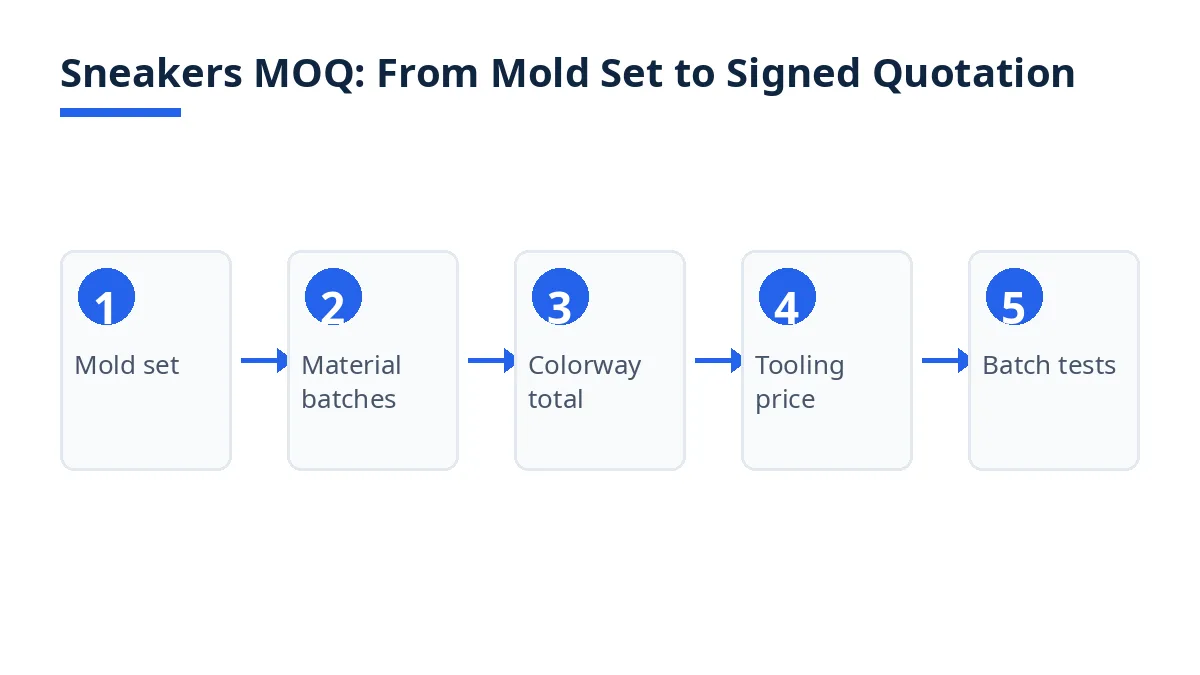
Work in the order below, and get each answer in writing before comparing quotations. A quotation that states only a pair total, with no mold or batch basis, cannot be compared with another quotation on price, because the two totals may rest on different tooling and different batches.
Name the sole unit and the mold set it needs.
Name every material batch the order needs, per colorway.
Work the colorway multiplication on paper.
Price the tooling as a separate line, and agree who owns it.
Agree the test record for each batch, not for the style in general.
The diagram puts the five passes in order.
The mold set: one cavity shape per size
In direct molding-on, the lasted upper forms the lid of the sole mold, and the base of the mold is the cavity in which the sole forms.2 The mold must seal well against the upper at the nip line, so sole material cannot leak out to an excessive degree.2 That is why a sole unit cannot be resized by trimming: the cavity is the size. Ask how many cavities the set holds, which sizes each cavity covers, and whether the set already exists for this sole shape or must be made for this order.
The materials that can be injection molded for soles include thermoplastics such as polyvinyl chloride (PVC) and thermoplastic rubber (TR), as well as polyurethane (PU) for reaction injection molding.2 Name the sole material with the mold question, because a mold made for one material and process does not automatically serve another. A cemented sole unit raises a different question: ask whether the outsole is a stock unit the supplier already buys, or a custom unit molded for this style. A stock sole unit can remove the mold floor; a custom tread keeps it.
The last set sits behind the mold set: it gives each shoe its foot shape. SATRA describes digital last assessment as a way to check three-dimensional last files against a foot dimensions database, giving a population coverage value for specific demographics.3 Ask whether the last set and the mold set cover the size run and the market the buyer sells in, including the end sizes.
The material batch: one run per colorway
A colorway is one color combination of one style. Each colorway can carry its own batch floor, because color is fixed in the material before the pair is assembled. In injection molding, material can be mixed before the injection process, and colored plastic can be added to virgin material and mixed thoroughly before being injected.2 A new color in the compound is a new mix, and a small mix carries the same setup as a large one. Ask whether each colorway needs its own compound run, and how many pairs one run must cover.
The upper raises the same question in a different material. A textile or synthetic upper lot is dyed or finished in a run, and shade must match across the pairs in the run. A minimum can be counted per color, so each color stands on its own for the count.1 Ask the batch question panel by panel where panels differ: a white mesh vamp and a black synthetic quarter do not share a batch. Leather panels follow the same logic: one lot, one shade agreement, one test record. Do not let a leather panel and a textile panel be counted as one batch.
Put the two floors together: the colorway multiplication
The mold set usually sets the size floor. The batch sets the colorway floor. The order total is the colorway floor multiplied by the number of colorways, with the size curve fitted inside each colorway total. Example figures only: a supplier states a batch floor of 600 pairs per colorway, for a size run of eight sizes.
Colorways in the order | Example figures | Smallest order |
|---|---|---|
1 colorway | 600 pairs per colorway | 600 pairs |
2 colorways | 600 pairs per colorway, 2 colorways | 1,200 pairs |
3 colorways | 600 pairs per colorway, 3 colorways | 1,800 pairs |
Inside each 600-pair colorway, the size curve must add to the total. Example figures: US sizes 6, 7, 8, 9, 10, 11, 12, and 13 at 40, 60, 90, 110, 110, 90, 60, and 40 pairs total 600 pairs (40 + 60 + 90 + 110 + 110 + 90 + 60 + 40 = 600). Dropping one colorway takes the smallest order from 1,800 pairs to 1,200 pairs in this example. Adding a fourth colorway adds one full batch floor, not a share of one.
Now add the tooling line. Example figures only: a mold set of eight cavities at 450 US dollars per cavity costs 3,600 US dollars (8 x 450 = 3,600). Spread over 600 pairs, the tooling adds 6.00 US dollars per pair (3,600 / 600 = 6.00). Spread over 2,400 pairs, the same set adds 1.50 US dollars per pair (3,600 / 2,400 = 1.50). The mold set does not get cheaper when the order grows; it gets thinner per pair.
What tooling and batch minimums do to cost, timing, and paperwork
Cost: separate the tooling line from the pair price
Ask for three lines in every quotation: the pair price, the tooling charge, and any batch surcharge. If the tooling is charged once, ask whether a repeat order on the same mold set carries the charge again, and get the answer as a date and a condition. If the tooling is spread into the pair price, ask over how many pairs it is spread, and what happens to the pair price if the order is split or phased.
Example figures only: a below-batch surcharge of 800 US dollars on a 300-pair run adds 2.67 US dollars per pair (800 / 300 = 2.67, rounded), and leaves no extra stock. Ordering up to the 600-pair batch floor at 9.00 US dollars per pair adds 300 pairs at 2,700 US dollars (300 x 9.00 = 2,700), and leaves 300 pairs in stock. Test each break from both sides before ordering up. Example figures only: 1,700 pairs at 9.00 US dollars per pair cost 15,300 US dollars (1,700 x 9.00 = 15,300), while 1,800 pairs at 8.60 US dollars per pair cost 15,480 US dollars (1,800 x 8.60 = 15,480). A cheaper unit price can still leave a higher total. Work the break with the tooling line included.
Timing: mold making, batch runs, and samples per mold and batch
Timing follows the mold set and the batches, not the order total. Mold making, mold trials, and sample approval each take their own time, and a new colorway adds a batch run and a sample pair in that colorway. Set a time for each stage in writing, linked to the mold set or batch it covers, rather than taking a single lead time for the whole order. A sample pair approved from one mold cavity does not approve every cavity, and a sample pair approved in one colorway does not approve the shade of the next. Require a sample gate whenever the mold set changes, the compound changes, or a colorway is added, and record which cavity and batch each sample pair came from. If the order is phased, agree in writing whether the second phase draws on the same mold set and batches, and share a realistic forecast for the repeat.1
Documents: batch identity, test records, and mold ownership
Test the batch being bought, not a previous batch of the same material. Under REACH Annex XVII, suppliers of consumer goods have a legal obligation to ensure products comply with the limits in the restrictions, and compliance can be shown through check testing or an audit of raw materials and production processes.4 The SATRA summary of the key entries for textiles, leather, and polymers includes the limits in the table below. Those limits are material limits, so a new batch needs its own record: ask for the test record by method name, tied to the batch identity in the quotation, and confirm which market the limits were checked against. No test result is stated here for any supplier or batch.
Material | Restricted substance | REACH Annex XVII limit |
|---|---|---|
Dyed textiles and leather | Aromatic amines from azo dyes | 30 mg/kg |
Leather | Chromium VI | 3 mg/kg |
Plastics and synthetic rubbers | Cadmium | Less than 100 mg/kg |
Polymers | Polycyclic aromatic hydrocarbons | Less than 1 mg/kg |
The paperwork that must match the pairs is short, and each line must name the mold set and the batch: the specification with the sole unit, mold set identity, and colorway color references; the accepted quotation stating the minimum per colorway and the tooling line; the purchase order carrying the same mold and batch identities; and the batch test records kept with the shipment documents. Add one line most quotations omit: who owns the mold set, where it is kept, and whether it may be used for other buyers.
Bangladesh checks that belong in a tooling-first order
Start with the trade body, and read its claim for what it is. On its president's page, the Leathergoods and Footwear Manufacturers and Exporters Association of Bangladesh says it represents makers and exporters of leather products, footwear, synthetic goods, and allied factories in Bangladesh.5 A directory check proves membership only. If a supplier claims membership, check the claim against the association listing, then test capacity with a trial run on the mold set and batches the bulk order will use.
Labeling is a batch consequence, not a packing afterthought. Under the European Union footwear labeling rules, a material is labeled only when it covers at least four-fifths of the upper, the lining and sock, or the volume of the outer sole; otherwise the two main materials are labeled.6 The label has to name the materials of the upper, of the lining and sock, and of the outer sole, and it has to sit on at least one shoe of every pair, with the person who first places imported footwear on the EU market responsible for the label and its accuracy.6 A material change that moves a panel across the 80 percent line changes the label wording, so agree the label artwork after the materials and batches are fixed. For the USA, UK, and UAE, confirm the labeling and marking rules with the broker, since this guide states only the EU position from the source opened.
Classification follows the same discipline. The 6404 heading applies to textile-upper shoes with outer soles made from rubber, plastics, leather, or composition leather. The UK schedule puts sports footwear, including training shoes, gym shoes, basketball shoes, and tennis shoes, under 6404 11.7 The chapter notes judge the upper by whichever material covers most of its outside, with trims and reinforcements left out of the count, and the sole by whichever material touches the ground most.7 Treat 6404 as indicative only: have a broker settle the complete national code, the duty entry, and any preference claim before you price the order. On the UK tariff page dated 5 April 2025, commodity 6404 1100 00 showed a third-country duty of 16.00 percent.7 No duty rate is stated here for the USA, EU, or UAE.
Name the delivery rule with the same care. Only FAS, FOB, CFR, and CIF are confined to sea and inland waterway transport.8 Both FAS and FOB are sea-or-inland-waterway rules. Each puts export formalities with the seller, and the carrier contract and port-to-port freight with the buyer.8 Where the sneakers move in containers handed to a carrier at a terminal, the ICC Academy notes that the FCA rule is more appropriate, since containers may remain at the terminal for days before loading.8 Name the rule, the Incoterms year, and the named place or port in every quotation.
On Exportain, read each badge for the check behind it. Exportain staff check documents and photographs for each badge. That review is not a visit to the factory, and it does not check a government database. A badge promises nothing about how much a factory can make, the quality of the pairs, or whether they arrive on time.9 Factory Verified means the factory photographs were reviewed, and Export Verified means the Export Registration Certificate was checked.9 Treat the badge list as a way to shorten a shortlist. Then ask for the export registration and trade license, check the names against the quotation yourself, and put the tooling, batch, Incoterm, payment, and inspection terms in writing before paying.9
Negotiation moves that backfire on a molded sole
Asking for the lowest mold charge and the lowest pair price together. A pair price that already spreads tooling thin assumes a large run. Separate the lines first, then decide which line to move.
Adding a colorway after the batches are agreed. A late colorway is a new batch, a new sample pair, and often a new shade agreement. Freeze colorways before the batch order, or price the late addition as its own batch.
Approving a sample pair from a different mold or batch. A sample made on a trial cavity or from a lab batch proves the design, not the production mold set or batch. Record the cavity and batch identity on every sample approval.
Accepting a test record from an earlier batch. A record for a previous compound run or dye lot says nothing about the batch in the order. Ask for the record tied to the batch identity in the quotation, by method name.
Treating a listing minimum as the contract figure. A listing states a minimum on its own terms, and only the accepted quotation binds both sides.1 A listing total with no mold or batch unit behind it is a starting point, not a settled figure.
Leaving mold ownership unstated. A mold set made for one buyer and kept without an ownership line can be reused, moved, or charged again on the repeat order. Settle ownership, storage, retention, and reuse in the quotation, even when the tooling charge is zero because an existing set is shared.
Tooling and batch checklist before you sign the quotation
Work down the table and fill every row before signing. An empty row means the figure tied to it is still open, no matter how firm the total sounds.
Line | Record it exactly |
|---|---|
Sole unit and mold set | Sole shape, material, process, cavity count, sizes covered, existing or new set |
Last set and size run | Last identity, size run, market sizing, fit check on end sizes |
Colorways and batches | Colorway list, color reference per panel, batch identity per material |
Size curve | Pairs per size, adding to the colorway total, per colorway |
Tooling line | Charge, spread or separate billing, repeat-order treatment, ownership and retention |
Batch tests | Test record by method name per batch, limits checked, market covered |
Labeling | Label artwork, material wording, checked on the approved sample pair |
Classification and duty | Broker-settled national code, duty entry, and preference claim for this pair and market |
Delivery rule | Rule, year, named place or port, container position, who clears import |
Sample and inspection | Approved sample pair per mold set and colorway, inspection plan, who inspects |
How Exportain helps you compare tooling answers
Exportain lets a buyer put the same mold and batch questions to several suppliers at once, so the answers arrive on one specification and can be compared line by line. State the sole unit, the mold position, the colorway list, and the size curve in the request, using the how a minimum is counted on Exportain page to frame the counting unit. Shortlist from the supplier directory, open each profile, and read the badge checks on Exportain before ranking anyone. Compare the wholesale sneaker guide when the order is an assortment, and keep the sneakers quality checklist beside the sample approvals.
How does a new outsole mold change the MOQ for sneakers from Bangladesh?
A new outsole mold adds a fixed tooling floor that must be carried by the order. The cavity shapes the sole, so a new tread or profile needs a new cavity set, and the charge spreads across the pairs ordered. Sharing an existing sole unit, or paying the tooling as a separate line with a written repeat treatment, can change the floor without changing the shoe. Ask for the cavity count, the sizes covered, and whether the set already exists, in writing, before discussing the pair total.
Can I cut the MOQ by using fewer sneaker colorways in Bangladesh?
Yes, where the floor is a batch floor. Each colorway can carry its own material batch, so cutting colorways cuts batch floors one for one: in the example figures in this guide, three colorways at 600 pairs per colorway need 1,800 pairs, and two need 1,200 pairs. Cutting colorways does not cut a mold floor that is already shared. Freeze the colorway list before the batches are ordered, and price any late colorway as its own batch.
Does a smaller sneakers order in Bangladesh need a new material batch test?
A smaller order needs a test record for the batch it will actually be made from, whether the batch is large or small. REACH Annex XVII limits apply to materials, and compliance is shown through check testing or an audit of raw materials and processes.4 A record from an earlier batch of the same material does not cover a new batch, and a record for one panel material does not cover a different panel. Ask for the record by method name, tied to the batch identity in the quotation.
What should a USA, UK, EU, or UAE buyer put in writing about sneaker tooling and batches?
Put the mold set identity, cavity count, and sizes covered; the colorway list with color references per panel and the batch identity per material; the tooling charge, ownership, and repeat treatment; the batch test record by method name; the labeling artwork for the destination market; the broker-settled classification code for that market; and the delivery rule with the named place or port. The EU labeling position and the UK duty figure in this guide apply to those markets only: confirm the labeling, marking, classification, and duty position for the USA and UAE, and for the EU beyond labeling, with the broker for the exact pair before shipment.
Next steps on Exportain
Put the sole unit, the mold position, the colorway list, and the size curve in a single message to each supplier, so the answer can settle the tooling and batch floors rather than restating a total. Check the HS classification guide for sneakers while writing the specification, and read the badge checks on Exportain before shortlisting from the supplier directory.
Sources
- MOQ Meaning (Minimum Order Quantity). Exportain (accessed )
- The development of injection moulding. SATRA (accessed )
- Footwear fit and comfort. SATRA (accessed )
- How REACH Annex XVII affects the manufacture of consumer products. SATRA (accessed )
- President's Message - LFMEAB. Leathergoods and Footwear Manufacturers and Exporters Association of Bangladesh (LFMEAB) (accessed )
- Footwear labelling. European Commission, EUR-Lex (accessed )
- Footwear with outer soles of rubber, plastics, leather or composition leather and uppers of textile materials. GOV.UK (accessed )
- FOB & FAS Incoterms® 2020 explained: Key differences. ICC Academy (accessed )
- How Supplier Verification Works on Exportain. Exportain, (accessed )
About the author
Sourcing from Bangladesh?
Post a request for quotation and suppliers on Exportain can send you their quotes directly.
Post an RFQ