HS Code for Sneakers: Classification Guide for Importers
Indicative HS heading 6404 for sneakers: how the heading is chosen, what decides the subheading, and how US, EU and UK national codes extend it - with a verify-before-you-ship check.
Short answer
Sneakers with a textile upper are indicatively classified under HS heading 6404, with subheading 6404.11 for sports footwear and tennis, basketball, gym and training shoes and 6404.19 for other textile-upper styles. The exact code depends on the upper material, sole construction and shoe purpose, so confirm the full national code in the destination tariff before shipping.
On this page
A sneaker has no single code that can be copied from a supplier catalogue onto every customs entry. The starting point most often used for a trainer with a textile upper is heading 6404, which the United States tariff describes as footwear with outer soles of rubber, plastics, leather or composition leather and uppers of textile materials.1 That heading is indicative only: whether it fits a given sneaker depends on the shoe itself, and the entry code is the full national code of the destination country.
Verify note: before you use any code in this guide on a real shipment, confirm the subheading and the full national code in the destination tariff with a customs broker or the customs authority where the goods will enter. A code that fits one sneaker style does not automatically fit the next style in the same order.
Quick answer: indicative HS heading (with verify note)
The indicative heading for a sneaker with a textile upper is 6404, and the indicative subheading for a sports-style sneaker is 6404.11, which covers sports footwear and tennis shoes, basketball shoes, gym shoes, training shoes and the like.1 That pair of numbers is a starting point, not an entry code. A casual trainer that is not a tennis, basketball, gym or training shoe falls under 6404.19 instead, and a mainly leather or mainly rubber-or-plastics upper leaves heading 6404 altogether.
Two tests decide the heading before any subheading is chosen. The first is the upper: United Kingdom guidance states that footwear is classified by the material of the upper and outer sole, and that where the material with the most external area of the upper is textile, the footwear is classified under heading 6404, while a leather upper points to heading 6403.2 The second is the outer sole: its material is the material with the greatest contact with the ground, ignoring add-ons such as spikes and bars.2
How HS codes are structured (2-4-6 digits)
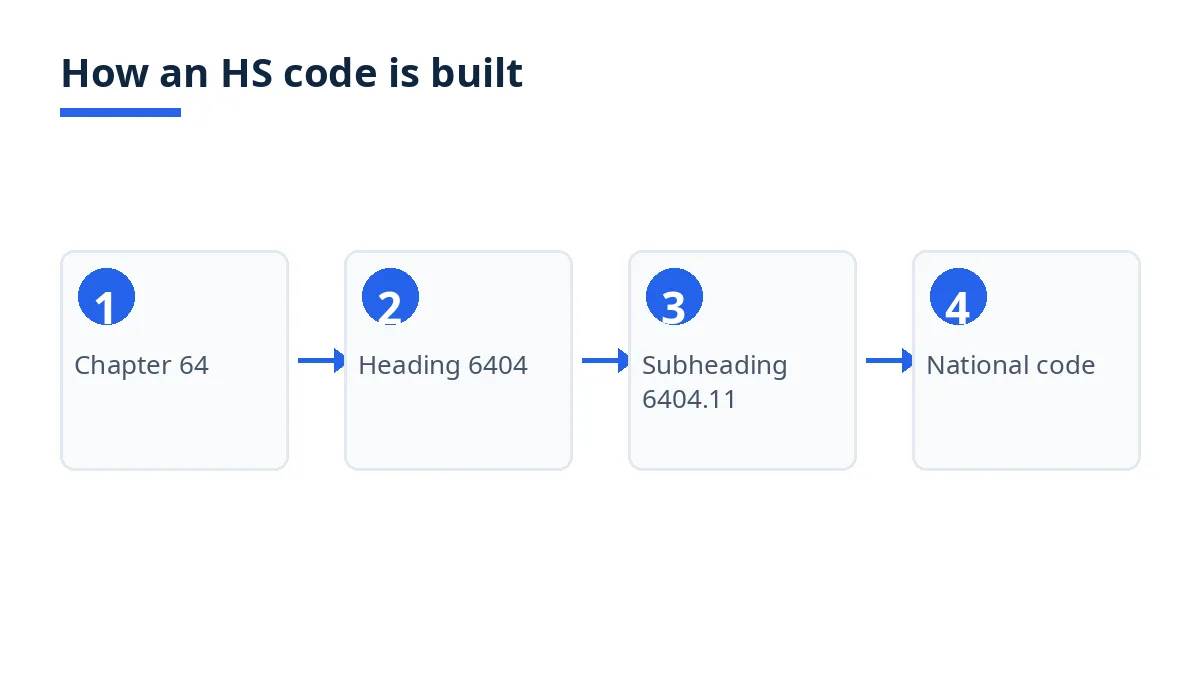
The Harmonized System narrows in three pairs of digits: the first two are the chapter, the next two complete the four-digit heading, and the final two complete the six-digit subheading, the level shared internationally. Chapter 64 covers footwear and parts of such articles. Heading 6404 sits inside it, with subheadings 640411 for sports footwear and tennis, basketball, gym and training shoes and the like, 640419 for other footwear with rubber or plastics soles, and 640420 for footwear with leather or composition leather soles.3
Only the first six digits are shared internationally. Beyond the sixth digit, each country adds its own digits, so the same sneaker can carry a different full code in different destinations. The United States works to a 10-digit import number, the European Union uses an 8-digit Combined Nomenclature code extended in TARIC, and the United Kingdom uses a 10-digit commodity code. Those trailing digits must never be copied from one destination to another.
Factors that decide the code for sneakers
Start with the upper, judged by greatest external surface area. Sneaker uppers are usually mixed: a knit body with leather overlays, a mesh vamp with synthetic panels, a canvas body with a rubber toe cap. United Kingdom guidance works through this kind of trainer section by section: where textile is found under a leather toe cap, vamp or side section, the textile counts as the upper and the leather piece as a reinforcement, but where only lining sits under a leather section, that leather section counts as upper material.2 Ask the supplier to state, in writing, which material covers the greatest external surface area and what lies under each overlay. Lining is not upper material.
Next, check the outer sole. Inside 6404, rubber or plastics soles lead to 6404.11 or 6404.19, while leather or composition leather soles lead to 6404.20.3 Note how the sole is attached and whether the shoe is made in one moulded piece, since that decides the boundary with the waterproof and rubber-plastics headings below.
Then check purpose and shape, because purpose separates 6404.11 from 6404.19. United Kingdom guidance states that trainers do not classify as sports footwear unless they are tennis, basketball, gym or training shoes: shoes designed for a specific sporting activity, or for running, jumping, quick turns and abrupt stops, with a shock-absorbing sole and a stability upper.2 A road running trainer with those features fits; a fashion trainer, walking shoe and hiking shoe do not, since footwear worn mainly for walking, trekking, hiking or mountain climbing is not sports footwear under the same guidance.2 The narrower sports-footwear test, for footwear designed for a sporting activity with, or with provision for, spikes, sprigs, cleats, stops, clips or bars, covers skating boots, ski boots, wrestling boots, boxing boots and cycling shoes.2 A cleated football boot therefore needs the cleat question answered first, while an ordinary gym trainer needs the tennis, basketball, gym and training question answered first.
Finally, check ankle coverage, insole length and intended wearer, which split national lines: United Kingdom guidance lists all three among the factors used to classify footwear.2 A high-top and a low-top sneaker with the same upper and sole can therefore need different national lines.
National codes: US HTS, EU CN/TARIC, UK commodity code
In the United States, the schedule extends the six-digit subheading to a 10-digit import number, listing 6404.11 for sports footwear and tennis, basketball, gym and training shoes and the like, with further lines below it by construction and wearer.1 Those lines are United States lines and must not be quoted for a European or United Kingdom entry.
In the European Union, the Combined Nomenclature adds two digits to make an eight-digit code, and TARIC adds further digits for EU measures. For a textile-upper sports sneaker with a rubber or plastics sole, the EU CN line is 64041100, the eight-digit form of 6404.11.4 5 Confirm it in TARIC for the entry date.
In the United Kingdom, the commodity code is also 10 digits. Under heading 6404 the tariff lists 6404110000 for sports footwear and tennis, basketball, gym and training shoes and the like with rubber or plastics soles, alongside 6404191000 for slippers and other indoor footwear, 6404199000 for other footwear with rubber or plastics soles, and 6404201000 and 6404209000 for the corresponding leather-soled lines.4 A casual knit slip-on therefore needs a different United Kingdom line from a gym trainer.
Heading boundaries decide the heading before any national line is read. Waterproof footwear with outer soles and uppers of rubber or plastics, where the uppers are neither fixed to the sole nor assembled by stitching, riveting, nailing, screwing, plugging or similar processes, belongs under heading 6401.2 Other footwear with rubber or plastics uppers belongs under 6402, leather uppers under 6403, footwear fitting none of 6401 to 6404 under 6405, and separate uppers, soles and parts under heading 6406.2
How to confirm the code officially
Start with the destination tariff, not a search result or supplier invoice. Open the current Chapter 64 section, read the heading text for 6404 and the chapter notes, then work down until the description matches the sneaker in front of you. Classification is determined by the terms of the headings and any relative section or chapter notes, applied at subheading level by comparing only subheadings at the same level.6 In one United Kingdom advance ruling, a lace-up casual shoe with a rubber sole and uppers of leather and textile mesh was classified under 6404199000, with the textile mesh as the upper material and the leather as reinforcement.6 Check that its materials and construction match your sneaker before relying on it.
Where the answer is still doubtful, ask a customs broker to confirm it in writing, or seek a formal ruling before shipping: an advance ruling in the United Kingdom, binding tariff information in the European Union, or a binding ruling in the United States. Keep a written record for every style: description, upper and sole materials, purpose test, codes chosen, tariff date checked, and any ruling or broker confirmation relied on.
Common classification mistakes
Stopping at the heading is the most common mistake. Writing 6404 on an entry or invoice and treating it as a complete code leaves the subheading and national extension undecided.
Judging the sneaker by its most visible material is the second mistake. A knit trainer with leather overlays, heel counter and toe cap is not necessarily a leather-upper shoe if textile covers the greatest external surface area, and a textile-lined shoe with a leather outer is not a textile-upper shoe on the strength of its lining.
Classifying by marketing name is the third. Calling a shoe a sports sneaker or running shoe does not place it in 6404.11; its shape, sole and upper must meet the tennis, basketball, gym and training description, or it must carry, or be designed to carry, spikes, cleats or similar features.
Copying a full national code from another destination is the fourth mistake: United States, European and United Kingdom lines can all start with 640411 and still differ after the sixth digit. Treating one code as covering a whole order is the fifth: one order can contain a knit gym trainer, a canvas court sneaker, a cleated football boot and a casual slip-on, each needing different codes.
Related duties and documents
The HS code does not by itself state what an importer will pay. The code points to the treatment in the destination tariff, which depends on the full national code, origin, any preference or trade measure on the entry date, and customs value. Ask your broker for the treatment that applies to your code, origin and entry date. This guide states no duty rates, because rates are national, change over time, and depend on origin.
The documents that normally travel with a sneaker shipment are the commercial invoice, the packing list, the bill of lading or airwaybill, and the certificate of origin where a preference or buyer requirement calls for one. The invoice description should match the classification: shoe type, upper material by external surface area, sole material and construction, sports or casual purpose, ankle coverage, and quantity.
FAQs
What is the HS code for sneakers?
There is no one code for all sneakers. A textile-upper sneaker is indicatively classified under heading 6404, with 6404.11 for sports footwear and tennis, basketball, gym and training shoes and the like, and 6404.19 for other textile-upper footwear with rubber or plastics soles.1 3 A leather-upper trainer falls under 6403 and a rubber- or plastics-upper trainer under 6402 instead. Confirm the subheading and full national code in the destination tariff before shipping.
Is the HS code the same in every country?
The first six digits should be the same internationally for the same product, because they come from the shared Harmonized System. The full code is not the same everywhere, because countries add their own digits, measures and notes after the first six.
How do I confirm the correct code?
Read the heading text and chapter notes in the destination tariff, apply the upper and outer-sole surface-area tests to your shoe, and work down to the subheading and then the national line. Cross-check rulings on similar shoes, and where doubt remains, ask a broker to confirm it in writing or seek a formal ruling before shipping.
What happens if I use the wrong code?
Customs can reclassify the goods, reassess duty and taxes due, delay clearance, and impose penalties under national law. A wrong code can also mean a missed licence or control on the correct line. Tell your broker promptly if you find an error, and correct the record for later shipments.
Next steps on Exportain
For the structure of the system behind this guide, read the Exportain HS hub at https://exportain.com/blog/hs-code-harmonized-system, and for the step-by-step method, read https://exportain.com/blog/hs-codes-how-to-classify-your-product. When you are ready to source, browse suppliers at https://exportain.com/suppliers and Post a free RFQ on Exportain, giving the supplier your upper material, sole material, shoe purpose and size run.
Sources
- Harmonized Tariff Schedule of the United States, Revision 18 (2026), Chapter 64. U.S. International Trade Commission (accessed )
- Classifying footwear for import and export. GOV.UK (accessed )
- HS Code 6404: Footwear with outer soles of rubber, plastics, leather or composition leather and uppers of textile materials. United Nations Statistics Division (accessed )
- Heading 6404: Footwear with outer soles of rubber, plastics, leather or composition leather and uppers of textile materials. UK Trade Tariff, GOV.UK (accessed )
- Combined Nomenclature, Chapter 64 (Council Regulation (EEC) No 2658/87, Annex I, as amended). legislation.gov.uk (accessed )
- Information for ruling 600007345: Search for Advance Tariff Rulings. GOV.UK (accessed )
About the author
Sourcing from Bangladesh?
Post a request for quotation and suppliers on Exportain can send you their quotes directly.
Post an RFQ