Top Sneakers Manufacturers in Bangladesh: How to Find and Verify Them
Seven scored checks for sourcing sneakers from Bangladesh: upper, midsole, outsole and bond, last and fit, assembly and flex, packing, and capacity with compliance evidence, with the written record to hold before an order.
Short answer
Find sneakers manufacturers in Bangladesh by scoring each factory on seven points: the upper specification panel by panel, the midsole compound and compression record, the outsole compound and sole bond, the last and fit across the size range, the assembly method and flex behavior, packing and labeling, and capacity with compliance evidence. Hold written evidence for each point, run a trial lot, and order only when every point passes or has a written fix.
On this page
Key takeaways
Score the sample pair and the trial lot as two different proofs: design first, repeatability second.
Name the upper material panel by panel, and keep a swatch for each panel beside the sample pair.
Hold midsole, outsole, adhesion, flexing, and abrasion records that name their test methods.
Read badges and certificates for scope and expiry, and prove capacity with a trial lot on the bulk line.
A sneakers order fails in the pair, not in the brochure. The panel that was swapped, the midsole that thins, the sole that parts at the toe, and the size that fits the sample but not the range all appear after the order is placed. This article gives buyers a scorecard to use before that happens. Each item is a check, not a company profile.
For each point, write down the evidence and the decision: pass, fix, or stop. Without the evidence, the point is not passed.
How the seven-point scorecard works
Score the pair first, the factory second: the sample shows whether the design can be made; the trial lot shows whether it can be made again, in every size and color.
For each point, ask for one named piece of evidence: a specification sheet, a test record that names its method, a measurement, or a photograph of a named part. General assurances do not count.
Scorecard point 1: Upper specification, panel by panel
Name the material for every panel of the upper, not one material for the whole shoe. The panels include the vamp over the toes, the quarters at the sides, the tongue, the collar, the toe cap, the heel counter area, and the eyelet stays. Each panel can carry a different material, and a substitution on one panel changes how the shoe looks, stretches, and wears. Record the material, fiber or construction, and color for each panel, with a swatch beside the sample pair.
A panel change between sample and bulk can leave the shoe looking right in a photograph and fitting wrong on the foot. Ask for a specification sheet listing each panel separately, and compare it panel by panel against the sample pair. Use the discipline of European Union footwear labeling, which must state the material for the upper, the lining and sock, and the outer sole, naming the material covering at least 80 percent of each part, or the two main materials where no single material reaches 80 percent.1
Scorecard point 2: Midsole compound, density, and compression
Name the midsole compound, its density, and its compression behavior, and hold a test record that names the method used. The midsole sits between the upper and the outsole and carries most of the cushioning. Common materials include ethylene vinyl acetate (EVA) foam and polyurethane (PU). Compound, density, and hardness together shape how the shoe feels under the heel and how it holds its thickness. Ask for the compound and hardness target, written as a range the sample must meet.
A midsole that loses thickness under repeated heel strikes changes the fit and the heel height. SATRA describes compression set as the loss of thickness measured after a period of compression and recovery, and its test method holds specimen discs under constant pressure for 24 hours before measuring the change.2 Shock absorption is a related check on the whole bottom unit, tested by SATRA with a falling mass method.3 Ask for the compression record by method name and compare the recorded density and hardness with the sample pair.
Scorecard point 3: Outsole compound, tread, and the sole bond
Name the outsole compound and tread, and hold a record for the bond between the sole and the upper. The outsole is the layer in contact with the ground, and in most sneakers builds it is rubber or a rubber compound, with a tread pattern cut or molded into it. Record the compound and tread, and ask how each surface is prepared before bonding: primer, cement, and pressing.
Sole separation usually starts at the toe or the heel, where the bond is worked hardest. SATRA tests sole adhesion with a rapid method that measures the strength of the bond at the toe and heel areas of the lasted margin on completed footwear, and it notes that a minimum required load can be set so production pairs can be checked against it.3 Abrasion and flexing records belong beside the adhesion record: SATRA assesses abrasion by weighing a specimen before and after a run against abrasive paper, and it tests resistance to cut growth on flexing with a method that stops after the cut has grown by 6 mm or after 150,000 cycles, whichever comes first.2 Inspect the bond line around the featherline for gaps and lifted edges, agree the minimum load in writing, and confirm a hand flex check against the laboratory flexing record.
Scorecard point 4: Last, size system, and fit across the range
Settle the last, the size system, and the width before sampling, and prove fit on more than one size. The last is the foot-shaped form the shoe is built around, and it sets the length, width, toe shape, and heel shape of the finished pair. Ask for last measurements per size, the size system, and the width fitting.
Fit complaints rarely come from the middle size. They come from the sizes at each end of the range, where grading stretches the last shape furthest from the sample size, and from widths that were never tried on. SATRA offers last assessment and fitting trials, and it compares digital last information with a foot dimensions database to give a population coverage value for specific demographics.4 Run a wear trial on the smallest size, a middle size, and the end size, with wearers who match the target market, and record length, width, heel slip, and pressure at the toes.
Scorecard point 5: Assembly method, stitching, and flex behavior
Name the assembly method in the specification, and inspect the stitching and flex points on the sample pair. Sneakers are commonly built by cold cement construction, in which the upper is steamed, lasted, and cooled to the last, the sole unit is primed and cemented, and the two parts are joined in a press and cooled to set the bond.5 The upper is often paired with a Strobel bottom, stitched to a thin sheet, which keeps the shoe lighter and more flexible than a board-lasted build.5 Vulcanized construction is the older alternative: the rubber outsole is cured with heat, the last must be metal, and EVA foam cannot be used because the heat would destroy it.5 Write the method into the specification.
In cold cement work, pressing matters as much as cement: the shoe passes through vertical, toe and heel, and side pressing so the upper and outsole meet over their full contact area, and it is then cooled before the last is removed.5 Check the stitching at the flex points, the heel seam, and the eyelet area for skipped stitches and loose thread ends, and require a fresh sample gate whenever the assembly method or the sole unit changes.
Scorecard point 6: Packing, labeling, and the classification record
Agree the packing unit, the carton marks, and the labeling before the trial lot, and confirm the classification record for the shoe in front of you. Each pair must match left and right in style, color, and size, and carry the same marks as every other pair. Agree the pairs per carton, the size breakdown inside it, the tissue or shape holder used, and the carton print: style, color, size breakdown, and quantity. Open one carton from the trial lot, or have your inspector open one, and compare the pairs inside with the packing list.
Packing errors are cheap to prevent and expensive to sort out after arrival, and the wrong heading can change the duty treatment and delay clearance. Heading 6404 covers shoes with textile uppers and outer soles made of rubber, plastics, leather, or composition leather, and within it the United Kingdom tariff lists sports footwear such as tennis shoes, basketball shoes, gym shoes, and training shoes under 6404 11, with other footwear under 6404 19.6 Chapter notes judge the upper by greatest external surface area, ignoring accessories and reinforcements, and the outer sole by greatest ground-contact area.6 Treat 6404 as indicative for a textile-upper build, confirm the code with your broker before shipment, and do not rely on a duty rate quoted without a schedule for your market. For labeling, the European Union summary states that labeling must cover the upper, the lining and sock, and the outer sole, that the label may use pictograms or written indications, and that it must appear on at least one shoe in each pair.1
Scorecard point 7: Capacity, compliance evidence, and the trial lot
Prove capacity with a trial lot, and read every compliance document for what it covers. Ask the pairs per day the assigned line can complete, the lines that will work on the order, the materials in stock, and the deliveries committed in the same period. Then test the answers with a trial lot: a small run, made on the bulk line, in the full size range, packed as bulk will be packed. A sample-room trial lot proves the design, not the line.
A good sample pair can mislead, because the line, the materials, or the outsole molds may be committed elsewhere. Compliance evidence misleads in a similar way when it is read for more than it says: a certificate may cover one site, one product range, or one period. The Leathergoods and Footwear Manufacturers and Exporters Association of Bangladesh describes itself as the trade body for leathergoods and footwear manufacturers and exporters in Bangladesh.7 If a supplier claims membership of an association, check the claim against that association's own listing. Read the badge and certificate record on Exportain the same way: Exportain staff review documents and photographs behind each badge, and a badge is not a factory visit, a check against a government database, or a promise about production capacity, product quality, or delivery.8 Score this point only when the trial lot has been inspected and the documents have been read for scope and expiry date.
What MOQ and price drivers do to the scorecard
MOQ and price sit inside the seven points; they do not replace them. A supplier may count the minimum by order, by style, by color, or by size group, and may apply more than one counting rule at once, so the same headline number can mean very different totals.9 Ask in writing how the minimum is counted before you plan the color and size mix. Example figures: a minimum of 1,200 pairs per style and color, for 2 styles in 3 colors, means 7,200 pairs (1,200 x 6), and at USD 8.50 per pair free on board the total is USD 61,200 (7,200 x 8.50). Example figures only; your quotation carries the real numbers.
Price drivers follow the scorecard order: upper material and panel count, midsole compound and density, outsole compound and tread, assembly method, size curve, packing, and labeling. A cheaper quotation that changes the midsole compound or drops a size from the curve is a different shoe, and it needs to be scored again from the point that changed. Agree the delivery term in the same record. Only FAS, FOB, CFR, and CIF are confined to sea and inland waterway transport. In contrast, CPT, DPU, and DDP apply to any mode of transport, and DDP places import clearance and duty with the seller.10 11
Summary table: seven points, evidence, and the decision each one drives
Scorecard point | Evidence to hold before bulk | Decision it drives |
|---|---|---|
Upper specification | Panel material and color sheet, with swatches | Whether bulk matches the sample |
Midsole | Compound, density, compression record by method | Whether cushioning keeps thickness |
Outsole and bond | Compound, tread, adhesion, flexing, abrasion records | Whether the sole stays attached |
Last and fit | Last measurements, wear-trial notes, three sizes | Whether the range fits |
Assembly and flex | Named assembly method, inspected flex points | Whether the build holds together |
Packing and labeling | Carton photos, packing list, classification note | Whether arrivals match the order |
Capacity and compliance | Trial-lot inspection, documents read for scope | Whether the factory can repeat the result |
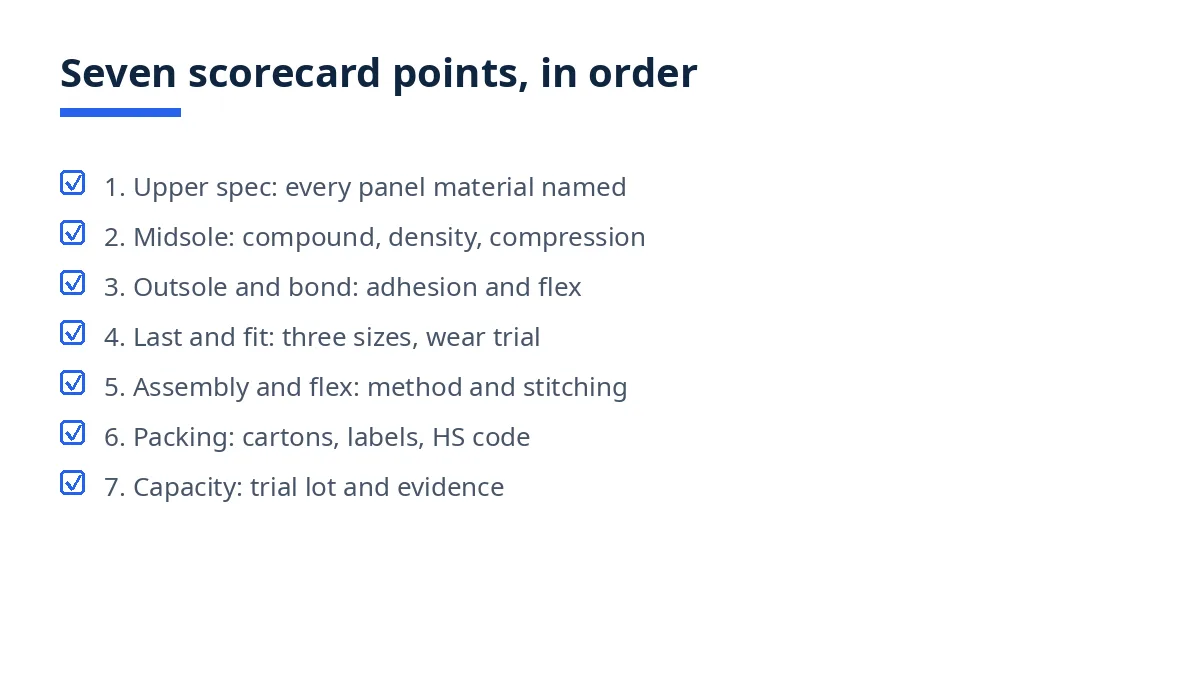
The diagram summarizes the seven points in order.
What mistake costs a sneakers order most often in Bangladesh?
Approving the sample pair and treating the approval as approval of the factory. The sample proves the design on one size. Bulk proves the line, the materials, and the packing across the full range. Skipping the trial lot, the three-size wear trial, and the document reading leaves the difference to be discovered when the cartons arrive. Score the trial lot with the same seven points, against the sealed sample pair.
How can I avoid ordering sneakers that do not match the approved sample pair?
Put the specification in writing before bulk starts, with panel materials, midsole and outsole compounds, last and size system, assembly method, packing marks, and delivery term each named. Inspect the trial lot against that record, pair by pair, and require a fresh sample whenever any named item changes. Confirm whether the minimum applies per order, per style, or per color before you fix the mix.9
Who is responsible for checking a sneakers manufacturer before an order?
You are, for the order itself. Exportain staff review the documents and photographs behind a badge, and a badge records what was reviewed; it does not replace your sample approval, your trial lot, or your pre-shipment inspection.8 Your forwarder or broker owns the classification and delivery-term advice for your market, and the body that issued a certificate owns confirmation of that certificate.
Where can I get help finding and checking sneakers manufacturers on Exportain?
Start with the supplier directory and the badge record on each profile, and use the RFQ thread to put the seven-point specification in front of several suppliers at once so their answers can be compared on the same evidence.8 Ask each supplier the same questions about upper panels, midsole and outsole records, last and fit, assembly, packing, and trial-lot timing, and keep the answers beside the sealed sample pair.
Next steps on Exportain
Browse the supplier directory on Exportain, open each badge record before you shortlist, and read what each badge records on Exportain and the minimum-counting rules for an order.
Sources
- Footwear labelling. European Commission, EUR-Lex (accessed )
- Test equipment used for assessing soles – part 1. SATRA (accessed )
- Test equipment used for assessing soles – part 2. SATRA (accessed )
- Footwear fit and comfort. SATRA (accessed )
- Vulcanized Shoe Construction vs. Cold Cement Process. Shoemakers Academy, (accessed )
- Footwear with outer soles of rubber, plastics, leather or composition leather and uppers of textile materials. GOV.UK (accessed )
- President's Message - LFMEAB. Leathergoods and Footwear Manufacturers and Exporters Association of Bangladesh (LFMEAB) (accessed )
- How Supplier Verification Works on Exportain. Exportain, (accessed )
- MOQ Meaning (Minimum Order Quantity). Exportain (accessed )
- FOB & FAS Incoterms® 2020 explained: Key differences. ICC Academy (accessed )
- Incoterms® 2020 C rules vs D rules: Risk transfer explained. ICC Academy (accessed )
About the author
Sourcing from Bangladesh?
Post a request for quotation and suppliers on Exportain can send you their quotes directly.
Post an RFQ