Sneakers Price in Bangladesh: FOB Cost Breakdown for Buyers
Read a sneakers FOB quotation as a costed bill of materials: tooling spread, volume tiers and quality tiers, then restate every quote to one pair on the same delivery basis before ranking.
Short answer
A sneakers FOB price in Bangladesh is the costed bill of materials for one pair: upper, lining, midsole, outsole, trims and pack, plus labor, overhead, tooling spread over the order, inspection, port lines, and margin. No single price holds across suppliers: the figure moves with the specification, counting basis, and volume. Restate every quote to one pair on the same delivery rule and named port, with fixed charges separated, before ranking. All figures here are example figures; duty is broker-confirmed.
On this page
Key takeaways
Read the FOB figure as a costed bill of materials, not a headline: materials, labour, overhead, tooling spread, inspection, port lines, and margin.
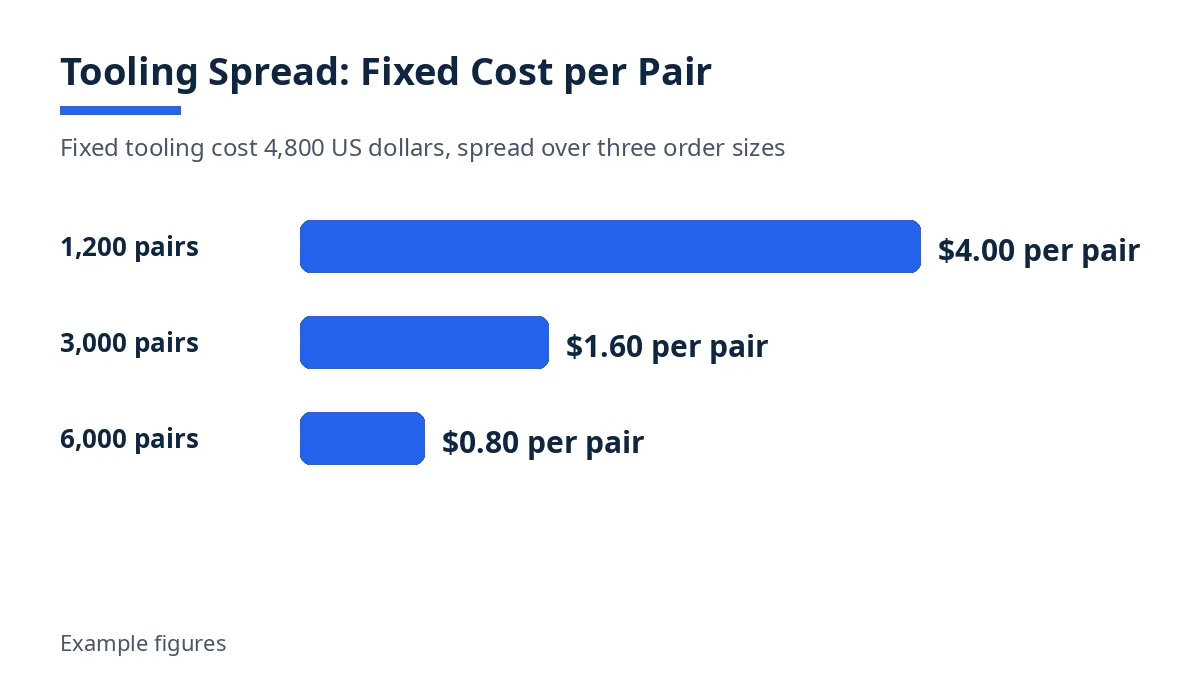
Tooling is a fixed cost spread over pairs: in the example figures, 4,800 US dollars spreads to 4.00 US dollars at 1,200 pairs and 0.80 at 6,000 pairs.
The counting basis sets the real order size: 900 pairs per style-and-color combination for 2 styles in 2 colours means 3,600 pairs in the example figures.
Restate every quote to one pair on the same delivery rule, named port, and validity date, with fixed charges separated, before ranking on price.
A sneakers quotation from Bangladesh usually arrives as one figure per pair, free on board (FOB) at a named port. Two quotations for what appears to be the same sneaker can sit far apart while both suppliers price honestly, because the figures rest on different uppers, sole compounds, mold charges, counting bases, or port lines. Every money figure is an example figure. Bangladesh made around 554 million pairs of footwear in 2025, ranking seventh in world production, according to the World Footwear Yearbook 2026 as reported by Prothom Alo.1 Leather and leather goods exports reached 1.14 billion US dollars in 2024-25, up 10.19 percent on the year before, per Export Promotion Bureau figures in New Age.2 LFMEAB describes itself as the trade body for the sector.3
What an FOB sneakers price covers, and where it stops
Under FOB (Free on Board), Incoterms® 2020, the seller puts the goods on board the vessel the buyer names at the agreed port of shipment, and risk passes to the buyer there.4 The seller carries transport to the port, loading, and export formalities; the buyer contracts the carrier, pays freight, and handles import formalities.4 Name the rule, year, and port in every quotation, for example FOB Chattogram Port, Incoterms® 2020.
FOB excludes freight, insurance, duty, and onward transport. If one quotation is FOB and another is CIF (Cost, Insurance and Freight), the two cannot be ranked until the freight and insurance inside the CIF figure are removed or added to the FOB figure on the same basis. Under Incoterms® 2020, only FAS, FOB, CFR and CIF are confined to sea and inland waterway transport. CPT, DPU and DDP apply to any mode of transport.5 The same ICC Academy summary warns that the four sea rules are written for port-to-port movement and are not suitable for container shipments in their current form, where FCA (Free Carrier) is the more fitting rule.5
Ask for the costed bill of materials first
Every factory quotation is built on a bill of materials (BOM): the line-by-line record of every material, component, process, and overhead charge that goes into one pair.6 Ask for the costed BOM, not only the unit price. A published cost guide puts the structure in shares of FOB that shift by shoe type: upper materials 25-45 percent, lining and insole 5-12 percent, outsole 8-18 percent, direct labor 15-25 percent, factory overhead 5-10 percent, packaging 2-5 percent, development and sampling amortization 1-4 percent, quality control and inspection 1-3 percent, and factory margin 8-15 percent.6
Read the BOM for materials, labor, and non-material lines: tooling, inspection, lab evidence, packing, and port lines.
Upper, midsole and outsole: where material money goes
The upper is often a major material line. Price moves with material type, grade, panel count, and cutting yield: the share of bought material that becomes finished uppers after cutting around flaws and offcuts. Ask for the material of every panel, not one material for the whole upper. A quotation that swaps a panel material is a different sneaker.
The midsole carries cushioning, and the outsole carries grip and wear. One published guide lists outsole material costs per pair in broad bands, with EVA at the lower end for lightweight sneakers, rubber higher for abrasion resistance, and TPU higher again for performance builds, and it notes that mold investment sits beside the per-unit material cost.6 Use them to frame the question: which compound, at which density and hardness, and with which test evidence. SATRA describes compression set as the loss of thickness measured after a period of compression and recovery, tested by holding specimen discs under constant pressure for 24 hours, and it tests flexing resistance by stopping after a cut has grown by 6 mm or after 150,000 cycles, whichever comes first.7 Ask for the compound name, the hardness target as a range, and the test record by method name.
Tooling and development: the fixed cost behind the pair price
Tooling is the fixed cost that most often explains why a small sneakers order prices high per pair. The table below uses example figures only, with one fixed tooling figure spread over three order sizes.
Order size (example figures) | Fixed tooling cost | Tooling cost per pair |
|---|---|---|
1,200 pairs | 4,800 US dollars | 4.00 US dollars |
3,000 pairs | 4,800 US dollars | 1.60 US dollars |
6,000 pairs | 4,800 US dollars | 0.80 US dollars |
The diagram shows the same spread.
Ask four tooling questions: what fixed charges sit inside the pair price and what fixed charges are billed separately; over how many pairs the supplier spread each charge, and whether a repeat order pays it again; who owns the molds and lasts if the relationship ends; and what a new size range or sole change would cost. Record how many sample rounds the price covers.
How volume moves the unit price
The counting basis decides how much volume an order really holds. Example figures: a minimum of 900 pairs per style-and-color combination, for 2 styles in 2 colors, means 3,600 pairs (900 x 4). A minimum is the smallest order a supplier takes on its normal terms. It may be counted per order, per style, or per color, and it may sit beside a minimum order value.8 Ask in writing how the minimum is counted.
Price tiers reward the same arithmetic. Example figures only: a supplier lists 1,200 to 2,999 pairs at 8.90 US dollars per pair, 3,000 to 5,999 pairs at 8.20 US dollars, and 6,000 pairs and above at 7.85 US dollars. An order of 2,900 pairs at 8.90 costs 25,810 US dollars. An order of 3,000 pairs at 8.20 costs 24,600 US dollars. Ordering 100 more pairs costs 1,210 US dollars less in total at the break, before storage and sell-through are considered. Check both sides of every break.8
Three quality tiers, one silhouette: what the money changes
Suppliers often price the same silhouette at more than one tier. The table below sets out what typically changes, in direction only. No tier price is stated, because no tier price holds across suppliers.
Tier element | Lower tier | Middle tier | Higher tier |
|---|---|---|---|
Upper | Fewer panels, standard textile | More panels, named grade | Named grade, tighter shade control |
Midsole | Standard EVA | Named EVA or PU, density range | Named compound, ranges, test record |
Outsole | Standard rubber or TPR | Named rubber, tread stated | Named compound, abrasion and flexing records |
A quotation that claims a higher tier without naming a changed material, compound, or check is a higher price for the same pair.
Samples, molds and the costs outside the pair price
Sample pairs come first: a quotation may include one sample round, charge each round separately, or carry sample costs inside the bulk pair price. Ask how many rounds the price covers, what each extra round costs, and whether sample freight is included. Approve one pair of each color. Mold charges may be billed once or spread over an agreed volume. Lab tests and inspection are charged per lot or per visit. Agree pack and label artwork before the price is fixed.
From FOB to landed cost: the lines after the ship
The table below uses example figures at 6,000 pairs, with duty left for the broker.
Landed-cost line (example figures) | Amount |
|---|---|
Pair price, 6,000 pairs at 8.20 US dollars per pair | 49,200.00 US dollars |
Ocean freight plus insurance (example figure) | 1,850.00 US dollars |
Import handling and broker fees (example figure) | 410.00 US dollars |
Duty | Rate confirmed by the broker, applied to the customs value; add here |
Total before duty | 51,460.00 US dollars |
Per-pair cost before duty | 8.58 US dollars |
51,460.00 divided by 6,000 is 8.58 US dollars per pair. Rework every line before comparing with a domestic purchase.
Classification decides the duty line. The Harmonized System classifies goods in sections, two-digit chapters, four-digit headings, and six-digit subheadings.9 Heading 6404 covers textile-upper footwear with rubber, plastics, leather or composition leather outer soles, including 6404.11 sports footwear.10 The upper material is the one with the greatest external surface area, ignoring accessories and reinforcements.10 Treat 6404 as indicative only; the broker confirms the full national code and duty line.
In the EU, only a material covering 80 percent or more of the upper, lining and sock, or outer sole volume needs labeling; otherwise the two main materials are labelled.11 The label may be written or in pictogram form, must be visible, securely attached and accessible, and must appear on at least one shoe of each pair.11 Where the footwear is imported, the person who first places it on the EU market is responsible for the label and its accuracy.11
The commercial invoice must carry the Export Registration Certificate number and the HS code, and match the other export documents.12 The packing list and certificate of origin complete the set.12
Compare three quotes on one worksheet
Rank quotations only after restating every figure to the same basis.
Restate each figure to one pair, on the same delivery rule, version year, named port, currency, and validity date.
Write the counting basis beside the total: per order, per style, per color, or per combination, with the total pairs and the size breakdown.
Separate the pair price from fixed charges: tooling, molds, samples, lab evidence, and inspection, each marked inside or outside the pair price.
List the pack, with custom items named.
Record sample, inspection, payment, and shipment terms in the same words for every supplier.
Add the landed lines separately: freight, insurance, import charges, and duty from the broker.
Example figures only.
Quote (example figures) | Quoted figure | Restatement | Comparable FOB per pair |
|---|---|---|---|
Quote A | 8.20 US dollars FOB | Tooling and inspection inside the figure | 8.20 US dollars |
Quote B | 7.95 US dollars FOB | Tooling of 0.80 US dollars per pair billed separately | 8.75 US dollars |
Quote C | 8.60 US dollars CIF | Freight and insurance of 0.55 US dollars per pair removed | 8.05 US dollars |
7.95 + 0.80 = 8.75; 8.60 - 0.55 = 8.05. Quote B looks cheapest before restatement and dearest after it. Quote C looks dearest before restatement and cheapest after it. Rank only on the completed worksheet.
Red flags in a sneakers quotation
A quotation that states no counting basis, no named port, no validity date, or no size breakdown is not a price. A quotation that prices a custom sole, custom hardware, or printed retail boxes without naming a tooling, mold, or trim charge has left a charge for later. A sharp price move after sample approval signals a different specification.
Read a badge the same way: as evidence with stated limits, not as a price guarantee. Each badge records a document and photo review by Exportain staff. It is not a factory visit, a government-database check, or a promise about capacity, quality, or delivery.13
Price checklist before you accept a quotation
Check | Written answer needed |
|---|---|
Delivery basis | Rule, version year, named port, currency, validity date |
Costed BOM | Grades, consumption, labor, overhead, margin |
Tooling and development | Fixed charges, spread volume, ownership, repeat treatment, sample rounds |
Counting basis and tiers | Counting basis; tier breaks checked both sides |
Samples and hidden costs | Sample rounds, mold billing, lab evidence, inspection, sample freight |
Pack and labeling | Pairs per carton, box print, markings, label artwork |
Classification and duty | Broker-confirmed national code and duty line for the exact pair |
Shipment papers | Invoice, packing list, transport document, origin proof, inspection evidence |
What does a typical FOB price structure look like for sneakers from Bangladesh?
There is no typical FOB price that a guide can state as fact. The structure is what holds steady: a costed bill of materials for upper, lining, midsole, outsole, trims, and pack; direct labor by construction; overhead; tooling and development spread over the order volume; inspection and lab evidence; port lines to the named port; and margin. Example figures in this guide put those lines at 8.20 US dollars per pair at 6,000 pairs, with tooling amortization of 0.80 US dollars inside that figure.
How does MOQ move the unit price for sneakers?
The minimum moves the unit price through the counting basis and through the volume tiers. A minimum counted per style and color multiplies the smallest order across the range, and each combination must reach the minimum on its own. Example figures: 900 pairs per style-and-color combination, for 2 styles in 2 colors, means 3,600 pairs. Ask for the counting basis in writing, check both sides of every tier break, and ask what a below-minimum surcharge would be.8
What tooling costs should I expect on a sneakers order?
Expect lasts, outsole molds, and cutting dies as fixed charges, billed once, spread over an agreed volume, or carried inside the pair price, and expect the treatment to be stated on the quotation. Example figures: a fixed tooling figure of 4,800 US dollars spreads to 4.00 US dollars per pair at 1,200 pairs, 1.60 at 3,000 pairs, and 0.80 at 6,000 pairs. Ask what is inside the pair price, who owns the molds, and what a new size range would cost.
How do I verify a sneakers quotation before I pay?
Verify the quotation against the specification, the sample, and the documents, in that order. Restate every competing figure to one pair on the same delivery rule, named port, currency, and validity date, and separate fixed charges from the pair price. Check the costed bill of materials for named grades, compounds, and consumption, and check the approved sample pair of each color against it. Ask the broker to confirm the full national code and duty position for the exact pair and destination. Keep sample approval, inspection, and payment terms in the accepted quotation before paying.13
Next steps on Exportain
Send each supplier the same specification, counting basis, and worksheet, so replies can be restated to one pair. Read the MOQ counting rules before fixing the color and size mix, check how each badge is earned as part of shortlisting, and compare the wholesale channel terms and the factory checks in the manufacturers guide before accepting any quotation. Start from the supplier directory on Exportain.
Sources
- Bangladesh ranks 7th globally in footwear manufacturing, China on top. Prothom Alo, (accessed )
- Leather, leather-goods exports see 10pc growth. New Age (accessed )
- President's Message - LFMEAB. Leathergoods and Footwear Manufacturers and Exporters Association of Bangladesh (LFMEAB) (accessed )
- FOB & FAS Incoterms® 2020 explained: Key differences. ICC Academy (accessed )
- Insider thoughts: Bob Ronai on Incoterms 2020 Rules; What are they about?. International Chamber of Commerce (accessed )
- How Much Does It Cost to Manufacture Shoes? A Brand's Cost Guide. Columbus News Online, (accessed )
- Test equipment used for assessing soles – part 1. SATRA (accessed )
- MOQ Meaning (Minimum Order Quantity). Exportain (accessed )
- Harmonised System. European Commission (accessed )
- Chapter 64: T2025 — Footwear, gaiters and the like; parts of such articles. Canada Border Services Agency (accessed )
- Footwear labelling. European Commission, EUR-Lex (accessed )
- Essential export documents for shipping from Bangladesh. DHL (accessed )
- How Supplier Verification Works on Exportain. Exportain, (accessed )
About the author
Sourcing from Bangladesh?
Post a request for quotation and suppliers on Exportain can send you their quotes directly.
Post an RFQ