How to Import Leather Belts From Bangladesh: 2026 Buyer Guide
Belt size is waist size plus two, measured from the buckle fold to the working hole. This guide covers sizing, widths, buckles, strap grades, HS 4203.30 duty and a worked order for 4,000 full-grain dress belts to the United States.
Short answer
To import leather belts from Bangladesh, size the order by waist size plus two inches, measured from the buckle fold to the middle hole, and fix the width and buckle type before pricing. Leather belts enter the United States under HTS 4203.30.00 at 2.7 percent duty and the European Union under 4203 30 00 at 5 percent third-country duty. Ask for a chrome VI test on the bulk leather, approve samples in rounds, and hold final payment until inspection.
On this page
Key takeaways
Belt size is waist size plus two inches, measured from the buckle fold to the middle hole; ordering the waist size leaves the wearer on the last hole.
A dress belt runs 1.25 to 1.38 inches wide and a casual belt 1.5 inches; the buckle type is a separate choice from the strap.
Leather belts fall under HS 4203.30: the United States charges 2.7 percent duty and the European Union 5 percent third-country duty.
EU REACH bars skin-contact leather with chromium VI at or above 3 mg/kg; test the bulk strap leather by EN ISO 17075 before bulk is released.
A belt ordered by waist size arrives one size short. That is the most common first-order error in this trade, and it is also the easiest to avoid: belt size is measured from the buckle fold to the working hole, not around the waist. This guide covers the import in that order — size, width and buckle, strap and edge, duty, chemistry, and a worked order for 4,000 dress belts to a US retailer.
Bangladesh is a sound place to buy them. Exports of leather and leather goods from Bangladesh reached $1.23 billion in the 2025-26 financial year, 7.07 percent higher than the year before, and leather goods alone contributed $400.4 million.1
Belt size is not your waist size
Belt size is a rule of thumb, not a body measurement. The trade convention is to add two inches to the trouser waist size: a 34-inch waist takes a 36-inch belt.2
Check a size by measuring a belt that already fits. Lay it flat and measure from the hole the wearer uses most to the fold where the leather wraps the buckle, leaving the buckle out.2 An odd result rounds up to the next even size, so a 33-inch measurement becomes a 34-inch belt.2 With no belt at hand, run a soft tape through the trouser loops at the height the belt is worn, then round up the same way.2
Write the size run into the order as a table, not as a single number. Jeans sit lower than dress trousers, so a jeans belt often needs three or four inches over the waist rather than two.2 Ask the maker to confirm the measurement point in writing: fold to the middle hole, with the hole count stated. Our leather belts MOQ guide explains how minimums apply per size and colour.
Trouser waist | Belt size to order |
|---|---|
30 | 32 |
34 | 36 |
38 | 40 |
42 | 44 |
Width and buckle: the two choices that set the belt
Width is about belt loops and occasion rather than fit. A dress belt runs 1.25 to 1.38 inches wide (32 to 35 mm) and a casual belt for jeans runs 1.5 inches (38 mm), while anything wider belongs with workwear or western styling.3 A 1.5-inch strap will not feed through a narrow dress-trouser loop, so check the loop opening first.2
The buckle is a separate choice from the strap. A single-prong buckle, one pin passing through one of five to seven holes, is the standard mechanism for dress belts.3 A double-prong buckle puts two pins through the strap at once and holds better on wide work belts, a plaque buckle hides its hook behind a smooth front face and reads as the most formal option, and a ratchet buckle carries no holes: teeth inside the strap engage a spring mechanism for adjustment in quarter-inch steps.3
Buckle type | How it fastens | Where it fits |
|---|---|---|
Single-prong | One pin through a punched hole | Dress, smart casual |
Double-prong | Two pins through two holes | Work, western |
Plaque or plate | Hidden hook behind a smooth face | Dress, designer |
Ratchet or track | Teeth inside the strap, no holes | Business, travel |
Buckles are usually bought in from hardware makers rather than cast by the belt maker, so name the buckle as its own line in the specification: type, metal, finish and attachment. A buckle fixed with screws can be swapped later; one riveted in place cannot.
What the strap is made of: grade, blanks and edges
Full-grain is the outermost layer of the hide, used without sanding or buffing, and it develops a patina with wear.3 Top-grain is one layer down: the surface has been lightly sanded and finished, which gives a uniform look at some cost in durability.3 Genuine leather is usually the lower split layers with a polyurethane coating to imitate a grain surface; it looks right when new and peels with regular wear.3 Embossed leather is a cowhide strap pressed with a pattern under heat and pressure, and the pattern holds only as long as the base leather.3
Name the grade as a cut of the hide in the specification, not as a marketing word, and ask in writing which cut it is and whether the surface is the natural grain or an embossed pattern. A belt maker cuts straps from full hides or from pre-cut belt blanks; either way, state the strap thickness in millimetres and whether the strap is one piece of leather or a bonded construction. Ask how the edge is finished — burnished and sealed, painted, or stitched — since a painted edge that cracks will show on every wear. State the hole count, the keeper loop and the tip shape.
What a belt pays at the border
A leather belt is classified by what it is, not by its buckle. Under the United States Harmonized Tariff Schedule, belts and bandoliers of leather or composition leather fall under subheading 4203.30.00, described as "belts and bandoliers with or without buckles", and the general rate of duty is 2.7 percent ad valorem.4 The European Union uses the same six-digit line, 4203 30 00, and the third-country duty is 5 percent.5
Destination | Code | Duty |
|---|---|---|
United States | 4203.30.00 | 2.7% of the customs value |
European Union | 4203 30 00 | 5% third-country duty |
Duty is charged on the goods value, so freight and insurance sit outside the duty calculation below. Ask your broker whether a preference applies to your shipment, and confirm the full national code before the goods ship.
Chrome VI and the tannery file
A belt spends its life against skin, so the European Union treats its chemistry as a safety matter. Under REACH, leather articles that come into contact with the skin may not be placed on the EU market where they contain chromium VI at or above 3 mg/kg of the total dry weight of the leather, and the regulation names EN ISO 17075 as the test method.6 Chromium VI can form during or after processing, so one batch passing says nothing about the next. Ask for a chrome VI test report on the bulk strap leather and hold bulk release until it arrives.
Ask which tannery supplied the leather. The check matters more in Bangladesh than in most places: only seven companies in Bangladesh hold Leather Working Group certification, while the Savar estate tanneries largely remain uncertified, because the estate is still not fully ready.1 A certificate is tied to one site and one scope, so ask for its number and confirm the tannery it names is the one that supplied your leather.
The order in six moves
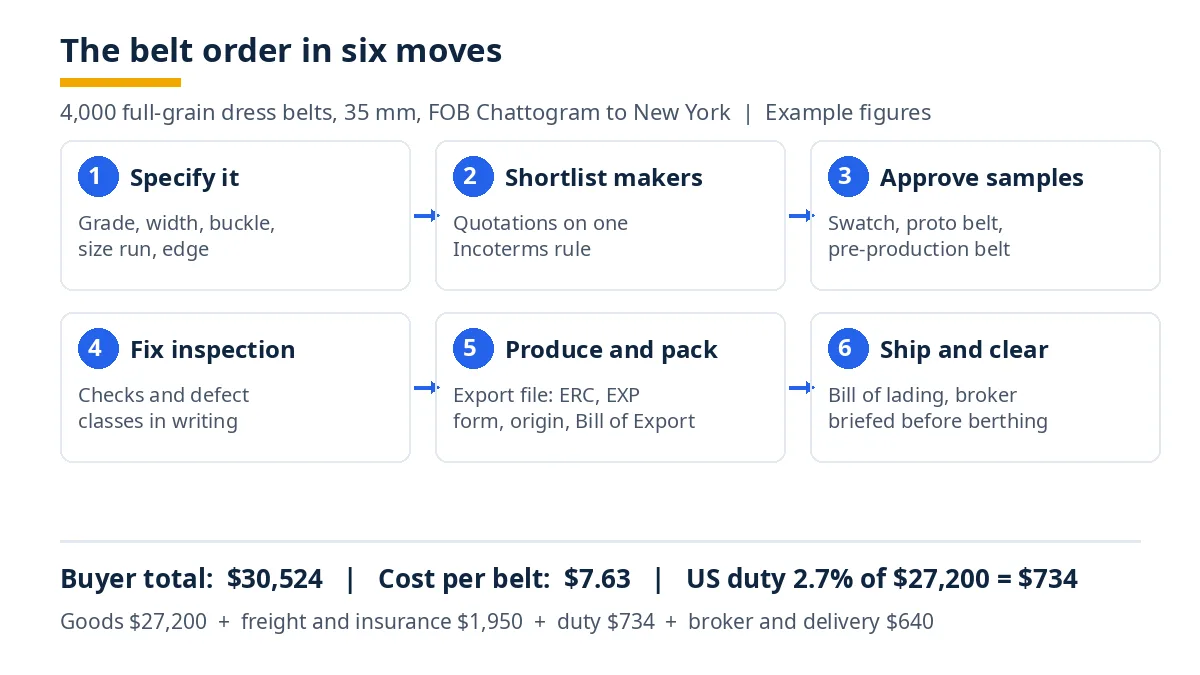
Write the belt on paper, in numbers: grade, tannage, strap thickness, width, buckle type and finish, sizes and size split, colours, holes, edge treatment, labels and packing.
Shortlist makers and weigh quotations on one delivery term. Incoterms 2020 gives eleven rules that divide delivery, cost and risk between seller and buyer.7 With FOB Chattogram you book the sea freight and insurance yourself; with CIF the seller pays them to your port, but the risk passes to you once the belts are loaded; with DAP the seller carries the belts to the place you name, and import clearance and duty stay with you. See our Incoterms guide.
Approve the sample in rounds: a cutting of the production leather in the production colour, with the chrome VI report; a proto belt to settle the width, buckle, holes and edge; then a pre-production belt in the bulk leather and bulk hardware, measured fold to hole and flexed at the edge. Keep one sealed pre-production belt as the bulk reference.
Put the inspection plan in the order before production starts, naming the checks and the defect classes. Measure strap length fold to hole, check width and thickness, pull-test the buckle, flex the edge, and check hole alignment. A chrome VI failure is critical; a buckle that pulls out is major; a loose thread end is minor.
Make the belts, pack them and complete the export file. Compare the leather lots on arrival with the retained cutting and the finished belts before packing. The exporter holds an Export Registration Certificate, and the export file runs on the commercial invoice, the packing list, the EXP form certified by an authorised dealer bank, the certificate of origin and the Bill of Export.8
Book the sailing, arrange insurance and follow the vessel. With FOB you arrange the freight and insurance yourself; with CIF, read the insurance certificate before the vessel sails. The bill of lading is the carrier's receipt for the goods.8
Worked example: 4,000 full-grain dress belts to a US retailer
Example figures. A US retailer orders 4,000 full-grain leather dress belts, 35 mm wide with single-prong buckles, in black and dark brown, FOB Chattogram to New York. Duty is charged on the goods value at 2.7 percent.4
Cost element | USD |
|---|---|
Product price, FOB Chattogram, 4,000 at $6.80 | 27,200 |
Freight and insurance to New York | 1,950 |
US duty at 2.7% of the $27,200 goods value | 734 |
Broker, port handling and delivery | 640 |
Total cash outlay | 30,524 |
Cost per belt | 7.63 |
Check it: 4,000 at $6.80 is $27,200; 2.7 percent of $27,200 is $734.40, rounded to $734; the lines add to $30,524.
Belt inspection points
Inspect the belt as a worn object, not as a flat strap. Lay each sampled belt flat and measure from the buckle fold to the middle hole, then check the remaining holes for even spacing and clean punching. Measure the width at three points along the strap; a strap that narrows toward the tip has been cut off square. Flex the edge and the buckle fold: the edge finish should not crack, and the fold should not split where the leather wraps the buckle bar. Pull the buckle by hand, check the prong moves freely, the keeper loop sits tight and the tip is cut clean, and compare the colour across cartons against the sealed sample, since black and dark brown drift between dye lots.
Six mistakes that cost belt importers money
Ordering the waist size as the belt size. A 34-inch waist takes a 36-inch belt.2
Paying a full-grain price for a split strap. Name the cut of the hide in writing and check the swatch.3
Fixing the width without checking the loops. A 1.5-inch strap will not feed through a narrow dress-trouser loop.2
Accepting a chrome VI report from another article. The limit for skin-contact leather is 3 mg/kg, tested by EN ISO 17075.6
Filing the entry under the wrong heading. Belts sit under 4203.30, not under the 4202 lines for bags and wallets.4
Paying the balance before the inspection report is read. Hold the final payment until the inspection report arrives.
Questions buyers ask about leather belts
What duty do leather belts from Bangladesh pay in the United States?
Leather belts fall under HTS subheading 4203.30.00 at 2.7 percent ad valorem on the customs value.4
How do I size a belt order for a retailer?
Add two inches to the trouser waist size and order even sizes, so a 34-inch waist takes a 36-inch belt, and measure from the buckle fold to the middle hole.2
What width should a dress belt be?
A dress belt runs 1.25 to 1.38 inches wide, while a casual belt for jeans runs 1.5 inches; width follows the occasion and the belt loops, not the waist.3
Next steps on Exportain
Start with the code in our HS code guide for leather belts, then read our importing guide and our leather belts manufacturers guide. Once the specification is set, post an RFQ with the size run, width, buckle type and tariff code, and search Bangladeshi suppliers for full-grain strap makers.
Sources
- Leather sector spots 'hope' despite old troubles. bdnews24, (accessed )
- Belt Sizing Guide: How to Measure, Pants Size Chart & Width vs. Loops. YourTack, (accessed )
- 25 Types of Belts with Names & Pictures. Beltley (accessed )
- Harmonized Tariff Schedule of the United States (2026), Chapter 42. United States International Trade Commission (accessed )
- Customs tariff number 42033000 – Belts and bandoliers, of leather or composition leather. tariffnumber.com (accessed )
- Commission Regulation (EU) No 301/2014 amending Annex XVII to Regulation (EC) No 1907/2006 as regards chromium VI compounds. EUR-Lex, (accessed )
- Incoterms® 2020. International Chamber of Commerce (ICC) (accessed )
- Procedures to be an Exporter. Bangladesh Trade Portal (accessed )
About the author
Sourcing from Bangladesh?
Post a request for quotation and suppliers on Exportain can send you their quotes directly.
Post an RFQ