Top Leather Belts Manufacturers in Bangladesh: How to Find and Verify Them
Seven belt-making routes in Bangladesh, sorted by strap construction and end use: match a route to dress, casual, work, and private-label belts, count the minimum, read supplier badges, and approve a sample before ordering.
Short answer
Leather belt suppliers in Bangladesh fall into seven routes, from tannery-integrated strap makers to trading consolidators. Start from the belt: fix strap construction, buckle, hole spacing, and sizes in a tech pack, then match each route to the belt type it controls. Count the minimum per style, per color, and per buckle finish, read each badge for the checks it records, and approve a sample in your own leather before bulk production.
On this page
Key takeaways
Judge a belt by its strap, hole run, buckle attachment, and edge finish: a hole out of line or a prong that will not seat fails the belt at the waist, whatever the leather looks like.
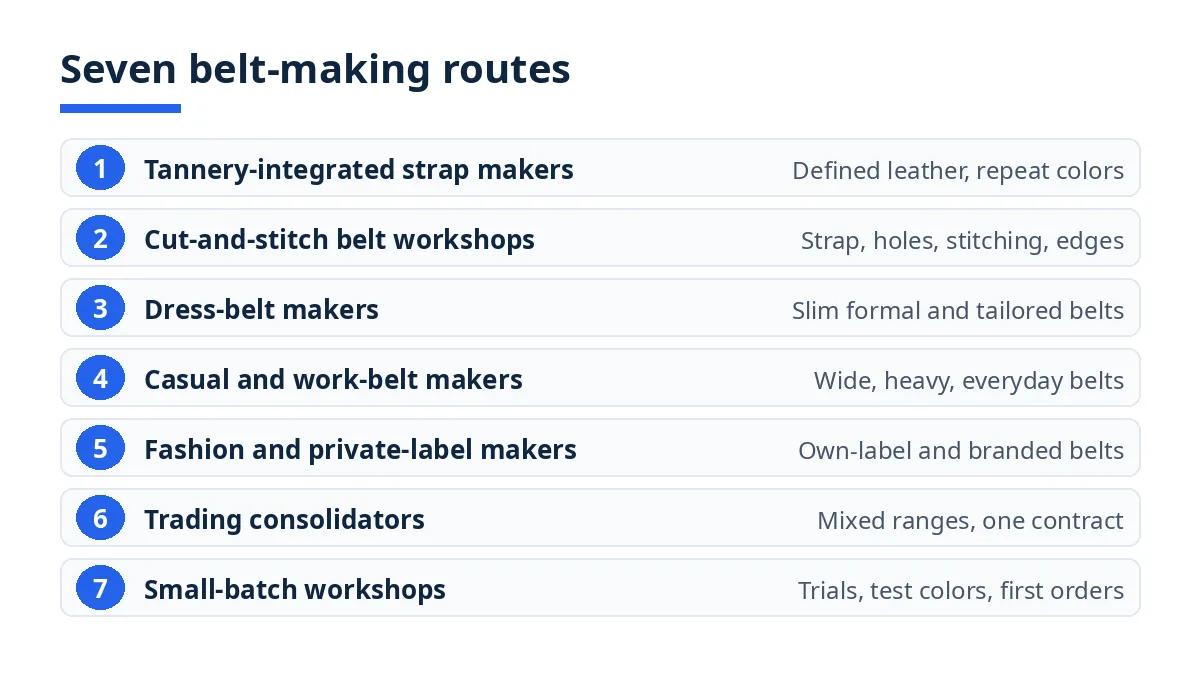
Seven routes cover belt making in Bangladesh, from tannery-integrated strap makers to trading consolidators; one company can sit in more than one route, so judge each order by the route that controls it.
Count every minimum per belt style, per color, and per buckle finish, and compare quotations only on one identical specification, leather, buckle, and packing included.
A badge records a document and photo review by Exportain staff, not a factory inspection or a guarantee; samples, inspection, and payment terms stay the buyer's own checks.
A belt is worn under tension every day, and it fails at the waist, not on the hanger. A hole out of line, a prong that will not sit, or a keeper loop that slides turns a finished belt into a return, even when the leather looks sound. That is the test for leather belts manufacturers in Bangladesh: strap, hole run, buckle attachment, and edge, judged belt by belt.
This article names no companies and ranks no supplier. It sorts belt making into seven routes by construction and end use: match the route to the belt, count the minimum on the right basis, read each badge for the checks it records, and approve a sample in your own leather first. Every calculation figure is an example figure, and no factory name, capacity, price, or certificate is stated as a fact here.
Start from the belt itself, before you shortlist anyone
A belt has five parts that decide whether it works: the strap, the edge finish, the buckle and its attachment, the keeper loop, and the tip. The quality control checklist for leather belts works along the strap in the order a wearer notices each fault, starting with length, hole spacing, and hole count, then buckle fit, keeper travel, and tip shape.1 Settle those parts in a tech pack first: leather type and grain, strap construction, buckle and keeper specifications, hole count and spacing, tip shape, edge finish, stitching, and lining or backing where fitted.1
Measure every belt the same way: laid flat, uncoiled, and relaxed, from buckle to tip and from buckle to each hole.1 Agree the shade standard, the light source, and the defect classes before production. Grain and shade must hold along the full strap, and defects are graded by position and size, because a mark minor on a wide panel can cross the full width of a strap.1
Finding leather belts manufacturers in Bangladesh: seven routes by belt control
The seven routes below cover how leather belts are made and sold from Bangladesh, and one company can sit in more than one route. Send every supplier the same tech pack. A gap with no named fix and no date is a reason to hold the order.
1. Tannery-integrated strap makers
What. Groups that tan or finish leather and cut straps within the same group, so the leather route is short and the group can usually name the tannery behind a sample.
Why. A program that reorders the same color needs the same leather again, not a close match.
How to fix a gap. Ask which tannery made the sample leather, and what evidence names that tannery and leather, with scope and expiry. If it names a different tannery or leather, treat it as background only.
2. Cut-and-stitch belt workshops
What. Workshops that buy finished leather and concentrate on belt making: cutting, skiving, stitching, edge finishing, lining, and buckle fitting.
Why. Most belt orders are decided at the strap, and a workshop running the same construction daily shows its quality in hole spacing, stitch density, and edge finish.
How to fix a gap. Ask which leather suppliers the workshop buys from, whether your leather is in stock, and which stages run in the named facility. Inspect a sample in your leather for shade, stitching, edge finish, and buckle seating at the first, middle, and last holes.1
3. Dress-belt makers
What. Makers set up for slim, refined belts for formal and tailored wear: narrow straps, clean edges, restrained buckles, and a precise hole run. The tip must pass through the keeper and lie flat.1
Why. A dress belt is judged up close, at the buckle and the tip, where hole drift, a curling tip, or cracking edge paint read as faults.1
How to fix a gap. Test the sample as worn: fasten and release at the first, middle, and last holes, and check the edge finish along the full length and the shade from buckle end to tip under the agreed light.1
4. Casual and work-belt makers
What. Makers set up for wider, heavier straps for casual, outdoor, and work wear: thicker straps, sturdy buckles, riveted or reinforced attachments, and keepers built to hold under tension. Width and thickness must stay consistent along the strap.1
Why. The faults that matter are the buckle attachment, the keeper hold, and the hole run under tension.
How to fix a gap. Agree the buckle attachment in writing, test buckle operation through the full hole run, and check hole edge distance and strap width at the buckle end, middle, and tip.1
5. Fashion and private-label belt makers
What. Suppliers set up to make belts under the buyer's label. Original equipment manufacturers produce to your tech pack. Original design manufacturers offer their own patterns and styles for you to label.
Why. A private-label belt carries your name on the strap, the label, and the carton. A label error becomes your problem at the shelf.
How to fix a gap. Judge the counter-sample against a complete tech pack, agree pattern ownership in writing for original design work, and approve every label proof word for word, checking labels and logo position at inspection.1
6. Trading consolidators
What. Export-licensed companies that sell belts made in partner factories rather than on their own stitching lines. They combine styles, colors, and buckle finishes into one order and handle export documentation.
Why. A consolidator can fill a range no single workshop covers, but the belt is made by the partner factory, so the tannery route must be known for each style.
How to fix a gap. Ask which factory will make each style, and get it named in the order terms before you pay a deposit, with the tannery route beside it. A badge records checks for the profile holder only, not an inspection of a partner factory.2
7. Small-batch and sample-first workshops
What. Smaller workshops and sample rooms set up for short runs, trial orders, and style development, including test colors and new buckle finishes.
Why. A small run proves the strap, the hole run, and the buckle before you commit to volume. Freight and clearance do not shrink because the order is small.
How to fix a gap. Check capacity with dates attached: what is in production now, when your run would start, and what happens if inputs arrive late. State in the order that bulk production starts only after written approval of a pre-production sample in your leather, color, and buckle.
Summary table
Route | Belt types it suits best | Main check before ordering |
|---|---|---|
Tannery-integrated strap maker | Defined leather, repeat colors | Tannery named; evidence names your leather |
Cut-and-stitch workshop | Most dress and casual straps | Sample in your leather; holes, stitching, edges |
Dress-belt maker | Slim formal and tailored belts | Wear test; tip, edge, hole run at narrow width |
Casual and work-belt maker | Wide, heavy, everyday belts | Buckle attachment; keeper hold; hole edge distance |
Fashion and private-label maker | Own-label and branded belts | Tech pack match; label proofs; pattern ownership |
Trading consolidator | Mixed ranges, one contract | Producing factory named per style |
Small-batch workshop | Trials, test colors, first orders | Dated capacity; same sample and inspection discipline |
Count the minimum per belt, per color, and per buckle finish
A minimum order quantity is the smallest quantity a supplier will accept for a product on its normal terms, counted per order, per style or product, or per color, sometimes combined with a minimum order value.3 On a belt order, ask for the counting basis in writing: the same number means very different commitments when counted per color or per buckle finish. A quotation that omits leather type, thickness, finish, and buckle cannot be compared with another.
Example figures: a minimum of 500 pieces counted per color, across three colors in two buckle finishes each, means a smallest order of 3,000 pieces, not 500. Three drivers set the minimum: the leather, the trims, and the variety. Custom leather brings the mill's minimum into the workshop's minimum, labels and buckles each carry minimums of their own, and every extra color or finish adds changeovers.3 State the numbers the supplier uses in the request for quotation: quantity per style, per color, and per size run, leather and finish, custom trims, Incoterm and destination, and whether the order is a trial.3 Each quotation states unit price, minimum, lead time, Incoterm, payment terms, and validity, so compare quotations on those fields, on one identical specification.3
Read the badge for what it records, then run your own belt checks
A Bangladeshi supplier on Exportain can hold up to five trust badges, each naming the checks behind it in a single sentence.2 Exportain Verified records checks of identity, phone, email, and business registration; Export Verified records a check of the Export Registration Certificate; Factory Verified records reviewed photos of the manufacturer's factory; Trading Company Verified records reviewed photos of the trading company's office or warehouse; and Trusted Trader records completed orders on Exportain with no disputes.2 Verification is a review of documents and photos by Exportain staff. It is not a factory visit and not a check against a government database, and a badge is not a guarantee of capacity, quality, or delivery.2 Verification is free, and membership never grants a badge.2
Read the profile's trust and verification checklist too. It lists each check as verified or not verified, with the dates verified and valid until, including a payment account line: when verified, the supplier's business bank account was checked against its verified company name, and no bank details are shown to buyers.2 Product certifications marked Verified by Exportain have been reviewed by staff and appear only while approved and not past expiry, while anything a supplier typed in is marked as declared by the seller and has not been verified by Exportain.2 Confirm any certificate that matters with the issuing body as well.2
Your own checks still decide the order. Ask for the documents yourself and check the company name and address across the trade license, the Export Registration Certificate, the quotation, and the invoice. Approve a pre-production sample in your leather, color, buckle, and edge finish, and agree the inspection plan in writing, using the belt checklist as the product layer the inspector checks against.1 As a published standard-table example only, the belt checklist gives a lot of 10,001 to 35,000 belts at General Inspection Level II with code letter M and a sample size of 315, with acceptance and rejection numbers of 14 and 15 for major defects at AQL 2.5 and 21 and 22 for minor defects at AQL 4.0; those are buyer-agreed values, not standard mandates for belts.1 Where you specify lab testing, name the method and record the result, including ISO 17075 for colorfastness to rubbing.1 Confirm the classification with your broker for each belt style before you price, put the payment terms in writing, confirm bank details through a second channel, and treat any late change as a reason to pause. Exportain is not a party to your trade, does not inspect goods, book freight, or clear customs, and holds money only when both parties agree to a funds hold.2
How Exportain helps
Browse suppliers on Exportain, filter by badge, sample availability, and OEM or ODM capability, and read each badge for the checks it records: the five badge names each cover one set of document and photo reviews, and none is a factory inspection or a guarantee.2 Send every supplier the same tech pack and compare versioned quotations on the same fields. Exportain does not inspect goods, book freight, or clear customs, so keep your broker and inspection provider central.2 Post a free RFQ with your tech pack, quantities, destination, and delivery term.
How do I choose between a tannery-integrated maker and a cut-and-stitch workshop for leather belts?
Choose the tannery-integrated maker when one defined leather and one repeat color decide the program. Choose the cut-and-stitch workshop when strap construction, hole spacing, stitching, and edge finish decide the belt. Either way, judge the sample in your leather, with the tannery or leather supplier named, before you judge the price.
What must a belt tech pack fix before I ask for prices?
A belt tech pack must fix leather type and grain, strap construction, buckle and keeper specifications, hole count and spacing, tip shape, edge finish, stitching, and lining or backing where fitted, measured flat, uncoiled, and relaxed.1 Add the shade standard, light source, defect classes, and packing requirements, and send the identical tech pack to every supplier.
How is the minimum order counted on a leather belt order?
The minimum is counted per order, per style, or per color, sometimes combined with a minimum order value, so ask for the counting basis in writing before you plan your color and buckle mix.3 Example figures: 500 pieces per color, across three colors in two buckle finishes, means a smallest order of 3,000 pieces. Stock leather, fewer colors, standard trims, or a surcharge can change the minimum, each with a trade-off in unit price.3
What does a badge prove about a leather belt supplier, and what checks stay mine?
A badge proves only the checks its name records: Exportain Verified for identity, phone, email, and business registration, Export Verified for the Export Registration Certificate, Factory Verified or Trading Company Verified for reviewed facility photos, and Trusted Trader for completed orders with no disputes.2 It is not a factory inspection, a database check, or a guarantee. The checks that stay yours are the documents, the sample in your leather, the inspection plan, and the payment terms, agreed in writing before you pay.
Next steps on Exportain
Browse Bangladeshi suppliers and filter by badge, sample availability, and OEM or ODM capability. Read how supplier verification works on Exportain and the MOQ guide before you order. Then post a free RFQ with your tech pack, quantities, destination, and delivery term, and compare the versioned quotations on the same fields.
Sources
- Quality Control Checklist for Leather Belts. Exportain, (accessed )
- How Supplier Verification Works on Exportain. Exportain, (accessed )
- MOQ Meaning (Minimum Order Quantity). Exportain (accessed )
About the author
Sourcing from Bangladesh?
Post a request for quotation and suppliers on Exportain can send you their quotes directly.
Post an RFQ