Quality Control Checklist for Leather Belts From Bangladesh
Leather belts quality control checklist for Bangladesh orders: hole spacing and buckle function, strap measurements, grain and shade along the strap, stitching and edges, lab evidence, and coiling packing, with a numbered checklist, failure fixes, and a summary table.
Short answer
This leather belts quality control checklist covers buckle-to-tip and buckle-to-hole lengths, hole spacing and alignment, strap width and thickness, buckle and keeper function, tip shape, grain and shade along the full strap, stitching on both edges, edge finishing, labels, lab evidence by named method, coiling packing that prevents creasing, and the sampling decision. Use it before production, during production, and at final inspection on finished, packed belts.
On this page
A belt fails at the waist, not on the hanger. A hole punched out of line, a buckle prong that will not sit, or a keeper loop that slides turns a finished belt into a return, even when the leather looks sound. A belt is one long strap worn under tension daily, so small errors along its length matter. This checklist works along the strap, in the order a wearer would notice each fault.
Why this checklist matters
A belt must fasten at the right length, stay fastened, and keep its shape through daily wear. An importer guide names accurate hole spacing as the functional test for belts, alongside strap length among the dimensions to measure.1 The same guide requires buckle hardware that operates smoothly, is firmly attached, has a consistent finish, and shows no rust or scratches.1 A leather goods inspection account lists defective buckles or hardware among functional failures, and incorrect dimensions and inconsistent grain among specification failures.2
Leather adds a second difficulty. Genuine leather comes from animal hides, so natural marks such as scars, insect holes, blood veins, and growth wrinkles are inherent, and the inspection goal is grading rather than zero defects.3 Grading turns on position and size: damage in a corner area may mean only a grade drop, while damage in the main material area may scrap the whole hide.3 On a belt, a mark minor on a wide panel can cross the full strap width.
Before you start
Approved sample, size run, and tech pack. The sealed, approved belt and tech pack: leather type and grain, strap construction, buckle and keeper specifications, hole count and spacing, tip shape, edge finish, stitching, lining or backing where fitted, and the size run.
Measurement method for a long strap. How length is measured (buckle to tip, and buckle to each hole), how the strap is laid out, and whether it is measured flat, uncoiled, and relaxed. Use the same condition for every belt.
Hole and buckle references. The hole template or gauge for spacing and edge distance, and the approved buckle for comparison.
Defect list with classes. Which faults count as critical, major, or minor, with photos for borderline cases, plus a rule for natural marks by position and size.3
Sampling plan. The standard, inspection level, and AQL values per defect class, plus the action on a fail. AQL figures here are buyer-specified values only.
Light, function, and test details. The light source for colour, how each buckle, keeper, and hole is operated, and each lab method, including ISO 17075 for colourfastness to rubbing.2
The full checklist (numbered, printable)
Work through the list in order, marking each item pass, fail, or not applicable, and photograph every fail.
Total length, buckle to tip. Against the size chart and buyer-specified tolerance, measured flat and relaxed.1
Length to each hole. Buckle to every hole in turn, against the tech pack, so stated wearing sizes fall as expected.
Hole spacing consistency. Even spacing across the full hole run, matching the approved sample.1
Hole count. Hole number matches the tech pack, with no extra or missing hole.
Hole shape and cutting. Clean holes in the specified shape, with no tearing, ragged edge, or oversized punch.
Hole alignment along the strap centre. Holes centred on strap width, in a straight line, not drifting toward either edge.
Hole edge distance. Enough leather between each hole and the strap edge, as specified, so holes do not tear out in use.
Strap width consistency. Width at the buckle end, middle, and tip, against the buyer-specified tolerance, with no unspecified taper.
Strap thickness consistency. Even thickness along the strap, including at folds and joins, so the belt sits flat.
Buckle frame and prong fit. Frame matches the approved sample in shape, size, and finish, and the prong seats fully in each hole.2
Buckle operation through the full hole run. Fasten and release at the first, middle, and last holes: smooth action, no sticking or prong slip.
Buckle attachment and bar. Firmly attached at the buckle end, with bar, loop, or rivets as specified.1
Buckle finish, burrs, and sharp edges. Consistent finish, no rust, scratches, or burrs.2
Keeper loop position and travel. Keeper sits where specified, slides as designed, and stays in place when fastened.
Keeper loop fit. Loop width and tightness suit the strap: snug enough to hold the tip, loose enough to move.
Tip shape and length. Tip cut and shaped as specified, with a clean end and stated length beyond the last hole.
Tip behaviour when worn. Tip passes through the keeper and lies flat, without curling, lifting, or twisting.
Leather type and grain. Against the tech pack and sample: full-grain, top-grain, suede, nubuck, or the type specified.1
Grain and shade along the full strap length. Consistent grain and shade from buckle end to tip, and between belts, under the agreed light.3
Surface defects, graded by position and size. Scars, insect holes, blood veins, loose grain, cracking, wrinkles, holes, and dents, judged by position and size.3
Stitching along both edges. Straight lines and even density on each edge, against the approved sample, for the full length.1
Stitching at buckle end, keeper, and tip. Reinforced where specified, at the buckle fold, keeper, and tip.1
Loose threads, skipped stitches, and open seams. None, on either edge or any join, including the strap reverse.2
Edge finishing along a long strap. Smooth, evenly painted or burnished, and uniform in colour on both edges.1
Edge cracks, peeling, and rough edges. None, especially at the tip, buckle fold, and hole run, where flexing is greatest.
Lining or backing, where fitted. Matching the tech pack, flat against the strap, with no lifting, bubbling, or glue marks.2
Labels, branding, and logo position. Main, care, and size labels where specified, and logo or branding: correct content, spelling, and position.2
Lab evidence, by named method and recorded result. For buyer-specified lab tests, the report names the method and records the result against the buyer specification, with no universal grade or pass mark stated here, including colourfastness to rubbing under ISO 17075 where specified2, abrasion testing by the named method, and buckle function as a buyer-specification item.
Coiling and rolling packing that prevents creasing. Coil diameter, sleeve or tissue, polybag, and carton as specified, packed so the strap does not crease, kink, or take a buckle mark.1
Sampling decision on the finished, packed lot. Apply the agreed plan to the finished, packed lot. As a published standard-table example only, a lot of 10,001 to 35,000 belts at General Inspection Level II gives code letter M and a sample size of 315, with acceptance and rejection numbers of 14 and 15 for major defects at AQL 2.5 and 21 and 22 for minor defects at AQL 4.0.4 Those numbers are buyer-agreed values, not standard mandates for belts.
Common failures and how to fix them
Hole spacing drifts across the run. Punching or template fault: check the template against the sample, re-measure buckle to each hole, and hold earlier belts.
Buckle prong will not seat. Frame, prong, or hole fault: check prong shape against the approved buckle, hole size, and strap thickness, then re-test at every hole.
Keeper loop slides out of place. Loop size or position fault: check loop width, tightness, and placement, and test with the tip passed through.
Tip curls or lifts. Tip cut or edge fault: check tip shape, edge finish, and thickness at the tip, and test it through the keeper.
Edge paint cracks along the strap. Preparation or coating fault on a long flexing edge: check paint layers along the full length, not only at the tip.
Shade bands along one strap. Selection or dyeing fault: check grain and shade from buckle end to tip under the agreed light, and hold unmatched straps.
Stitching wanders on one edge. Machine or guiding fault: check both edges separately for the full length, including the buckle fold and tip.
Crease from a tight coil. Packing fault: check coil diameter and interleaving, and re-pack affected belts at the specified coil size.
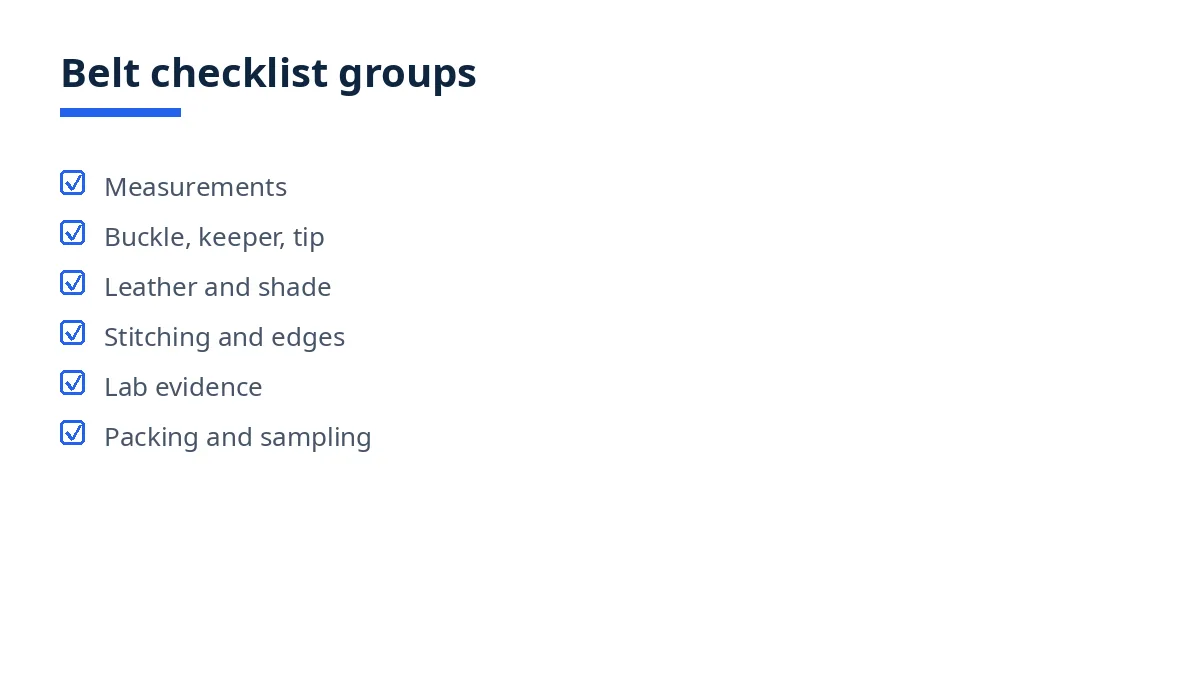
Downloadable template / summary table
No file download is offered with this article. Use the table below as the printable summary, adding one row per sampled belt.
Check group | What to check | Record |
|---|---|---|
Measurements | Buckle-to-tip and buckle-to-hole lengths, hole spacing, width | Against chart |
Buckle, keeper, and tip | Frame, prong, attachment, keeper, tip | Function result |
Leather and shade | Type, grain, defects, shade along strap | Mark position |
Stitching and edges | Both edges, joins, edge finish | Photographed |
Labels and lab evidence | Labels, branding, lab methods | Method and result |
Packing and sampling | Coiling, carton, lot, sample | Counts and decision |
How Exportain helps
Exportain connects buyers with Bangladeshi sellers and service providers; it does not itself inspect goods. The inspection contract is always between buyer and provider, and the provider works to the buyer's checklist and pass criteria. For the inspection step, see the inspection services category on Exportain, with the exact caveat that applies there: No services published in this category yet. Use this checklist as the product-specific layer the provider checks against.
FAQs
When should this checklist be used?
Before production, when leather, buckle, hole spacing, and tip shape are approved; during production, when early belts show whether faults repeat; and at final inspection, on finished, packed belts.
Who should complete it?
The buyer, the buyer's inspection provider, or the supplier's quality team can each complete it, but roles must stay separate: a supplier checking its own work is factory quality control, not independent inspection.
What are the most common failures?
In leather goods inspection, the recurring failures are defective buckles or hardware, incorrect dimensions, inconsistent grain, colour variation, misaligned stitching, loose threads, glue marks, weak seams or poor edge finishing, and sharp edges or burrs.2 The accessories list adds uneven stitching, weak edge paint, and inconsistent dimensions.1
Can a third party do it?
Yes. A third-party provider can carry out the sample, during-production, and pre-shipment checks against this checklist and the buyer's sampling plan, and arrange lab testing where specified. Require a report recording lot, sample size, defects with photographs, measurements, packing, and hole and buckle function results.
Next steps on Exportain
Write the hole spacing, buckle specification, defect list, and sampling plan into one requirement, then read the AQL guide and the pre-shipment inspection guide before setting values for a belt order.
Sources
- Leather Accessories Quality Checklist for Importers. Walletsplus (accessed )
- Leather Goods Inspection and Quality Control in Asia & China. V-Trust (accessed )
- Genuine Leather Inspection | Grading and Defects. NITR (accessed )
- AQL Calculator | Sample Size and ISO 2859-1 Tool. AQMBD (accessed )
About the author
Sourcing from Bangladesh?
Post a request for quotation and suppliers on Exportain can send you their quotes directly.
Post an RFQ