Typical MOQ for Leather Belts in Bangladesh (and How to Negotiate It Down)
Belt MOQs in Bangladesh are counted per waist size, color and buckle finish, not per order total. This guide works the size curve, the strap and buckle minimums and six belt negotiation levers, with every number labelled as an example figure.
Short answer
There is no single typical MOQ for leather belts from Bangladesh. Each supplier counts the minimum per waist size, per color, and per buckle finish, through four counts: the size curve, the strap and leather lot, the buckle and hardware lot, and packing. State the size curve first, find the binding count, and negotiate by changing the split, standardizing the buckle, or paying tooling separately.
On this page
Key takeaways
There is no single typical MOQ for leather belts from Bangladesh, because each supplier counts the minimum per waist size, per color, and per buckle finish.
The size curve binds first: one failing waist size in one color can stop a run whose order total looks large enough.
Four counts set a belt minimum: the size curve, the strap and leather lot, the buckle and hardware lot, and the packing run.
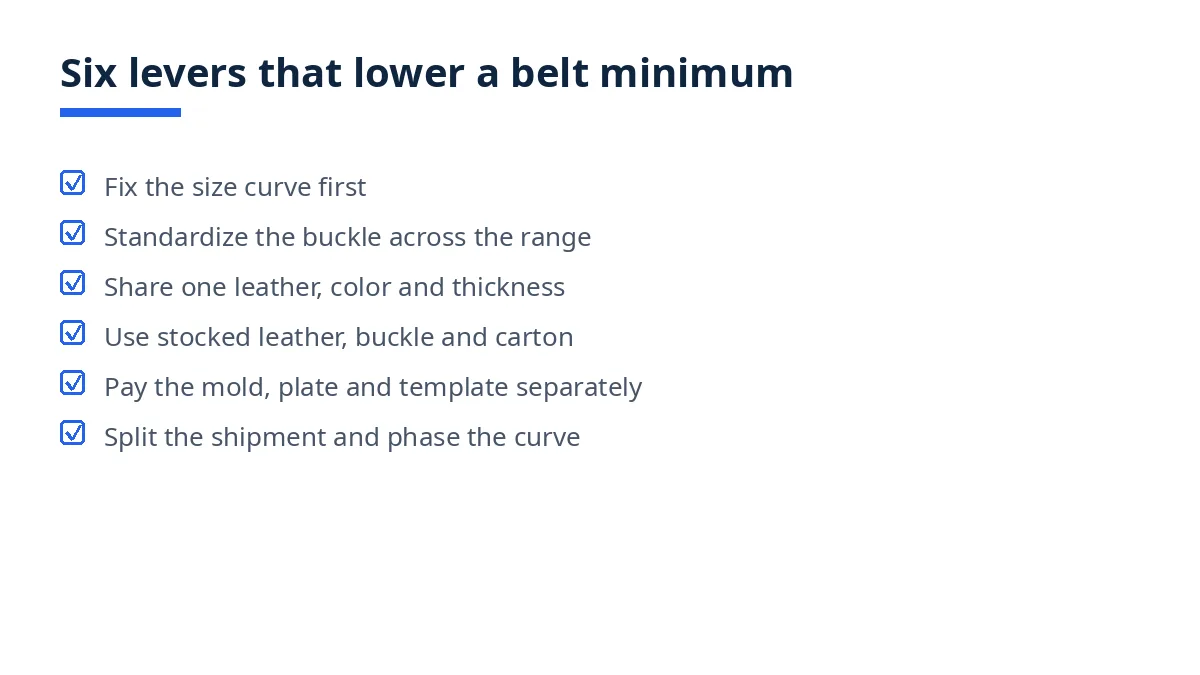
Negotiate in belt order: consolidate the size curve, standardize the buckle, share one leather lot, use stocked inputs, pay tooling separately, and phase the curve.
An agreed minimum is tied to a size curve, a lot, a tooling set, a price validity, and a production slot, and it stops applying when any of them changes.
A belt order fails at one waist size. The total looks large enough, the leather lot is covered, and the buckles are in stock, yet a single size in a single color falls short and the run cannot start. There is no single typical leather belts MOQ in Bangladesh that a buyer can plan around. Each supplier counts the minimum against a different split, and for belts the split is driven first by the size curve.
This guide is for buyers ordering leather belts from Bangladesh for resale in the USA, UK, EU, or UAE.
Why a belt minimum follows the waist, not the order total
A belt is a length product worn under tension. Each waist size needs its own strap length, its own hole run, and its own place on the size chart. A hole punched out of line, a buckle prong that will not seat, or a keeper loop that slides turns a finished belt into a return, even when the leather looks sound.1
A minimum order quantity is the smallest quantity a supplier will accept on its normal terms, counted per order, per style, or per color as the supplier states, and a supplier can combine a quantity minimum with a minimum order value.2 For belts, add two more counting bases: per waist size and per buckle finish. For the general meaning of MOQ, see the MOQ meaning guide.2
The four counts are:
Count | What multiplies it | Ask for it as |
|---|---|---|
Size curve | Waist sizes, hole run, length ladder | Minimum per size and color |
Strap and leather | Width, thickness, grade, leather and color lot | Minimum per leather, color, and width |
Buckle and hardware | Frame, prong, finish, tooling, embossing | Minimum per buckle finish and tooling cost |
Packing | Coil size, sleeve, size-marked carton | Minimum per packing type and size |
The size curve multiplies every belt order
A belt range is a ladder of waist sizes, and each rung is a separate production line: a strap length, a hole count and spacing, and a size label. Cutting the ladder in half does not halve the work. It halves the quantity on each rung.
Example figures: a buyer plans five waist sizes in three colors, at 60 belts per size and color. The order totals 900 belts and clears a 500-piece total minimum. Against a minimum of 100 belts per size and color, all 15 lines fail by 40. The same 900 belts in three waist sizes and two colors, at 150 per line, clear the same minimum on all six lines. Only the curve changed.
Drop the thinnest-selling waist sizes first, and keep the core sizes that carry the range.
Strap, leather and thickness: blanks, grades and lots
A belt strap is cut long, so leather yield and shade work differently than on a small panel. Natural marks such as scars, insect holes, blood veins, and growth wrinkles are inherent in genuine leather, and the inspection goal is grading by position and size rather than zero defects.1 Grain and shade must hold along the full strap length, from buckle end to tip, and between belts, under the agreed light.1
Leather is bought and finished in lots, and a color made to order carries the lot minimum with it. A running leather in a standard color the workshop already holds may carry a lower minimum. Thickness adds a further split: a thick dress strap and a thinner casual strap in the same leather and color are two cutting and edge runs. Ask whether the leather is stocked or finished to order and whether one lot can serve more than one width. State whether the quotation covers belt blanks or finished belts.
Tannery evidence rides with the leather lot, not with the workshop. The Leather Working Group (LWG) audit, first launched in 2005, assesses a tannery across 17 sections, with thresholds of 85 percent for Gold, 75 percent for Silver, 65 percent for Bronze, and 50 percent for Audited, and the final medal is set by the lowest-scoring section.3 Certification is valid for 24 months for leather manufacturing facilities, and certification does not guarantee that there will be no restricted substance failures in a final product.3 For Gold and Silver, chromium VI must be below 3 mg/kg, and any level above that results in automatic failure.3
Buckles carry a minimum of their own
Frames, prongs, bars, and keeper loops are bought in lots in one metal and one finish, and a brass finish and a gunmetal finish are two lots. The buckle must operate smoothly, be firmly attached, and show a consistent finish with no rust or scratches, and the prong must seat fully in each hole across the full hole run.1 A frame that fits one strap width and thickness does not fit another, so a width change can restart the buckle lot even when the leather lot stays the same. Ask for the buckle minimum per frame and per finish, apart from the strap minimum.
Tooling is separate from the lot. A new buckle frame may need a mold or casting setup, and an embossed logo needs a plate or die per logo, per position, and per strap width. Ask what each piece of tooling costs as a separate line that you pay once and reuse on a repeat order.
Work the belt split on paper before you ask for a price
Work your own split line by line before you accept a quotation. The table below uses example figures only, for the same 900-belt order seen from each counting base, against a 100-piece minimum per size and color and a 400-piece lot per buckle finish.
Split | Example figures | Against the stated minimum |
|---|---|---|
Total order | 900 belts | Passes a 500-piece total minimum |
Per size and color, 15 lines | 60 belts per line | Fails a 100-piece line minimum |
Per size and color, 6 lines | 150 belts per line | Passes a 100-piece line minimum |
Per buckle finish | 450 belts per finish | Passes a 400-piece finish lot |
Per size, color, and finish, 30 lines | 30 belts per line | Fails a 100-piece line minimum |
Shared leather and color lot | 900 belts, one lot | Passes an 800-piece lot minimum |
Sharing one leather and color lot clears the lot, but splitting the same order across two strap widths restarts the buckle fit, the edge finish, and the hole template for the second width. Counting per size, color, and finish together, the finest split, turns a passing order into 30 failing lines. Coiling and rolling packing must prevent creasing, packed so the strap does not crease, kink, or take a buckle mark, and a carton marked for one size does not serve another size.1 Ask for the packing minimum per carton type and per size, apart from the belt minimum.
Six levers that lower a belt minimum
Record each agreed change on a new quotation version. An MOQ can often be discussed, but a smaller order usually costs more per unit, and none of these options is guaranteed: each changes the supplier's costs, so raise them as questions and expect a trade-off.2
Consolidate the size curve before anything else. Dropping a waist size removes its strap run, hole template, size marking, and packing line at once.
Standardize the buckle across the range. One frame and one finish across all colors and widths removes the finish lots and the finish-matching checks.
Share one leather, color, and thickness across widths and styles. Two widths cut from the same lot can sometimes share the lot, if the supplier confirms it in writing. A thickness change breaks the share.
Use stocked leather, a running buckle, and a standard carton. Stocked inputs remove the made-to-order lots. Custom leather, a new finish, and a printed carton each add a lot back.
Pay the mold, the plate, and the template as separate lines. Ask for the buckle mold, the embossing plate, and the hole template apart from the unit price, with ownership recorded, so the tooling can serve the repeat order.
Split the shipment and phase the curve, with the repeat in writing. A first shipment of core sizes, with a written repeat price and MOQ for the extended sizes on the same leather, buckle, and lots, can succeed where a one-off small order covering every size fails.
Do not trade away inspection for a lower minimum. ISO 2859-1:2026 defines acceptance sampling plans indexed by AQL, the maximum average percentage of defective items considered acceptable during random sampling.4 See the quality control checklist for leather belts for belt-level checks along the strap.
What a lower minimum costs
All figures here are example figures. A supplier may state in a quotation that an order below the quoted quantity will carry an upcharge.2
Example figures: a buyer needs 480 belts in one size, color, and buckle finish against a 600-piece line minimum. A surcharge of 4 units per belt on 480 belts costs 1,920 units, with no extra stock. Ordering up to 600 belts at 15 units for the 120 extra belts costs 1,800 units and leaves 120 belts in stock.
Example figures: a supplier quotes an index price of 100 units per belt below 600 belts and 94 units per belt from 600 belts. An order of 480 belts at 100 units costs 48,000 units, while 600 belts at 94 units cost 56,400 units. Check the tier the same way: compare the total at each tier, not only the unit price.
When an agreed belt minimum stops holding
An agreed MOQ is tied to a size curve, a lot, a tooling set, a price validity, and a production slot. It stops applying when any of them changes: a leather lot sells out, a color lot is replaced, a buckle finish is discontinued, a mold wears or is lost, or a price validity expires. Agree the validity in writing at the first order. Classification under indicative subheading 4203.30, for belts and bandoliers of leather or of composition leather, is confirmed by the broker before pricing is fixed.5 See the HS code guide for leather belts.
Belt mistakes that cost a second run
Agreeing a total without a size curve. The binding minimum is usually per size, per color, or per buckle finish.
Adding a size, a width, or a finish late. A late size change restarts the strap cutting and the hole template. A late width change restarts the buckle fit and the edge run. A late finish change restarts the hardware lot.
Treating a tannery certificate as a belt certificate. An audit for a tannery covers the tannery and the leather it names, not the belt workshop or the finished belt, and LWG certification does not guarantee that there will be no restricted substance failures in a final product.3
Judging capacity from a listing or a badge. A listing and a badge do not test whether a supplier can cut long straps to a size curve, hold shade along a strap, and seat a buckle at every hole. Verification on Exportain is a review of documents and photos by Exportain staff, not a factory visit, and a badge is not a guarantee of production capacity, product quality, or delivery.6 Read each badge for the check behind it, using the supplier verification guide. Confirm any association claim with the association: LFMEAB has rebranded as the Footwear Leathergoods and Accessories Exporters Association (FLAXA), unveiled at its 22nd annual general meeting on 5 March 2026.7
Agree these eight lines before you pay
Size curve per waist size and color, with the quantity against each line.
Strap width, thickness, leather, and color per line, with stocked or finished-to-order status in writing.
Buckle frame, prong, finish, and keeper per width, with the finish lot named.
Mold, embossing plate, and hole template costs itemized, with tooling ownership recorded.
Hole count, spacing, and size marking per waist size, against the approved sample and tech pack.1
Pre-production sample approved in writing per size and finish, with a sealed counter-sample kept.
Inspection level and AQL values in the purchase order, with defect classes named.4
Price tier basis and validity dates confirmed, with repeat-order terms, and classification as indicative 4203.30 to be confirmed by the broker.5
What should I know first about leather belt MOQs?
Know the order as four counts, not one number. The size curve, the strap and leather lot, the buckle and hardware lot, and the packing run each set a minimum per waist size, per color, per width, or per buckle finish, and the first one that fails decides the order. State the size curve first, ask for each minimum in writing, and test every line before you discuss price.
What are the typical costs and timelines for a small belt order?
There are no typical costs or timelines a guide can state as fact, because each supplier prices your size curve, leather, thickness, buckle finish, split, and delivery term. A smaller order usually costs more per piece, through a surcharge or a setup charged apart from the unit price, and timelines follow the lots, the tooling, and the sample approval in that order. A smaller order can also carry an upcharge stated in the quotation for an order below the quoted quantity.2
Which documents lock in an agreed belt MOQ?
The order documents are the specification with the size curve, strap width and thickness, leather, color, buckle frame and finish, hole run, and packing, the accepted quotation version stating the minimum per size, color, and finish, and the purchase order carrying the same split, the inspection standard, and the validity dates. Classification under indicative subheading 4203.30, for belts and bandoliers of leather or of composition leather, is confirmed by the broker before filing.5
What are the most common mistakes with leather belt MOQs?
The most common mistakes are agreeing a total without a size curve, asking for the lowest minimum and the lowest tier price together, accepting a lower minimum verbally, adding a size, width, or finish late, reading a tannery certificate as a belt certificate, judging capacity from a listing alone, and paying a deposit before the split, the curve, and the finish are written.
Next steps on Exportain
Browse suppliers, then read the leather belts manufacturers guide. When the size curve, widths, colors, and buckle finish are fixed, post a free RFQ on Exportain with the split per waist size, color, and finish, and compare quotes on the same specification, delivery term, and packing.
Sources
- Quality Control Checklist for Leather Belts. Exportain, (accessed )
- MOQ Meaning (Minimum Order Quantity). Exportain (accessed )
- Certification - Leather Working Group. Leather Working Group (accessed )
- ISO 2859-1:2026 - Sampling procedures for inspection by attributes — Part 1: Sampling schemes indexed by acceptance quality limit (AQL) for lot-by-lot inspection. ISO (accessed )
- Classification Detail: HS, 2017, Code 4203. United Nations Statistics Division (accessed )
- How Supplier Verification Works on Exportain. Exportain, (accessed )
- LFMEAB has rebranded as FLAXA. Footwear Leathergoods and Accessories Exporters Association (FLAXA) (accessed )
About the author
Sourcing from Bangladesh?
Post a request for quotation and suppliers on Exportain can send you their quotes directly.
Post an RFQ