

Top Hotel Linen Manufacturers in Bangladesh: How to Find and Verify Them
Eight verification criteria for finding hotel linen manufacturers in Bangladesh, from programme fit and in-house stages to laundry evidence, certificate scope and inspection terms, with no named ranking.
Short answer
Hotel linen manufacturers in Bangladesh should be chosen by eight verification criteria, not by ranking: hotel programme fit, in-house production stages, laundry durability evidence, hotel references, staged sample approval, certificate scope checks, a written inspection agreement, and comparable commercial terms quoted on one specification.
On this page
Key takeaways
Judge a supplier against your full hotel programme, bed, bath and table linen together, not against one sample item.
In-house control, laundry evidence and hotel references tell you more than a catalogue or a low quote.
Check every certificate by number, site, scope and expiry in the issuing scheme register before you rely on it.
Agree the inspection standard, the sample rule and the payment terms in writing before production starts.
Exportain badges record document and photo checks reviewed by the Exportain team; they are not factory inspections or quality guarantees.
Buyers looking for hotel linen manufacturers in Bangladesh face a wide field, not a short ranking. Home textiles were USD 871.57 million on the Export Promotion Bureau (EPB) shipment series in 2024-25, a category large enough to support established export departments and repeat programmes.1 A hotel programme is also a mixed order: bed linen, bath linen and table linen, each in its own sizes, fibres and constructions.2
This article gives you that test. It lists eight criteria for finding and checking a hotel linen supplier in Bangladesh. Each criterion states what to look for, why it matters for a hotel programme, and how to check it before you pay.
Key points to take away
Judge a supplier against your full hotel programme, bed, bath and table linen together, not against one sample item.
In-house control, laundry evidence and hotel references tell you more than a catalogue or a low quote.
Check every certificate by number, site, scope and expiry in the issuing scheme register before you rely on it.
Agree the inspection standard, the sample rule and the payment terms in writing before production starts.
Exportain badges record document and photo checks reviewed by the Exportain team; they are not factory inspections or quality guarantees.3
The list: eight criteria for hotel linen suppliers in Bangladesh
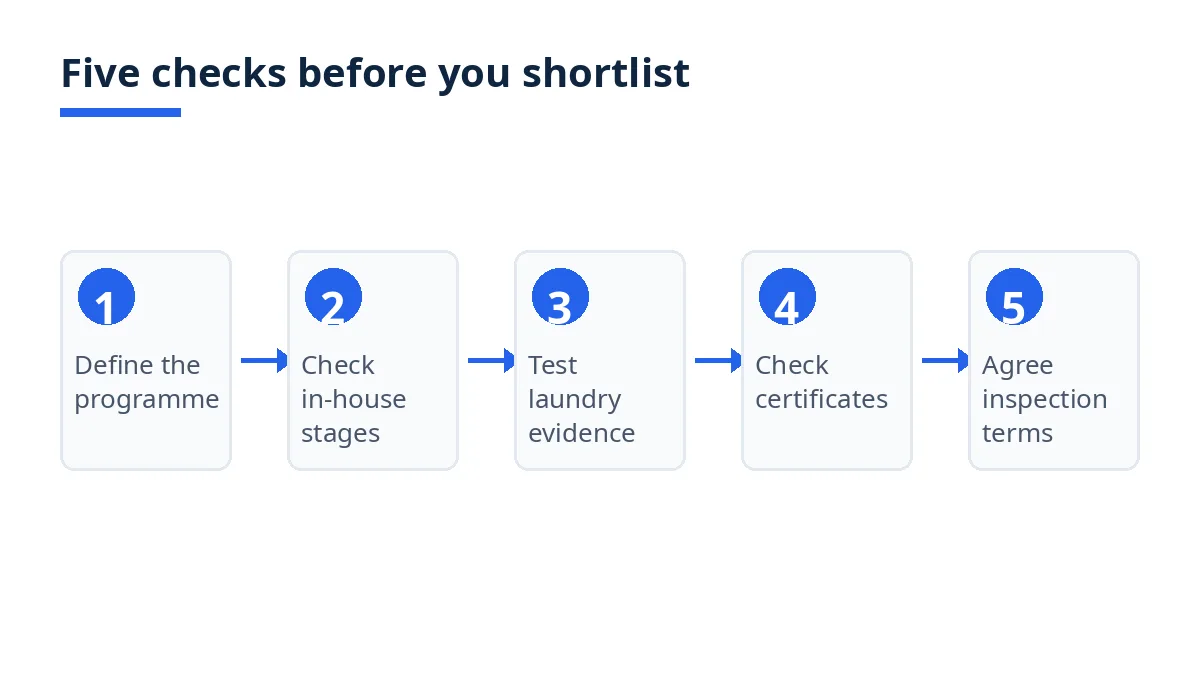
Work through the eight criteria in order. The first three test whether the supplier can make your programme at all. The next three test whether the quality claims hold up. The last two test whether the commercial terms protect you when something goes wrong.
1. Hotel programme fit: does the supplier already make your mix?
What it is. Current production that already covers your item mix: flat and fitted sheets, pillowcases and duvet covers for the bed; hand towels, bath towels and bath sheets for the bath; tablecloths and napkins for the table. A home-textile mill or exporter whose regular range includes hotel or institutional linen is a different starting point from a garment factory that sews only apparel.2
Why it matters. Each family uses different machinery, skills and quality risks. Terry towelling, woven sheeting and table linen do not share one production line, and a supplier learning a new family on your order will learn it at your expense.
How to check it. Ask for the current item list with the sizes and constructions the supplier runs every month, and for finished pieces from current production in each family you plan to buy. Cross out any candidate whose regular range covers only one of your three families unless you are willing to split the programme across suppliers.
2. In-house stages: which steps happen under the supplier's own roof?
What it is. A plain statement of which production stages are in-house and which are subcontracted: weaving or knitting, dyeing and bleaching, finishing, cutting, sewing and packing. Individual mills may run several stages at one integrated site or spread them across sister units and subcontractors, and the answer decides which factory address your certificates and inspection need to cover.1
Why it matters. Control follows the stage. A supplier that weaves and dyes its own sheeting controls shade and fabric supply directly. A supplier that buys dyed fabric in depends on a mill you have not checked, and a delay or shade problem at that mill becomes your delay.
How to check it. Ask for the stage map in writing, stage by stage, naming the subcontractor for any stage sent out. Confirm the producing address for each stage, and make the order terms name it.
3. Laundry durability evidence: will the linen survive your laundry?
What it is. Evidence that the linen holds size, shade and hand feel after repeated commercial laundering, measured against your own wash programme rather than a single gentle wash.
Why it matters. A sample that looks right when folded can fail after ten washes, and by then the bulk order is already sewn. Shrinkage, shade drift and towel pile loss are programme risks, not cosmetic details, because a room set with mismatched pieces cannot be put into service.
How to check it. Wash the sample the way your laundry will wash it, then re-measure it and re-check hems, shade and labels on that same piece. Agree the wash programme, tolerances and re-measurement step in the order documents before bulk production. The companion hotel linen quality control checklist turns this check into piece-level steps you can hand to an inspector.
4. Hotel references: who already buys this programme from the supplier?
What it is. References you can contact: hotels, serviced-apartment operators, hospitality wholesalers or institutional buyers who already buy a comparable programme from the supplier, with the item mix and order pattern each reference covers.
Why it matters. A reference tests repeat performance, not one good sample. A hotel that reorders sheets and towels each season has already answered the questions you cannot answer from a factory visit: whether shade holds across batches, whether packing matches the room set, and whether problems get fixed without a dispute.
How to check it. Ask for two references per family you plan to buy, and contact them with the same three questions: what was ordered, what went wrong, and what changed after it. A reference that cannot describe a problem is less useful than one that can describe how a problem was fixed.
5. Sample discipline: does approval follow a written rule?
What it is. A staged sample process with a written approval at each stage. A development sample shows whether the factory can construct each item, hem it evenly and hold the finished size. A pre-production sample, made in the actual production fabric, colour or white shade and finish, is the sample you approve for bulk.2
Why it matters. Size, shade and hand feel cannot be approved from a sample in substitute fabric, because washing, bleaching and finishing change dimensions, shade and absorbency.2 Without a written approval rule, bulk production starts on a verbal understanding, and every later disagreement becomes a question of who said what.
How to check it. Before sampling, send one written specification covering item, fibre, weave, finished size, colour or white shade, logo treatment, labelling and packing. Approve the pre-production sample in writing, keep one sealed counter-sample of each item, and state in the order that bulk must match it.
6. Certificate scope: does the certificate cover your goods, site and claim?
What it is. A check of every certificate and audit report the supplier offers, against the issuing scheme register, on four points: certificate number, factory site, product scope and expiry date. BGMEA notes the frameworks factories in Bangladesh are assessed against, including BSCI, WRAP, SMETA, ICS, the Higg Index, ZDHC, GOTS and OEKO-TEX.4
Why it matters. Certificates answer different questions, and mixing them up is a common and costly error. OEKO-TEX Standard 100 covers harmful substance testing for the certified article, while GOTS supports an organic claim through a chain of custody system, so one cannot stand in for the other.1 A certificate for a different site, a different product or an expired period covers nothing you are buying.
How to check it. Ask for the certificate number and check it in the scheme register yourself. Confirm the factory address on the certificate matches the site that will make your goods, confirm the product category covers your items, and confirm the expiry date runs past your shipment date. For an organic claim, ask for the scope certificate for capability and make the transaction certificate for your shipment a condition in the order documents.
7. Inspection agreement: is the acceptance rule written before production?
What it is. A written inspection plan agreed before production starts: who inspects, at which stages, against which sample and tolerances, and what happens to a failed lot. The acceptance quality limit (AQL) is the maximum percentage of defective items considered acceptable in a batch or lot, and ISO 2859-1:2026 provides sampling schemes indexed by AQL for lot-by-lot inspection.5
Why it matters. An inspection agreed after production is a negotiation, not a standard. The supplier and the inspector need the same rule before cutting starts, so a failed lot has an agreed outcome: sorting and rework, documented partial acceptance, or rejection.
How to check it. Set the AQL and inspection level in the order, name the inspector or inspection provider, and schedule an inline check during production as well as a final random inspection on packed goods. State that the inspector draws pieces across items, sizes, colours and cartons, not pieces the factory selects.
8. Commercial terms: do the quote, MOQ and payment terms match your programme?
What it is. A complete commercial package, quoted on your specification: unit price, minimum order quantity (MOQ), lead time, delivery term, payment terms and quote validity, with exclusions stated. There is no single typical MOQ, price or transit time for a hotel linen programme, so confirm each one in writing for your exact item list, sizes, colours, logo treatment, route and shipment date.2
Why it matters. Two quotes can differ because one assumes a lighter sheeting, a smaller towel, a lower towel weight or no logo work, not because one supplier is cheaper.2 MOQ also splits by item, size, colour and logo treatment, because sheeting and terry fabric are woven, bleached or dyed in batches and a cutting plan is set up per size.
How to check it. Send every candidate the identical specification and ask for the same reply format: fabric assumed for each item, items per pack, price inclusions, validity and minimum per item and per colour. Example figures: a request for 400 white flat sheets, 400 pillowcases and 200 bath towels in one size and one white shade is a single-colour programme, while the same quantities split across three colours carry a different minimum per colour. Compare quotes line by line on the same specification, and question any line that differs before you accept.
Summary table
Criterion | What to check | Main evidence before ordering |
|---|---|---|
1. Hotel programme fit | Current range covers bed, bath and table linen | Current item list and finished pieces per family |
2. In-house stages | Which stages are in-house, which are subcontracted | Written stage map with producing addresses |
3. Laundry durability | Size, shade and hand feel after your wash programme | Washed sample re-measured against your chart |
4. Hotel references | Repeat buyers of a comparable programme | Two contactable references per family |
5. Sample discipline | Staged samples with written approval | Sealed pre-production sample per item |
6. Certificate scope | Number, site, scope and expiry in the scheme register | Register check for each certificate offered |
7. Inspection agreement | AQL, inspector, stages and failed-lot outcome | Written inspection plan in the order |
8. Commercial terms | Price, MOQ, lead time, delivery and payment terms | Comparable quotes on one specification |
How Exportain helps
Exportain is a B2B marketplace for sourcing from Bangladesh. Buyers search published products by keyword and category, and can filter to suppliers holding the Exportain Verified badge, sample availability and OEM or ODM capability, and sort by MOQ or lead time.6 Each supplier profile shows its verification level, location, main products and the certifications the supplier has declared.6 Buyers then post a request for quotation (RFQ) stating quantity, target price, destination, Incoterm, required certifications and deadline, and suppliers in that category quote against it.6
Use the badges as a starting filter, not a conclusion. Verification on Exportain is a document and photo review by the Exportain team, not a factory inspection, and membership never grants a badge.3 Run the eight criteria above on your shortlist, including the suppliers you found on the platform, and keep the whole exchange in the RFQ and message thread so the agreed terms are recorded.
FAQs
What is the biggest mistake?
Choosing a supplier by the quoted price before checking programme fit. A supplier quoting bed sheets only, a supplier quoting another factory's terry towels, and a supplier quoting its own woven and dyed programme are three different offers at three different prices. The cheapest quote in that set is usually the one that leaves out a stage, a test or a packing step you will pay for later.
How can I avoid it?
Write one specification covering item, fibre, weave, finished size, colour or white shade, logo treatment, labelling and packing, and send the identical document to every supplier you quote. Run the eight criteria in order, approve a washed pre-production sample in writing, and set the AQL inspection level in the order before production starts. Name the producing factory and the producing site for each stage in the order terms, and check every certificate in the scheme register before you rely on it.
Who is responsible?
Both sides, at different points. The supplier is responsible for making linen to the agreed specification and the approved sample, at the producing site named in the order. The buyer is responsible for making that specification complete and checkable, for approving the sample in writing, and for inspecting against it before shipment. Exportain is not a party to the goods contract and does not inspect goods, so the inspection duty stays with you or the inspector you appoint.
Where can I get help?
Start with the records that exist: BGMEA runs a member search on its own site, and the certificate issuer holds the register for any audit or fibre claim.4 For the buying method, read the home textiles sourcing guide and the guide to how supplier verification works on Exportain so you know what each badge covers.
Next steps on Exportain
Browse Bangladeshi suppliers and filter the home textiles listings by badge, MOQ and OEM or ODM capability. Before you order, read how supplier verification works on Exportain so you know what each badge covers. Then post a free RFQ with your hotel programme specification, quantities, destination and Incoterm, and compare the versioned quotations that come back against the eight criteria in this article. For the ordering steps that follow, read the guide to how to import hotel linen from Bangladesh.
Sources
- Home Textiles Sourcing Guide. Exportain (accessed )
- How to Import Hotel Linen From Bangladesh. Exportain (accessed )
- Supplier verification: Earn trust badges buyers can see. Exportain (accessed )
- BGMEA | Home. Bangladesh Garment Manufacturers and Exporters Association (BGMEA) (accessed )
- ISO 2859-1:2026 — Sampling for Inspection by AQL. American National Standards Institute (ANSI) (accessed )
- How to source and buy from Bangladesh. Exportain (accessed )
About the author
Sourcing from Bangladesh?
Post a request for quotation and suppliers on Exportain can send you their quotes directly.
Post an RFQ


