Harmonised System Codes for Export: A Guide for Bangladeshi Exporters
Definition
Harmonised system codes for export are the six-digit numbers of the Harmonized Commodity Description and Coding System, developed by the World Customs Organization, that classify traded goods the same way in more than 200 countries and economies. The first two digits give the chapter, the next two the heading and the last two the subheading. Destination countries add their own digits for duty and trade measures.
Published 8 min read
On this page
Key takeaways
Harmonised system codes for export are six-digit HS subheadings: two digits for the chapter, two for the heading and two for the subheading, shared by more than 200 countries and economies.
Only the first six digits are international; the United States, the European Union and the United Kingdom each add their own digits for duty, statistics and trade measures.
Classification follows the product's material, construction and use under the General Rules for Interpretation and the section and chapter notes, never the trade name or price.
The exporter declares the code at origin and the importer carries responsibility for the import declaration in the destination country, even when a broker files it.
A knitted cotton T-shirt from Bangladesh is subheading 6109.10, and a change of fibre moves the same garment to subheading 6109.90.
Every product that crosses a border carries a number, and harmonised system codes for export are how that number is agreed worldwide. If you buy from Bangladesh, the code decides how customs identifies the goods, which duty rate applies, and whether the shipment clears on the first presentation or stops for questions.
What do harmonised system codes for export mean in plain English?
The Harmonised System is the short name for the Harmonized Commodity Description and Coding System, a multipurpose international product nomenclature developed by the World Customs Organization (WCO).1 It is a product dictionary written in numbers: customs authorities read the same six digits and place the goods in the same category, whatever the trade name.
The system comprises more than 5,000 commodity groups, each identified by a six digit code, arranged in a legal and logical structure and supported by well-defined rules to achieve uniform classification.1 More than 200 countries and economies use it as a basis for their customs tariffs and for the collection of international trade statistics.1
Digits | Level | What it gives you |
|---|---|---|
1-2 | Chapter | A broad family of goods |
1-4 | Heading | A narrower group inside the chapter |
All six | Subheading | The most detailed level that is the same worldwide |
Beyond six digits, each country adds numbers, so your import code will be longer than the supplier's six-digit code. The code classifies the product, not the company or the shipment: one product keeps the same six-digit identity on every route.
How does classification work, step by step?
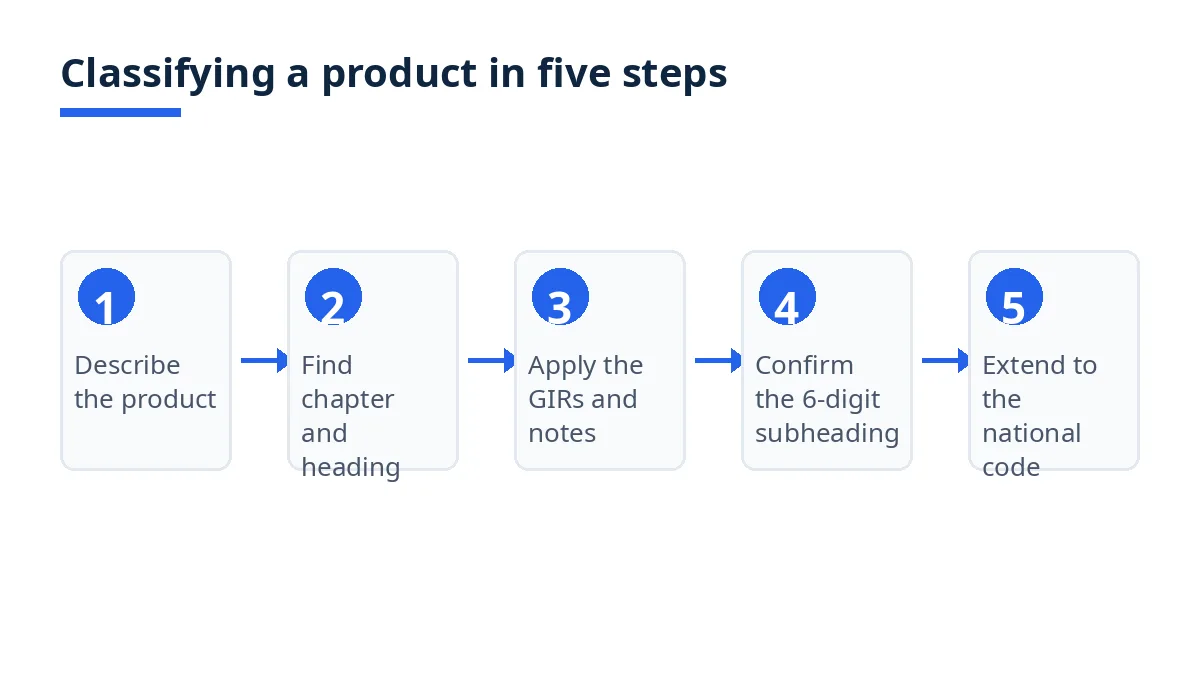
Describe the product objectively. Material, composition, construction and use. "Cotton T-shirt, knitted" is classifiable; a marketing name is not.
Find the chapter and heading. Match the description against the headings and the section and chapter notes. The general rules of interpretation, the section, chapter and subheading notes, and the terms of the headings and subheadings together form the legal text that decides classification.2
Apply the General Rules for Interpretation. Applied in order, these rules resolve the difficult cases: goods made of more than one material, sets, and unfinished products.
Confirm the six-digit subheading. This is the agreed international level. In the US schedule, Chapter 61 covers knitted or crocheted apparel and clothing accessories, heading 6109 covers T-shirts, singlets, tank tops and similar garments, knitted or crocheted, and subheading 6109.10 is "of cotton".3
Extend to the destination's full code. In the US schedule, digits beyond six are unique to the United States; the legal text ends at 8 digits, where tariff rates are assigned, and a statistical suffix completes the 10-digit number used on entries.2 The European Union adds two digits for the 8-digit Combined Nomenclature (CN) code and two more for the 10-digit TARIC code.4 The United Kingdom uses a 10-digit commodity code for imports and an 8-digit code for exports.5
Use the same code consistently on the commercial invoice, the packing list, the export declaration and the import declaration.
Our overview of the HS code and the Harmonized System gives the background, and how to classify your product with HS codes works through the checking process. The WCO prepares amendments updating the HS every 5 to 6 years, so re-check old codes against the current edition.1
Who is responsible for what?
The Bangladeshi exporter describes the goods accurately, declares the code on the export side, and keeps the specification consistent with the classification. In Bangladesh, goods cannot be loaded for export unless an export declaration, known as the Bill of Export or Shipping Bill, has been submitted to Customs and approved, and the standard export set includes the commercial invoice, the packing list and the EXP form certified by Authorised Dealers.6 Bangladesh Customs directs traders whose code a product name alone does not settle to the Bangladesh Customs Tariff and its notes, and to the WCO Explanatory Notes.7
The buyer or importer confirms the full national code, including the digits beyond six, and carries responsibility for the import declaration in their own country, even when a broker files it. In the European Union, it is incumbent on the declarant to determine the appropriate code for each good in the declaration, and a business can request binding tariff information for a classification valid throughout the European Union.4 A broker can research and file, but filing through a broker does not move the declarant's responsibility. Never accept a supplier's code without checking it against your own tariff.
Worked example: a cotton T-shirt shipment from Bangladesh
Example figures: 12,000 men's cotton T-shirts, knitted, in 600 cartons, shipped from Chattogram to a buyer in the European Union. Quantities are illustrative; the codes are real.
Digits | Code so far | What it means |
|---|---|---|
61 | 61 | Chapter 61: apparel and clothing accessories, knitted or crocheted. The chapter applies only to made up knitted or crocheted articles.3 |
6109 | 6109 | Heading 6109: T-shirts, singlets, tank tops and similar garments, knitted or crocheted.3 |
6109.10 | 6109.10 | Subheading 6109.10: of cotton. The fibre decides the last two digits.3 |
The export documents carry 6109.10, and the EU buyer extends those digits through the CN code to the 10-digit TARIC code before filing.4 Change one fact and the code moves: the same garment of other textile materials sits at 6109.90, not 6109.10.3 The same logic applies outside garments: heading 5303 covers jute and other textile bast fibres, and subheading 5303.10 covers those fibres raw or retted.8
How do harmonised system codes differ from related terms?
Term | Digits | Used for |
|---|---|---|
HS code | 6 | The international subheading, shared by every country that uses the Harmonized System |
HTS code | 10 | United States imports: the HS base plus the US rate line and statistical suffix |
CN code | 8 | European Union classification: the HS base plus two EU digits |
TARIC code | 10 | European Union imports: the CN code plus two digits for EU import measures |
Commodity code | 10 for imports, 8 for exports | The United Kingdom's term for its code built on the same six-digit base |
SKU | Varies | A company's private stock code, with no customs meaning |
Only the first six digits travel between countries: a US HTS extension has no standing as an EU TARIC code, and an EU code has no standing on a US entry. The harmonized system tariff code article explains how national tariffs attach to the HS base. See also the 6-digit HS code, 10-digit HS code and HS code in the UK articles.
What are the common mistakes to avoid?
Copying a code from a similar product. A knitted polo shirt and a woven shirt look alike but are classified on different facts.
Classifying by trade name or price. Customs uses material, construction and function. A brand, style name or value settles nothing.
Stopping at six digits for the import declaration. Your import entry usually needs your country's full 8-digit or 10-digit code.
Ignoring fibre blends. The last digits often turn on exact composition, and "cotton blend" is not enough.
Reusing an old code after a change. A new fabric, component or HS edition can move a product. Re-check rather than repeat.
Letting the supplier's code go unchecked. The importer carries the consequences of a wrong declaration, including reassessed duty and delays.
How Exportain helps
Exportain is a marketplace where buyers find Bangladeshi suppliers, post requests for quotation and compare replies. Precise product descriptions, the starting point for correct classification, are easier to give when categories and specifications are clear. Include material, composition and construction in your requirement, so suppliers respond against the same facts you will classify. Exportain's supplier badges record document and photo reviews; they are not factory inspections or guarantees. Exportain is not a party to your contract for goods, and it does not inspect goods, book freight or clear customs.
FAQs
What is Harmonised System Codes for Export?
Harmonised System Codes for Export are the six-digit numbers of the Harmonized Commodity Description and Coding System, developed by the World Customs Organization, that identify traded products the same way at export and import.1 The first two digits give the chapter, the next two complete the heading, and the final two give the subheading.
How does Harmonised System Codes for Export work in practice?
The exporter describes the product, finds the heading that matches its material, construction and use, applies the interpretation rules and the notes, and declares the six-digit subheading. The importer extends it to the full national code, for example a 10-digit US HTS number2 or a 10-digit EU TARIC code,4 and declares that code on entry.
Is Harmonised System Codes for Export used for shipments from Bangladesh?
Yes. A shipment leaving Bangladesh is declared on a Bill of Export approved by Bangladesh Customs before loading,6 and classification sits in the Bangladesh Customs Tariff, read with the WCO Explanatory Notes.7 A knitted cotton T-shirt leaves under subheading 6109.103 and raw or retted jute under subheading 5303.10.8
What are common mistakes with Harmonised System Codes for Export?
Copying a code from a similar product, classifying by trade name instead of material and construction, stopping at six digits when a longer code is required, ignoring exact fibre composition, and reusing an old code after the product or the schedule changes. Each can mean the wrong duty rate or a held shipment.
Next steps on Exportain
Start from the product facts: agree material, construction and specification with your supplier, then confirm the full destination code in the official tariff before the goods leave. Browse suppliers, read the how to buy guide, and when the specification is ready, post an RFQ with the full detail so every quotation rests on the same description.
Sources
- What is the Harmonized System (HS)?. World Customs Organization (accessed )
- Frequently Asked Questions about Tariff Classification, the Harmonized Tariff Schedule, Importing, and Exporting. U.S. International Trade Commission (accessed )
- Harmonized Tariff Schedule of the United States, Chapter 61 (2022, Revision 2). U.S. International Trade Commission (accessed )
- Tariff classification of goods (CN/TARIC code). Guichet.lu, Government of Luxembourg, (accessed )
- Checking the origin of your goods using product specific rules when trading between the UK and EU. GOV.UK (accessed )
- Customs Clearance Procedures for Export. Bangladesh Customs, National Board of Revenue (accessed )
- Bangladesh Customs & VAT Import Export Hub: Import Requirements. National Board of Revenue, Bangladesh, (accessed )
- UNSD Classification Detail: HS Code 5303. United Nations Statistics Division (accessed )
Reviewed by Naim Islam
About the author
Sourcing from Bangladesh?
Post a request for quotation and suppliers on Exportain can send you their quotes directly.
Post an RFQ