10-Digit HS Codes: How the US HTS and EU TARIC Extend the HS System
Definition
A 10 digit HS code is the full customs classification number used on an import declaration in a destination country. Its first six digits are the international Harmonized System subheading set by the World Customs Organization. The destination adds four digits: the United States through its Harmonized Tariff Schedule, and the European Union through the Combined Nomenclature and TARIC.
By Naim Islam
Published 8 min read
On this page
Key takeaways
The first six digits of a 10-digit code are the international HS subheading and are the same in every country that uses the Harmonized System.
In the United States, digits seven and eight form the HTS rate line where the duty rate is assigned, and digits nine and ten are the statistical suffix used on entries.
In the European Union, the Combined Nomenclature takes the code to eight digits and TARIC adds two more digits for EU import measures.
Only the first six digits travel between countries, so a US HTS code cannot be used as an EU TARIC code.
The importer of record carries the legal duty for the code declared at destination, even when a customs broker files the entry.
If you import into the United States or the European Union, the six-digit code on your supplier's quotation is only the starting point. A 10 digit hs code is the full classification number entered on the import declaration at destination, and it sets the duty line your shipment is assessed on.
What does a 10-digit HS code mean in plain English?
A 10-digit HS code is a ten-digit customs classification number for one product in one destination country. The first six digits are the international Harmonized System (HS) subheading, and the destination country adds four digits of its own.
Customs uses the code to identify what is in a shipment, apply duty and taxes, check restrictions and record trade statistics. The Harmonized System behind the first six digits is a nomenclature developed by the World Customs Organization (WCO), organized as a hierarchy of sections, chapters, headings and subheadings.1 Because that part is shared, a supplier in Bangladesh and a buyer in the United States or the European Union can discuss the same product in the same six-digit terms before either side adds national digits.
How is the code built in the United States and the European Union?
Level | United States (HTS) | European Union (CN and TARIC) |
|---|---|---|
Digits 1–2 | Chapter, for example 61 for knitted apparel | Chapter, on the same HS basis |
Digits 3–4 | Heading, for example 6109 for T-shirts and similar garments | Heading, on the same HS basis |
Digits 5–6 | HS subheading, for example 6109.10 for cotton | HS subheading, on the same HS basis |
Digits 7–8 | US rate line: the 8-digit level is where tariff rates are assigned | Combined Nomenclature (CN) digits for EU duties and restrictions |
Digits 9–10 | Statistical suffix: the 10-digit number must be used on US entries | TARIC digits for EU measures such as antidumping rules, duty suspensions and tariff quotas |
In the US Harmonized Tariff Schedule (HTS), the 4-digit and 6-digit provisions are part of the international Harmonized System, while the 8-digit and 10-digit provisions are unique to the United States. The legal text ends at 8 digits, and a two-digit statistical suffix completes the 10-digit reporting number.2 In the EU, the Combined Nomenclature adds digits seven and eight to the HS base, and digits nine and ten are the TARIC digits for EU measures.3 EU guidance states the same build in figures: HS 6, CN 8, TARIC 10.4
How do you find the full code, step by step?
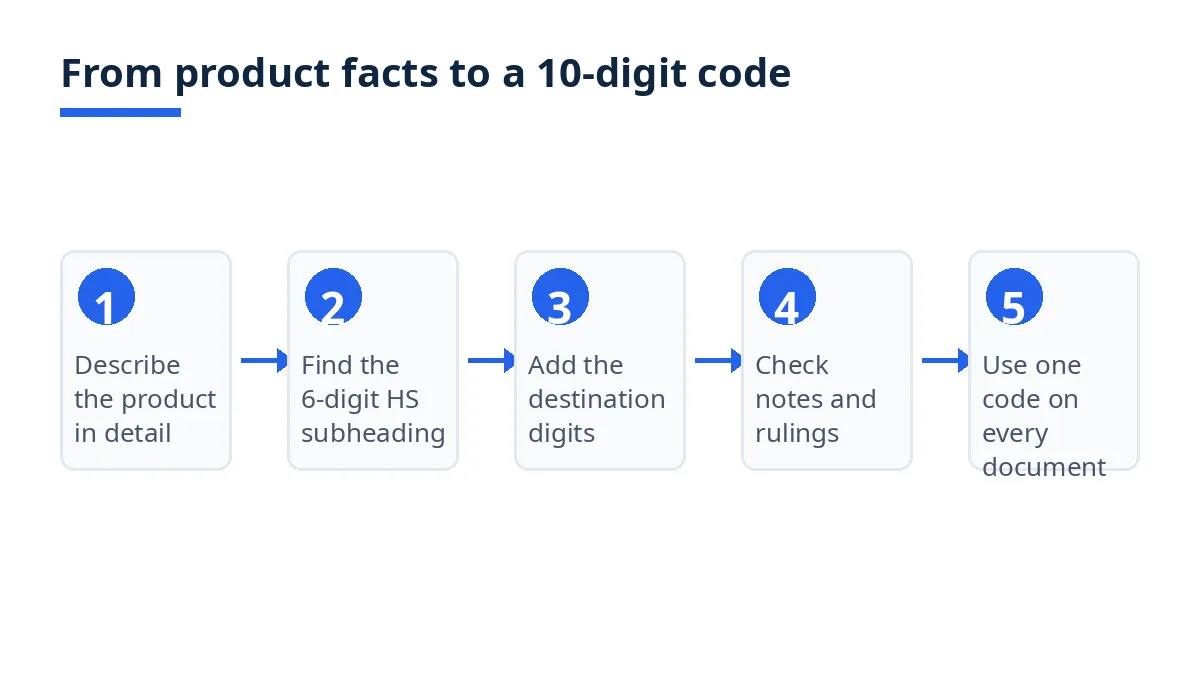
Describe the product in full. Record material, function, construction and stage of processing. For garments, fiber content and whether the fabric is knitted or woven decide the chapter; for seafood, species and whether it is fresh, chilled or frozen decide the heading.
Find the six-digit subheading. Work from chapter to heading to subheading using the General Rules for the Interpretation of the Harmonized System, applied in order. The general rules, with the section, chapter and subheading notes and the terms of the headings, form the legal text.2
Extend the code for the destination. For the United States, look the subheading up in the HTS and add the rate line and statistical suffix. For the European Union, add the CN digits and then the TARIC digits.
Check the notes and any rulings. Chapter notes can move a product between headings, and a small change in composition or finish can change the subheading.
Use one code on every document. Put the confirmed full code on the commercial invoice, packing list and customs entry, and keep it the same on repeat shipments.
Worked example: a men's cotton T-shirt from Bangladesh to the United States
Take a men's cotton T-shirt, knitted, exported from Bangladesh to a US buyer. It builds as follows in the US HTS, Chapter 61.5
Digits | Code so far | What it means |
|---|---|---|
1–2 | 61 | Chapter 61: articles of apparel and clothing accessories, knitted or crocheted |
3–4 | 6109 | Heading 6109: T-shirts, singlets, tank tops and similar garments, knitted or crocheted |
5–6 | 6109.10 | Subheading 6109.10: of cotton. These six digits are the international HS code |
7–8 | 6109.10.00 | US rate line: the 8-digit provision "of cotton," where the duty rate is assigned |
9–10 | 6109.10.0012 | Statistical suffix 12, listed for men's other T-shirts |
Send the same T-shirt to the European Union and the first six digits stay 6109.10, but the EU applies its own CN and TARIC digits, so the last four differ. The product has not changed; the national extension has. Always confirm the current full code in the destination's official schedule before you ship, and never copy a 10-digit code from a listing for a similar product.
Who is responsible for the code?
The exporter describes the product truthfully and in full. A Bangladeshi seller knows the material, construction and processing, and should supply that detail and the export code used at origin.
The importer of record is responsible for the declaration in the destination country. In the United States, the importer of record is responsible for using reasonable care to enter, classify and value imported merchandise under section 484 of the Tariff Act of 1930 (19 U.S.C. § 1484).6 In the EU, it is incumbent on the declarant to determine the appropriate code for each good in the declaration.4
A customs broker can prepare and file the entry, but filing through a broker does not move the importer's legal duty. In the United States, only US Customs and Border Protection (CBP) can issue a legally binding ruling on an import's classification.7 In the EU, a trader can request binding tariff information from a customs authority, valid throughout the European Union.4
For a first shipment: the seller sends a complete specification, the buyer or the buyer's broker confirms the full destination code in writing before the goods leave, and both sides use that code throughout.
How does a 10-digit code differ from related terms?
Term | Digits | Used for |
|---|---|---|
HS code | 6 | The international subheading, shared by every country using the Harmonized System |
HTS code | 10 | US imports: the HS base plus the US rate line and statistical suffix |
TARIC code | 10 | EU imports: the HS base plus the CN digits and the TARIC digits for EU measures |
Schedule B number | 10 | US exports: a statistical code for goods leaving the United States, administered by the US Census Bureau |
SKU | Varies | A company's private stock code. It has no customs meaning |
The first six digits of Schedule B and HTS numbers are the same, because both rest on the HS, but their 8-digit and 10-digit statistical reporting numbers differ.7 A Schedule B number is therefore not a substitute for an HTS number on a US import entry.
What are the common mistakes to avoid?
Stopping at six digits. Six digits leave the US duty line and the EU measures undecided, so your landed cost rests on a line customs has not assessed.
Copying a code from a similar product. A cotton T-shirt and a T-shirt of other textile materials sit in different subheadings, and two products in one subheading can still split at the statistical suffix.
Using one country's extension in another country. Only the first six digits travel. A US HTS extension has no standing as an EU TARIC code, and an EU code has no standing on a US entry.
Skipping re-checks. The WCO updates the Harmonized System on a five-year review cycle; the version approved in June 2019 entered into force on 1 January 2022.1 National digits change on their own cycles, so re-check the full code after a product change and before a new season, following the method in how to classify your product with HS codes.
Frequently asked questions
What is HS code?
An HS code is the Harmonized System number that identifies a traded product for customs. The international code has six digits, set within the WCO nomenclature of sections, chapters, headings and subheadings.1 Destination countries extend it, to ten digits in the US HTS and the EU TARIC, to fix the duty line and statistical category.
How does HS code work in practice?
In practice, you describe the product, find its six-digit subheading under the interpretation rules and chapter notes, then add the destination country's digits. The full code goes on the customs declaration, where it drives the duty assessment, any restrictions or measures, and the trade statistics.
Is HS code used for shipments from Bangladesh?
Yes. Bangladesh Customs works with HS codes under the Bangladesh Customs Tariff, and its guidance points traders to the tariff's section, chapter, heading and subheading notes and to the WCO Explanatory Notes when a product name alone does not settle the code.8 A shipment leaving Bangladesh carries an HS-based code at origin; the importer confirms the full destination extension on arrival.
What are common mistakes with HS code?
The common mistakes are stopping at six digits for a US or EU import, copying a code from a similar but different product, using one country's extension in another country, classifying by brand or price instead of material and construction, and not re-checking the code after the product or schedule changes.
Next steps on Exportain
Start from the product facts: agree the material, construction and specification with your supplier before any document is cut, then confirm the full destination code with your broker. For background, read the HS code and the Harmonized System guide and the method in how to classify your product with HS codes. When the specification is ready, post an RFQ with the full detail so suppliers quote on the same facts.
Sources
- The HS: A Multi-Purpose Tool. World Customs Organization (accessed )
- Frequently Asked Questions about Tariff Classification, the Harmonized Tariff Schedule, Importing, and Exporting. U.S. International Trade Commission (accessed )
- Customs Tariff. German Customs Administration (accessed )
- Tariff classification of goods (CN/TARIC code). Guichet.lu, Government of Luxembourg, (accessed )
- Harmonized Tariff Schedule of the United States, Chapter 61 (2022, Revision 2). U.S. International Trade Commission (accessed )
- Customs Bulletin and Decisions, Vol. 59, No. 34. U.S. Customs and Border Protection, (accessed )
- Definitions and Classifications. U.S. International Trade Commission (accessed )
- Bangladesh Customs & VAT Import Export Hub: Import Requirements. National Board of Revenue, Bangladesh, (accessed )
Reviewed by Nourin Tabassum
About the author
Sourcing from Bangladesh?
Post a request for quotation and suppliers on Exportain can send you their quotes directly.
Post an RFQ