UK Commodity Codes: How to Find the Right Code on the UK Trade Tariff
Definition
A UK commodity code is the number used on a UK customs declaration to classify imported goods. Its first six digits are the international HS code from the World Customs Organization system. The UK extends the code to ten digits for imports and uses eight digits for exports. The code sets the duty rate and shows any VAT treatment, controls or restrictions.
By Naim Islam
Published 7 min read
On this page
Key takeaways
A UK import declaration needs the full ten-digit commodity code; UK exports use eight digits.
The first six digits are the international HS code, shared under the World Customs Organization system.
The UK Trade Tariff page for a code carries its duty rates, VAT treatment and any controls.
The importer holds legal responsibility for the code, even when a supplier or agent supplies it.
If you import goods from Bangladesh into the United Kingdom, the hs code uk customs applies to your shipment is called a commodity code. It decides your duty rate, shows whether a control or restriction applies, and sits on your import declaration. This guide explains what the code is and how to find the right one on the UK Trade Tariff.
What does HS code mean in plain English?
HS stands for Harmonized System, the Harmonized Commodity Description and Coding System developed under the World Customs Organization (WCO). It gives traded goods a shared numeric language: about 5,000 commodity groups, each identified by a six-digit code, applied by more than 200 administrations for customs tariffs and trade statistics.1 The structure runs to 21 sections, 96 chapters, over 1,200 headings and over 5,000 subheadings, updated every five years, with the current edition released in 2022.2
Each pair of digits makes the code more precise. GOV.UK sets out the levels: chapters at 2 digits, tariff headings at 4 digits, and tariff subheadings at 6 digits, the level sometimes referred to as the Harmonized System code.3
Digits | Level | What it covers |
|---|---|---|
1–2 | Chapter | A broad family of goods, such as Chapter 61 clothing |
3–4 | Heading | A narrower product group inside the chapter |
5–6 | Subheading | Most detailed level shared by every HS country |
7–8 | UK and Combined Nomenclature level | Subdivision used on imports and exports |
9–10 | UK import level | Final digits, import declarations only |
The UK extends the shared six digits: a 10-digit commodity code for imports and an 8-digit code for exports, found with the trade tariff tool.3 See the HS code and the Harmonized System for the international system.
How do you find the right code on the UK Trade Tariff?
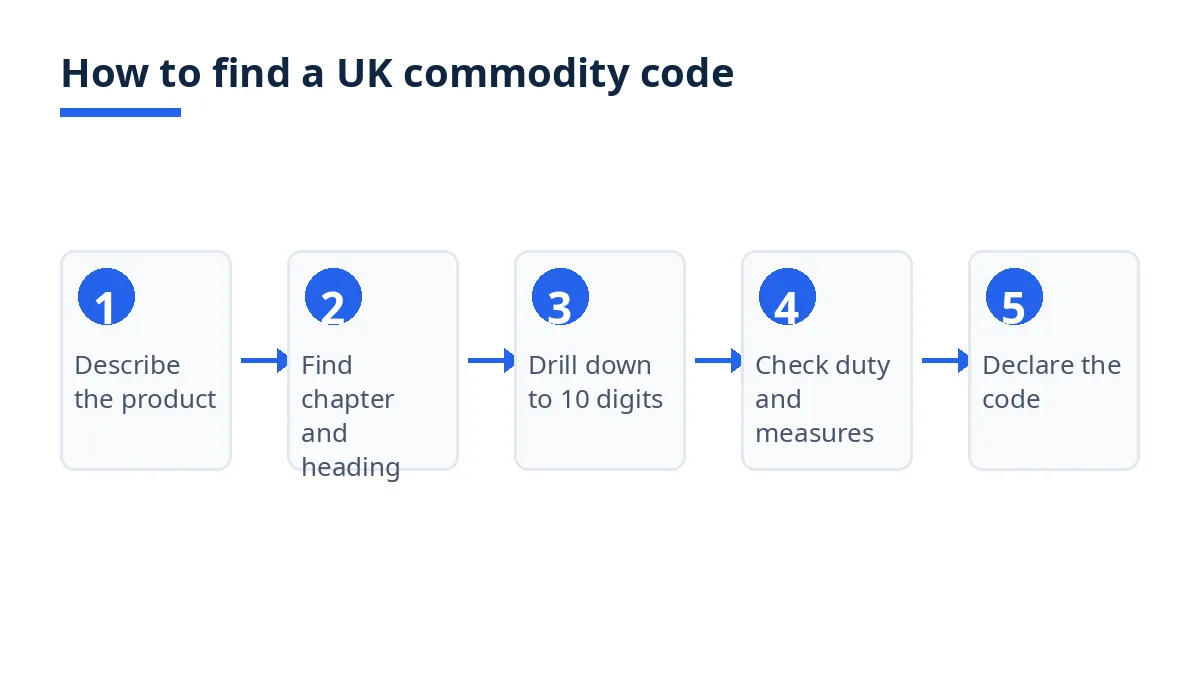
Finding the right code is a classification exercise, not a search for the lowest duty rate:
Describe the product exactly. What the goods are, what they are made of, how they are made, and what they are used for. For a garment: fibre content, knit or woven construction, and garment type, not the trade name.
Start from the chapter and heading. In the UK Trade Tariff, search by product type to reach the correct chapter and four-digit heading.
Apply the classification rules and read the notes. Classification is governed by the General Rules for the Interpretation of goods, printed on each UK Integrated Online Tariff commodity page. Rule 1 bases classification on the terms of the headings and the relevant notes; later rules settle cases where goods could fall under two headings.4
Drill down to ten digits. Continue until a ten-digit description matches your product exactly. The first eight digits form the combined nomenclature code and decide the Customs Duty rate. Digits nine and ten are import-only and can affect duty and measures.5
Read the measures attached to the code. A commodity page lists import controls, duties by country or scheme, trade remedies, and import VAT and excise, and shows the shorter export code.4 Select Bangladesh as origin, and check whether a Developing Countries Trading Scheme (DCTS) preference is listed.
Record the code and use it consistently. Put the agreed code on the commercial invoice and packing documents. It is also needed on letters of credit, certificates of origin and packing lists.6
Apply for a ruling if the case is hard. A UK importer can apply to HMRC for an Advance Tariff Ruling before customs procedures are completed. HMRC replies in 30 to 120 days with the correct code, a reference number, a description of the goods and the legal justification. Decisions are non-transferable.7
Who is responsible for the code?
The UK importer carries the responsibility. UK government business guidance states it directly: you can ask buyers and freight forwarders for advice, but the legal responsibility for the right commodity code lies with you.6 HMRC guidance adds that you must identify the correct code before completing a declaration, and that an incorrect declaration may result in a penalty, a rejected declaration, and the loss of reliefs, suspensions or simplifications.5
The Bangladeshi supplier is responsible for accurate product information: fibre content, construction and composition on the invoice and specification are the facts classification is built from.
The customs agent or freight forwarder submits the declaration from the information supplied. Using an agent does not move the importer's responsibility. Agree the code before the goods ship.
Worked example: cotton T-shirts from Bangladesh
A UK buyer orders 10,000 men's T-shirts from Bangladesh: knitted, 100 percent cotton, 50 pieces to a carton, 200 cartons. The quantities are illustrative. Classification builds digit by digit:
Chapter 61 covers apparel and clothing accessories, knitted or crocheted.
Heading 6109 covers T-shirts, singlets and other vests, knitted or crocheted.
Subheading 6109 10 narrows the heading to goods of cotton.
Eight digits, 6109 1000, give the Combined Nomenclature code described as T-shirts, singlets and other vests of cotton, knitted or crocheted, with a supplementary unit of items.8
Ten digits for the import declaration are confirmed on the UK Trade Tariff page for this heading. Read the final digits from the live tariff, never from a similar listing or an old shipment.
With the code fixed, open the tariff page with Bangladesh selected as origin. It shows the third country duty and any preferential measure for that origin, including a DCTS preference where one applies and its conditions.4 Duty is a percentage of the customs value: the code supplies the percentage, the invoice supplies the value. A polyester blend would move the subheading. See how to classify your product with HS codes and the harmonized system tariff code.
How does a UK commodity code differ from related terms?
Term | What it means | Where it is used |
|---|---|---|
HS code | International six-digit code from the WCO system | Shared core of national codes |
UK commodity code | Full UK version, ten digits for imports, eight for exports | UK declarations |
Combined Nomenclature (CN) code | Eight-digit subdivision built on the HS | EU tariff; first eight UK digits |
TARIC code | Digits nine and ten, added detail on imports | Import declarations |
HTS code | Harmonized Tariff Schedule code, the US version | US imports only |
The European Commission confirms the link: the EU Combined Nomenclature is based on the WCO Harmonized System and integrates the HS with additional eight-digit subdivisions.1 The first six digits match across countries; later digits are national. An EU or US code never completes a UK declaration.
What are the common mistakes to avoid?
Declaring only six digits on a UK import. An import declaration needs the full ten-digit code. Digits nine and ten are import-only and can affect duty and measures.5
Copying a code from a similar product. A cotton T-shirt and a polyester T-shirt sit in different subheadings. Small changes in fibre or construction move the code.
Copying an EU or US code. The first six digits are shared; the rest are national. Check the full code on the UK Trade Tariff.
Classifying by trade name. A style name tells customs nothing. Classify by material, construction and function.
Ignoring origin. Duty also depends on origin. Select Bangladesh on the tariff page and read the measure that applies.
Never re-checking the code. Codes, rates and measures change. Confirm it on the live tariff for each new product.
FAQs
What is HS code?
An HS code is the six-digit number from the Harmonized System maintained under the World Customs Organization. It identifies a product by what it is and what it is made of, in a system of about 5,000 commodity groups applied by more than 200 administrations for tariffs and trade statistics.1 The UK extends the six digits to ten for imports.
How does HS code work in practice?
You describe the product exactly, find its chapter and heading, apply the General Rules for the Interpretation of goods and the chapter notes, and continue down the levels until a code description matches your goods. GOV.UK directs traders to the trade tariff tool for a 10-digit import code and an 8-digit export code.3 The code goes on the declaration and sets duty and measures.
Is HS code used for shipments from Bangladesh?
Yes. Goods from Bangladesh are classified on both sides: the exporter documents the goods, and the UK importer declares the full ten-digit code on import. The tariff page shows the measures for Bangladesh as origin, including any DCTS preference and its conditions.4
What are common mistakes with HS code?
Declaring only the six-digit code on a UK import, copying a code from a similar product or an EU or US tariff, classifying by trade name instead of material and construction, ignoring the origin line, and failing to re-check the code when the product or tariff changes.
Next steps on Exportain
The product description in your requirement does double duty: suppliers quote against it, and it is the factual basis for the UK commodity code. State material, construction and use in full when you post an RFQ, and read how to write an RFQ first. Browse Bangladeshi suppliers, follow how to buy, and plan with how to import from Bangladesh so the classification is settled before the goods are made.
Sources
- Harmonized System. European Commission, (accessed )
- An Overview of Harmonized System Codes. U.S. Department of Commerce, International Trade Administration, (accessed )
- Checking the origin of your goods using product specific rules when trading between the UK and EU. GOV.UK (accessed )
- Commodity code 6912002390: Other - UK Integrated Online Tariff. UK Integrated Online Tariff, GOV.UK (accessed )
- Using commodity codes and related additional codes in the Customs Declaration Service. GOV.UK (accessed )
- How to use Harmonised System (HS) or commodity codes. Business.gov.uk (accessed )
- Apply for an Advance Tariff Ruling. HM Revenue & Customs (GOV.UK), (accessed )
- HS Code 61091000 - T-shirts, singlets and other vests of cotton, knitted or crocheted. tariffnumber.com (accessed )
Reviewed by Nourin Tabassum
About the author
Sourcing from Bangladesh?
Post a request for quotation and suppliers on Exportain can send you their quotes directly.
Post an RFQ