

FOB for Small Importers: Is It the Right Incoterm for First Order?
FOB for small importers is a decision about who does the work after loading. This guide tests FOB against FCA, CIF, EXW and DAP for a first, small order from Bangladesh.
Short answer
FOB can fit a small first order from Bangladesh when you have a freight forwarder, a sea shipment and insurance arranged from loading, and you accept that you book and pay for main carriage, insurance and import clearance. Without a forwarder, or for containerised LCL cargo, FCA or a bundled CIF quotation usually describes the first order more honestly.
On this page
Key takeaways
FOB transfers risk when goods are loaded on board at the named port, and the buyer then books and pays main carriage and handles import clearance.
For containerised or LCL cargo, FCA usually fits better, because risk passes at handover to the carrier, before days in a terminal.
A small first order needs a forwarder, insurance from loading, and a named port and vessel in writing before confirmation.
Compare landed cost per unit, not headline prices: FOB excludes freight, insurance, destination charges, duty and delivery.
In Bangladesh, export clearance needs an approved Bill of Export and its enclosed documents before goods are loaded.
A first order is small on purpose. You want enough stock to test the product, the seller and the market, without filling a warehouse before you know whether the line sells. A small order still needs a vessel booking, export clearance, insurance and an import entry, and under FOB most of that work sits with you from loading.
FOB, or Free On Board, is one of the 11 rules in Incoterms 2020, which give a clear allocation of cost, risk and obligations for each rule.1 Under FOB the seller delivers the goods loaded on board the vessel nominated by the buyer at the named port of shipment, completes export formalities, and transfers risk once the goods are on board.2 FOB applies only to sea and inland waterway transport, so air cargo, or cargo handed to a carrier well before loading, needs a different rule. The FOB meaning guide explains the term itself. This guide answers whether FOB fits a first, small order, and what you must arrange yourself if you choose it.
The first-order decision test: five questions that settle FOB or not
Start with capacity, not price: a lower FOB price is not a lower landed cost. Work through the five questions before you confirm any quotation, and write the answers into the purchase order.
1. Do you have a freight forwarder before you confirm? Under FOB the buyer contracts the carrier and pays the port-to-port transport costs, while the seller completes export formalities.2 Without a forwarder, FOB leaves the main booking in your hands on a first order. Appoint one first, or ask for a comparable FCA or CIF quotation while you do.
2. Will the cargo travel in a container, and will it share that container? If the goods are containerised, the seller typically delivers them to a container terminal, where they may stay for several days before loading.3 FCA is then the more appropriate rule, because risk passes at handover. A small order will often travel as LCL, sharing a container with other shippers cargo, charged per cubic metre or per ton, whichever is greater, with consolidation and deconsolidation adding handling and time.4
3. Can you arrange insurance that starts at loading? FOB imposes no insurance duty on either party, and both the buyer and the seller may insure their respective legs if they so desire.5 Your cover must start when risk passes to you, at loading, not when the vessel arrives.
4. Do you want the seller to handle freight and insurance instead? Under CIF the seller contracts and pays freight to the named port of destination and contracts insurance cover for the buyers risk, but risk still passes to the buyer when the goods are on board, and the seller is required to obtain only minimum cover.5 Compare the CIF price against the FOB price plus your own freight and insurance quotes, line by line.
5. Would EXW, or a delivered term, describe the order more honestly? Under EXW the buyer handles export formalities, and traders are strongly encouraged to consider FCA instead where goods cross a border.6 EXW is a poor fit for a first import from Bangladesh unless you already have an export agent there. Under DAP the seller bears the risks of bringing the goods to the named place of destination,5 which removes freight work from you but also removes your control over carrier choice and freight cost.
Term | Who books main carriage | Risk passes | First-order signal |
|---|---|---|---|
FOB | Buyer | When goods are on board | Forwarder in place, sea shipment, cover from loading |
FCA | Buyer | At handover to the carrier | Containerised or LCL cargo, or multimodal transport |
CIF | Seller pays freight | When goods are on board | Freight and minimum insurance bundled, cover checked |
EXW | Buyer | At the sellers premises | Avoid for a first cross-border order without export help |
DAP | Seller | At the named place of destination | Seller carries the journey, bundled price accepted |
For the full comparison of all 11 rules, read the Incoterms guide.
Step-by-step: how a small FOB order moves from quotation to delivery
A small FOB order follows the same sequence as a large one, with less margin for error.
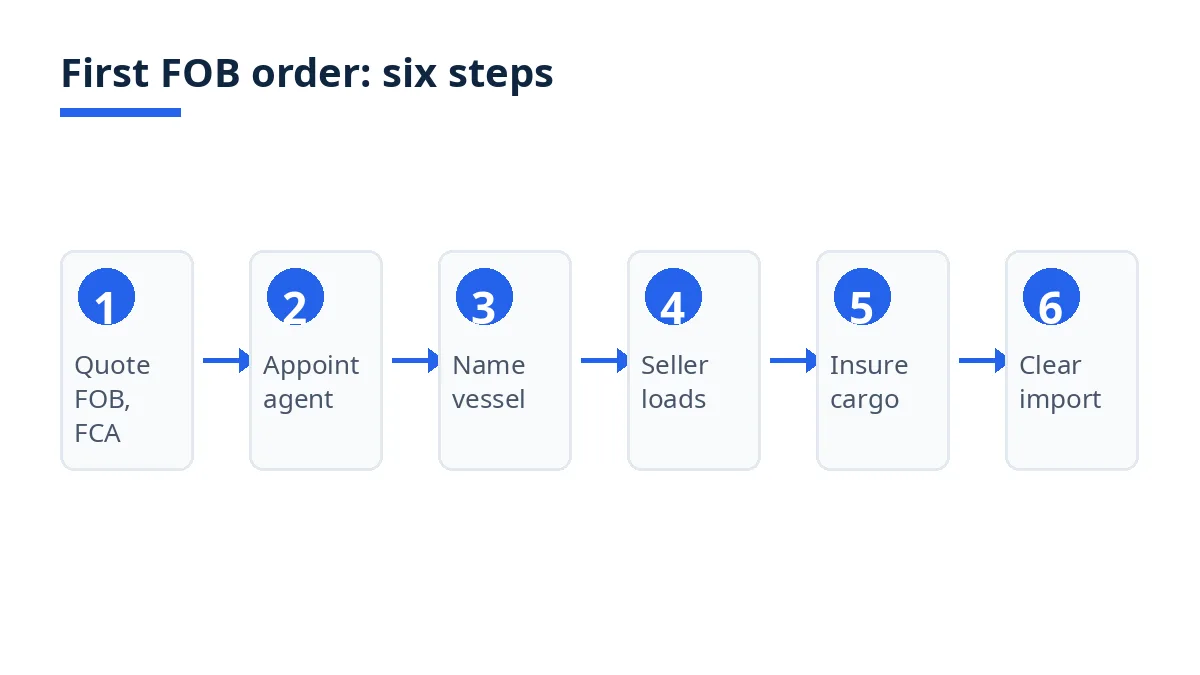
Ask for two quotations on the same specification. Request FOB Chattogram and FCA, each with the named place, quantity per size or colour, packing and payment terms.
Appoint your forwarder and broker before you confirm. Give the forwarder the ports, cargo description, volume and weight, and sailing window. Give the broker the product description and HS code so duty is checked before sailing; this guide states no rate.
Name the vessel, place and point in writing. The buyer must inform the seller in time of the vessel name and the specific loading place and point within the port.3 If that notice is late, or the vessel closes for cargo early, risk and additional costs can pass to the buyer even though the goods have not been loaded.3
Let the seller clear export and load the goods. The seller completes export formalities and loads the goods on board the buyer-nominated vessel.2 Ask for the on-board bill of lading, or for LCL the house bill of lading, and check that shipper, consignee, marks, quantity and port names match the purchase order before you pay any balance.
Insure from the on-board moment. Arrange cover that starts at loading and runs to your warehouse, with the insured value, cargo description and voyage stated. Check whether the cover follows the goods through transshipment and LCL deconsolidation.
Clear import and take delivery. Handle import formalities, pay duties and taxes assessed at destination, and arrange onward transport to your warehouse. Confirm with your broker which documents your destination customs authority requires.
Why this matters for buyers and sellers
For a small buyer, FOB buys control. You choose the carrier, you see the freight rate separately from the goods price, and you can compare forwarders on the same sailing. It is a burden when the first order is also your first contact with a forwarder, a broker and an insurer, because three new relationships must all work on the same sailing.
For the seller, FOB keeps the obligation at the port of shipment: the seller transports the goods to the port, completes export formalities and loads them on board, and does not contract the ocean carriage.2 A seller who offers to arrange the journey informally should put that service, its price and its insurance position in writing.
The price comparison must be on landed cost, not on the FOB figure alone. The landed cost guide works through the build-up from goods price to cost per unit at your warehouse. Under FOB, add ocean freight, insurance, destination terminal and handling charges, import duty and taxes, broker fees and inland delivery to the FOB price. A small LCL order carries fixed handling and documentation charges that weigh more heavily per unit than they do on a full container.
Costs, timelines and documents
There is no typical FOB cost or timeline. Freight depends on the lane, sailing, volume and forwarder. Only a written agreement moves a line in the table below.
Cost or charge | Seller pays | Buyer pays |
|---|---|---|
Goods, packing and marking | Yes | No |
Inland transport to the port | Yes | No |
Export clearance and loading | Yes | No |
Ocean freight | No | Yes |
Cargo insurance after loading | No | Yes, if cover is arranged |
Destination charges and delivery | No | Yes |
Import clearance, duty and taxes | No | Yes |
Example figures: at USD 150 per chargeable unit, USD 200 LCL fixed fees and a USD 2,200 20-foot FCL rate, break-even is 13.3 cubic metres: (2,200 minus 200) divided by 150.4 The break-even point is typically around 12 to 15 cubic metres.4 Use your own quotes; the example shows structure only.
For timelines, treat the sailing schedule as the controlling document. LCL typically takes 3 to 7 days longer than FCL on the same route because of consolidation at origin and deconsolidation at destination.4 Ask the forwarder for the cut-off, sailing and arrival dates in writing before you confirm.
Keep the invoice, packing list, bill of lading, certificate of origin and insurance cover note together, with names, quantities and values consistent. In the European Union, goods are released for free circulation once all import requirements have been met, including payment of duties and presentation of required certificates.7 Proof of origin is declared with the customs declaration, and importers use an EORI number with customs authorities.7
Bangladesh-specific rules and tips
Export clearance starts before loading: goods shall not be loaded or stuffed for export unless an export declaration, the Bill of Export or Shipping Bill, is submitted to Customs and approved.8 The documents enclosed include the export letter of credit or, where there is none, the export contract, purchase order or export guarantee approved by the negotiating bank, the commercial invoice, packing list, EXP form certified by authorized dealers, certificate of origin issued by the EPB or a Chamber of Commerce and Industry, VAT registration certificate and taxpayer identification number.8 Product-specific documents may also apply, such as a phytosanitary certificate.8
Write the term in full, for example "FOB Chattogram, Incoterms 2020", with the port named, not a country. A port that does not match the handover point leaves the same gap: goods may sit at a terminal for days before loading.3 If cargo goes to a consolidator at a container freight station, ask where handover happens and consider FCA with that place named.
Keep one legal name and product description across all documents. The Bill of Export specifies the goods, value, exporter, buyer and transport operator,8 so any change between documents slows clearance. Check the draft bill of lading before sailing.
Mistakes and red flags
Comparing an FOB price with a CIF price as if they were the same offer. The CIF price includes freight and minimum insurance; the FOB price stops at loading. Compare landed costs.
Confirming the order before appointing a forwarder. Without a forwarder there is no vessel booking or cut-off date. Appoint the forwarder first.
Treating an LCL handover as an on-board delivery. A container at a terminal is not yet on board; risk passes at loading, days later.3 Name the handover place, consider FCA, and check insurance covers the terminal period.
Leaving insurance until the goods arrive. Under FOB neither party must insure, and both may insure their own legs.5 Arrange cover before loading.
Accepting an unnamed or country-only port. "FOB Bangladesh" names no port of shipment. Insist on all three in writing before the goods move.
Accepting EXW because the price looks lower. Under EXW the buyer handles export formalities.6 Price EXW, FCA and FOB on the same specification.
Guessing duty, tax or import requirements. Duty depends on product, origin and destination, and this guide states no rate. Ask your broker in writing.
Checklist
Before you confirm a first FOB order, every line below should be answered in writing.
Specification, quantity, packing and payment terms agreed on one document.
Term written in full: "FOB Chattogram, Incoterms 2020", or the named port that applies.
FCA quotation requested on the same specification, where the cargo is containerised or LCL.
Forwarder appointed, with sailing, cut-off and freight quote in writing.
Vessel name, loading place and point, and sailing date notified to the seller in writing.
Insurance arranged from loading to your warehouse.
Export document set confirmed: contract or purchase order, invoice, packing list, EXP form, certificate of origin and Bill of Export.8
Draft bill of lading checked against the purchase order before sailing.
Import duty, tax and document requirements confirmed with your broker, with no rate assumed.7
Landed cost calculated per unit.
How Exportain helps
On Exportain, post an RFQ stating quantity, target price, destination, Incoterm and required certifications, so suppliers quote against the same requirement.9 State "FOB Chattogram, Incoterms 2020" in the RFQ, and ask each reply to quote FCA on the same specification as well. Compare quotations on the same term and specification, and read the how to buy steps before you accept.9
Read trust badges for what they record. Exportain verification is a document review by Exportain staff, not a factory inspection and not a check against any government database, and a badge is not a guarantee of production capacity, product quality or delivery.10 Exportain Verified means Exportain has checked identity, phone, email and business registration, Export Verified means it has checked the Export Registration Certificate, and Factory Verified means it has reviewed photos of the manufacturer factory.10 Exportain does not book freight or clear customs for you.
FAQs
What should I know first about FOB?
FOB means the seller delivers the goods loaded on board the vessel you nominate at the named port of shipment, completes export formalities, and transfers risk once the goods are on board.2 FOB applies only to sea and inland waterway transport.
What are the typical costs and timelines?
There are no typical FOB costs or timelines a guide can state, because freight, handling and duty depend on the lane, volume, product and destination. Under FOB you pay freight, insurance, destination charges, duty and inland delivery on top of the FOB price.2 LCL typically takes 3 to 7 days longer than FCL,4 so ask your forwarder for the cut-off and sailing dates in writing.
Which documents are needed?
The export set centres on the Bill of Export, with the contract or purchase order, invoice, packing list, EXP form, certificate of origin, VAT certificate and taxpayer identification number enclosed.8 You also need the bill of lading, insurance cover note, and the import-entry documents your destination requires.7
What are the most common mistakes?
The most common mistakes on a first FOB order are comparing an FOB price with a CIF price, confirming before appointing a forwarder, treating an LCL terminal handover as an on-board delivery, leaving insurance until arrival, and guessing duty.3 5 Fix each one before confirmation: name the port and vessel, appoint the forwarder and broker early, arrange cover from loading, and calculate landed cost per unit.
Next steps on Exportain
Post your specification, quantity and named port as an RFQ on the RFQ board and ask for FOB and FCA quotations on the same terms, then read the FOB meaning guide and the landed cost guide before you accept.
Sources
- Incoterms® 2020. International Chamber of Commerce (ICC) (accessed )
- FCA & FOB Incoterms 2020 explained: Key differences. ICC Academy (accessed )
- FOB & FAS Incoterms® 2020 explained: Key differences. ICC Academy (accessed )
- FCL vs LCL Meaning: Differences, Costs + Calculator. Drip Capital, (accessed )
- Incoterms delivery clauses. If (accessed )
- FCA & EXW Incoterms® 2020 explained: Key differences. ICC Academy (accessed )
- Customs clearance documents and procedures. European Commission (accessed )
- Customs Clearance Procedures for Export. Bangladesh Customs, National Board of Revenue (accessed )
- How to source and buy from Bangladesh. Exportain (accessed )
- Trust & Safety Center. Exportain (accessed )
About the author
Sourcing from Bangladesh?
Post a request for quotation and suppliers on Exportain can send you their quotes directly.
Post an RFQ


