

Shipping FCA From Bangladesh: How It Works, Costs and Pitfalls
Shipping FCA from Bangladesh: agree the full named place, nominate the carrier early, and track the handover at Chattogram, Mongla or Dhaka airport, with the seller and buyer cost split explained.
Short answer
Under FCA, the seller delivers the goods, cleared for export, to a carrier you nominate at a named place you both agree, such as a factory in Gazipur, a terminal near Chattogram, or Dhaka airport. The seller bears preparation, export clearance and delivery to that place, and you bear main carriage, insurance if you choose it, import clearance and duty from there onward.
On this page
Key takeaways
Under FCA, the seller delivers the goods, cleared for export, to a carrier the buyer nominates at a named place agreed in the contract.
The named place decides the work: the seller loads at its own premises, and at any other named place delivers ready for unloading.
The buyer bears main carriage, any cargo insurance it chooses, destination handling, import clearance and duty from the named place onward.
In Bangladesh, goods may not be loaded for export until the Bill of Export is submitted to Customs and approved.
Name the full place, nominate the carrier early, and confirm export clearance before the carrier is booked to collect.
A buyer with a forwarder of their own in the United States agrees FCA terms with a knitwear supplier in Gazipur, expecting a smooth collection. The contract says only "FCA Bangladesh". On collection day, the forwarder waits at a container terminal near Chattogram while the supplier waits at the factory gate, each expecting the other to move the cartons. The shipment stalls, because the one line that decides where the seller's job ends was never finished.
FCA, or Free Carrier, is one of the 11 Incoterms 2020 rules published by the International Chamber of Commerce (ICC), and it works for any mode of transport.1 2 Under FCA, the seller delivers the goods, cleared for export, to a carrier or another person the buyer nominates, at a named place the two sides agree in the contract.2 This guide follows the shipment itself, from the named place to delivery.
Why this matters for buyers and sellers
FCA suits a buyer who already has carrier relationships and wants to control the main journey. The buyer chooses the forwarder, the route and the mode, and can consolidate cartons from more than one Bangladeshi supplier into one onward booking. The seller keeps the part of the work it handles in its own country: preparing the goods and clearing them for export.
For the seller, the benefit has a limit: the duty ends at the named place, not at the destination port and not when the vessel sails. For the buyer, the benefit has a cost: from the named place onward, the buyer arranges and pays for main carriage, and handles import formalities at destination.2 Both sides need the handover point written in full, because it decides who loads, who unloads, and who pays for each leg.
What should I know first about FCA?
Know the named place before you agree the price. FCA is not one fixed handover point. It is a handover at a place you name, and the place changes what the seller must do. If the named place is the seller's premises, the seller loads the goods onto the buyer's collecting vehicle. If the named place is somewhere else, such as a container terminal or an airport cargo terminal, the seller delivers the goods there ready for unloading, and unloading is the carrier's work.2 A contract that names only a city or a country has not named a place.
Step-by-step: how it works
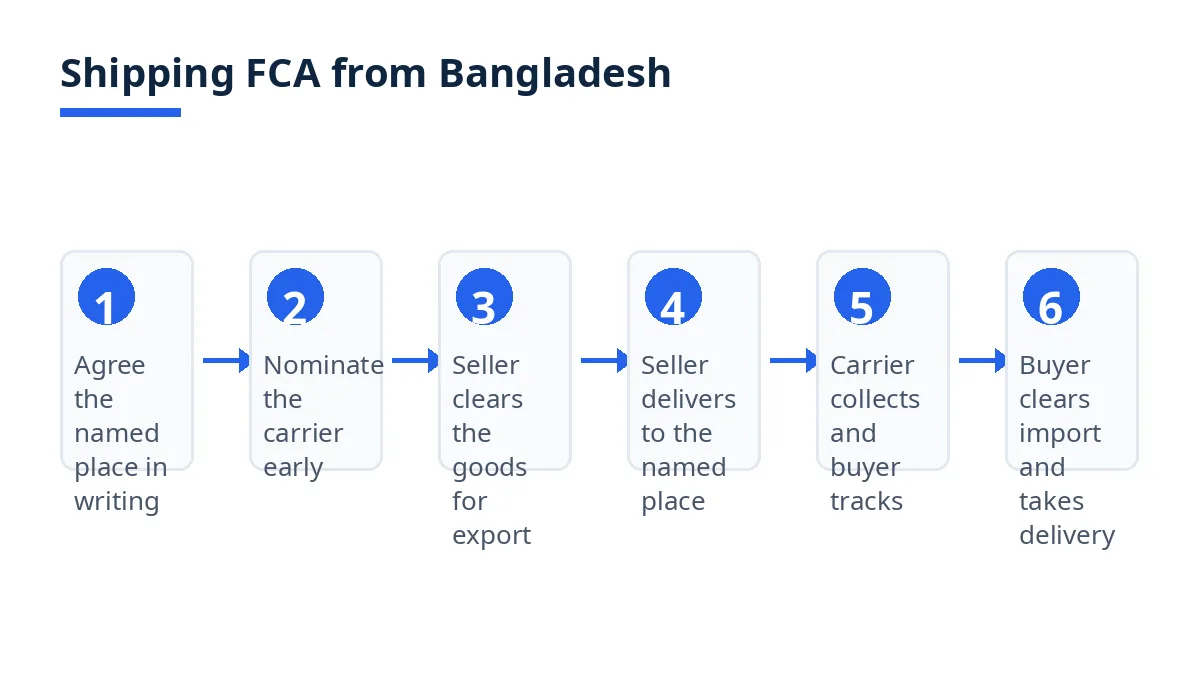
Write the named place in full. State the place, the point inside it where delivery happens, and the rule version, for example "FCA buyer's forwarder depot, Chattogram, Bangladesh, Incoterms 2020". Add the delivery window and receiving contact.
Nominate the carrier early. Send the seller the carrier name, booking reference, vehicle or flight details, and collection date, in writing and in good time, so the seller can complete export declarations correctly.2
Let the seller prepare and clear the goods. The seller packs and marks the goods for export and completes export clearance. In Bangladesh, goods may not be loaded or stuffed into containers for export unless an export declaration, the Bill of Export or Shipping Bill, is submitted to Customs and approved.3
Deliver to the named place. At the seller's premises, delivery happens when the goods are loaded onto the buyer's collecting vehicle. At another named place, delivery happens when the seller's vehicle arrives with the goods ready for unloading.2 Get a signed receipt at that moment, showing the place, date and time.
Hand over to the buyer's carrier and start tracking. From the named place, the buyer's carrier takes the goods onward. Ask for the booking confirmation, transport document reference and tracking link, and check that the description, quantity and weight match the invoice and packing list.
Clear import and take delivery at destination. The buyer handles import clearance, duties and taxes at destination, and takes delivery from the carrier there.2 Keep the handover receipt with the transport document, so any later question about where the goods changed hands has a written answer.
The mode changes the named place, not the rule. A sea shipment from a Gazipur factory might name a container terminal near Chattogram, with the seller trucking the container there. An air shipment might name the cargo terminal at Dhaka airport, for the buyer's airline booking. A factory in the southwest might name a point near Mongla, to shorten the inland leg. In each case, the contract must name the actual point, not the city alone.
Named place example | What the seller does | What the buyer's carrier does |
|---|---|---|
Seller's factory, Gazipur | Loads the goods onto the buyer's collecting vehicle | Drives the goods onward from the factory gate |
Forwarder depot near Chattogram | Trucks the goods there, ready for unloading | Unloads, then books the onward sea leg |
Container terminal, Chattogram | Delivers the container ready for unloading | Takes the container into the terminal system |
Cargo terminal, Dhaka airport | Delivers the cartons ready for unloading | Takes them for the booked flight |
Costs, timelines and documents
What are the typical costs and timelines?
There is no typical FCA shipping cost a guide can state, because the inland distance, the mode and the destination change every leg. What is fixed is the split. The seller bears preparation, export clearance and delivery to the named place. The buyer bears main carriage from the named place, any cargo insurance the buyer chooses, destination handling, import clearance and duty.2
For the cost picture in full, including which lines sit inside an FCA price and which sit outside it, see the companion guide on what an FCA price includes. For the timing of loss and damage, a separate question from cost, see the companion guide on when risk transfers under FCA.
Timelines follow the same split. The seller's timeline runs from production and packing to export clearance and delivery at the named place. The buyer's timeline runs from carrier booking and collection to transit and import clearance. Example figures: a buyer nominates the carrier 5 working days before the agreed collection date, the seller confirms export clearance 2 working days before collection, and the carrier collects inside a 1-day window. Those figures are illustrative only, not a standard lead time, and a late nomination compresses every step after it.
Which documents are needed?
At the named place, the buyer needs the signed handover receipt and the carrier's booking or transport reference. Behind the handover, the seller's export file includes the commercial invoice, packing list, EXP form certified by an Authorized Dealer bank, and certificate of origin, all enclosed with the Bill of Export.3 The full list, split by who prepares each item, is in the companion guide on FCA documents required.
One document point belongs in a shipping guide because it changes the sailing. Under Incoterms 2020, where goods are sold FCA for carriage by sea and a bank asks for a bill of lading with an on-board notation, the parties can agree that the buyer will instruct the carrier to issue that document to the seller once the goods are loaded on board, and the seller then tenders it to the buyer, often through the banks.1 Agree that point in the contract if a letter of credit will ask for it. Without the agreement, the carrier has no duty to issue it, and payment can stall after the goods have sailed.
Bangladesh-specific rules and tips
Chattogram is the port most FCA sea shipments from Bangladesh will pass through, so plan around its pressure, not just its location. According to the port authority, the country's busiest seaport handled a record 34 lakh TEUs and 4,324 vessels in FY26, and now processes around 92 percent of Bangladesh's seaborne trade and 98 percent of containerised cargo.4 The same report notes utilisation near 95 percent of annual container handling capacity, above the level at which ports often begin to face vessel delays and yard congestion.4 Build a buffer between the FCA delivery date and the vessel cut-off, and confirm the terminal cut-off with the carrier, not only the sailing date.
Roads carry most of the inland leg. The Daily Star report notes that freight transport in the Chattogram corridor still depends heavily on roads, that rail-based container transport remains limited, and that connecting roads around the corridor remain incomplete in places.4 A Gazipur to Chattogram truck leg can absorb a full day in congestion, so the seller's delivery window and the carrier's collection window should overlap, with a named contact at each end.
For export clearance itself, the sequence is fixed. The export declaration names the goods, their value, the exporter, the foreign buyer and the transport operator, and once it is approved after documentary check and physical verification, the goods are loaded for the ship, aircraft or truck.3 Export is complete once the ship, truck or airline leaves the port and the customs officer signs the shipping bill as shipped on board.3 Ask the seller to confirm approval before the carrier is booked to collect, because a carrier that arrives for goods still awaiting approval waits at the buyer's cost.
Three practical tips close the Bangladesh section. First, match the named place to the factory: a southwest factory gains little from a Chattogram named place if a Mongla point shortens the inland leg, and an air shipment gains nothing from a sea terminal named place. Second, keep one legal name for the seller across the contract, invoice, packing list and export declaration, since the declaration names the exporter and the foreign buyer.3 Third, confirm who books the inland truck when the named place is a terminal, so a road delay is visible before the collection window closes.
Mistakes and red flags
What are the most common mistakes?
Naming a city instead of a place. "FCA Chattogram" does not say whether delivery is at the factory, a forwarder depot or a container terminal, and each answer changes who loads and who unloads.2 Write the building, depot or terminal, and the point inside it.
Nominating the carrier late. A carrier nominated the day before collection may not get a booking or a slot, and the collection window passes. Nominate in writing, with booking references, days ahead, and confirm receipt.
Assuming the seller insures the main leg. Neither party is obliged to arrange insurance under FCA, and DHL notes that buyers are advised to take out cover from the point of delivery.2 If no one arranges cover, the main leg travels uninsured. Arrange cover before handover, starting at the named place.
Assuming the seller unloads at a terminal. At a named place other than the seller's premises, the seller delivers the goods ready for unloading and does not unload them.2 Do not expect the seller's driver to unload at the terminal.
Booking main carriage before export clearance is confirmed. A flight or vessel booking made before the Bill of Export is approved can expire while customs checks run. Confirm approval, then hold the booking.
Treating FCA as a door-to-door price. FCA ends at the named place in Bangladesh. Main carriage, destination handling, import clearance and duty are the buyer's account.2 For the wider set of rules, see the Incoterms guide for shipments from Bangladesh, and for a sea-only term that includes main carriage and insurance to the destination port, see the CIF guide.
Checklist
Before the goods move, every line should be answered in writing.
Full FCA named place, point inside it, and "Incoterms 2020" written in the contract.
Carrier nominated in writing, with booking reference, vehicle or flight details, and collection date and window.
Seller confirms export clearance approval, including the Bill of Export, before the carrier is booked to collect.3
Loading and unloading agreed: seller loads at its premises, carrier unloads at any other named place.2
Handover receipt agreed: signed at the named place, showing place, date and time.
Cargo insurance arranged by the buyer from the named place onward, where cover is wanted.
On-board bill of lading mechanism agreed in the contract, where a letter of credit will ask for one.1
Buffer between the FCA delivery date and the vessel or flight cut-off, allowing for Chattogram congestion.4
One seller legal name across contract, invoice, packing list and export declaration.3
How Exportain helps
On Exportain, post a request for quotation (RFQ) and state the quantity, destination, Incoterm and required certifications, so suppliers quote against the same term.5 Every quotation is versioned, showing unit price, MOQ, lead time, Incoterm, payment terms and validity, and accepting a quotation creates an order record with those terms.5 Write the full FCA named place into the RFQ itself, not only into later messages, so every quotation answers the same handover point.
For the onward leg, look up freight rates published by forwarders on Exportain and request quotes from listed freight, customs and inspection providers.5 Read badges for what they record: badges such as Exportain Verified record which checks the Exportain team has reviewed, and a badge is not a capacity or quality guarantee.5 That distinction matters under FCA, because the buyer, not the platform, controls the main carriage from the named place onward.
FAQs
What should I know first about FCA?
FCA means the seller delivers the goods, cleared for export, to a carrier you nominate at a named place you both agree.2 The seller loads at its own premises, and at any other named place delivers ready for unloading.2
What are the typical costs and timelines?
There are no typical figures, because inland distance, mode and destination change every leg. The split is fixed: the seller bears preparation, export clearance and delivery to the named place, and the buyer bears main carriage, insurance it chooses, destination handling, import clearance and duty.2
Which documents are needed?
At the handover, the buyer needs the signed handover receipt and the carrier booking or transport reference. Behind it, the seller's export file includes the commercial invoice, packing list, EXP form and certificate of origin, enclosed with the Bill of Export.3 An on-board bill of lading needs a separate contract agreement where a letter of credit asks for one.1
What are the most common mistakes?
Naming a city instead of a place, nominating the carrier late, assuming the seller insures the main leg or unloads at a terminal, booking main carriage before export clearance is confirmed, and treating FCA as a door-to-door price.2 Each is fixed in writing before the goods move.
Next steps on Exportain
Read how to buy from Bangladesh, then post your RFQ on the RFQ board with the full FCA named place, the mode and the collection window, so suppliers quote against the same handover point. Before you confirm a term, compare it with the Incoterms guide for shipments from Bangladesh and browse suppliers in the category you are buying.
Sources
- Incoterms® 2020. International Chamber of Commerce (ICC) (accessed )
- FCA Incoterms Explained: Free Carrier Meaning. DHL (accessed )
- Customs Clearance Procedures for Export. Bangladesh Customs, National Board of Revenue (accessed )
- Logistics woes stand in way of Ctg export hub. The Daily Star, (accessed )
- How to source and buy from Bangladesh. Exportain (accessed )
About the author
Sourcing from Bangladesh?
Post a request for quotation and suppliers on Exportain can send you their quotes directly.
Post an RFQ


