

FCA Pros and Cons: When Should Importers Use It?
FCA gives importers control of main carriage and insurance, but only pays off with a trusted forwarder and a precise named place. See when it wins, when it loses, and the checks to run before you agree it.
Short answer
FCA suits an importer who already has a forwarder in Bangladesh, buys containerized goods, and can consolidate loads, because the buyer then controls carrier choice and rates while the seller clears export and delivers to the named place. It is the wrong choice for a first-time buyer with no forwarder, a single small load, or a vague named place, where insurance, import clearance and early risk outweigh any freight saving.
On this page
Key takeaways
FCA pays when you already have a forwarder in Bangladesh, buy containerized goods, and can consolidate loads, because you then control carrier choice and rates.
FCA loses when you have no forwarder, a single small load, or a vague named place, because insurance, import clearance and early risk fall on you.
The named place decides who loads and unloads: the seller loads at its own premises, and anywhere else the unloading party must be stated in writing.
Judge FCA on its landed total, priced with your own forwarder, not on the FCA price alone, and confirm insurance starts at handover.
In Bangladesh, confirm the Bill of Export gate is owned and timed before your carrier booking, because goods are not loaded until the declaration is approved.
FCA, or Free Carrier, is a decision about control. Under this Incoterms 2020 rule, the seller delivers the goods, cleared for export, to a carrier or another person you nominate at a named place, and you take over main carriage, insurance and import clearance from that point. The International Chamber of Commerce (ICC) publishes 11 Incoterms 2020 rules that allocate cost, risk and obligations.1 FCA suits containerized cargo and works for any mode of transport.2
This guide answers only the decision question: when does FCA serve an importer, and when does it create work and exposure that another term would avoid. Price, risk timing and document detail live in companion guides, linked as pointers only.
The FCA decision in one table
Your situation | Verdict | Why it points that way |
|---|---|---|
Trusted forwarder, regular consolidated loads | Use FCA | Carrier choice and rate control, with the forwarder handling handover |
Containerized goods on a repeat lane | Use FCA | Fits containerized and multimodal movement, defined handover point2 |
First order, no forwarder in Bangladesh yet | Do not use FCA yet | Carriage, insurance and import clearance without a tested partner |
Single small load, no consolidation | Compare a delivered term first | Forwarder, insurance and handling effort spread across one small load |
Seller unsure on export clearance, or named place vague | Pause and fix the term | Vague named place is where handover disputes start |
Delivered quotation close to your FCA landed total | Compare both on the same specification | Control has value only if it saves money or time after full buyer-side costs |
When FCA wins for importers
You choose the carrier and the route. Once the seller hands the goods to your nominated carrier at the named place, you manage the rest of the journey and pay for the main carriage.2 If you already negotiate rates or consolidate loads, that control is worth more than seller-arranged freight.
You can consolidate across sellers. FCA lets each seller deliver to the same named place or forwarder, so several Bangladesh orders can travel as one consolidated load under your arrangement. That is where FCA most clearly beats a delivered term. Without consolidation, the same control buys less.
Costs split at a visible line. The seller covers costs and risks up to delivery to the carrier, and you take over from there.2 That split makes quotations easier to compare, because you can price your side with your own forwarder instead of accepting a bundled seller figure. Price every buyer-side head before you accept.
It fits containers and mixed transport. FCA can be used for rail, road, air, sea or multimodal shipments, and it is particularly suited to containerized cargo where the buyer often arranges the main carriage.2 It avoids the mismatch that sea-only terms create for containers.
You gain more than under Ex Works, with less burden than a delivered term. Compared with Ex Works, FCA puts export clearance and delivery to the carrier on the seller. Compared with a delivered term, it keeps freight and insurance decisions with you. That middle position is the point of FCA for an importer with logistics capability.
When FCA loses for importers
Insurance starts with you, at handover. The seller's responsibility ends when the goods are handed over, so you must have adequate insurance coverage for the onward journey in place before that moment.2 A gap between handover and the start of your cover is your loss, so confirm place, carrier and handover proof with your insurer in writing first.
Import clearance is your job, in full. You clear import customs, obtain licenses and permits, complete documentation and pay import duties, taxes and fees.2 For a buyer entering a new market, or buying a regulated product for the first time, that workload can outweigh any freight saving.
Loading and unloading depend on the named place. If delivery is at the seller's premises, the seller loads the goods onto your carrier. Anywhere else, the buyer may be responsible for unloading, which can lead to confusion if it is not clearly specified.2 State the exact address and both parties.
Risk arrives early. Under FCA you take risk and cost sooner than under a delivered term, because your responsibility begins at the named place rather than at destination. That is manageable for a repeat buyer with insurance and a forwarder, and a real exposure for a buyer who has arranged neither.
A weak seller side still hurts you. FCA does not remove the seller's export obligations, and a seller who struggles with export clearance or delivery to the named place can delay your carrier booking. A delivered term may then be the honest choice, even at a higher quoted price.
Scenario verdicts
These are illustrative scenarios, not real orders.
United States buyer consolidating knitwear from two Dhaka factories through one forwarder: use FCA. Loads consolidate, each seller delivers to the same arrangement, and handover sits with a partner the buyer already uses.
United Kingdom buyer placing a first order, with no forwarder in Bangladesh: do not use FCA yet. Appoint the forwarder first, run one order with its guidance, and revisit FCA on the repeat.
United Arab Emirates distributor with regular consolidated loads and its own forwarder: use FCA. Repeat volume, a standing carrier relationship and consolidation are exactly the conditions under which buyer control pays.
European Union buyer whose seller cannot confirm export clearance steps or a precise named place: pause. Fix the named place, loading party and export clearance owner in writing, or choose a term where the seller carries the journey to destination.
Why this matters for buyers and sellers
For the buyer, FCA changes the landed cost and the workload at the same time: rate control and consolidation on one side, main carriage, insurance and import clearance on the other. For the seller, FCA limits exposure after handover, but still requires export clearance and delivery to the named place. When either side treats it as a price label rather than a division of work, the named place becomes the dispute.
This guide stays on that decision. For the line-by-line price inclusions, see the FCA price guide. For when risk moves in detail, see the FCA risk transfer guide. For the full document list, see the FCA documents guide.
Step-by-step: how it works
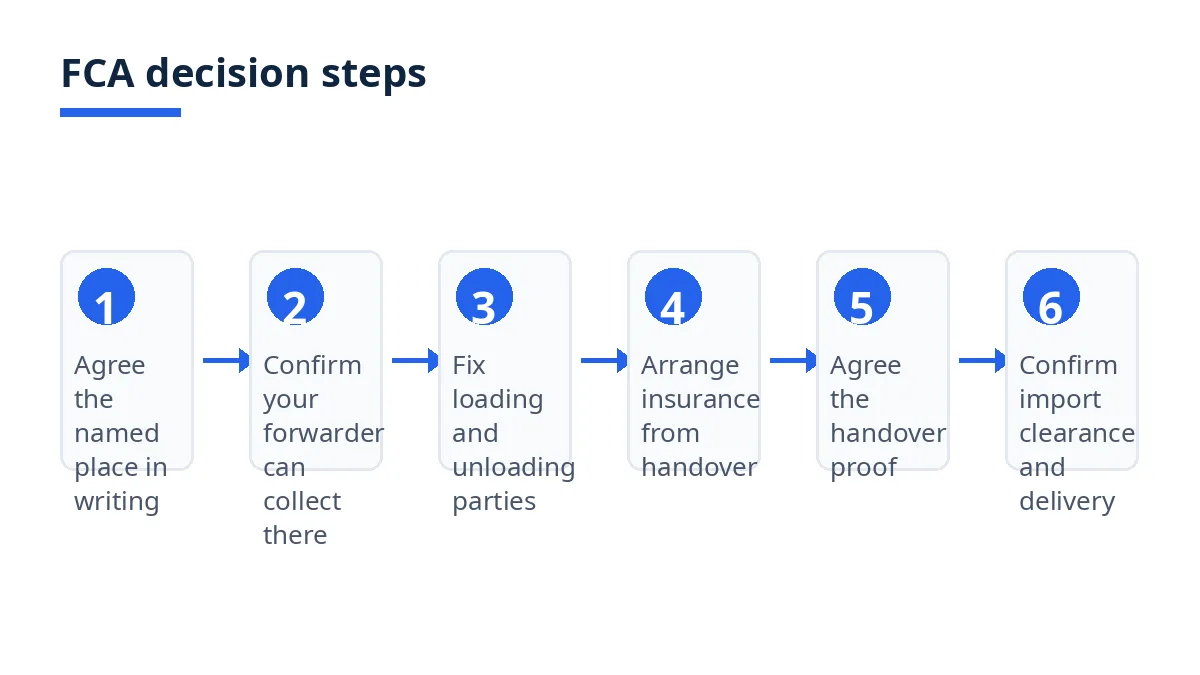
Name the exact place, in writing. Record the full address, not a city or a port name alone. It decides who loads, who unloads, and where your responsibility begins.
Confirm your forwarder can collect there. Check that your carrier serves that place, can meet the collection window, and will confirm handover in a form your insurer accepts.
Fix the loading and unloading parties. If delivery is at the seller's premises, the seller loads onto your carrier. Anywhere else, confirm who unloads.2
Put insurance in place from handover. Arrange cover that starts at the named place, not at the destination port, and confirm place, carrier and handover proof with your insurer before collection.
Agree the handover proof. For sea carriage under a letter of credit, Incoterms 2020 allows the parties to agree that the buyer will instruct the carrier to issue an on-board bill of lading to the seller once the goods have been loaded on board.1 Agree that document before shipment.
Confirm import clearance and delivery at destination. Name the broker, the duty payer and the final delivery address before the goods leave origin.
Costs, timelines and documents
What are the typical costs and timelines?
There are no typical FCA costs or timelines a guide can state as fact, because main carriage, insurance, import duties and destination handling all depend on your lane, your forwarder and your destination rules. Price the buyer-side heads with your own forwarder before you accept: main carriage from the named place, insurance from handover, import duties, taxes and fees, and onward transportation from the destination port.2 Compare that total with any delivered quotation on the same specification.
For timelines, ask your forwarder for collection, departure and destination delivery windows as separate lines, and ask the seller for the date the goods will be ready at the named place. Do not accept a single delivery week that hides the handover date.
Which documents are needed?
The full FCA document list is in the FCA documents guide. At decision stage, confirm only two things: the seller can complete export clearance and deliver to the named place, and you will receive handover proof your insurer, broker and payment terms accept.
Bangladesh-specific rules and tips
Choose the named place for loading, not just for geography. A seller factory in Dhaka or Gazipur and a forwarder terminal near Chattogram are different handover points with different loading parties. If delivery is at the seller's premises, the seller loads onto your carrier; anywhere else, confirm who unloads.2 Pick the place your forwarder serves, and write the loading party into the contract.
Respect the export gate. Under Bangladesh customs rules, goods shall not be loaded or stuffed into containers or shipped for export unless an export declaration, known as the Bill of Export or Shipping Bill, is submitted to Customs in the prescribed format and approved by the Customs authority.3 The declaration specifies the goods, value, exporter, foreign buyer or importer, and transport operator, and the enclosed set includes the export letter of credit or, where there is none, the bank-approved export contract or purchase order, the commercial invoice, the packing list, the authorized-dealer-certified EXP form, the certificate of origin, the VAT registration certificate and the taxpayer identification number.3 Confirm that this gate is owned and timed before your carrier booking.
Test the seller's FCA experience on the first order. Ask how the seller has delivered to a buyer-nominated carrier before, and who handled export clearance. A seller that has only sold on delivered terms may need extra coordination first time.
Keep destination rules on the buyer side. Import clearance, duties and taxes at destination sit with you under FCA.2 For the United States, the United Kingdom, the European Union and the United Arab Emirates alike, confirm duty, license and broker arrangements with your own adviser.
Mistakes and red flags
What are the most common mistakes?
Naming a city instead of a place. A contract that says only Dhaka or Chattogram does not fix the loading party, the collection address or the handover point. Name the full address and the loading party.
Leaving insurance to start at destination. Insurance must cover the onward journey from handover.2 A policy that starts at the destination port leaves the main carriage uncovered.
Assuming the seller loads at a terminal. The seller loads only when delivery is at its own premises. At any other named place, unloading and loading need an explicit owner.2
Booking no forwarder before ordering. FCA without a forwarder is a term without an operator. Appoint the carrier and confirm collection and handover proof before the purchase order.
Comparing an FCA price with a delivered price as if they were the same. An FCA price excludes main carriage, insurance and import costs that a delivered price includes. Compare landed totals on the same specification.
Accepting a verbal named place. Record the named place, the loading party, the insurance start point and the handover proof on the quotation and purchase order. If it is not written, it is not agreed.
Checklist
Named place as a full address, with loading and unloading parties named.
Forwarder confirmed to serve that place and confirm handover in an accepted form.
Insurance from handover at the named place, with carrier and place confirmed to the insurer.
Main carriage, insurance, import duties, taxes and destination delivery priced with your own forwarder.2
FCA landed total compared with any delivered quotation on the same specification.
Seller able to complete export clearance and deliver to the named place.
Bangladesh export declaration route confirmed before carrier booking.3
Handover proof agreed, including any on-board bill of lading arrangement for sea carriage under a letter of credit.1
Import broker, duty payer and final delivery address named before the goods leave origin.
Named place, loading party, insurance start and handover proof on the quotation and purchase order.
How Exportain helps
On Exportain, post an RFQ stating quantity and unit, target price, destination, Incoterm, required certifications and deadline, so suppliers quote against the same term.4 Every quotation is versioned with unit price, MOQ, lead time, Incoterm, payment terms and validity, and accepting creates an order record with those terms.4 Use that record to keep the named place and the FCA split visible. The steps for searching, comparing quotations and arranging freight and inspection are set out in how to buy from Bangladesh.
For the journey after handover, look up freight rates published by forwarders on Exportain and request quotes from listed freight, customs and inspection providers.4 Supplier verification is a document review by Exportain staff, not a factory inspection, and a badge is not a guarantee of capacity, quality or delivery.5
FAQs
What should I know first about FCA?
Know the split before you know the price. FCA, or Free Carrier, is one of the 11 Incoterms 2020 rules published by the ICC.1 The seller delivers the goods, cleared for export, to your nominated carrier at a named place, and you then pay for main carriage, arrange insurance and clear import customs.2 If you cannot yet name a forwarder, an insurer and a broker, FCA is premature.
What are the typical costs and timelines?
There are no typical figures, because main carriage, insurance, import duties and destination handling depend on your lane and destination rules. Price those buyer-side heads with your own forwarder before accepting.2 Judge FCA on its landed total, not on the FCA price alone.
Which documents are needed?
The full list is in the FCA documents guide. At decision stage, confirm that the seller can complete export clearance, including the Bangladesh Bill of Export gate,3 and that you will receive handover proof your insurer and payment terms accept.
What are the most common mistakes?
The most common mistakes are naming a city instead of a full named place, leaving insurance to start at destination, assuming the seller loads at a terminal, booking no forwarder before ordering, and comparing an FCA price with a delivered price as if they covered the same costs. Each is fixed by writing the named place, loading party, insurance start and handover proof into the contract.
Next steps on Exportain
Browse suppliers, then post your FCA named place, forwarder plan and destination on the RFQ board so suppliers quote on the same term and handover point. Before you accept, read the Incoterms guide and compare the FCA landed total with the CIF guide on the same specification.
Sources
- Incoterms® 2020. International Chamber of Commerce (ICC) (accessed )
- What does FCA mean? Incoterms explained. Pro Carrier (accessed )
- Customs Clearance Procedures for Export. Bangladesh Customs, National Board of Revenue (accessed )
- How to source and buy from Bangladesh. Exportain (accessed )
- Trust & Safety Center. Exportain (accessed )
About the author
Sourcing from Bangladesh?
Post a request for quotation and suppliers on Exportain can send you their quotes directly.
Post an RFQ


