EXW vs FOB: Key Differences, Costs and Which One to Choose
An FOB quote runs higher than an EXW quote for the same cargo, because the seller has already paid for the road to the port, the export papers and the lift aboard. This comparison prices that middle stretch and shows where money, risk and notices change hands.
Short answer
Under EXW, the seller makes the goods available at the factory, and the buyer handles the lift, export clearance, carriage and insurance. Under FOB, the seller clears the goods for export and puts them aboard the vessel the buyer nominates at the named port of shipment, and loss or damage becomes the buyer's concern once the goods are aboard. The buyer pays ocean freight and insurance under both terms, and FOB covers sea and inland waterway transport only.
On this page
Key takeaways
EXW leaves the lift, export clearance, road carriage and loading aboard with the buyer; FOB moves all four to the seller.
Under FOB, loss or damage becomes the buyer's concern once the cargo is aboard the buyer's nominated vessel, and late vessel notice can move the risk even earlier.
Neither term makes the seller buy insurance; the buyer buys cover to start when the risk starts, at the factory under EXW and at loading under FOB.
On the same journey the buyer spends the same total under both terms in the worked example; the term decides who runs each leg and when the risk moves.
A buyer comparing two quotations for one sea shipment is really comparing two different finish lines. One seller stops at the factory door and leaves the buyer to find a truck, clear the export and reach the ship. The other seller keeps going to the vessel itself and hands the cargo over only once it is aboard. The prices look far apart because the second seller has already bought the middle of the journey. This article sets the two finish lines side by side and prices the middle stretch.
Reading the two prices: where each seller stops
An FOB quotation runs higher because the seller has already paid to move the cargo to the port, clear it and lift it aboard. An EXW quotation runs lower because none of that work is in it. Freight across the ocean and marine cover sit outside both quotations, and the buyer pays for them either way.
Point of comparison | EXW (Ex Works) | FOB (Free On Board) |
|---|---|---|
Finish line | Cargo made available for collection at a named place, most often the seller's own site | Cargo aboard the ship the buyer chose, at the loading port named in the contract |
When loss or damage becomes the buyer's problem | As soon as the cargo is ready for the buyer's truck | As soon as the cargo is aboard the vessel |
Lift onto the first truck | Buyer's cost and buyer's risk | Seller's cost, inside the move to the port |
Export papers | Buyer | Seller |
Road to the port, port handling and the lift aboard | Buyer | Seller |
Ocean freight and marine cover | Buyer | Buyer |
Import papers, duty and delivery after arrival | Buyer | Buyer |
Modes the rule covers | Any mode, alone or combined | Sea and inland waterway only |
Place the contract must name | A place, usually the seller's premises | A port of shipment |
Delivery promises in plain terms: factory floor and vessel deck
Under EXW, delivery is complete when the seller makes the cargo available at the agreed place, most often its own premises, in a state ready for the buyer's vehicle.1 The buyer pays for the lift onto that vehicle and takes the risk of it, and the buyer also takes on the export formalities.1 No rule asks less of the seller: the price the seller quotes covers the goods and their packing.1 Because the buyer carries the export formalities, traders whose goods cross a border are urged to look at FCA instead, and a seller can finish up recorded as the exporter of record when the buyer has no establishment in the seller's country.1
Under FOB, delivery is complete once the cargo is aboard the vessel the buyer has nominated, at the port of shipment, and from that moment loss or damage is the buyer's concern.2 Getting the cargo to the port, putting it aboard and finishing the export formalities all sit with the seller.2 The buyer, in return, owes the seller prompt word of the ship's name and of the exact spot inside the port where loading will happen.2 Miss that notice and the consequences land early: where the cargo cannot be loaded because the buyer gave no timely word, the risk — and the extra costs — move to the buyer anyway.2 Where the nominated ship runs late and loading cannot happen at the agreed time, the buyer likewise carries the risk and the storage cost at the port while waiting for the vessel.2
Only FAS, FOB, CFR and CIF are confined to sea and inland waterway transport.3 EXW carries no mode limit, and the buyer books the onward carriage under it, alone or across several modes.1 FOB belongs to port-to-port sea carriage only.4 For FOB, the contract must name the port of shipment, and payment terms and title still need their own clauses, because the Incoterms rules do not settle them.3
The split, leg by leg: money, risk and notices
The table below follows one cargo from factory to ship.
Task or cost | EXW: seller | EXW: buyer | FOB: seller | FOB: buyer |
|---|---|---|---|---|
Goods, packed for export | Seller pays | No | Seller pays | No |
Lift onto the first vehicle | No | Pays, at own risk | Pays and arranges | No |
Road carriage to the port | No | Pays and arranges | Pays and arranges | No |
Handling at the port and the lift aboard | No | Pays and arranges | Pays and arranges | No |
Export clearance | No | Pays and arranges | Pays and arranges | No |
Ocean freight | No | Pays and arranges | No | Pays and arranges |
Marine cover | No | Arranges any cover | No | Arranges any cover |
Import clearance, duty and onward delivery | No | Pays and arranges | No | Pays and arranges |
Cover is the point buyers misjudge most often on an FOB quotation. The rule gives the buyer no insurance: once the cargo is aboard, the seller owes nothing for cover, and the buyer is under no duty to buy it either, so a buyer who does nothing sails uninsured.5 Only CIP and CIF put an insurance duty on the seller.6 A buyer who wants protection must therefore buy it to start when the risk starts. Under EXW the risk starts at the factory, so a policy that begins only at sailing leaves the road and the terminal uncovered. Under FOB the policy must be live by the moment of loading, because the risk moves aboard with the cargo, whether or not the ship has sailed.
The risk calendar makes the gap concrete. Harm during the factory lift sits with the buyer under EXW and with the seller under FOB. Harm on the road to the port sits the same way. Harm at sea sits with the buyer under both rules, because the cargo is already aboard under FOB and long since collected under EXW. One more case turns on the buyer's own message: if notice of the ship arrives late and the master closes for cargo early, the risk and the costs move to the buyer even though the cargo never went aboard.2 Put the ship, the loading spot and the shipment window in the order in writing, and ask the seller to confirm in writing when the cargo goes aboard or when a vessel fails to take it in the agreed window.2
Priced both ways: raw jute bales from Khulna to Antwerp
The figures below are illustrations, with exact arithmetic. Re-price every leg with a forwarder and a broker first. One buyer orders a load of raw jute bales from a mill outside Khulna for shipment to Antwerp. Jute bales go aboard in bulk at the port. The load is priced on EXW at the mill and on FOB at Chattogram.
Price element | EXW at the mill | FOB Chattogram |
|---|---|---|
Goods and export packing | 9,750 | 9,750 |
Lift onto the first vehicle at the mill | Buyer pays 75 | 75 |
Export clearance and documents | Buyer pays 185 | 185 |
Road carriage, mill to Chattogram | Buyer pays 340 | 340 |
Port handling and lift aboard | Buyer pays 165 | 165 |
Seller's quoted price | 9,750 | 10,515 |
Still owed after the seller price | 2,841 | 2,076 |
Buyer total to Antwerp, before duty | 12,591 | 12,591 |
The diagram below sets the two seller prices against the buyer-paid legs that finish each route.
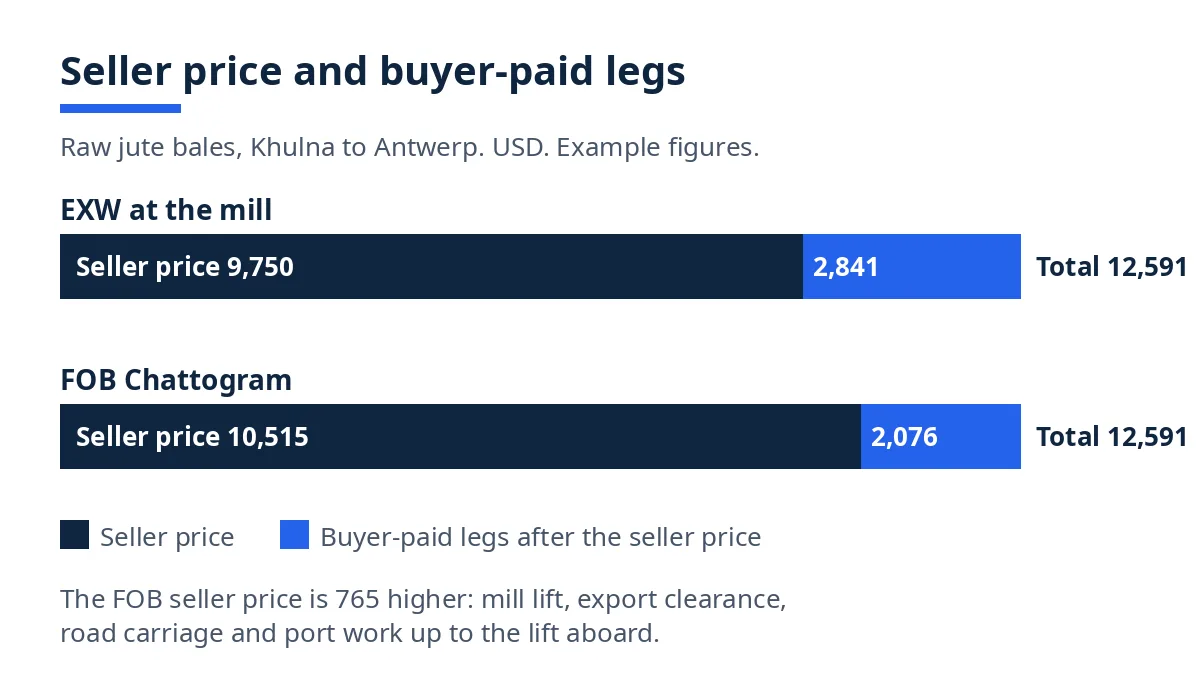
Both totals agree because the cargo and the voyage stay the same. After the seller's price, the EXW buyer still owes 2,841: the mill lift, clearance, road carriage, port handling and lift aboard, 1,980 of freight and 96 of premium. The FOB buyer still owes 2,076: freight and premium alone. Adding the legs gives 9,750 plus 75 plus 185 plus 340 plus 165 plus 1,980 plus 96, which equals 12,591 on either term.
The 765 gap between the two seller prices is the price of the four origin legs the FOB seller has absorbed. A buyer beats the FOB total only by buying one of those legs below the seller's figure for it. Duty at Antwerp, import clearance and delivery after arrival fall outside both totals; the duty figure needs a broker's confirmation, as no duty schedule was used here.
Picking the term: cargo shape, carrier control and local help
FOB fits a genuine port-to-port sea movement where the cargo goes aboard directly and the buyer wants the ocean leg in its own hands. The ICC guidance lists bulk and breakbulk cargo — minerals, oil, gas, cement, steel, grain and new vehicles — as the cargo that suits delivery aboard, and warns that containerised cargo, which usually reaches a terminal and waits, points to FCA instead.2 4 FOB also fits a buyer holding ocean contracts, since the buyer picks the line, fixes the sailing and pays the freight, while the seller handles the origin side.2 FOB also fits a buyer with nobody on the ground in Bangladesh.2
EXW pays only where the buyer already has hands in Bangladesh: a carrier able to collect at the mill, a forwarder able to clear the export, and a loading plan settled before collection day. With that help in place and orders repeating on one lane, keeping the origin legs under the buyer's own contracts can beat the seller's figures. Without it, the buyer is buying work it cannot watch, and export clearance is the leg likeliest to hold the order up.
Two misuses deserve a direct warning. First, FOB does not belong on air, road or rail movements, or on a multimodal journey that merely touches a vessel part-way; the rule covers sea and inland waterway carriage only.4 Second, the United States domestic phrases "FOB Origin" and "FOB Destination" are accounting shorthand, not Incoterms, and they have no place on an international purchase order.5 Write the full form instead, such as "FOB Chattogram, Incoterms® 2020", with the port, the shipment window and the last date for naming the vessel all stated.5
At Chattogram: export papers, the loading window and proof on board
Export clearance in Bangladesh is the reason an overseas buyer without an agent often cannot run an EXW order at all. Under section 131 of the Customs Act, 1969, no export cargo may be loaded or stuffed until Customs has cleared it, on an approved export declaration known as the Bill of Export.7 The declaration states what the goods are and what they are worth, who exports them, who buys them overseas and who carries them.7 The bundle that goes with it runs from the letter of credit for the export — or an approved contract, order or guarantee from the negotiating bank where there is no letter of credit — through the signed invoice, the authorised-dealer-certified EXP form, the packing list, the origin certificate, the VAT registration and the taxpayer identification number.7 Jute goods carry one more paper: an Export Registration Certificate sits among the product-specific documents that can apply.7 The seller runs all of this under FOB. Under EXW the buyer must run it, which is where a buyer with no agent in Bangladesh usually stalls.1
Approval comes before loading, and the export counts as complete when the ship sails, with the customs officer signing the shipping bill as shipped on board.7 Consignments stuffed at a private depot or at the exporter's own premises can face an inspection by gate-division officers before they travel on to the port area.7 Under FOB, the proof to hold is the document that matches the finish line: the bill of lading issued once the cargo is aboard, together with the seller's word that delivery is done.5 Before sailing, settle the port, the ship's name and the date the buyer's cover begins.
Buyers ask: four EXW-or-FOB questions
Which is cheaper, EXW or FOB, for the same shipment?
Neither. The seller prices differ by 765 in the example above, yet the buyer spends 12,591 before duty on either term. A cheaper total comes only from buying a leg for less than the other side's figure for it. Rank quotations only after adding the buyer-paid legs to each seller price, then add duty, import clearance and delivery after arrival to both.
Which is safer for a first-time importer, EXW or FOB?
FOB, by a clear margin. The seller moves the cargo to the port, finishes the export papers and puts it aboard, and the buyer takes the risk only from loading.2 EXW hands the buyer the risk at the factory and the whole export job with it, and the ICC Academy guidance warns that cross-border use of EXW can bring complications for both sides.1 The margin is not a guarantee: the buyer must still buy cover before loading and name the vessel on time, or the risk can move early and the voyage can sail uncovered.2 5
Can I switch from EXW to FOB after the purchase order is signed?
Yes, before shipment, if both sides agree it in writing. The term forms part of the sale contract, so the change belongs in an amended order with a fresh quotation and corrected papers.3 Price the change at the same time: the seller takes on the mill lift, the road, the port work and the clearance, so the seller price rises by those legs. Once the cargo has been made available under EXW, a later change cannot undo a risk position that has already begun.
Which term do Bangladeshi suppliers prefer, EXW or FOB?
FOB, in most cases the buyer meets. Clearance stays with the side that holds the papers and knows the Customs routine, which is the seller.7 The preference is a habit, not a rule: a mill with no export desk may offer EXW alone. Ask each supplier which term it quotes, ask what the price covers up to the moment of loading, and write the named port and the Incoterms edition into the request for quotation.
Next steps on Exportain
Start with the full FOB explainer, Chattogram example included, check the document checklist for an FOB sailing before the booking, and turn both quotations into one warehouse figure with the landed-cost method for the whole journey. Then request quotations on the term you have chosen.
Sources
- FCA & EXW Incoterms® 2020 explained: Key differences. ICC Academy (accessed )
- FOB & FAS Incoterms® 2020 explained: Key differences. ICC Academy (accessed )
- INCOTERMS® 2020 RULES. Dia Tisa (accessed )
- FCA & FOB Incoterms 2020 explained: Key differences. ICC Academy (accessed )
- FOB Incoterms Explained: A Complete Guide for Importers and Freight Forwarders 2026. GoFreight (accessed )
- Incoterms® Groupings Explained. School of Export (accessed )
- Customs Clearance Procedures for Export. Bangladesh Customs, National Board of Revenue (accessed )
About the author
Sourcing from Bangladesh?
Post a request for quotation and suppliers on Exportain can send you their quotes directly.
Post an RFQ