EXW vs FCA: Key Differences, Costs and Which One to Choose
EXW quotes look cheaper than FCA quotes for the same goods, because the buyer still has to pay for loading, export clearance and the first road leg. This comparison prices one container load three ways and shows where cost, risk and paperwork change hands.
Short answer
Under EXW, the seller places the goods at the buyer's disposal at a named place, the factory, and the buyer handles loading, export clearance, carriage and insurance. Under FCA, the seller clears the goods for export, loads them at its premises or delivers them ready for unloading at another named place, and hands them to the carrier the buyer nominates. The buyer pays main carriage and insurance under both terms, and risk passes at each term's handover point.
On this page
Key takeaways
EXW leaves loading, export clearance, carriage and insurance with the buyer; FCA moves loading at the seller's premises and export clearance to the seller.
FCA has two handover modes: loaded at the seller's premises, or delivered ready for unloading at another named place such as a container terminal.
Neither term obliges the seller to insure the goods; the buyer arranges cover from the moment risk passes.
For the same journey the buyer's total is the same under both terms in the worked example; the term decides who arranges each leg and when risk moves.
A quotation marked EXW and one marked FCA can describe the same cartons leaving the same factory, yet the EXW buyer takes on loading, export clearance and the first road leg, while the FCA buyer does not. The gap between the two prices is usually the cost of those jobs, not a discount on the goods.
The verdict in one table: EXW against FCA at the handover point
EXW gives the lowest quoted price and the most work. FCA gives a higher quoted price and a shorter job list, because the seller clears the goods for export and delivers them to the carrier the buyer names. Neither term includes main carriage or insurance in the seller's price.
Point of comparison | EXW (Ex Works) | FCA (Free Carrier) |
|---|---|---|
Delivery point | Goods placed at the buyer's disposal at a named place, usually the seller's premises | Goods handed to the buyer's nominated carrier, at the seller's premises or another named place |
Risk passes | When the goods are placed at the buyer's disposal, ready for loading | When the goods are handed over to the nominated carrier or person |
Loading at the seller's premises | Buyer pays and bears the risk | Seller loads the goods onto the buyer's collecting vehicle |
Export clearance | Buyer | Seller |
Main carriage and insurance | Buyer contracts and pays; buyer arranges cover | Buyer contracts and pays; buyer arranges cover |
Delivery under each rule: where the seller's job ends
Under EXW, the seller delivers by placing the goods at the buyer's disposal at the named place, typically the seller's own premises, ready for loading onto the vehicle the buyer sends.1 The seller neither loads the goods nor clears them for export; loading is at the buyer's expense and risk, and the buyer handles every export formality.1 The rule places the minimum obligation on the seller, and is most safely used for domestic trade.1
For imports from Bangladesh this matters: although EXW may technically be used internationally, traders are strongly encouraged to consider FCA instead where goods cross a border, because export duties fall on the buyer.1 A buyer not established in the seller's country can find the seller treated as the exporter of record, which creates difficulty for both sides.1
Under FCA, the seller delivers the goods to the carrier or person nominated by the buyer at the agreed place and point, and carries out export clearance.1 Risk transfers at handover to that carrier or person, and the buyer then contracts the main carriage and handles import formalities.1
Both rules sit inside the eleven Incoterms 2020 rules published by the International Chamber of Commerce (ICC). Only four are limited to sea and inland waterway transport: FAS, FOB, CFR and CIF.2 FCA works with any mode, including multimodal shipments, as do CPT, DPU and DDP.1 DDP goes further, because the seller also clears the goods for import and pays the duty at the destination.
The two FCA handover points, and why the second one changes the price
FCA is the only rule in this comparison with two delivery modes, and the mode chosen changes what the seller's price must cover.
In the first mode, the named place is the seller's premises, and the seller fulfils the duty by loading the goods onto the buyer's collecting vehicle.1 Risk passes at that loading, and the seller's price covers the goods, packing, loading and export clearance, and nothing beyond the factory gate.
In the second mode, the named place is elsewhere: an airport or port container terminal, a train terminal, or an inland container depot.1 The seller fulfils the duty by delivering the goods to the carrier or the buyer's designated person, ready to be unloaded from the vehicle that brought them there, and does not load them onto the next mode of transport.1 The buyer unloads them and loads them onto the next leg. The seller's price in this mode also covers carriage from the factory to the named place, which is why an FCA terminal quote runs higher than an FCA factory quote for the same goods.
Carrier nomination makes the second mode work: the buyer nominates the carrier, and the seller delivers to that carrier at the agreed place and point.1 Record the carrier, the named place and point, and the collection date in the order; a handover agreed in general terms, with no carrier named, is the most common reason a terminal delivery is disputed.
Incoterms 2020 added one FCA mechanism for sea carriage: the parties may agree that the buyer will instruct the carrier to issue an on-board bill of lading to the seller once the goods have been loaded on board, for the seller to tender to the buyer, often through the banks.2 This matters where payment is by letter of credit and the bank asks for an on-board document. Agree it before shipment; it does not apply automatically.
Cost, risk and paperwork: the three splits that decide the quote
The table below splits the same journey leg by leg; the next section puts example figures on each leg.
Task or cost | EXW: seller | EXW: buyer | FCA: seller | FCA: buyer |
|---|---|---|---|---|
Goods and export packing | Pays and arranges | No | Pays and arranges | No |
Loading at the seller's premises | No | Pays, at own risk | Pays and arranges | No |
Carriage to a named terminal | No | Pays and arranges | Pays, where the named place is the terminal | Pays, where the named place is the premises |
Export clearance | No | Pays and arranges | Pays and arranges | No |
Main carriage, insurance, import clearance, onward transport | No | Pays and arranges | No | Pays and arranges |
Buyers often assume a higher-priced term includes insurance. It does not, under either rule: the Incoterms rules place an insurance duty on the seller in only two cases, CIP and CIF.1 Under EXW and FCA the seller owes no insurance, so the buyer who wants cover arranges it from the moment risk passes; cover starting only at sailing can be too late for damage at the factory gate or terminal.
Risk timing decides claims. Under EXW, risk passes when the goods are placed at the buyer's disposal ready for loading, so a pallet dropped during loading is the buyer's loss.1 Under FCA at the seller's premises, risk passes at loading, so the same pallet is still the seller's loss. Under FCA at another named place, risk passes at handover to the carrier, so damage on the road leg to the terminal is the seller's loss and damage after handover is the buyer's.
One container, two quotes: a worked comparison
Example figures only: illustrative figures, exact arithmetic, to be re-priced with a forwarder and a broker before ordering. One buyer orders a container of cotton bed linen from a factory outside Dhaka for delivery to Felixstowe. The same journey is priced three ways: EXW at the factory, FCA at the factory, and FCA at the Chattogram container terminal.
Price element | EXW at the factory | FCA at the factory | FCA at the terminal |
|---|---|---|---|
Goods and export packing | 18,400 | 18,400 | 18,400 |
Loading onto the collecting vehicle | Buyer pays 120 | 120 | Buyer pays 120 to unload at the terminal |
Export clearance and documents | Buyer pays 310 | 310 | 310 |
Inland carriage, factory to terminal | Buyer pays 420 | Buyer pays 420 | 420 |
Terminal handling at the named place | Buyer pays 180 | Buyer pays 180 | 180 |
Seller's quoted price | 18,400 | 18,830 | 19,310 |
Buyer-paid legs after the seller's price | 4,345 | 3,915 | 3,435 |
Buyer total to Felixstowe, before duty | 22,745 | 22,745 | 22,745 |
The diagram below shows the three seller prices side by side, with the buyer-paid legs that complete each route.
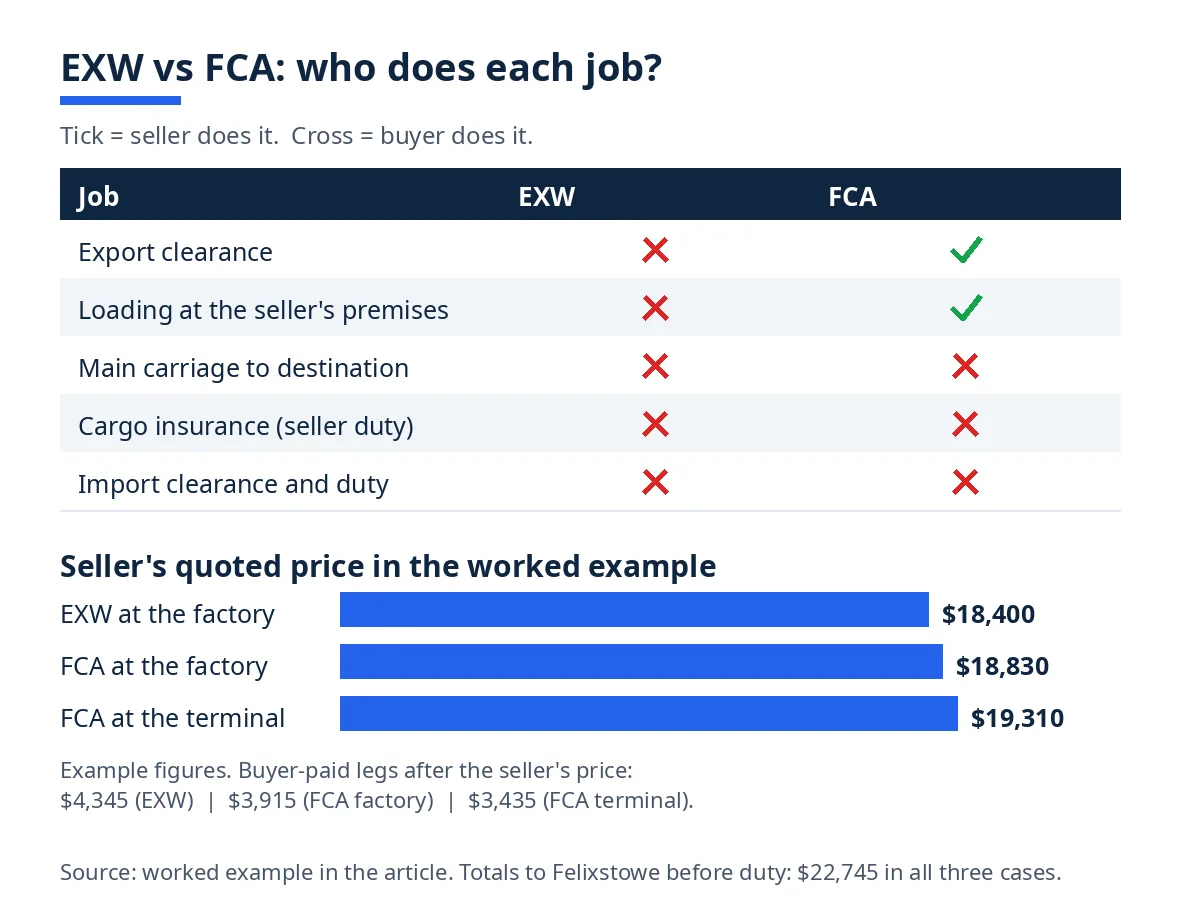
The totals match because the journey is the same. The EXW buyer pays 4,345 after the seller's price, covering loading, clearance, inland carriage, terminal handling, freight of 3,150 and a premium of 165. The FCA factory buyer pays 3,915, and the FCA terminal buyer pays 3,435. In each case 18,400 plus 120 plus 310 plus 420 plus 180 plus 3,150 plus 165 equals 22,745.
An EXW quote that looks 910 lower than an FCA terminal quote is not 910 cheaper: it is 910 of work the buyer has not yet bought. The saving appears only if the buyer's own forwarder moves a leg for less than the seller's figure for that leg. Duty at Felixstowe, import clearance and onward transport sit outside all three totals, and must be added under either term.
Choosing between EXW and FCA for container loads and nominated carriers
Container loads are the strongest case for FCA. Containers are usually handed to a carrier at a yard, depot or terminal well before loading on a vessel, and the FCA handover point can be fixed there. The rule suits container and multimodal transport.3 FOB, by contrast, fixes delivery and risk at loading on board at the port of shipment, and suits bulk cargo moving port to port.3 Writing FOB for a sealed container handed over at an inland depot chooses a risk point that does not match the real handover.
Choose EXW only where the buyer can perform the Bangladesh legs: a carrier who can collect at the factory, a forwarder who can complete export clearance, and a loading plan agreed before collection. A buyer with a freight partner in Bangladesh and repeated orders on the route can make EXW pay; one with no local presence is taking on work it cannot supervise.
Choose FCA at the seller's premises where the buyer wants to keep control of the main carriage and the carrier, but wants the seller to load the goods and clear them for export. Risk passes at loading, and the price gap to EXW is small: 430 on an 18,400 order above.
Choose FCA at a named terminal where the buyer wants a single handover with a carrier receipt at the point where its carrier takes over, as with consolidated containers or a forwarder collecting at the terminal. Name the terminal and the point inside it, so the handover can be proved from the receipt. For air freight the same logic applies, since both rules work with any mode.1
Ordering from Bangladesh: export clearance and the terminal handover
Bangladesh export clearance is the practical reason many overseas buyers move from EXW to FCA. Goods may not be loaded or stuffed in containers for export until Customs has approved a Bill of Export for the consignment.4 The declaration records the goods, their value, the exporter, the foreign buyer and the transport operator.4
The documents enclosed with the Bill of Export include the export letter of credit or, where there is none, the contract, purchase order or guarantee approved by the negotiating bank, the signed commercial invoice, the packing list, the EXP form certified by an authorised dealer, the certificate of origin, the VAT registration certificate and the taxpayer identification number.4 Product-specific documents can also apply, such as an Export Registration Certificate for jute goods and tea.4 Under FCA the seller completes this clearance; under EXW the buyer must arrange it, which is why an overseas buyer with no agent in Bangladesh often cannot perform an EXW purchase in practice.
The terminal handover has its own checkpoint. Once the declaration is approved, the goods are loaded into containers, and the export is complete once the ship, truck or aircraft leaves the port.4 Where goods are loaded at private inland container depots or the exporter's premises, a gate division officer may check them before they proceed to the port area.4 Confirm the depot, gate and receiving point, and ask for the carrier receipt recording the handover time and place.
Questions buyers ask before choosing EXW or FCA
Is EXW or FCA cheaper for a first container order?
The EXW quote is lower, but the buyer's total for the same journey is usually the same: 22,745 before duty above. EXW becomes cheaper only when the buyer's own carrier performs a leg for less than the seller's figure for it. Compare the quote plus every buyer-paid leg, not the headline prices.
Which term is safer for a first-time importer: EXW or FCA?
FCA is safer for a first-time importer: the seller loads the goods, completes export clearance, and hands them to a carrier the buyer nominates.1 Under EXW the buyer carries the risk from the moment the goods are placed at its disposal and must arrange loading and clearance itself, which the ICC Academy guidance warns can lead to complications where goods cross a border.1
Can an EXW or FCA term be switched after the purchase order is signed?
Yes, if both parties agree in writing before shipment, recorded in an amended purchase order with a reissued quotation and corrected documents: the term is part of the sale contract.1 A switch after handover cannot rewrite the risk position that already applied, so agree the change and any price adjustment before dispatch.
Which term do Bangladeshi suppliers prefer, EXW or FCA?
Suppliers commonly prefer FCA, because it keeps export clearance with the party holding the documents and the Customs routine above.4 That preference is not a rule: a factory with no export desk may quote EXW only. Ask which term the supplier quotes, and record the answer in the request for quotation.
Next steps on Exportain
Start with the eleven-rule comparison for shipments leaving Bangladesh, check what an EXW price on its own covers before accepting a factory-gate quote, and see how the sea-freight term prices insurance and freight if a seller offers a delivered-port price. Then work the buyer-side legs into a landed figure for the full journey, and request quotations on the term you have chosen by following the buying process on the platform.
Post a free RFQ on Exportain and get quotes from verified Bangladeshi suppliers
Sources
- FCA & EXW Incoterms® 2020 explained: Key differences. ICC Academy (accessed )
- Incoterms® 2020. International Chamber of Commerce (ICC) (accessed )
- FCA & FOB Incoterms 2020 explained: Key differences. ICC Academy (accessed )
- Customs Clearance Procedures for Export. Bangladesh Customs, National Board of Revenue (accessed )
About the author
Sourcing from Bangladesh?
Post a request for quotation and suppliers on Exportain can send you their quotes directly.
Post an RFQ