EXW vs DPU: Key Differences, Costs and Which One to Choose
Under DPU the seller delivers the goods unloaded at a named place, inland included, and carries the risk to that point. Under EXW the seller's part ends at the factory gate. This comparison prices one shipment of tote bags both ways.
Short answer
Under EXW, the seller makes the goods available at a named place, usually the factory, and the buyer handles loading, export clearance, carriage and insurance. Under DPU, the seller arranges carriage, completes export formalities, and delivers the goods unloaded at a named place, which can be any place, not only a terminal. Risk passes on unloading. Under both terms the buyer clears import customs and pays duty.
On this page
Key takeaways
DPU delivery happens at the named place after the seller unloads the goods; risk passes there, not at shipment.
Under DPU the seller pays carriage, bears the transit risk and completes export and transit formalities; the buyer clears import and pays duty.
DPU can name any place, not only a terminal: a depot, warehouse bay or rail siding inland all qualify.
DPU differs from DAP only on unloading and from DDP only on who clears import and pays duty; EXW leaves the buyer to load, clear export and buy all carriage.
In 2020, one Incoterms® name changed, and the change explains the whole EXW vs DPU comparison. DAT, Delivered at Terminal, became DPU, Delivered at Place Unloaded, because delivery under the rule was never confined to a terminal. The seller had to deliver the goods unloaded at whatever place the contract named. EXW, by contrast, never moved at all: the seller's part still ends where the goods stand ready for collection. This article compares the two rules through that single contrast, unloaded delivery at a named place against collection at the seller's premises, and prices one Bangladesh shipment both ways.
DPU in brief, EXW in brief
DPU means the seller carries the goods to the place and point the contract names, unloads them from the arriving vehicle, and places them at the buyer's disposal there. Risk passes when the goods stand unloaded and the seller has notified the buyer so collection can take place.1 The seller arranges and pays for the carriage, completes export formalities and any transit customs, and bears the risk of loss or damage for the whole journey to the named place.1 The buyer then clears import, pays duty, and arranges onward carriage past the named place.1
EXW means the seller leaves the goods where the buyer can collect them, usually at its own factory or warehouse, and does no more. Loading onto the buyer's vehicle, export clearance, carriage, insurance and import all fall to the buyer, and risk passes the moment the goods stand ready for loading.2 The seller's price, on that basis, covers the goods and their packing only.2 EXW is the lightest seller obligation in the set of eleven rules, and it suits domestic trade, where no border crossing creates an export file.2
Comparison point | EXW | DPU |
|---|---|---|
Seller's obligation ends | Goods ready for loading at the seller's premises | Goods unloaded at the named place, at the buyer's disposal |
Final lift off the vehicle | Buyer's job, at the buyer's risk and cost | Seller's job, at the seller's risk and cost |
Risk passes | On readiness for loading | On unloading at the named place |
Carriage arranged and paid by | Buyer | Seller |
Export formalities | Buyer | Seller, with transit customs where needed |
Import formalities and duty | Buyer | Buyer |
Insurance the seller must buy for the buyer | None | None |
Transport modes | Any mode, or a combination | Any mode, or a combination |
Named place | Normally the factory or warehouse | Any place the parties describe |
The table shows why the two quotations for one container look so different. DPU folds carriage, export papers, handling and the final lift into the seller's price. EXW leaves every one of those items for the buyer to buy separately. A buyer that cannot unload safely at the destination should not accept DPU: the Academy guidance states plainly that where safe unloading cannot be ensured, DAP fits better,1 since DAP leaves the lift to the buyer.
The named place: anywhere the contract can describe
The DAT rename matters because it widened the map. Under DAT, delivery sat at a terminal, broadly understood, such as a port, airport or rail terminal. Under DPU, the parties may designate any place, and the guidance stresses that freedom as the reason for the new name.1 The ICC index states the same point from the other side: DPU replaced DAT to make clear the destination can be any place and not just a terminal, and that unloading is the only difference from DAP.3 A depot, a warehouse bay, a distribution centre or a rail siding inland can therefore serve as the named place, as long as the seller can unload there and the contract describes the spot well enough for a driver, a forklift operator and a customs officer to find the same place.
Description is where DPU contracts succeed or fail. The named place fixes two things at once: the end of the seller's carriage and risk, and the start of the buyer's. A city name fixes neither. Write the site, the bay or terminal inside it, the street address and the delivery window, and repeat that wording, unchanged, across the quotation, invoice and transport document. The Academy guidance illustrates the standard with a DPU contract naming a refrigerated terminal at Le Havre, and a DAP contract naming a numbered terminal at Changi airport: in both, the place is a precise point, not a town.1
Mode follows the same widening. DPU belongs to the rules usable for any mode of transport, including journeys that combine modes.1 A container that starts at an inland depot, travels by road, then by sea, then by road again, reaches a single DPU handover at the end. The D rules as a group deliver at the destination, so delivery and destination coincide; the C rules deliver at the origin handover and treat the destination as the end of the carriage the seller paid for.4 The four sea-only rules cannot describe that journey: only FAS, FOB, CFR and CIF are confined to sea and inland waterway transport.
Following the carton: origin, carriage, lift, import
Take the journey in the order it happens. At the origin, the EXW buyer must agree a loading plan with the factory, send a vehicle, and handle the export file. The seller's duty under EXW stops at making the goods available, and the buyer bears the loading risk.2 Where the buyer has no presence in Bangladesh, the export file creates the complication the guidance highlights: the file can end up in the seller's name although the buyer arranged the shipment.2 The guidance steers border-crossing trades toward FCA in that situation.2 Under DPU, the origin work belongs to the seller, including the factory lift inside the carriage arrangement used in the priced example below, and the export and transit papers.1
During carriage, the DPU seller bears the risk and pays the freight to the named place, across every mode the journey combines.4 The EXW buyer bears the risk from readiness at the factory and pays each leg separately. Checking, measuring, weighing and packing are the seller's tasks under the D rules, so ask for the check records alongside the shipping documents and query any short count before the goods leave the named place.4 Insurance tracks the same split. No D rule requires the seller to insure for the buyer; whether the seller insures its own exposure on the way to the destination is for the seller to decide.4 The only rules that require a seller-bought policy for the buyer are CIF, at Institute Cargo Clauses (C) as the default level, and CIP, at the higher Clause (A) level.3 The DPU buyer therefore arranges cover starting at delivery, for the lift's aftermath and the onward leg. The EXW buyer arranges cover starting at the factory, before the first lift. Set each policy to begin at the risk point in the contract.
At the destination, the lift is the delivery act under DPU. The seller unloads, gives notice, and risk passes. Under the Asunción example in the C-versus-D guidance, a seller delivered 250 vehicles to a street address in Paraguay, unloaded them there, and only then passed the risk to the buyer, who had already completed import formalities at the border.4 After delivery, import clearance, duty and onward carriage belong to the buyer under both DPU and EXW. If the goods never arrive, or arrive damaged, the D seller must offer a remedy, for instance sending the goods again, or be in default.4 Under EXW, damage after readiness at the factory is the buyer's loss, whether or not the goods left Bangladesh.
Stage | EXW | DPU |
|---|---|---|
Origin and loading | Buyer loads, buyer bears the risk | Seller, inside the carriage arrangement |
Export and transit papers | Buyer | Seller |
Carriage and transit risk | Buyer | Seller |
Final lift | Buyer | Seller, always at the seller's cost |
Import papers, duty, onward leg | Buyer | Buyer |
One shipment priced both ways: canvas tote bags to an inland depot in Duisburg
The figures below illustrate the method only. They are illustrations, not quotations. Re-price each leg through a forwarder and a broker for a live order. Example figures throughout. One container of cotton canvas tote bags leaves a factory in Narayanganj for a named depot in Duisburg, Germany, with the bay number written into the contract. From Narayanganj the box moves by road, by sea, then by road again, ending at the Duisburg depot. The seller's carriage arrangement includes the factory lift and the road leg to the port. Unloading at Duisburg sits inside the DPU seller's price, because under DPU the seller always bears the unloading charge.4
Price element | EXW at the factory | DPU at Duisburg |
|---|---|---|
Goods plus export packing | 14,820 | 14,820 |
Loading the truck at the factory | Buyer pays 95 | 95 |
Export papers | Buyer pays 210 | 210 |
Road carriage to Chattogram | Buyer pays 285 | 285 |
Handling at Chattogram port | Buyer pays 165 | 165 |
Sea freight and final road leg | Buyer pays 1,840 | 1,840 |
Transit premium | Buyer pays 118 | No premium: seller holds the risk |
Unloading at the depot | Buyer pays 140 | 140 |
Seller's quoted price | 14,820 | 17,555 |
Legs the buyer still pays | 2,853 | 0 |
Buyer total before duty and import clearance | 17,673 | 17,555 |
The chart below places the two seller prices beside the remaining buyer-paid legs, with the example figures labelled.
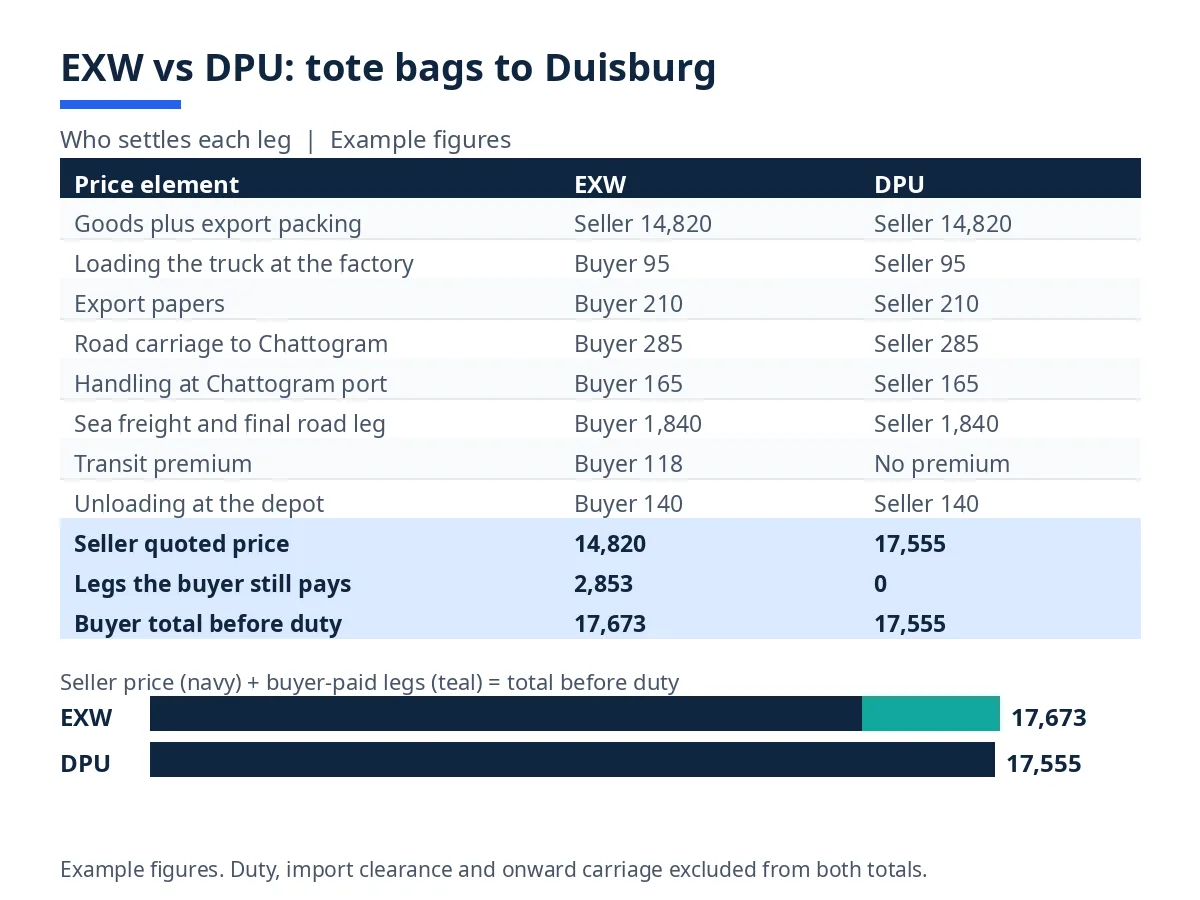
The EXW addition runs: 14,820 plus 95 plus 210 plus 285 plus 165 plus 1,840 plus 118 plus 140, giving 17,673. The DPU addition omits the 118 premium, because the transit risk sits with the seller, so the buyer purchases no cover for it, giving 17,555. Between the two seller prices lies 2,735 of work the DPU seller already purchased: the factory lift, the export papers, the road and sea freight, the port handling, and the unloading at the depot. Once the seller is paid, the EXW buyer still faces 2,853 of legs to settle. The DPU buyer faces none of the legs in this table, and moves directly to the import file, the duty payment and the onward truck. Read the 2,735 gap as work already purchased, not as a surcharge. Duty, import clearance and onward carriage from Duisburg fall outside both totals, whichever term applies. No duty rate is printed here, because this article consulted no duty schedule for Germany. Have a broker confirm the duty figure, then complete both columns with duty, clearance and onward carriage before ranking any quotation.
Deciding: five buyer situations
The buyer controls the Bangladesh end. With an agent, a carrier and a forwarder already working in Bangladesh, EXW keeps carrier choice and timing in the buyer's hands, and the buyer can often price each leg more cheaply on its own. EXW also suits domestic sales, where no export file arises.2
The buyer has no one at the destination to unload. DPU is the answer where the seller can unload safely at the named place and the buyer has no crew, forklift or yard there. The seller performs the lift and bears its risk and cost.1
The buyer has its own warehouse crew. DAP fits better where the buyer wants the lift under its own control, or where the seller cannot guarantee safe unloading. DAP and DPU agree on carriage, risk, export papers and import papers, and part company only on the lift.1 Note the cost wrinkle: under DAP, the unloading charge may or may not fall inside the carriage contract, so the sales contract must state the position. In the Changi pasta case, the buyer paid the carrier's unloading fee because the freight deal excluded it.1
The buyer wants the seller to handle import too. DDP is the maximum-obligation rule: the seller delivers at the named place and the seller also takes on import clearance and pays duty and taxes, while the buyer takes the goods off the vehicle.5 Use it only where the destination country's rules allow the seller itself to clear import. Where the local importer must clear the goods, DDP cannot operate, and a buyer-clearance D term is the correct choice.5 Under DDP, the buyer owes the seller help in obtaining the documents and information the import authorities request.5 Ask a Bangladeshi seller offering DDP how it will clear import and who will act as importer of record before accepting the price.
The buyer has no broker yet. No D term repairs that gap on its own. Appoint a broker first, confirm the duty funds, and then choose DPU or DAP. Under DPU, the goods stand unloaded while the import file remains the buyer's task, and the risk from delivery onward already sits with the buyer.
Record the decision in the purchase order: the rule, the named place in full, the unloading position, a notice contact, and the import plan. An order that names only a city and stays silent on the delivery window leaves the delivery point, the completeness of the lift, and the timing of clearance all open to argument after the seller has finished its part.
Bangladesh orders: three preparations before the ship sails
First, settle the import file early. The seller completes the export papers and any transit customs under DPU, so the buyer never handles the Bangladesh export file.1 Give the seller the order details, consignee information and destination papers promptly, in the form requested. A late document from the buyer can stall export clearance and with it a journey the seller agreed to run.
Second, agree how arrival notice will reach the buyer. The seller must notify the buyer so the buyer can collect the goods at the named place.4 Agree one reachable contact for arrival days, with an email address and a phone number that are checked, rather than a shared inbox nobody owns. Keep the broker's file ready before the vessel sails, duty funds confirmed, so clearance can begin as soon as the goods stand unloaded.
Third, book the onward leg. The seller's duty ends at delivery, and the buyer arranges any further transport.1 A container that arrives on schedule and then waits for a broker or a truck has not failed in transit. The plan around it failed. Reconfirm the full sequence when the transport document issues: the named place in full, the delivery window, the notice contact, and the moment risk passes, after unloading.
Questions buyers ask about EXW vs DPU
Is DPU the safer pick for a first-time importer?
On the voyage, yes; on arrival, DPU demands preparation. The seller takes the goods to the named place at its own risk, completes the export papers, arranges the carriage, and performs the lift, taking away the stages where first orders most often stall.1 Import clearance, the duty payment and the risk after delivery remain the buyer's.1 Pair a first DPU order with a broker appointed before shipment, cover arranged from delivery onward, and a delivery window fixed in writing. EXW carries the heaviest risk for a newcomer with no Bangladesh agent, because loading, export clearance and carriage all sit with the buyer from the factory gate.2
Does DPU work out cheaper than EXW on the same shipment?
In the Duisburg example, the DPU total before duty sits 118 dollars below the EXW total, because no transit premium is purchased while the transit risk sits with the seller. The gap reflects the insurance position, not cheaper freight, and other orders will produce other gaps. Add every remaining buyer-paid leg to each seller figure, then complete both columns with duty, clearance and onward carriage before comparing. A DPU figure without duty beside an EXW figure with duty proves nothing: the comparison is incomplete until both columns carry the same additions. A broker must confirm the duty figure, since this article opened no schedule of rates.
Can EXW be switched to DPU after the purchase order is signed?
Yes, before dispatch, by agreement. The term forms part of the sale contract, so both sides should sign an amendment that re-prices the deal and aligns the documents: re-issue the order and the quotation, and make the invoice, packing list and transport document all state DPU. The change adds the seller's carriage, papers, transit risk and final lift to the price, and shifts the delivery point from the factory to the named place, after unloading. The reverse change removes them and returns freight booking, export papers, transit risk and the lift to the buyer. If a letter of credit states the old term, amend it too, since banks check the documents against it. Settle the price, the unloading position and the start of cover before dispatch: risk that passed at the factory gate stays passed.
Which term do Bangladeshi suppliers usually offer, EXW or DPU?
There is no single answer, and none is claimed here. A seller's offer follows its setup. A seller already booking its own freight and handling its own export papers can quote DPU readily. A factory that sells through an agent and holds no freight arrangement of its own may quote EXW and nothing else. Raise the question in the request for quotation: state the term wanted and the exact place, and request separate lines for freight, papers, handling, unloading and insurance. A DPU quotation without a named place, a delivery window, or a split of the legs cannot be set beside another seller's EXW quotation, and the lower headline may simply be the quotation that left the most work unpurchased.
Next steps on Exportain
Start with the EXW page, which sets out the seller's minimum obligation, then see how the eleven rules divide into E, F, C and D groups to place DPU among the any-mode rules. Apply the landed-cost method that adds duty, clearance and the last leg to either quotation, and compare the insurance position with the CIF page, where the seller buys the policy and the buyer claims on it. When the term is settled, use the steps for asking suppliers to quote on the term you picked to request quotations on DPU or EXW.
Sources
- DAP & DPU Incoterms 2020 explained: Key differences. ICC Academy, (accessed )
- FCA & EXW Incoterms® 2020 explained: Key differences. ICC Academy (accessed )
- Incoterms® 2020. International Chamber of Commerce (ICC) (accessed )
- Incoterms® 2020 C rules vs D rules: Risk transfer explained. ICC Academy (accessed )
- DAP & DDP Incoterms 2020 explained: Key differences. ICC Academy (accessed )
About the author
Sourcing from Bangladesh?
Post a request for quotation and suppliers on Exportain can send you their quotes directly.
Post an RFQ