EXW vs DDP: Key Differences, Costs and Which One to Choose
Under DDP the seller carries the goods to your named place, clears import and pays duty and tax. Under EXW the seller stops at the factory gate. This comparison prices one shipment of tote bags both ways, with duty shown as an example figure.
Short answer
Under EXW, the seller places the goods at your disposal at its own premises, and you arrange loading, export clearance, carriage, insurance and import clearance. Under DDP, the seller arranges carriage, clears the goods for export and import, pays duty and taxes, and delivers them to the named destination ready for unloading, where risk passes to you. You still bear the unloading risk, and the unloading cost depends on the carriage contract.
On this page
Key takeaways
DDP puts carriage, export and import clearance, duty and taxes on the seller; risk passes only at the named destination, ready for unloading.
EXW puts loading, export clearance, all carriage and import clearance on the buyer; risk passes at the seller's premises.
DDP differs from DAP only on import clearance and duty, and from DPU only on unloading, which DPU puts on the seller.
Never rank an EXW figure against a DDP figure until duty, clearance charges and unloading are added to both, with the duty figure confirmed by a broker.
Two quotations can cover the same cartons and still look like they describe different shipments. One ends at the factory. The other ends at your door, with the border already crossed and the duty already settled. The gap between them is not a freight margin. It is the whole import job, moved from your desk to the seller's.
This article treats that move as the subject. It starts with the import question, because that question decides whether DDP can work at all, then sets out the obligations, the price anatomy and a priced shipment from Bangladesh. Every illustrative number is labelled as an example figure.
Start with clearance, not freight: the test that decides DDP
Test | EXW (Ex Works) | DDP (Delivered Duty Paid) |
|---|---|---|
Who runs the import file | Buyer | Seller |
Who pays duty and taxes | Buyer | Seller |
When does risk move | At the seller's premises | At the named destination |
Who books the carriage | Buyer | Seller |
Who loads the goods | Buyer, at the buyer's risk | Seller, onto the transport vehicle |
Who unloads at the destination | Buyer | Buyer, at the buyer's risk |
Insurance bought for the buyer | None owed | None owed |
The test is simple to state and hard to pass. A DDP seller must complete import formalities in the buyer's country, pay the duty and taxes, and still deliver at the named place. Some countries bar foreign entities from import formalities altogether, and even where the practice is allowed, the destination country's paperwork and tax rules can be hard and expensive for an outsider to meet, above all for a smaller seller.1 Where the seller has no route into the import system, DDP should not be agreed, and DAP is the better-advised rule, since the import obligation then rests with the buyer.1 Ask the clearance question before asking about freight rates. A cheap DDP freight figure from a seller who cannot clear import is not a bargain. It is a shipment that will stop at the border.
Transport mode does not separate these two terms. Both work with any mode of transport, or with several modes combined.1 Only FAS, FOB, CFR and CIF are confined to sea and inland waterway transport.2 A container that travels by truck, ship and rail can therefore move under either term, and the mode of travel tells you nothing about who clears import.
What each term asks of the seller, in one pass
Under EXW the seller's share is the smallest the rules allow. The seller hands over the goods at its own premises, prepared for loading onto the truck the buyer sent; loading is then the buyer's job, at its own risk and cost.1 From that moment the buyer assumes all costs and risks, including export clearance, carriage and import clearance.1 The seller helps with transport security documents only when the buyer asks, and then at the buyer's risk and cost.1 An EXW invoice carries the goods and their packing. It carries nothing else.3 Because the seller handles no customs file, EXW fits domestic trade most naturally, and traders moving goods across a border are strongly encouraged to consider FCA instead, under which the seller carries out export clearance.3 A buyer with no establishment in Bangladesh can also face a recording difficulty, since customs can treat the seller as the exporter even though the buyer organised the movement.3
Under DDP the seller's share is the largest the rules allow. The seller delivers the goods and transfers risk only when they reach the agreed destination, typically the buyer's premises, so the movement is in substance door to door, with every risk and cost on the seller except unloading.1 The seller loads the goods, books and pays for the carriage, runs the export, transit and import files, and carries the transport security duties at its own risk and cost.1 The seller must make the goods available to the buyer on the arriving vehicle, ready for unloading, by the date in the contract or inside the agreed window, and must warn the buyer in time to receive them.4 The buyer then unloads, carrying the risk of the lift, and in most carriage deals the buyer also pays for it. Where the transport contract already includes the unloading charge, the buyer does not pay it again, but the risk of the lift remains the buyer's in either case.1 Settle the charge and the risk as two separate lines in the contract, so neither is assumed from the other.
Insurance is not part of either bargain. Under DDP the seller answers for the goods until the named place, and whether the seller insures that exposure is the seller's own call; no policy is owed to the buyer.1 Under EXW the buyer answers from the factory gate, so cover must start there, covering the lift, the road to the port and the wait before sailing. A policy that starts when the vessel sails leaves those early legs uncovered. Under DDP the buyer's own cover matters only from unloading onward, for the lift and any onward movement, since the seller's risk ends at the named place. The eleven rules together require the seller to buy a policy for the buyer under only two of them, CIP and CIF, and DDP is not one of the two.2 5 The ICC index records the two levels of cover behind that split: Clause (C) remains the default for CIF, with a higher level available, while CIP requires the higher Clause (A) cover.5
Where DDP ends and DAP or DPU begins
The three D rules look alike from the origin. All three put carriage, transit risk, export formalities and transit customs on the seller, and all three deliver at the named destination rather than at shipment.4 The differences sit at the destination end, and they are small in words and large in effect.
DAP and DDP share delivery ready for unloading, carriage, risk and export formalities, and differ on one point only: under DAP the buyer carries out and pays for import clearance, while under DDP the seller does.4 DPU differs from both on unloading: under DPU the seller takes the goods down from the arriving vehicle at the named place, while under DAP and DDP the buyer does.2 A buyer who confuses DDP with DPU will expect the seller to unload goods the seller has no duty to unload, and a buyer who confuses DDP with DAP will expect the seller to clear import goods the seller has no duty to clear. Name the rule, the place and the unloading position in the same sentence of the order, so the three rules cannot be mistaken for one another.
The C rules give a useful contrast for buyers coming from CIF or CFR. Under a C term the seller delivers at shipment, by handing the goods to the carrier or loading them on board, while the destination named in the contract is only the place to which the seller has paid the carriage.2 Under a D term delivery and destination coincide, and the seller's risk runs to that place.2 That is why a DDP seller who fails to reach the named place has not performed, while a CIF seller whose goods are lost at sea after loading has delivered, although the buyer bears the loss from loading onward. The distinction matters when a shipment goes wrong: under DDP the seller owes the buyer a remedy, for example shipping the goods again, or is in default.2
Inside a DDP price: the duty line, the tax question, and the importer of record
A DDP invoice should read as a finished figure. It covers the goods and packing, loading, carriage to the destination, security requirements, export, import and transit customs, and the risk of loss or damage, which may require the seller to buy insurance and include it in the price.1 An EXW invoice, by contrast, carries the goods and packing only.3 Any comparison that sets the two headlines side by side without opening the DDP figure is therefore comparing a finished figure with an unfinished one. Ask for the split: carriage, clearance charges, duty and taxes, and the unloading position, each on its own line. A seller who cannot show the duty amount inside the price has given a figure that cannot be checked.
No duty or tax rate appears in this article. Duty turns on classification, origin, value and the destination country's rules, and this article opened no tariff schedule for the destination. Get the duty amount from a broker first, then add duty, the clearance fee, unloading and the onward leg to both sides before ranking quotations. Tax needs the same treatment. Who can recover import VAT, or a similar tax, and who cannot, turns on the destination country's tax rules and on who stands as importer of record. Confirm that position with a broker or tax adviser before accepting a DDP figure. A duty-paid headline is not automatically the cheaper landed figure once the tax position is counted.
The importer-of-record question is the practical form of the clearance test. In an Academy case, a Dhaka seller agreed DDP delivery to a named address in Beaverton, Oregon, and carried out and paid the import formalities with United States Customs; where a seller has no entity or presence in the United States, the seller might have to take on foreign-importer-of-record status.2 Before agreeing a DDP figure from a Bangladeshi seller, ask who will stand as importer of record, which broker or agent will act in the destination country, and what happens if the authority there refuses a foreign declarant. The buyer must assist the seller with documents or information the import authorities ask for, but that assistance does not move responsibility: the seller remains answerable for the clearance process and its difficulties.4 Unclear answers are a reason to choose DAP and use a broker of your own, even though the DDP headline looks more convenient.
One shipment, two invoices: canvas tote bags from Dhaka to Rotterdam
The figures below are example figures, not quotations. Get fresh figures from a forwarder and a broker before relying on any leg. A buyer orders one container of printed cotton canvas tote bags from a maker in Dhaka, for a named warehouse in Rotterdam, Netherlands, with the delivery bay stated in the contract. A truck carries the container to Chattogram, a vessel carries it to Rotterdam, and for this example the seller's transport booking includes the factory lift and both inland legs, and leaves unloading out. The duty and tax line is an example amount of 940 dollars, used only so both columns can be completed; replace it with the broker-confirmed figure before any decision.
Price element | EXW at the factory | DDP at Rotterdam |
|---|---|---|
Goods and export packing | 11,940 | 11,940 |
Origin legs: loading, papers, inland, port | Buyer pays 645 | 645 |
Main carriage to Rotterdam | Buyer pays 1,980 | 1,980 |
Transit premium | Buyer pays 95 | No premium: seller carries the risk |
Import clearance charge | Buyer pays 290 | 290 |
Duty and import taxes (example amount) | Buyer pays 940 | 940 |
Unloading at Rotterdam | Buyer pays 120 | Buyer pays 120 |
Seller's quoted price | 11,940 | 15,795 |
Buyer-paid legs after the price | 4,070 | 120 |
Buyer total | 16,010 | 15,915 |
The chart that follows puts each seller figure next to the amounts still left for the buyer, with every number marked as an example figure.
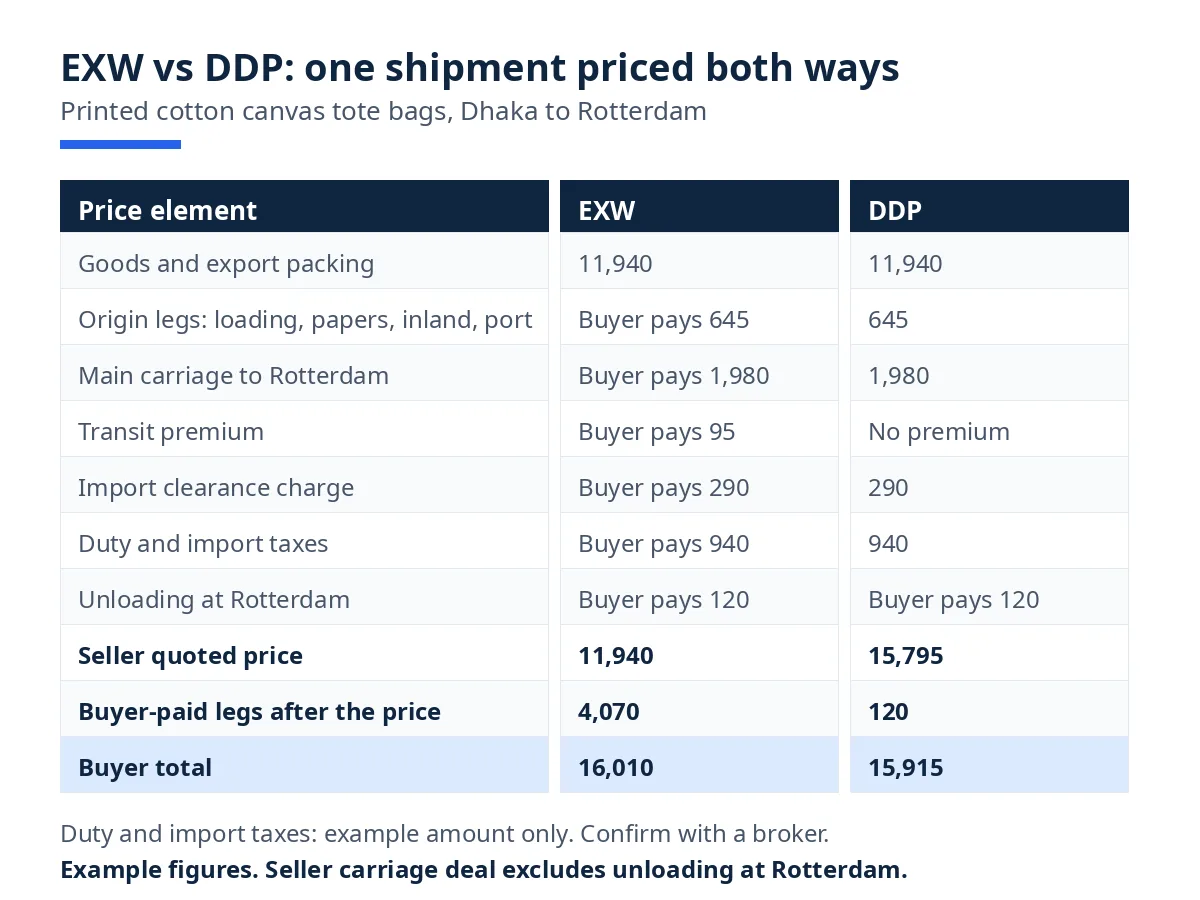
The arithmetic is straightforward. On the EXW side, 11,940 plus 645 plus 1,980 plus 95 plus 290 plus 940 plus 120 equals 16,010. On the DDP side, the seller's price of 15,795 already holds the origin legs, the carriage, the clearance charge and the duty amount, and adding the 120 unloading charge gives 15,915. The seller prices differ by 3,855, which is the origin work, the carriage, the clearance charge and the duty amount that the DDP seller has already settled. After paying the seller, the EXW buyer still has 4,070 to settle. The DDP buyer still has 120 to settle, for unloading only. The 95 gap between the two totals is the transit premium alone: the EXW buyer buys cover from the factory gate, while the DDP buyer buys none for the transit leg, because the seller holds the risk until the named place. That gap will not appear on every order, and it says nothing about whose freight is cheaper.
A change in the duty amount moves both totals by the same amount, since the duty line sits in both columns, once as a buyer payment and once inside the seller's price. A change in the carriage figure moves only the side that booked the carriage: the DDP seller's price if the seller booked it, or the EXW buyer's remainder if the buyer did. Rank the two figures only after every remaining leg, the clearance fee, any unloading fee left outside the carriage deal, and the onward leg have been added to each side. A DDP total with no duty line cannot be called cheaper than an EXW total that includes one. It is unfinished.
Picking between the two by what each side can actually run
Situation | Term that fits |
|---|---|
Buyer controls its own agent, transport and paperwork in Bangladesh, and wants to pick the carrier | EXW, after checking FCA for a cross-border movement |
Buyer wants carriage and transit risk handled by the seller, and will run import itself | DAP |
No unloading crew or equipment waits at the destination | DPU |
Buyer wants import clearance and the duty bill handled by the seller | DDP, if the seller has a lawful import route |
Seller cannot get the goods through the destination import system | DAP, not DDP |
Buyer has no broker and import would be slow | Appoint a broker first; no term fixes that gap alone, then DAP or DDP |
EXW suits a buyer able to manage the Bangladesh end without help and who wants control of carrier choice and timing. It also suits a buyer who prefers to keep every booking in its own hands, accepting that the work starts at the factory gate. Even that buyer should check FCA first for goods crossing a border, since FCA moves export clearance to the seller while keeping delivery at the seller's premises in one of its two forms.3
DDP suits a buyer who wants one figure to cover the whole arrival and a seller who can genuinely deliver it. It does not suit a buyer who must stand as importer of record for tax reasons, or a seller with no broker, agent or registration route in the destination country. DAP suits the buyer between those positions: the seller runs carriage and risk to the destination, and the buyer keeps its import routine, its duty bill and its last leg in its own hands. DPU suits the narrower case where the destination site has no unloading crew or gear and the seller can safely unload there.
For a first order, DDP removes the legs where new importers stall: export papers, carriage booking and transit risk. It replaces them with one reliance, on the seller's clearance route. A first-time importer who accepts DDP without checking that route has traded visible work for a risk that only appears at the border. For a newcomer with no agent in Bangladesh, EXW demands the most work of all, since the buyer takes on the lift, the export file and the carriage booking. The term whose hardest job sits with the party already equipped to do it is usually the safer pairing, whether that is the seller's clearance under DDP or the buyer's own broker under DAP.
Running a DDP order from Bangladesh: checks before the ship sails
Put four questions to the seller in writing before the purchase order is signed. How will you clear import in the destination country, and who will stand as importer of record. Which broker or agent will act for you there, and what duty and tax amount sits inside your price. How will unloading be charged, inside your carriage deal or by the buyer. And what notice will you give, through which named contact, so the buyer can receive the goods on arrival. The seller must give timely notice of arrival at the agreed destination, enabling the buyer to receive the goods.4 Agree one named contact who answers during the delivery window, rather than a general inbox that nobody checks on arrival days.
The buyer's own duties under DDP are small but not empty. Give the seller the order and consignee details, plus any destination documents it requests, quickly and in the format it asks for. A document that arrives late can hold up the clearance the seller is paid to run. Book the unloading crew and gear for the delivery window, with written agreement on who pays for the lift, following what the carriage deal says. Book onward carriage from the named place, because the seller's carriage, clearance and risk end there, ready for unloading. The seller completes export formalities and any transit customs under DDP, so the Bangladesh export file never reaches the buyer's desk.4 The buyer's preparation then belongs at the destination: the place written precisely, the crew booked, the onward carrier booked, and the seller's clearance route confirmed before sailing.
Write the fallback into the order as well. If the seller cannot complete import clearance, or the destination authority refuses a foreign declarant, the order should state the next step: conversion to DAP at an agreed price adjustment, with the buyer clearing import and paying duty, rather than a shipment held at the border while the parties argue about a term that cannot be performed. Confirm the sequence, the notice contact and the handover place again once the transport document is issued, so the papers, the price and the term all show the same bargain.
Questions buyers ask before choosing EXW or DDP
Which term gives the lower total for the same shipment?
In this example the DDP total sits 95 dollars under the EXW total, and the whole gap is the transit premium the DDP buyer does not buy. That result comes from the insurance position alone, not from freight that costs less, and it need not repeat on another order. Rank the figures only after duty, the clearance fee, any unloading fee left outside the carriage deal, and the onward leg have been added to both sides. Get the duty amount from a broker, since this article opened no tariff schedule for the destination. A comparison that leaves duty out of one column is not a comparison.
Is DDP the safer choice for a first-time importer?
DDP is safer on the voyage and more dependent at the border. The seller brings the goods to the named place, with the risk staying with the seller until then, finishes export and import papers, pays duty and taxes, and buys the carriage.1 The buyer still carries the unloading risk, and depends on the seller's clearance route in a foreign import system, which can be difficult for the seller to run.1 For a first order, DDP with the clearance route checked in writing, the unloading charge settled, and cover in place for the lift and the onward movement is the safer pairing. For a newcomer with no agent in Bangladesh, EXW demands the most work, since the buyer takes on the lift, the export file and the carriage booking, with risk moving at the seller's premises.3
Can the term change from EXW to DDP once the order is placed?
Yes, while the goods remain with the seller, if both sides agree in writing. Treat the change as a fresh bargain, not a correction: a fresh quotation carrying the new price, and fresh paperwork naming DDP throughout, with the transport document, the packing list and the invoice all aligned. A letter of credit that names the old term needs amending as well, because the bank checks the documents against the credit. Settle the new price, the unloading charge, the importer of record and the start of cover before the goods move, since the risk point moves with the term.
Why do some Bangladeshi sellers decline to quote DDP?
Sellers decline when they have no way into the destination import system. That is a capability question, not a price question. A seller with a broker or agent in the destination country and a route into its import formalities can offer DDP, while a maker with no such route faces the foreign-clearance difficulty the Academy guidance warns about, including countries where foreign entities are barred from import formalities altogether.1 Raise it in the RFQ. State the term and the precise place, and ask for freight, papers, handling, clearance, duty and unloading each priced on its own line. Without a named destination, a delivery point and a split of the legs, a DDP quote cannot be set beside an EXW quote from another seller on equal terms.
Next steps on Exportain
Start by checking what an EXW figure on its own actually buys, then see where DDP sits among the other ten rules and the seller-bought policy that CIF, unlike DDP, must provide. Turn either quotation into a single door-to-door figure by building one warehouse figure from either quotation, and when the term is settled, ask sellers to quote on it through the buying flow for asking sellers to quote DDP.
Sources
- DDP & EXW Incoterms® 2020 explained: Key differences. ICC Academy (accessed )
- Incoterms® 2020 C rules vs D rules: Risk transfer explained. ICC Academy (accessed )
- FCA & EXW Incoterms® 2020 explained: Key differences. ICC Academy (accessed )
- DAP & DDP Incoterms 2020 explained: Key differences. ICC Academy (accessed )
- Incoterms® 2020. International Chamber of Commerce (ICC) (accessed )
About the author
Sourcing from Bangladesh?
Post a request for quotation and suppliers on Exportain can send you their quotes directly.
Post an RFQ