EXW vs DAP: Key Differences, Costs and Which One to Choose
A DAP price carries the goods, and the risk, to a named place in your country, ready for unloading. An EXW price stops at the factory gate. This comparison prices one shipment of polo shirts both ways.
Short answer
Under EXW, the seller makes the goods available at a named place, usually the factory, and the buyer handles loading, export clearance, carriage and insurance. Under DAP, the seller arranges carriage and bears the risk to a named place in the buyer country, delivering the goods ready for unloading. The buyer then unloads, clears import customs and pays duty under DAP, and under both terms.
On this page
Key takeaways
DAP delivery happens at the named destination, with the goods ready for unloading and still loaded; risk moves there, not at shipment.
Under DAP the seller pays carriage, bears the transit risk and completes export and transit formalities; the buyer unloads, clears import and pays duty.
Unloading cost under DAP turns on the carriage contract: confirm in the sales contract whether it sits inside the seller's freight.
DAP differs from DPU only on unloading and from DDP only on import clearance and duty; EXW leaves loading, export clearance and all carriage with the buyer.
A factory-gate quotation and a delivered quotation for the same polo shirts can differ by more than three thousand dollars. The shirts cost the same in both. The difference is everything that happens after the shirts leave the factory: the truck, the export papers, the port, the ocean leg, and who answers for a loss along the way.
DAP puts that whole journey on the seller. The seller must bring the goods to a spot both sides named in the buyer's country, and hand them over still loaded on the arriving vehicle, ready to be taken off. EXW puts the journey on the buyer from the start. The seller only has to leave the goods where the buyer can fetch them, usually at the factory, before anyone loads a truck.
This article compares the two terms on one real-shaped journey, answers the unloading question that sparks most destination arguments, and separates DAP from DPU and DDP.
The destination test: a DAP price ends ready for unloading, an EXW price ends at the gate
Every quotation answers one question first: how far does the seller go? With EXW, the seller goes as far as its own gate. With DAP, the seller goes as far as the spot named in the contract, in the buyer's country. The rest of the comparison grows out of that distance.
What changes | EXW (Ex Works) | DAP (Delivered at Place) |
|---|---|---|
Delivery happens | At the named place, usually the factory, before loading | At the named spot in the buyer's country, goods still loaded, ready to be taken off |
Risk moves | As soon as the goods stand ready for the buyer's truck | On arrival at the named spot |
Carriage bill | Buyer | Seller |
Factory loading | Buyer pays and bears the risk | Seller, inside the carriage deal used in the example below |
Export papers and transit customs | Buyer | Seller |
Import papers and duty | Buyer | Buyer |
Taking goods off the vehicle | Buyer | Buyer, at the buyer's risk; who pays depends on the carriage deal |
Cover in transit | Buyer buys it if wanted | No policy owed to the buyer; the seller carries the risk |
Carriage after the named spot | Buyer | Buyer |
DAP fits a buyer who wants goods brought to its door country at the seller's risk, and who can still clear import, pay duty and unload when they arrive. EXW fits only a buyer who can fetch, load, clear and ship from Bangladesh without help. Anyone else who signs EXW has chosen the lowest headline and the longest list of jobs.
What delivery means under each term: factory availability against arrival ready for unloading
EXW asks the least of any Incoterms® 2020 rule. The seller leaves the goods at its own premises, ready for the truck the buyer sent, and the buyer pays to lift them on.1 Export papers are the buyer's problem too.1 That can embarrass both sides: customs may record the seller as exporter although the buyer arranged the shipment, when the buyer has no local presence.1 Where goods cross a border, traders are strongly encouraged to pick FCA instead.1 An EXW price holds the goods and their packing, and nothing else.1 The rule works for any mode, or several modes together, with the buyer hiring the carrier.1 It fits domestic sales, where no border is crossed.
DAP asks far more. The seller must carry the goods to the spot named in the contract and hand them over ready to be taken off the arriving vehicle, still loaded.2 Risk of loss or damage moves at that spot, in the buyer's country in most trades.2 The seller books the carriage, pays for it, finishes the export papers and any transit customs, and carries the risk for the full journey.2 The buyer steps in after the seller's arrival notice, takes the goods, finishes import papers, and books any carriage beyond the named spot, for example to its own warehouse.2
Delivery and destination are one and the same under the D rules.3 The named spot is where the goods arrive, where they are handed over, and where risk moves. Under the C rules the two ideas split: the seller ships from the origin and pays freight to the destination, yet delivery and risk move far earlier, at handover to the carrier or at loading on board.4 A CIF seller naming Shanghai delivers at the load port in Europe, and arrival in Shanghai is no longer the seller's concern between seller and buyer.2 A DAP seller naming the same port must get the goods there, at its own risk.2
The mode boundary decides which rules can even apply. Only FAS, FOB, CFR and CIF are confined to sea and inland waterway transport. DAP joins the rules that work for any mode, which is why it suits container loads and journeys that mix truck, ship and train.3 A sealed box collected at an inland depot and carried three ways has a single DAP handover, at the end. A sea-only rule would pin delivery to a loading moment that the box, in that form, never meets.
The named place, written precisely: point, unloading and the import file
A DAP contract lives or dies on its named spot. Name more than a city. Name the terminal, the cargo area, the rail siding or the warehouse bay, with an address and a delivery window. The Academy examples do exactly that: a numbered terminal at an Asian airport, a named airport in Spain.2 3 The spot is where delivery happens and risk moves, so it is also where the buyer must be ready. A city name leaves both sides disputing which gate the truck should use and whose timetable governs when it gets there. Put the same spot on the quotation, the invoice and the transport document, word for word.
Unloading then needs its own line in the contract. The buyer takes the goods off the arriving vehicle, at the buyer's risk.2 Whether the buyer also pays for that work is a different question. The charge may sit inside the carriage deal the seller made with the carrier, or it may sit outside it. When it sits outside, the buyer pays.2 Parties are advised to settle the point in the sales contract rather than discover it at the gate.2 One Academy case shows a buyer paying the carrier's unloading fee at an airport because the freight deal excluded it, and the carrier holding the cargo until the fee was paid.2 Another shows a seller telling the buyer the fee was already inside the freight deal, while the risk of the lift itself still rested with the buyer.3 Both outcomes fit DAP. Silence does not. The example priced in this article charges unloading to the buyer in both columns, so the fee stays visible instead of hiding inside the seller's price.
Import papers need the same discipline. The buyer runs and pays for every import formality under DAP.3 For door-to-door delivery to the buyer's own site, the buyer finishes import clearance, tells the seller it is done, and the seller then resumes the journey to the buyer's premises.3 While clearance runs, the buyer carries all risk of loss or damage.3 A buyer who will not carry that risk should choose DDP, accepting that a foreign seller may struggle to clear import in the buyer's country.3 For a Bangladesh order, the lesson is to appoint the broker, prepare the import file and hold duty money ready before the ship sails. The seller's arrival notice only tells the buyer the goods are ready to collect.2 A buyer who meets that notice with no broker, no duty funds and no unloading crew has taken delivery on paper while the goods wait in practice.
Settle five points in the purchase order, each in one sentence. The exact spot, with address and window. The unloading charge, inside the seller's freight deal or paid by the buyer. The notice contact, a person who answers on arrival days. The broker and the duty funds. The onward carrier from the named spot, and the moment risk passes to the buyer for the lift and the last leg. Leave any of the five open and it returns as a fee, a delay or a dispute at the destination.
Who pays, who carries the risk, and who clears customs, leg by leg
The table below tracks one box from a factory gate to a distribution centre. It treats factory loading and the inland leg as part of the seller's carriage deal, and unloading as a buyer charge. Real contracts split the first legs differently, so write the split down instead of assuming it.
Job or charge | EXW payer | DAP payer |
|---|---|---|
Goods and export packing | Seller | Seller |
Factory loading | Buyer, at own risk | Seller, inside the carriage deal in this example |
Export papers | Buyer | Seller |
Carriage security | Seller meets the security rules; buyer hires the carrier | Seller, for the carriage it hired |
Inland carriage and port handling | Buyer | Seller |
Main carriage to the named spot | Buyer | Seller |
Cover in transit | Buyer, if cover is bought | No policy owed; seller carries the risk |
Taking goods off the vehicle | Buyer | Buyer; the charge follows the carriage deal |
Import papers, duty, onward carriage | Buyer | Buyer |
With EXW, money and risk part from the seller together, at the factory gate.1 With DAP, they travel together to the named spot and part there: the seller's freight and risk end at handover, and the buyer's import, unloading and onward work starts.4 That late split is the whole bargain. The seller does the freight buying and answers for the voyage. The buyer keeps its own import routine, its duty payment and its final leg under its own control.
Cover follows risk. Eleven rules make up Incoterms® 2020, and only CIP and CIF make the seller buy a policy for the buyer: CIF retains Clause (C) of the Institute Cargo Clauses as its default level, while CIP demands the higher Clause (A) cover.5 No D rule makes the seller buy a policy for the buyer.4 The seller may still insure its own interest, since the risk to the destination is the seller's.4 In the priced example the DAP buyer buys no transit policy, and instead needs cover from handover for the lift and the onward leg, where the risk is now the buyer's. Under EXW the buyer needs cover from the factory gate, because risk arrives before the first lift.1 A policy starting at sailing leaves the factory lift, the road leg and the port wait bare under EXW. A policy starting at arrival leaves the lift bare under DAP. Match each policy start date to the risk point in the contract, and ask to see the schedule before the goods move.
Checking, measuring, weighing and packing also sit with the seller under the D rules, with the seller paying for checks and suitable packing.4 Ask for the check records with the shipping documents, so a short count or poor packing is caught on paper before the goods leave the named spot.
When goods never reach the named spot, or reach it damaged, the DAP seller must answer for it.4 The seller owes the buyer a remedy, such as sending the goods again, or stands in default.4 Delivery at destination means exactly that: no performance until the goods stand at the named spot, ready to be taken off. Under EXW, a loss after the goods stood ready at the factory belongs to the buyer, even if the goods never left Bangladesh. DAP suits a buyer who cannot chase a carrier, a terminal and an insurer from another continent. EXW suits a buyer who already has people and contracts at the origin.
Priced both ways: polo shirts from Gazipur to a Southampton distribution centre
The figures below are illustrations, not quotations. Have a forwarder and a broker re-price every leg before you commit. A buyer orders one container of cotton polo shirts from a factory in Gazipur, for a named distribution centre in Southampton, England, delivery bay included in the name. Trucks carry the box to Chattogram, a vessel carries it to Southampton, and the seller's carriage deal covers the factory lift and the inland leg. Unloading at Southampton falls outside that deal. The same box carries two prices: EXW at the factory, and DAP at the Southampton centre.
Price element | EXW at the factory | DAP at Southampton |
|---|---|---|
Goods and export packing | 18,350 | 18,350 |
Factory loading | Buyer pays 120 | 120 |
Export papers | Buyer pays 260 | 260 |
Inland carriage to Chattogram | Buyer pays 335 | 335 |
Port handling at Chattogram | Buyer pays 190 | 190 |
Ocean freight to Southampton | Buyer pays 2,205 | 2,205 |
Transit premium | Buyer pays 135 | No premium: seller carries the risk |
Unloading at the centre | Buyer pays 175 | Buyer pays 175 |
Seller's quoted price | 18,400 | 21,460 |
Buyer-paid legs after the price | 3,370 | 175 |
Buyer total before duty | 21,770 | 21,635 |
The chart below sets the two seller prices beside the legs the buyer still pays, with the example figures labelled.
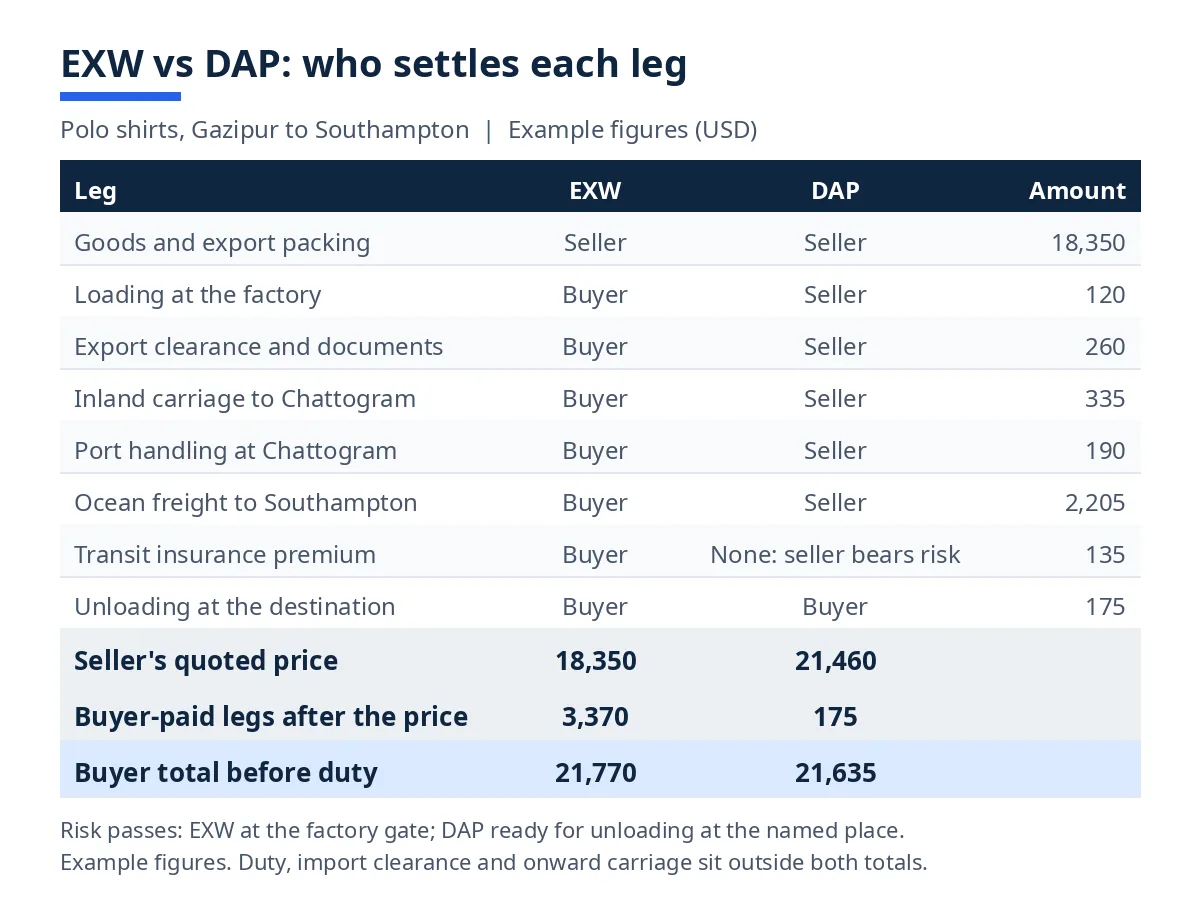
The columns tell the same journey twice, yet the totals differ by 135 dollars. Add the EXW column: 18,350 plus 120 plus 260 plus 335 plus 190 plus 2,205 plus 135 plus 175 equals 21,770. The DAP column drops the 135 premium, since the buyer buys no transit cover while the seller holds the risk, and lands at 21,635. The seller prices sit 3,110 apart: the lift, the papers, the road leg, the terminal handling and the sea freight that the DAP seller has already bought. Once the seller has been paid, the EXW buyer must still find 3,370. The DAP buyer still owes 175, for unloading only. A DAP quotation 3,110 above an EXW quotation is not 3,110 dearer. It is 3,110 of origin and ocean work already paid for, plus a premium the buyer no longer needs on the transit leg.
Duty, import clearance and carriage onward from Southampton sit outside both totals, under either term. No duty rate appears here, because this article consulted no schedule of duty rates for the destination. Ask a broker to confirm the duty figure before fixing a price, and add duty, the clearance charge and onward carriage to both columns before ranking quotations. Apply the same check to unloading: when a real carriage deal includes unloading, move the 175 into the seller's price, out of the buyer-paid remainder, and add both columns again before comparing.
Choosing between DAP and EXW, and when DDP or DPU answers instead
EXW fits a buyer who can run the Bangladesh side alone: a local carrier, a forwarder for papers, and a loading plan agreed with the factory. It fits domestic sales, and the guidance pushes traders toward FCA once goods cross a border.1 A buyer with an agent in Bangladesh, a contracted carrier and a forwarder filing export papers weekly can beat the seller's leg prices one by one, and EXW leaves carrier choice and timing in that buyer's hands.
DAP fits a buyer who wants the seller to handle carriage as far as a named destination and finish export papers, while keeping import papers and duty at home. Container loads and multi-mode journeys suit DAP, because delivery happens once, at the destination, however many modes the trip combined.3 It fits a buyer strong at home: it knows its customs routine, its broker and its duty position, and would rather keep them than pay a foreign seller to run them. It does not fit a buyer who cannot clear import quickly. Under DAP the goods arrive while the import file is still the buyer's job, and clearance risk sits with the buyer.3 A first DAP order with no broker appointed is a delivered shipment waiting on paperwork.
DPU answers a narrower question. DAP and DPU share carriage, risk, export papers and import papers. They differ only on unloading: DPU makes the seller take the goods off the vehicle at the named spot, at the seller's risk and cost, while DAP leaves the lift to the buyer.2 Pick DPU where the seller can safely unload at the destination and the buyer has no crew, no forklift or no yard there. The seller should weigh carefully whether unloading can be ensured at the agreed spot; when it cannot, DAP is the better pick.2 In the Southampton example, DPU would move the 175 charge and the lift risk to the seller. Where the buyer runs its own warehouse crew, DAP keeps the lift, and the control over it, with the buyer.
DDP answers the widest question. The seller delivers ready to be taken off at the named spot, and also runs and pays for import clearance, including duty and taxes.3 The seller carries maximum responsibility for risk and cost, and the buyer is left with unloading as part of taking delivery.3 Pick DDP only where the seller can lawfully clear import in the destination country. Some customs authorities demand that the local importer clear the goods, and then DDP cannot be used at all, and DAP is the right rule.3 A foreign seller may also find import clearance hard in the destination country, and under DDP the buyer must help the seller obtain papers and information the import authorities ask for.3 Before agreeing a DDP price from a Bangladeshi seller, ask how the seller will clear import, who acts as importer of record, and what happens when the destination authority refuses a foreign declarant. Vague answers point back to DAP with the buyer's own broker, even though the headline looks less convenient.
Situation | Term that fits |
|---|---|
Buyer runs its own Bangladesh agent and carrier, and wants carrier choice | EXW |
Buyer wants carriage and risk carried to a named spot, and can clear import | DAP |
Buyer has no unloading crew or gear at the destination | DPU |
Buyer wants the seller to clear import and pay duty too | DDP, only where the seller can lawfully clear import |
Buyer has no broker and cannot clear import fast | No D term alone; appoint a broker first, then DAP |
Write the term, the named spot, the unloading position, the notice contact and the import plan into the purchase order. A DAP order naming only a city, silent on unloading, with no broker named, invites three destination disputes at once: where delivery happened, who pays the lift, and why clearance is late, all after the seller finished its part.
Buying from Bangladesh on DAP: the export file, the arrival notice and clearance readiness
The export side is why many buyers pick DAP: the seller finishes export papers and any transit customs, so the buyer never touches the Bangladesh export file.2 The buyer's preparation then focuses on the destination. Supply the seller promptly with the order details, consignee information and any destination papers it asks for, in the form requested. A late paper from the buyer that stalls export clearance stalls a journey the seller is paid to run.
Arrival readiness has four parts. First, the seller must give the buyer the notice that lets the buyer receive the goods at the named spot.4 Agree the channel in advance: a named email address and phone number checked on arrival days, not a general inbox. Second, the broker holds the import file ready before the vessel sails, with duty money confirmed, so clearance can start the moment the goods reach the named spot. Third, the unloading crew and gear are booked for the delivery window, with the charge settled in writing against the carriage-deal position agreed in the order. Fourth, onward carriage from the named spot is booked, because the seller's duty ends there and the buyer books any further transport.2 A box that arrives on time and waits three days for a broker, a crew or a truck has not failed as a shipment. It has failed as a plan.
When the named spot is the buyer's own warehouse and import clearance must finish before the last leg, add one more sentence to the order: the buyer finishes import papers, tells the seller, and the seller resumes the journey to the warehouse.3 Without it, the carrier may treat the named spot as the last stop while the buyer treats the warehouse as the named spot, and the cartons sit between the two meanings. Confirm the sequence, the notice and the handover spot again when the seller issues the transport document.
Questions buyers ask before choosing EXW or DAP
Is DAP cheaper than EXW for the same shipment?
In the priced example the DAP total before duty runs 135 dollars below the EXW total, because the buyer buys no transit policy while the seller holds the risk. That outcome comes from the insurance position, not from cheaper freight, and it will not repeat on every order. Judge quotes only once every leg the buyer still pays has been added to each seller figure, then adding duty, the clearance charge, unloading where the carriage deal excludes it, and onward carriage to both columns. Ask a broker to confirm the duty figure, since no duty schedule for the destination was consulted here. A DAP total without duty is not cheaper than an EXW total with duty. It is incomplete.
Is DAP safer than EXW for a first-time importer?
DAP is safer on the voyage and harder on arrival. The seller carries the goods and the risk to the named spot, finishes export papers and buys the carriage, removing the legs where first orders stall most often.2 The buyer still carries import clearance, the duty payment, the lift risk, and the risk while clearance runs.3 For a first order, DAP with a broker appointed before shipment, cover bought for the lift and the onward leg, and the unloading charge settled in writing is the safer pairing. For a newcomer to importing with no Bangladesh agent, EXW carries the most risk, because the buyer must lift the goods, clear them for export and hire the carriage, with risk passing before the first lift.1
Can the term be changed from EXW to DAP after the purchase order is signed?
Before the goods leave, both sides can sign an amendment. The term sits in the sale contract, so the amendment must re-price the deal and correct the papers together: a new order, a new quotation, and an invoice, packing list and transport document that all show DAP. The switch from EXW to DAP adds the seller's carriage, papers and transit risk to the price, and moves delivery from the factory to the named spot. The reverse switch strips them out and hands freight booking, export papers and transit risk back to the buyer. When a letter of credit names the superseded term, amend the credit as well, since banks match documents to the credit. Agree the new price, the unloading position and when cover begins, before dispatch, because risk that already passed at the factory gate does not pass back.
What do Bangladeshi suppliers usually quote, EXW or DAP?
No single answer holds for every seller, and none is stated here as a fact. What a seller quotes follows how the seller is set up: one that already runs its own freight bookings and export paperwork can offer DAP with ease, while a maker selling through an agent with no freight link may quote EXW only. Put the question in the request for quotation. Name the term wanted and the exact spot, and ask for freight, papers, handling, unloading and insurance priced as separate lines. Without a named destination, a delivery spot, or a split of the legs, a DAP quote cannot sit beside an EXW quote from another seller, and the lower headline may only be the quote that left the most work unbought.
Next steps on Exportain
Start with the factory-gate meaning of an EXW quotation, then read the full set of eleven Incoterms rules in one place to place DAP among the any-mode and sea-only rules. Turn both quotations into a single figure by adding duty, clearance and delivery to reach a warehouse figure, and compare the insurance position with how a seller-bought CIF policy is priced inside the freight. When the term is settled, ask suppliers to quote on it by placing the order through the Exportain buying steps.
Sources
- FCA & EXW Incoterms® 2020 explained: Key differences. ICC Academy (accessed )
- DAP & DPU Incoterms 2020 explained: Key differences. ICC Academy, (accessed )
- DAP & DDP Incoterms 2020 explained: Key differences. ICC Academy (accessed )
- Incoterms® 2020 C rules vs D rules: Risk transfer explained. ICC Academy (accessed )
- Incoterms® 2020. International Chamber of Commerce (ICC) (accessed )
About the author
Sourcing from Bangladesh?
Post a request for quotation and suppliers on Exportain can send you their quotes directly.
Post an RFQ