EXW vs CIP: Key Differences, Costs and Which One to Choose
A CIP price for handbags flown Dhaka to Frankfurt carries freight and Clause A cover to the destination. An EXW price stops at the factory. This comparison prices one air shipment both ways.
Short answer
Under EXW, the seller makes the goods available at the factory and the buyer handles loading, export clearance, carriage, and insurance. Under CIP, the seller delivers the goods to the first carrier, pays carriage to the named destination, and buys Clause A insurance for at least 110% of the contract price. Risk passes to the buyer at handover to the carrier under CIP, and import clearance and duty stay with the buyer under both terms.
On this page
Key takeaways
CIP delivery happens at handover to the first carrier, not at the named destination; the seller pays carriage and insurance to the destination while the buyer carries transit risk.
CIP insurance must be Clause A cover for at least 110% of the contract price, issued so the buyer can claim directly; CIF uses Clause C and sea transport only.
In the worked example both totals reach 22,320 dollars before duty, because the same 3,920 dollars of legs sit inside the CIP price and outside the EXW price.
Import clearance and duty stay with the buyer under both EXW and CIP; no duty rate is stated, so a broker must confirm the figure.
A carton of leather handbags waits at Dhaka airport for the airline to take it. Who pays if it is crushed on the ramp or lost between Dhaka and Frankfurt depends on which three letters sit in the sales contract, and where the seller's part ended before the plane moved. This is the EXW vs CIP choice in its sharpest form: who books, who pays, and who carries the risk.
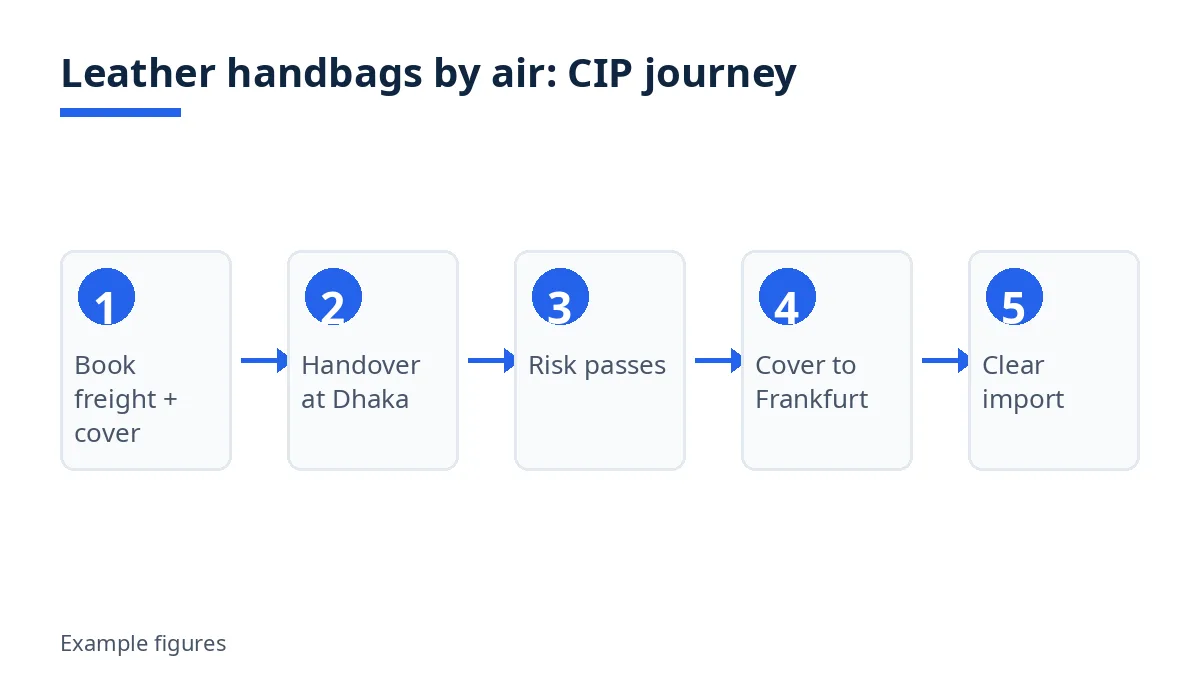
Under CIP, the seller booked the flight, paid the air freight, and bought a policy for the buyer, yet the buyer carries the risk from the moment the airline accepted the cartons. Under EXW, the buyer booked everything and carried the risk from the factory door.
The flight test: CIP buys the journey and the policy, EXW buys neither
A CIP quotation names a destination airport, Frankfurt, and carries the cartons there at the seller's expense, insured. An EXW quotation names a factory address and stops there. The road to the airport, the airline booking, and the cover for the flight are still to buy.
Point of comparison | EXW (Ex Works) | CIP (Carriage and Insurance Paid To) |
|---|---|---|
Seller price covers | Goods and export packing only | Goods, packing, carriage to Frankfurt, and the premium |
Delivery is complete | When goods stand ready for collection at the factory | When the carrier accepts the cartons at the handover point |
Risk passes to the buyer | At the factory, before loading | At handover to the carrier, usually before the flight |
Air freight | Buyer books and pays | Seller books and pays to the named destination |
Insurance for the buyer | None owed; the buyer buys its own cover | Seller must buy Clause A cover, at least 110% of the contract price |
Export formalities | Buyer | Seller |
Import formalities and duty | Buyer | Buyer |
CIP suits a buyer who wants the seller to arrange the flight and the policy, accepting that risk starts at handover, not at landing. EXW suits only a buyer with a forwarder and an insurer already working in Bangladesh.
What each term promises: a factory address against a handover at the airport
No rule asks less of the seller than EXW. The seller sets the goods out at its own site, ready for the buyer's vehicle, and the buyer pays for the lift and takes the risk of it.1 The buyer also handles export formalities, which causes trouble when the buyer lacks any foothold in the seller's country.1 For a cross-border sale, discuss FCA before settling on EXW.1
Under CIP the seller delivers the goods to the carrier it contracted, at the place and point the parties agreed, and risk moves to the buyer at that handover.2 Where several carriers carry the load in turn, delivery happens at handover to the first carrier.2 The seller pays the carriage to the named destination, finishes the export paperwork, and handles transport security at its own expense and risk.2 The buyer handles import formalities and pays for carriage beyond the named destination.2
Do not confuse the two places in a CIP contract. The place of delivery is where the carrier takes the cartons, often a cargo terminal at the departure airport. The named destination marks where the seller's paid carriage ends, often Frankfurt airport. The contract cites the destination, yet delivery and risk moved earlier, at handover.2 The seller answers for the freight bill and the policy until Frankfurt. The buyer answers for loss or damage from handover onward, claiming under the policy the seller bought. Delivery fixes risk; destination fixes how far carriage and insurance run.3
Clause A cover, line by line: the 110% policy and the CIF contrast
Insurance separates CIP from CPT. Under CPT the seller pays carriage but owes the buyer no policy. Under CIP the seller must contract and pay for insurance covering the goods during carriage to the agreed destination.2 Only two of the eleven rules place an insurance duty on the seller, and CIP is one of them.2
The policy must meet three tests. It must comply with Clause A of the Institute Cargo Clauses, or equivalent clauses, described as maximum coverage.2 It must cover at least 110% of the contract price.2 It must be issued in favour of the buyer, or another party the buyer names with an insurable interest, so the buyer can claim directly from the insurer, with cover running from handover to at least the named destination.2
In the example below, the CIP contract price is 22,320 dollars, so the minimum insured sum is 24,552 dollars, 110% of 22,320. A policy insuring only the goods value of 18,400 falls short. Ask for the certificate before the flight, and check the sum, destination, and beneficiary against the contract. Clause A is broad, not unlimited, cover: read the certificate.
CIF looks similar and is not the same term. CIF also puts the policy purchase on the seller, for the buyer, but CIF is a sea-only rule, and its default cover is Clause C, the minimum level. Only FAS, FOB, CFR and CIF are confined to sea and inland waterway transport.4 CIF delivers when goods go on board a vessel, while CIP delivers when goods reach the first carrier, by any mode.4 The ICC states the difference plainly: CIF keeps Clause C as the default, while CIP now requires the higher Clause A cover.5
Insurance question | CIP | CIF |
|---|---|---|
Seller must buy a policy for the buyer | Yes | Yes |
Default cover level | Clause A, maximum | Clause C, minimum |
Minimum insured sum | At least 110% of the contract price | At least 110% of the contract price |
Modes allowed | Any mode, including air | Sea and inland waterway only |
Risk passes | At handover to the first carrier | When goods go on board the vessel |
Cost, risk, and papers, leg by leg
Job or charge | EXW payer | CIP payer |
|---|---|---|
Goods and export packing | Seller | Seller |
Loading at the workshop | Buyer, at the buyer's risk | Seller, in this example |
Road carriage to Dhaka airport | Buyer | Seller |
Export formalities | Buyer | Seller |
Airport handling and transport security | Buyer, for the carriage it hired | Seller, for the carriage it hired |
Air freight to Frankfurt | Buyer | Seller, prepaid to the destination |
Insurance premium | Buyer, if the buyer buys cover | Seller, for the Clause A policy |
Import formalities and duty | Buyer | Buyer |
Carriage beyond Frankfurt airport | Buyer | Buyer |
Money and risk part company under CIP: the seller keeps paying after risk has passed.
The seller owes the buyer a delivery notice with the details needed to collect the goods at destination.3 Risk still moves at handover even if that notice arrives late, so agree the notice channel in advance.3 Unloading charges follow the carriage contract: under the C rules the seller pays them only where the contract makes them the seller's, and otherwise the buyer pays.3
Priced both ways: leather handbags by air, Dhaka to Frankfurt
Example figures throughout this section. They illustrate the arithmetic; they are not quotations for any real shipment.
Price element | EXW at the workshop | CIP at Frankfurt airport |
|---|---|---|
Goods and export packing | 18,400 | 18,400 |
Loading and road carriage to Dhaka airport | Buyer pays 320 | 320, inside the seller price |
Export papers and handling | Buyer pays 260 | 260, inside the seller price |
Airport handling and security | Buyer pays 180 | 180, inside the seller price |
Air freight to Frankfurt | Buyer pays 2,950 | 2,950, inside the seller price |
Insurance premium | Buyer pays 210 for its own cover | 210, inside the seller price, for the Clause A policy |
Seller quoted price | 18,400 | 22,320 |
Buyer-paid legs after the price | 3,920 | 0 for the legs listed |
Buyer total before import clearance and duty | 22,320 | 22,320 |
Example figures.
The EXW column adds to 22,320: 18,400 plus 320 plus 260 plus 180 plus 2,950 plus 210. The CIP column adds the same legs to reach 22,320. The seller prices sit 3,920 apart: origin work, air freight, and cover the CIP seller already bought. A CIP quotation 3,920 above an EXW quotation is not 3,920 dearer. It is 3,920 already paid for.
The premium is held at 210 in both columns so the comparison isolates who buys the cover. The CIP premium buys Clause A cover to Frankfurt at a 24,552 insured sum; a buyer policy starting at the airport leaves the loading and road leg bare. Duty, import clearance, destination handling, and onward carriage sit outside both totals. This article states no duty rate, since it consulted no destination duty schedule. Have a broker confirm the duty figure before ranking quotations.
EXW vs CIP: choosing by control, cover, and the first-carrier test
EXW suits a buyer already able to manage the Bangladesh end unaided: a forwarder collecting at the workshop, an agent filing export papers, a carrier booked to the airport, and a policy starting at the factory. It strains as soon as export clearance needs a local presence the buyer does not have.1 What a seller quotes follows its setup: one running its own freight bookings can offer CIP readily, while a maker selling through an agent may quote EXW only, so name the term wanted in the request for quotation.
CIP suits a buyer asking the seller to book the flight, finish export papers, and buy Clause A cover, while the buyer keeps import papers and duty in its own hands. It does not fit a buyer who believes the seller answers for the goods until landing: under CIP the buyer carries transit risk and must be ready to claim, certificate in hand.
Run three tests. Mode: if any leg flies, drives, or rides a train, a sea-only rule cannot describe it. Cover: if the buyer holds no policy of its own, CIP removes the gap CPT leaves open. Control: if the buyer holds cheaper freight rates, EXW or FCA keeps carrier choice with the buyer, at the price of running the origin legs. Write the term, the handover point, the named destination, the policy level and sum, the notice contact, and the import routine into the order.
Clearance, the first carrier, and the policy papers: four checks before the flight
Under CIP the seller completes export formalities, so the buyer stays clear of the Bangladesh export file.2 Four points still need the buyer's attention.
First, name the first-carrier point precisely: cargo terminal, airline counter, or freight station, with an address and a handover window. Where the parties do not agree the point, the seller may choose it.2 Do not leave it silent on an air shipment.
Second, settle the policy papers before payment: Clause A wording, insured sum, beneficiary, goods description, and destination, in time to act on arrival. Import formalities and transit customs stay with the buyer under CIP.2 Appoint the broker, confirm duty funds, and hold the documents ready. Fourth, agree the notice and the onward leg together: timely notice of delivery, onward carriage booked from Frankfurt airport, cover bought for that leg, and the destination handling position confirmed in writing.2 3
Four questions buyers ask about EXW and CIP
Which is cheaper, EXW or CIP, for an air shipment from Dhaka?
In the example the totals match at 22,320 dollars before import clearance and duty, because the same five legs appear in both columns. Compare quotes only after adding, to each seller figure, every leg the buyer must still fund, plus duty, clearance, handling, and onward carriage.
Is CIP the safer pick for a first air shipment from Dhaka?
CIP is safer on the origin legs and the policy, and no safer on import. The seller books the flight, finishes export papers, and buys Clause A cover.2 The buyer still carries risk from handover, files import papers, and pays duty. For a first order, CIP with a broker appointed before shipment and the certificate checked before payment is the safer pairing. EXW carries the most risk for a newcomer, who must load, clear, hire carriage, and buy cover from the factory.
Can EXW be switched to CIP once the purchase order is signed?
Both sides can sign an amendment while the goods have not yet moved, changing the price and aligning the paperwork: a fresh order and quotation, plus an invoice, packing list, and transport document all naming CIP, with the handover point and named destination written in full. The switch adds the seller's carriage, export papers, and Clause A policy to the price. Agree the new price, the policy sum and beneficiary, and when cover begins, before dispatch.
What must the CIP policy show before the buyer pays?
Four items, checked against the contract: Clause A wording, or equivalent clauses; an insured sum of at least 110% of the contract price, in the contract currency; the buyer, or the party the buyer named, as the party who can claim directly from the insurer; and cover running from the handover point to at least the named destination. If any item is missing, ask the seller to correct the policy before payment.
Next steps on Exportain
Start with what an EXW figure leaves outside the price, then read all eleven rules side by side for Bangladesh shipments to place CIP among the any-mode and sea-only rules. Turn either quotation into one warehouse total by building the full cost from the factory to your warehouse, and compare the insurance position with the Clause C policy behind a sea-freight CIF figure. When the term and the handover point are settled, ask suppliers to quote on them by following the eight buying steps on Exportain.
Sources
- FCA & EXW Incoterms® 2020 explained: Key differences. ICC Academy (accessed )
- CPT & CIP Incoterms 2020 explained: Key differences. ICC Academy (accessed )
- Incoterms® 2020 C rules vs D rules: Risk transfer explained. ICC Academy (accessed )
- CIF & CIP Incoterms 2020 explained: Key differences. ICC Academy, (accessed )
- Incoterms® 2020. International Chamber of Commerce (ICC) (accessed )
About the author
Sourcing from Bangladesh?
Post a request for quotation and suppliers on Exportain can send you their quotes directly.
Post an RFQ