Shipping EXW From Bangladesh: How It Works, Costs and Pitfalls
Under EXW, a Bangladesh seller delivers when goods are placed at your disposal at the named place. This guide walks the shipping execution after that point: pickup, loading, inland carriage, export clearance handover and freight booking, with the cost structure and pitfalls buyers face.
Short answer
Under EXW, a Bangladesh seller delivers when goods are placed at your disposal at a named place, usually the factory, without loading them or clearing them for export. From that point you own the shipping execution: the collecting vehicle and loading, the inland leg to the port or airport, the export clearance handover, main carriage, insurance and import clearance. This guide walks each handover in order.
On this page
Key takeaways
Under EXW, delivery happens at the named place in Bangladesh, and the buyer owns loading, inland carriage, export clearance, main carriage and insurance from that point.
Agree loading, the exporter of record and the declaration filer in writing before collection day, because the rule requires none of these from the seller.
Chattogram is the principal seaport and Mongla the second seaport, so name the gateway, depot and terminal in the forwarder instruction.
Price EXW with a full cost stack, not against a delivered price, and get each leg quoted by your forwarder.
Exportain badges record document and photo checks reviewed by staff, not a factory inspection or a guarantee.
Under EXW (Ex Works), the seller's job ends at the factory gate, and the buyer's shipping job starts there. This guide covers that second half: how a buyer collects goods from a Bangladeshi seller, gets them loaded, moves them to a port or airport, hands them over for export clearance, and books them onto a vessel or aircraft.
The Incoterms 2020 rules are 11 rules with a clear allocation of cost, risk and obligations between seller and buyer.1 Under EXW, the seller delivers when it places the goods at the buyer's disposal at a named place, such as a factory or warehouse, and for delivery to occur the seller does not need to load the goods on any collecting vehicle, nor does it need to clear the goods for export.2 That single point shapes every step below.
Why this matters for buyers and sellers
For the buyer, EXW buys control. You choose the forwarder, the route, the carrier and the insurer, and you see each cost as a separate line instead of inside one delivered price. That control is worth most when you already run freight into your region, when you consolidate cargo from several suppliers, or when your destination broker prefers to work from your own booking.
For the seller, EXW limits the commitment to making conforming goods available at the named place on the agreed date, without pricing inland carriage, ocean or air freight, or destination charges. That is why EXW prices often look low beside a delivered price: the comparison is incomplete until the buyer adds every step in this guide.
The trade-off is that the buyer also owns every failure point between the factory gate and the destination warehouse: a truck that cannot load, a declaration filed late, a booking that misses its cut-off, or insurance that starts at the port instead of at the factory.
Step-by-step: how it works
The shipment runs in six handovers.
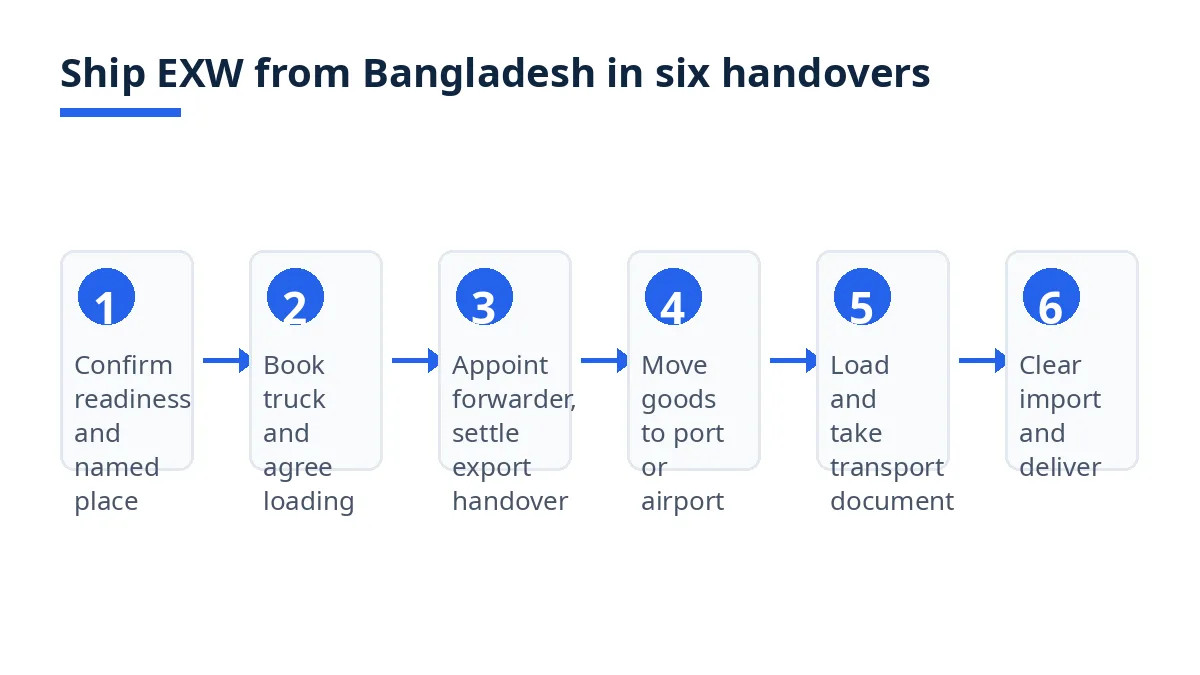
Confirm readiness and the named place in writing. Get a readiness notice stating the date, the full address of the named place, the carton count and the gross weight, and confirming the goods are at your disposal. Check that the named place in the notice matches the contract word for word: a vague place name, such as a city without a factory address, is the first dispute in an EXW shipment, because the delivery point is where risk transfers.3
Book the collecting vehicle and agree who loads it. Under EXW the seller is not required to load, so loading must be agreed expressly if you expect the seller's staff or forklift to do it.2 Tell the seller the vehicle type, the arrival window, the loading method and who supplies labour and equipment, and record the seal number where a container is used.
Appoint the forwarder and settle the export clearance handover. Name, in writing, who acts as exporter of record and who files the export declaration, and attach the seller's undertaking to supply the documents and information the buyer needs for export.3 If no one in your chain can act in Bangladesh, reconsider the term: where a buyer anticipates difficulty obtaining export clearance, FCA, under which export clearance lies with the seller, may be the better rule.3
Move the goods to the port, airport or inland depot. The inland leg is yours: the truck from the factory, any transfer at an inland container depot, and delivery to the terminal within the carrier's receiving window. Send the forwarder the packing list, carton count and weights before the vehicle leaves the factory, so a mismatch is found at origin.
Load onto the vessel or aircraft and take the transport document. Check the bill of lading or air waybill against the invoice and packing list before the carrier closes the file: shipper, consignee, notify party, package count, description and gross weight must match. If your payment route needs an on-board notation, request it before loading.
Clear import and deliver to destination. Send your destination broker the full set early: invoice, packing list, transport document, certificate of origin and insurance certificate, with one consistent set of names, descriptions, counts and weights. Confirm who pays destination charges and who books final delivery before the vessel berths.
Costs, timelines and documents
What are the typical costs and timelines?
There is no typical EXW shipping cost a guide can state as fact, because each leg is priced for your route, weight, volume and mode. Work from this cost stack, and ask your forwarder to price each line separately.
Cost line | Who pays under EXW | What drives it |
|---|---|---|
Goods and export packing | Buyer, in the EXW price | Specification and packing agreed in the contract |
Collecting vehicle and loading | Buyer | Vehicle type, distance to the terminal, labour and equipment |
Inland carriage to port or airport | Buyer | Route, mode and terminal |
Export clearance and agent fees | Buyer | Filing party, document set, product certificates |
Main carriage, ocean or air | Buyer | Route, carrier, weight and volume |
Cargo insurance | Buyer, if arranged | Cover from the named place, not from the port |
Import duty, taxes and broker fees | Buyer | Destination tariff and classification |
Final delivery to destination | Buyer | Destination address and unloading terms |
Example figures: a buyer prices a single container shipment as goods 60,000, inland carriage and loading 800, export clearance and agent fees 400, ocean freight 2,200, insurance 300 and destination charges 900, giving a door-to-door total of 64,600 before duty. These are example figures that show structure only, not a quote, a rate or a typical cost for any route. Replace every line with a forwarder quotation for your shipment before you commit.
Timelines work the same way: there is no standard transit time to quote. Ask for each date as a separate line, not a single delivery week: readiness, collection, declaration approval, terminal cut-off, sailing or flight, arrival and destination clearance. A shipment is late most often because one of those dates was never agreed.
Which documents are needed?
The export set for Bangladesh starts with the Bill of Export, also called the shipping bill. Goods must not be loaded or stuffed for export unless an export declaration in the prescribed format has been submitted to Customs and approved, and the declaration states the goods, value, exporter, foreign buyer and transport operator.4 The enclosures for all export consignments include the export letter of credit or, where there is none, the export contract or purchase order, the commercial invoice, the packing list, the EXP form certified by an Authorized Dealer, the certificate of origin issued by the EPB or a Chamber of Commerce and Industry, the VAT registration certificate and the Taxpayer Identification Number.4
That is the export clearance set only. The shipping set also needs the booking, the transport document, the insurance certificate and the destination broker's requirement sheet. This guide does not repeat the full checklist, because a dedicated checklist already covers it: work through the EXW documents checklist alongside this guide, and keep one master data set across every document.
Bangladesh-specific rules and tips
Name the gateway in the booking, not only in the contract. Chattogram is Bangladesh's principal seaport and busiest container hub, and Mongla is the second largest seaport, serving the south-west region as an alternative when Chattogram is congested.5 For factory cargo around Dhaka, an inland container depot transfer may sit between the factory and the seaport. Put the gateway, the depot and the terminal in the forwarder's instruction, so the driver and the booking clerk work from the same plan.
Treat the export declaration as a buyer task with seller inputs. The seller supplies the invoice, packing list, origin certificate and registration papers, but the filing itself is the buyer's chain to run, through its appointed forwarder or customs agent. Agree the filer and the deadline before collection day, and confirm approval before the goods are loaded or stuffed.4
Check the seller's loading capability before you book the vehicle. Some factories load containers at their own premises, some load only loose cartons onto a truck, and some have no forklift for heavy pallets. Ask what equipment and labour the seller will provide, then book the vehicle to match.
Keep one legal name across the file. The export declaration names the exporter and the foreign buyer,4 so the name on the trade licence, invoice, packing list, transport document and payment account should match. A shortened name on one document and the full legal name on another is a common reason a file is queried.
Insure from the named place. Under EXW, neither party is obliged to insure, and a buyer who does arrange cover should start it at the factory gate, where risk transfers, not at the port of loading.3 Write the named place into the insurance instruction.
Mistakes and red flags
What are the most common mistakes?
Assuming the seller will load. The most repeated EXW mistake is arriving with a truck and expecting the seller's team to load it. The rule does not require loading,2 so an unagreed loading expectation becomes a delay at the gate. Agree loading in writing, with equipment and labour named.
Booking freight before the export file is ready. A sailing booked before the certificate of origin is issued or the declaration is approved can sail without your cargo. Work backward from the carrier's document cut-off, and confirm the file before you confirm the booking.
Pricing EXW against a delivered price. An EXW price beside a DAP or CIF price is not a comparison until the buyer adds inland carriage, clearance, main carriage, insurance, duty and final delivery. Use the cost stack in this guide and the landed cost guide to compare like with like.
Leaving the exporter of record unnamed. If no one in the buyer's chain can act as exporter of record in Bangladesh, the shipment cannot clear, however ready the goods are. Name the filer in the contract, or switch to FCA while there is still time.3
Accepting a vague named place. "EXW Dhaka" does not say which factory, which gate or which warehouse. The delivery point decides where risk transfers,3 so the contract should carry the full address, and the readiness notice should repeat it.
Treating insurance as a port-to-port matter. Risk passes at the named place, so cover that starts at the port leaves the factory-to-port leg uninsured. Start cover at the named place and check the certificate.
Checklist
Before collection day, answer every line in writing.
Named place in the contract carries the full factory address and matches the readiness notice.
Readiness notice received: date, place, carton count, gross weight, goods at disposal.
Collecting vehicle booked: type, arrival window, loading method, labour and equipment agreed.
Loading agreed expressly in writing, with who loads and who pays for equipment.
Forwarder appointed; exporter of record and declaration filer named in writing.
Seller's cooperation undertaking attached: invoice, packing list, origin certificate, registration papers.
Export declaration approved before loading or stuffing.4
Inland leg planned: route, depot or terminal, receiving window, document cut-off.
Main carriage booked: carrier, vessel or flight, port of loading and discharge confirmed.
Transport document checked against invoice and packing list before the file closes.
Insurance certificate checked: cover starts at the named place.
Destination broker briefed: full document set, duty treatment, final delivery and unloading terms.
How Exportain helps
On Exportain, state the EXW named place and the delivery term in your request for quotation, so suppliers quote against the same place and term. An RFQ on Exportain states quantity and unit, target price, destination, Incoterm, required certifications and deadline, and suppliers in the category can quote against it.6 Compare replies on the same named place: two EXW prices from different factory towns carry different inland legs, and only the full cost stack shows which is lower.
For the legs after the factory gate, look up freight rates published by forwarders on Exportain and request quotes from listed freight, customs and inspection providers.6 Badges on a profile record which checks the Exportain team has reviewed, and a badge is not a capacity or quality guarantee.6 Exportain is not a party to the goods contract and does not inspect goods, book freight or clear customs, so the shipping execution in this guide stays with you and your forwarder. For the full rule comparison, see the Incoterms guide, and for the term itself, see the EXW guide.
FAQs
What should I know first about EXW?
Know that EXW ends the seller's delivery duty at the named place. The seller places the goods at your disposal there, without an obligation to load them or clear them for export,2 and from that point you own the loading, the inland leg, the export file, the main carriage, the insurance decision and the import clearance. If you cannot run the export file in Bangladesh, settle that before you agree the term, or consider FCA.3
What are the typical costs and timelines?
There are no typical costs or timelines to rely on, because each leg is priced for your route, weight, volume and mode. Use the cost stack in this guide, get each line quoted by your forwarder, and agree each date separately: readiness, collection, declaration approval, terminal cut-off, sailing or flight, arrival and destination clearance. The example figures in the cost table show structure only, not a rate for any route.
Which documents are needed?
The export clearance set is the Bill of Export with its enclosures: export contract or letter of credit, commercial invoice, packing list, EXP form certified by an Authorized Dealer, certificate of origin, VAT registration certificate and Taxpayer Identification Number.4 Add the booking confirmation, transport document, insurance certificate and destination broker set, and keep one master data set across all of them. Work through the EXW documents checklist for the full list.
What are the most common mistakes?
The most common mistakes are assuming the seller will load, booking freight before the export file is ready, comparing an EXW price with a delivered price without adding every later leg, leaving the exporter of record unnamed, accepting a vague named place, and insuring only from the port while risk passed at the factory. Each one is fixed in writing before collection day.
Next steps on Exportain
Browse suppliers and post your requirement on the RFQ board with the EXW named place, the gateway and the delivery term stated, so quotations arrive on the same basis. Before you confirm, read the Incoterms guide and the landed cost guide, and follow the buying steps in how to buy so the shipping execution is agreed at enquiry stage, not at the factory gate.
Sources
- Incoterms® 2020. International Chamber of Commerce (ICC) (accessed )
- Incoterms. DHL Global Forwarding (accessed )
- DDP & EXW Incoterms® 2020 explained: Key differences. ICC Academy (accessed )
- Customs Clearance Procedures for Export. Bangladesh Customs, National Board of Revenue (accessed )
- Ports: Bangladesh Seaports Overview. JAR World Shipping Line (accessed )
- How to source and buy from Bangladesh. Exportain (accessed )
About the author
Sourcing from Bangladesh?
Post a request for quotation and suppliers on Exportain can send you their quotes directly.
Post an RFQ