EXW for Small Importers: Is It the Right Incoterm for Your First Order?
EXW for small importers: a first-order go or no-go test, a comparison with FCA and FOB, and a pre-acceptance checklist for a first order from Bangladesh.
Short answer
EXW fits a small importer first order only when a forwarder is already appointed in Bangladesh, a named person covers loading and export clearance, and the order can absorb per-shipment legs and a delay. Without any one of those, FCA or FOB is the safer first-order term. Decide on a written forwarder quote for your exact order, not on the goods price alone.
On this page
Key takeaways
EXW fits a first order only when a forwarder is appointed, a loading and export clearance helper is named, and the order can absorb per-shipment legs and a delay.
A no on any go or no-go question means changing the term for the first order, not abandoning the supplier.
FCA fits when the gap is the export side only, and FOB fits a first sea order when the gap is the whole chain to the vessel.
Per-shipment legs weigh more per unit on a small order, so landed-cost math must come from a forwarder quote for the exact order.
Exportain verification is a document review, not a factory inspection, and a badge is not a guarantee of capacity, quality or delivery.
An EXW price from Bangladesh can look like a saving on a first order. The goods price is low, and the rest of the journey is yours to arrange. That rest of the journey is the decision. For a small importer, EXW fits only when you can already run the chain from the seller premises to your own door, or when a forwarder you have appointed can run it for you.
EXW stands for Ex Works. Under the Incoterms 2020 rules, the seller delivers by placing the goods at your disposal at a named place, and the rules allocate cost, risk and obligations between seller and buyer for each of the 11 rules.1 This article is a first-order decision framework only. It does not repeat a general EXW definition, a freight cost build-up or a customs clearance procedure. It tests whether EXW fits your first order, shows when FCA or FOB fits better, and gives a pre-acceptance checklist. See the EXW definition guide and the Incoterms for shipments from Bangladesh guide for the term and the full rules.
Why this matters for buyers and sellers
For a seller, EXW keeps the sale simple: the seller makes the goods available at the named place and does not take on transport, loading or export clearance as part of delivery. For a buyer, that simplicity moves work, cost and risk to your side at the earliest point in the journey. On a large repeat order, a buyer with a forwarder in Bangladesh can spread that work across many units. On a first order, the same work falls on a small quantity, and any gap in the chain is yours to close at short notice.
Three questions decide the matter before price does. Answer each one in writing, with a name attached, before you accept an EXW quotation.
Go or no-go question | A pass looks like | If you cannot pass it |
|---|---|---|
Forwarder appointed in Bangladesh | A named forwarder or agent confirms in writing it will collect, arrange transport and handle the export side | Do not accept EXW yet. Appoint the forwarder first, or ask for FCA or FOB |
Loading and clearance helper named | The seller, forwarder or agent is named for loading help and the export declaration, with papers each side supplies | Get the name and papers in writing, or change the term |
Small order can absorb fixed legs and delay | Landed-cost math from a forwarder quote for this order still leaves an acceptable margin after a delay or paper correction | Use FCA or FOB for the first order |
A no on any question is not a reason to abandon the supplier. It is a reason to change the term for the first order. A first order tests the supplier, product and route; a term that forces you to build a logistics chain at the same time adds a second test. Sellers gain too: a buyer without a forwarder may return with requests for help the seller never agreed to provide.
Step-by-step: how it works
Use these steps as a decision sequence. Each step ends with written confirmation. If a step cannot be confirmed, stop and change the term.
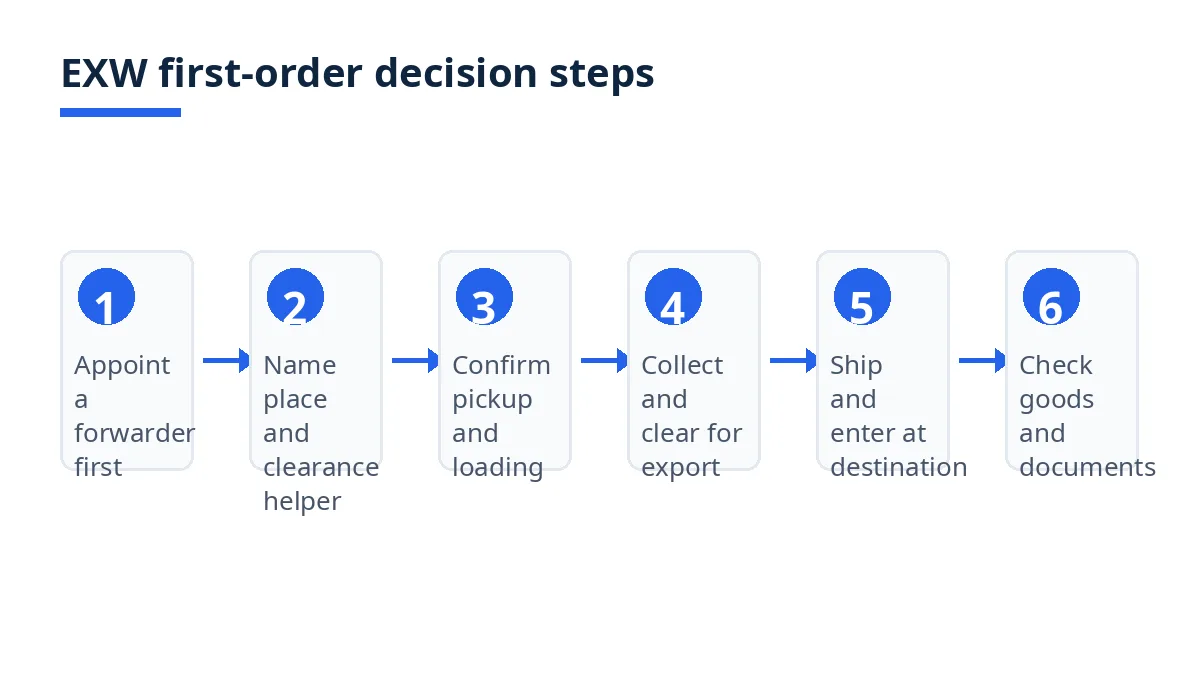
Appoint the forwarder before you accept the quotation, with a written quote for this order: collection, transport, export handling, main carriage and import entry support.
Name the place, loading help and clearance helper in the quotation: seller premises, town or district, pickup window, who loads the vehicle, and who handles the export declaration.
Confirm goods-ready and pickup in writing: ready date, packing, carton marks, premises contact, vehicle size the premises can receive, and loading hours.
Let the forwarder collect and arrange the onward chain, and keep the collection note and transport document with the order file.
Arrange main carriage and import entry at destination. Confirm who files the import entry, which papers that filer needs, and what happens if the entry is queried. Confirm insurance cover from collection, since risk passes to you early under EXW.
Check the goods and close the order file: match delivered cartons against the packing list and invoice, note shortage or damage at delivery, and keep the papers with the payment record.
Under EXW, the forwarder appointment comes before the quotation is accepted, because without it no one runs the chain from the factory gate.
When EXW beats FCA or FOB for a first order, and when it does not
Term | Export clearance and loading for onward transport | First-order fit |
|---|---|---|
EXW | You, through your forwarder or agent, with seller help only as agreed in writing | You already have a forwarder in Bangladesh and want control from the gate |
FCA | Seller delivers to your carrier and handles export clearance; you arrange main carriage | Your gap is the export side only |
FOB | Seller handles export clearance and loading on board; you arrange ocean freight | First sea order, and you want the seller to carry the chain to the vessel |
Choose FCA when your gap is the export side only, and FOB for a first sea order when your gap is the whole chain to the vessel. Choose EXW only when you have no such gap. A lower EXW goods price with an unquoted chain is not a lower landed cost.
Costs, timelines and documents
What are the typical costs and timelines?
There are no typical EXW costs or timelines for a first order, because the chain depends on the named place, route, mode and destination. The decision point is not a cost total. Under EXW, several legs are charged per shipment rather than per unit: forwarder handling, inland transport, loading help, export handling, insurance arrangement and import entry support. On a small first order, those per-shipment legs weigh more per unit than on a large order, so the same chain can make a small order uneconomic even when a large order on the same route would pass.
Example figures: a first order of 200 units at a goods value of 4,000, with per-shipment legs quoted at 900 for this order only, carries 4.50 per unit before main carriage and import charges. The same legs on 2,000 units carry 0.45 per unit. The example shows structure only, not a price or typical cost. Build the same math from a written forwarder quote for your exact place, quantity and destination, then read the landed cost from Bangladesh guide to check which legs you have missed.
For timelines, ask for dated stages: goods-ready date, pickup window, sailing or flight date, arrival date and import entry date, with a buffer after the goods-ready date. If your selling date cannot absorb that buffer, the term is part of the problem.
Which documents are needed?
For a first-order decision, name four document responsibilities before you accept EXW. The commercial invoice and packing list come from the seller. The export declaration, known as the Bill of Export or Shipping Bill, must be submitted to Customs and approved before goods are loaded for export.2 The import entry papers at destination come from you and your filer, using the seller papers and the transport document. Product-specific papers, where the destination or product requires them, must be named before the goods are ready, since Bangladesh Customs notes that some categories need additional certification or documents.2
Ask your forwarder to list who supplies each paper and who files each declaration. If no one can be named for the export declaration, the first order is not ready for EXW. The full shipment set is in the documents for EXW shipments guide, to use after the decision.
Bangladesh-specific rules and tips
Bangladesh export clearance directly affects an EXW first order. Goods may not be loaded for export unless an export declaration, the Bill of Export or Shipping Bill, is submitted to Customs and approved.2 The declaration specifies the goods, value, exporter, foreign buyer or importer, and transport operator.2 Someone must therefore act on the exporter side, supply the exporter papers and file the declaration, named before the goods are ready.
Make three checks. Ask the seller, in the quotation, whether it will supply the exporter papers and whether it will file or support the filing, and record the answer in writing. Ask your forwarder whether it can file or arrange filing for a buyer who is not based in Bangladesh, and what papers it needs from the seller. Confirm pickup practicalities at the actual premises: vehicle access, loading help, packing and a contact person on the pickup day. Name any product-specific papers in the first enquiry, since a paper that arrives after the goods are ready loses the pickup window, and under EXW that delay sits with you.
Mistakes and red flags
These are decision errors, made before the goods move and fixed by changing the decision.
What are the most common mistakes?
Accepting EXW because the goods price is lowest. A goods price without a forwarder quote for the full chain is not a landed cost. Compare terms only after a forwarder has quoted the chain from the same named place to the same destination.
Comparing an EXW price with an FOB price as if they were the same offer. The FOB price carries the chain to the vessel. The EXW price stops at the gate.
Leaving the named place vague. A town, a district or a seller name is not a named place. State the premises, so the forwarder can quote collection from that place and the pickup can happen there.
Assuming the seller will load the vehicle and clear the export as a favour. Under EXW, loading and export clearance are not part of seller delivery unless agreed in writing. That assumption becomes a dispute on pickup day, when the vehicle is already booked.
Ordering before the destination entry route is confirmed. A first order needs a named filer for import entry at destination and a list of the papers that filer needs.
Treating a small order as low risk because the value is low. A small order still carries per-shipment legs, a pickup window, an export declaration and an import entry. The value is small. The number of legs is not, and the per-unit effect of a delay is larger.
A red flag is a seller or intermediary who will not name the premises, state what loading or export help it will give, or put the term and named place in writing. Any such gap is a reason to pause the order.
Checklist
Use this checklist before accepting a first order on EXW. Every line needs a written answer.
Forwarder appointed in Bangladesh, with a written quote for this order from the named place to destination.
Named place stated in the quotation: premises, town or district, pickup window and premises contact.
Loading help named in writing: who loads the vehicle and what equipment or labour that needs.
Export declaration helper named in writing: who supplies the exporter papers and who files the declaration.2
Destination import entry filer named, with the papers that filer needs from you and from the seller.
Insurance cover confirmed from the point of collection, not only from the port or airport.
Landed-cost math built from the forwarder quote for this order, with per-shipment legs shown apart from the goods value. Example figures in that math are labelled as such.
Goods-ready date, pickup window and selling-date buffer agreed in writing.
Product-specific papers named in the first enquiry, not after the sample is approved.2
Fallback term agreed: if the forwarder or clearance helper cannot be named, the order moves to FCA or FOB.
How Exportain helps
On Exportain, you can search suppliers and post a request for quotation (RFQ) stating the quantity, destination and Incoterm, since the buying steps include stating the Incoterm in the RFQ.3 Compare quotations on the same term and named place, and ask each supplier to state what loading or export help it will give. When you accept a quotation, Exportain creates one order and issues one proforma invoice from the accepted terms.4 For freight, the buying steps include requesting quotes from listed freight, customs and inspection providers.3
Read badges for what they record. Verification is a document review by the Exportain team, not a factory inspection and not a check against a government database.4 A badge is not a guarantee of production capacity, product quality or delivery.4 A badge helps you shortlist a supplier, while a written term, a named forwarder and a named clearance helper carry the order.
FAQs
What should I know first about EXW?
Know first that EXW is a decision about who runs the chain, not only a price. The seller delivers by placing the goods at your disposal at a named place, and the Incoterms 2020 rules allocate the remaining cost, risk and obligations to you.1 Before you accept EXW, you need a forwarder appointed, a named place, a named loading and clearance helper, and a destination entry filer. If any is missing, FCA or FOB is safer.
What are the typical costs and timelines?
There are no typical costs or timelines for an EXW first order, because the chain depends on the named place, route, mode and destination. Per-shipment legs weigh more per unit on a small order, so build your math from a written forwarder quote for your exact order. Example figures here show structure only. For timelines, ask for dated stages with a buffer after the goods-ready date.
Which documents are needed?
The seller supplies the commercial invoice and packing list. The export declaration, the Bill of Export or Shipping Bill, must be submitted and approved before loading for export, and it names the exporter, buyer and transport operator.2 You and your destination filer handle import entry papers. Name who supplies and files each paper before you accept EXW, and name product-specific papers in the first enquiry.2
What are the most common mistakes?
The most common first-order mistakes are accepting EXW on the goods price alone, comparing EXW with FOB as if they were the same offer, leaving the named place vague, assuming help never agreed in writing, ordering before a destination filer is named, and treating a small order as low risk. Each is fixed before shipment: appoint a forwarder, name the helpers in writing, or move to FCA or FOB.
Next steps on Exportain
Read how to buy from Bangladesh to set up your first RFQ with the Incoterm stated, then check the landed cost from Bangladesh guide against your forwarder quote and the Incoterms for shipments from Bangladesh guide before you choose between EXW, FCA and FOB for that first order.
Sources
- Incoterms® 2020. International Chamber of Commerce (ICC) (accessed )
- Customs Clearance Procedures for Export. Bangladesh Customs, National Board of Revenue (accessed )
- How to source and buy from Bangladesh. Exportain (accessed )
- Trust & Safety Center. Exportain (accessed )
About the author
Sourcing from Bangladesh?
Post a request for quotation and suppliers on Exportain can send you their quotes directly.
Post an RFQ