How to Write an EXW Clause in Your Sales Contract (Template Included)
An EXW contract clause that names one full address, states Incoterms 2020, and fixes delivery, risk, loading, and export clearance in writing, with a copy-ready template table and a filled example buyers can adapt.
Short answer
An EXW clause should name one full street address, state Incoterms 2020, and say delivery occurs when the seller places the goods at the buyer's disposal at that address, with risk passing at the same moment. It must also state, expressly, who loads the goods and who handles export clearance, plus the collection window and notice method.
On this page
A sales contract that says only "EXW" leaves the most disputed points undecided: where the goods change hands, which edition of the rules applies, and who carries the risk from that point on. This article gives you a clause you can adapt, field by field, so those points are settled in writing before collection day. It is drafting guidance, not legal advice, and the finished clause should be checked against the governing law of your contract.
What the document is for
The EXW clause is not a separate document. It is the delivery section inside a sales contract, and its job is to record one delivery bargain both sides can act on. Under Incoterms 2020, EXW means the seller delivers when it places the goods at the disposal of the buyer at a named place, which may or may not be the seller's premises.1 The clause turns that rule into an address, a date window, and a statement of who bears risk and export formalities.
That precision matters because delivery and risk transfer coincide under the Incoterms 2020 rules.2 If the named place is only a city, a driver can arrive at the wrong gate. The ICC Academy stresses that both parties must define delivery and risk elements explicitly in the contract.2
Required fields explained
Work through each field in order. A blank entry is a gap the other side will fill.
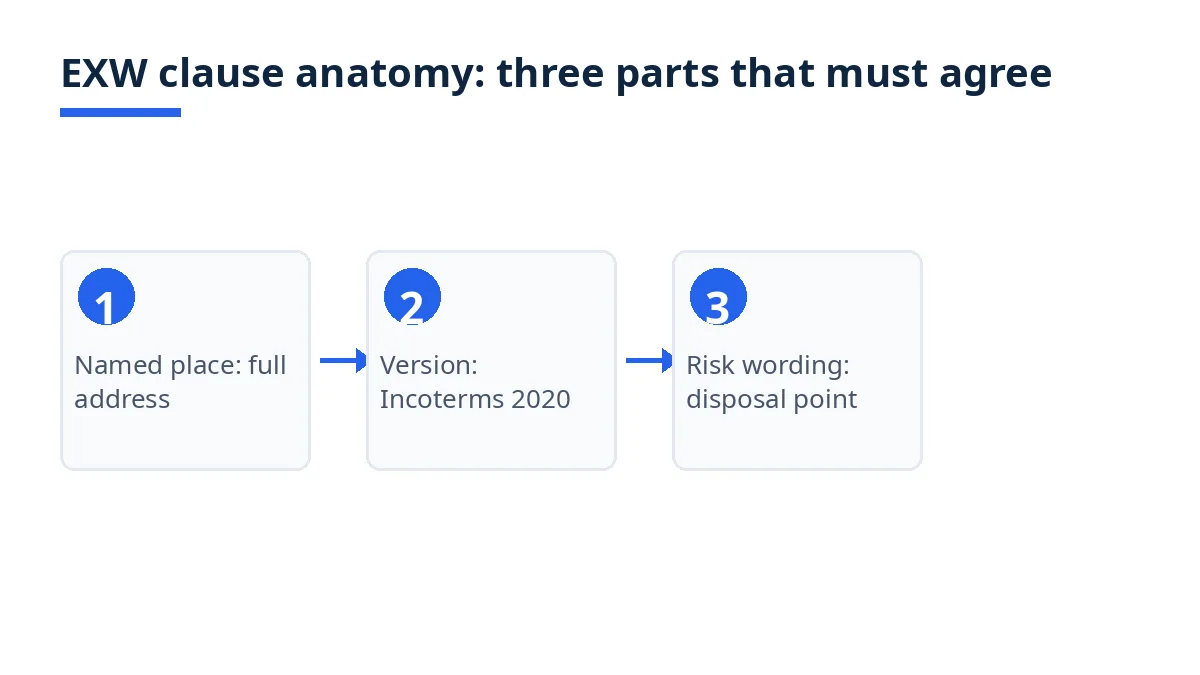
The named place, written as an address
Write the full address: building or factory name, street, area, city, and country. "EXW Bangladesh" is not a named place for collection purposes. The ICC Academy advises specifying the full street address with the Incoterms 2020 reference, not only a city name.3 If collection is at a gate or warehouse inside a larger site, add that point.
The Incoterms version
Write "Incoterms 2020" in full, next to the rule and the named place. Editions change obligations, so a clause saying only "EXW" invites a dispute about which edition applies. The standard form is "EXW (named place) Incoterms 2020".
Delivery and risk wording
State that delivery occurs when the seller places the goods at the buyer's disposal at the named place, and that risk passes to the buyer at that moment. Under EXW, delivery and risk transfer occur at that point, not loaded on any collecting vehicle.2 Do not add a second risk point, such as "risk passes on shipment".
Loading, stated expressly
Under the default EXW rule, the seller does not need to load the goods on any collecting vehicle.1 If your deal differs, say so: either loading is for the buyer's account and risk, or the seller will load while risk still passes when the goods are placed at the buyer's disposal.
Export clearance, stated expressly
Under EXW, the seller is not required to clear the goods for export where such clearance applies.1 The buyer therefore carries export formalities unless the clause says otherwise. Where the buyer expects difficulty obtaining export clearance, the ICC Academy notes FCA is the better choice, because under FCA export clearance lies with the seller.3 Any agreed seller help with export documents should be written down, including who pays.
Collection date or window, and notice
Add the date the goods will be ready, or a window such as a three-day period, and say how the seller will notify the buyer. A clause with a perfect address but no date gives the buyer no deadline to plan transport. Tie the notice to a named contact and method, such as email.
Goods identification
Name the goods, quantity, and marks or packing that identify the consignment. Cross-refer to the order number or packing list so the clause and the shipment point to each other.
Template (table or downloadable)
Copy the table below into your contract and fill in every row. Delete no row without deciding, in writing, what replaces it. Replace bracketed text; do not leave it in the signed contract.
Clause element | Wording to use | What to fill in |
|---|---|---|
Delivery term | Delivery is EXW (named place) Incoterms 2020. | Full street address, including the collection point inside the site. |
Delivery event | The seller delivers when it places the goods at the buyer's disposal at the named place. | Date or window when the goods will be ready. |
Risk transfer | Risk passes to the buyer when the goods are placed at the buyer's disposal at the named place. | No separate risk point elsewhere. |
Loading | Loading onto the buyer's collecting vehicle is for the buyer's account and risk, unless stated otherwise. | State expressly if the seller agreed to load, and who pays. |
Export clearance | Export clearance, where applicable, is for the buyer's account and risk, unless stated otherwise. | State agreed seller assistance and who pays. |
Collection notice | The seller will notify the buyer when the goods are at the buyer's disposal, by the method stated in the contract. | Named contact, method, and notice period. |
Goods covered | This clause applies to the goods, quantity, and order identified in the contract. | Order number, description, quantity, and marks. |
Read the completed table from each side. If either side must still ask who pays for loading, the clause is not finished.
Filled example
The example below is illustrative only. The parties must adapt every entry to their own contract and take advice on the governing law.
Delivery clause (example). Delivery is EXW Plot 12, Factory Road, Gazipur, Bangladesh, Incoterms 2020. The seller will place 5,000 cotton T-shirts, order number EX-1042, at the buyer's disposal at the seller's warehouse loading bay at that address, on or between 10 and 12 November. The seller will notify the buyer by email when the goods are ready for collection. Delivery occurs, and risk passes to the buyer, when the goods are placed at the buyer's disposal at that address, not loaded on any collecting vehicle. Loading, export clearance, onward transport, insurance, and import clearance are for the buyer's account and risk.
The example names one address, one collection point, one order, and one window, and keeps the default EXW positions on loading and export clearance. If the real deal changes any of those, the wording must change with it.
Common errors
Naming a city instead of an address. A city is a region, not a collection point. Carriers need a street address and, where the site is large, a named bay or gate.
Omitting the Incoterms version. Without "Incoterms 2020", the clause can be read against an older edition. Put the version in the same sentence as the rule and the named place.
Assuming the seller will load. By default, the seller need not load the goods on the collecting vehicle.1 A buyer who sends a truck expecting loading help, without a written agreement, may face a delay or a refusal at the gate.
Assuming the seller will clear the goods for export. The same default applies to export clearance.1 Check before signing who can file the export declaration in the seller's country. If the buyer cannot, consider FCA, under which the seller handles it.3
Adding a second risk point. If one clause says risk passes at the factory and another says it passes on loading, there are two answers to one question. Keep one risk sentence, in the delivery clause.
Leaving the collection window open. Without a date or window and a notice method, neither side can plan transport or prove delay. A short window and a written notice rule prevent most collection disputes.
Copying the template without adapting it. A row left blank, or an example copied with its address and dates intact, looks complete while pointing at the wrong place. Every bracket must be replaced before signing.
FAQs
Who issues this document?
No single authority issues an EXW clause. The buyer and seller agree it together as part of their sales contract, and it takes effect when that contract is signed. The Incoterms 2020 rules supply the meaning of EXW; the named place and dates are the parties' own drafting.
Which fields are mandatory?
The named place, the Incoterms version, the delivery event, and the risk transfer point are the minimum. Loading, export clearance, the collection window, the notice method, and goods identification are also needed in practice, since leaving any out hands the decision to assumption. A clause missing the named place or version is not ready to sign.
Can it be digital?
A clause can sit inside a digital contract, and the signed contract can be stored electronically, provided the contract as a whole meets the form requirements of its governing law and both sides agree to that form. Confirm how signatures and electronic records are treated first.
What errors cause delays?
Vague named places, missing Incoterms versions, and unagreed loading or export clearance cause most delays. Each leaves a practical question unanswered on collection day: where to go, which rules apply, who loads, and who files the export declaration. All trace back to a field left blank in the clause.
Next steps on Exportain
Compare the clause with the EXW cost picture in What Does an EXW Price Include?, how EXW sits beside the other rules in Incoterms for Shipments From Bangladesh, and the full cost to your warehouse in Landed Cost for Imports from Bangladesh. When ready to source, browse suppliers or post an RFQ.
Sources
- Incoterms. DHL Global Forwarding (accessed )
- Place of delivery & risk transfer in trade contracts. ICC Academy (accessed )
- DDP & EXW Incoterms® 2020 explained: Key differences. ICC Academy (accessed )
About the author
Sourcing from Bangladesh?
Post a request for quotation and suppliers on Exportain can send you their quotes directly.
Post an RFQ