

7 Costly EXW Mistakes Importers Make (and How to Avoid Them)
Seven EXW errors that turn a low headline price into a high landed cost: vague named places, unplanned loading, missing export clearance, insurance gaps, late collection and forgotten destination charges, each with a fix.
Short answer
The most expensive EXW mistake is treating the EXW price as the total cost. Under EXW, the seller only makes the goods available at a named place, and the buyer pays for loading, export clearance, freight, insurance, import duty and final delivery. This guide lists seven such errors, each with its cost and a fix, so an EXW quote can be compared with other terms on a landed-cost basis before signing.
On this page
Key takeaways
Under EXW the price covers the goods at the named place only. Loading, export clearance, freight, insurance, import duty and final delivery are all extra costs the buyer must budget.
A city name is not a named place. Write the full factory address, the edition Incoterms 2020, and a collection window into the contract.
Loading risk and export clearance sit with the buyer. Confirm who loads and who acts as exporter of record before signing, or switch to FCA.
Insure from the named place, agree a readiness notice and a collection deadline in writing, and price every quote to your warehouse before signing.
An EXW price from a Bangladeshi supplier often looks like the cheapest quote on the table. Under EXW, short for Ex Works, the seller's job ends when the goods are placed at the buyer's disposal at a named place, and the buyer takes on loading, export clearance, carriage, insurance, import clearance and final delivery from that point.1 The ICC Academy notes that EXW places the minimum obligation on the seller and the maximum responsibility on the buyer, and that it is most suitable for domestic trade, with FCA encouraged instead where goods cross a border.1 Every mistake below is a version of the same error: signing an EXW contract while still thinking in FOB terms.
EXW is one of the eleven Incoterms 2020 rules, and each rule fixes the delivery point, the point where risk passes, and who pays for carriage, insurance and customs clearance.2 The seven mistakes below are ordered by where they bite in a shipment, from the quote comparison to the warehouse door. Each one states what the mistake is, what it costs, and the contract fix that prevents it. Example figures are used throughout: they illustrate the method only and are not real prices, freight rates or charges for any product, route or country.
Key points to take away
Under EXW, the price covers the goods at the named place only. Loading, export clearance, freight, insurance, import duty and final delivery are all extra.
A city name is not a named place. Write the full factory address, the edition Incoterms 2020, and a collection window.
Loading and export clearance sit with the buyer. Confirm who loads and who acts as exporter of record before signing, or switch to FCA.
Insure from the named place, agree a readiness notice and a collection deadline in writing, and price every quote to your warehouse.
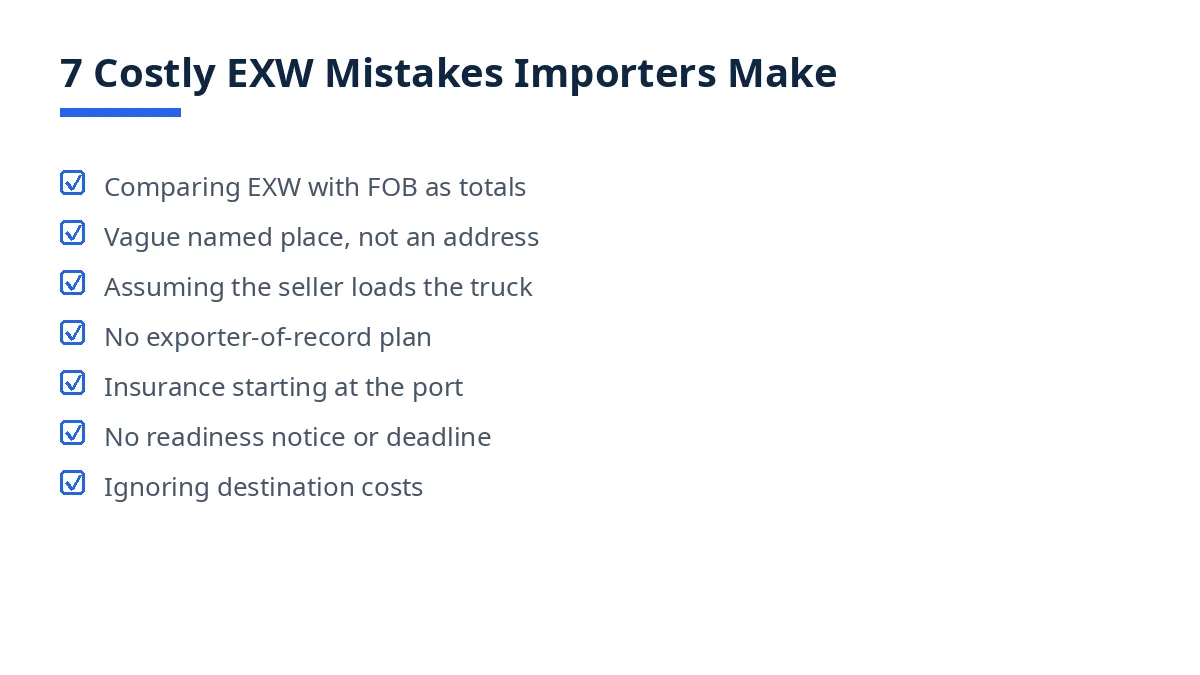
The list: 7 costly EXW mistakes importers make
The seven errors below are distinct, but they share one root cause: the contract was signed before the buyer had priced and staffed the whole journey from the factory gate to the warehouse.
1. Comparing an EXW quote with an FOB quote as if both were totals
What it is. A buyer lines up two supplier quotes, sees the EXW figure lower than the FOB figure, and picks the EXW supplier as the cheaper option. The comparison is invalid because the two prices contain different journeys: the FOB price already includes export clearance and loading on board at the port of shipment, while the EXW price includes neither.3
Why it costs money. The buyer discovers the missing origin leg only after signing, when the forwarder quotes collection, inland transport to Chattogram, export handling and terminal charges. Example figures: an EXW quote of USD 18,000 against an FOB quote of USD 19,200 looks like a USD 1,200 saving until the origin leg adds USD 1,900, making the EXW route USD 700 dearer before freight is even booked. The landed cost method, adding every charge the price does not cover and dividing by good units received, is the only fair comparison basis.4
How to fix it. Never compare headline prices across Incoterms rules. Ask a forwarder to price the origin leg, add freight, insurance, duty, broker fees, destination charges and inland delivery, and compare the two totals at your warehouse door.4
2. Writing the named place as a city, not an address
What it is. The contract reads "EXW Dhaka" or "EXW Bangladesh" with no street address, no factory name and no reference to the Incoterms edition. The named place is the exact point where delivery happens and risk passes, so a vague place leaves both questions open.5
Why it costs money. The ICC Academy warns that vague descriptions of the place of delivery lead to disputes over delays and delivery location, and gives the example of a contract naming only a destination port, where the buyer and seller then disagree about which terminal was meant.5 In an EXW case the equivalent dispute is about which factory gate, which warehouse door and which collection point. While the parties argue, the truck waits, storage accrues and the sailing is missed.
How to fix it. Write the term in full: "EXW [factory name, street address, city, Bangladesh], Incoterms 2020", and add the collection window, for example a three-working-day window from the readiness notice. If the seller has more than one site, name the site that holds the goods.
3. Assuming the seller will load the truck
What it is. The buyer sends a truck to the factory and expects the seller's staff to load it, because that is how most other terms work. Under EXW, the seller is not obliged to load the goods onto the collecting vehicle, and loading is done at the buyer's expense and risk.1
Why it costs money. Two costs follow. First, the practical cost: the truck arrives, nobody is assigned to load, and the buyer pays for a second visit or hired labour at short notice. Second, the risk cost: because risk has already passed when the goods were placed at disposal, damage during loading is the buyer's loss, even if the seller's forklift did the lifting.1 Example figures: a pallet of cartons damaged during an unplanned loading operation can cost USD 800 in rework and repacking, with no seller liability to claim against under the term as written.
How to fix it. Decide loading in the contract, not at the gate. Either write in that the seller will load at an agreed charge, with the risk of the loading operation stated, or instruct your forwarder to bring labour and equipment. Never leave loading to assumption.
4. Signing EXW with no exporter-of-record plan
What it is. The buyer signs EXW without checking who will file the export declaration in Bangladesh. Under EXW, export clearance is the buyer's responsibility, but a foreign buyer may not be able to act as exporter in the seller's country.1
Why it costs money. If the buyer's forwarder cannot file, the goods sit at the factory while the parties negotiate a workaround, and storage, missed sailings and rebooked freight follow. The ICC Academy strongly encourages traders to consider FCA instead of EXW where goods cross a border, precisely because FCA puts export clearance with the seller.1
How to fix it. Before signing, confirm in writing who files the export declaration: your forwarder's local agent, the seller acting for you, or nobody yet. If no party can file cleanly, change the term to FCA, under which the seller clears the goods for export and loads them if delivery is at the seller's premises.1
5. Buying insurance that starts at the port, not at the factory gate
What it is. The buyer arranges cargo insurance from the port of loading, following the habit built under FOB, where risk passes on board. Under EXW, risk passes much earlier, when the goods are placed at the buyer's disposal at the named place.1 Neither party is obliged to insure under EXW, so cover exists only where the buyer arranges it.3
Why it costs money. The uninsured window covers loading, the inland leg to Chattogram and waiting time at the factory, and damage there is fully the buyer's loss. Example figures: a consignment worth USD 22,000 damaged in a road incident between Gazipur and the port would be an uninsured USD 22,000 loss if the policy was written port-to-door instead of named-place-to-door.
How to fix it. Tell the insurer the risk point in writing: cover from the named place, including loading and inland transport, to the warehouse. Check the policy wording names the factory address, not the port, as the start of cover.
6. Agreeing no readiness notice and no collection deadline
What it is. The contract states a shipment month but not how the seller notifies readiness, nor how long the buyer has to collect. Under EXW, delivery is complete when the goods are placed at disposal and the buyer is notified, and risk can pass from the agreed collection date if the buyer fails to collect on time.3
Why it costs money. Without a notice method, the buyer learns the goods are ready late and scrambles for a truck. Without a deadline, the goods sit in the seller's warehouse, the seller may charge storage, and the buyer bears deterioration or damage during the wait.
How to fix it. Write three lines into the contract: the notice method and the person to notify, the collection window in working days, and what happens after it, such as storage charges at an agreed daily rate or the right to move goods to a third-party warehouse at the buyer's cost. Confirm the readiness notice in writing and keep it with the order record.
7. Budgeting nothing for the destination side
What it is. The buyer prices the journey to the destination port and stops there, forgetting import duty, import taxes, broker fees, destination port and terminal charges, and inland delivery to the warehouse. Under every rule except DDP, import clearance and duty stay with the buyer, and the destination lines are the buyer's to pay.4
Why it costs money. The destination lines are not small. The landed cost guide lists broker fees, destination charges, inland delivery, inspection and bank costs as separate lines, and warns that a copied duty rate is the most dangerous figure in the calculation, because the rate must come from the destination country's official tariff for the product's classification.4 Example figures: on a USD 20,000 consignment, destination handling of USD 320, a broker fee of USD 180, inland delivery of USD 260 and inspection of USD 300 add USD 1,060 before duty, and duty itself is still to be added from the official tariff.
How to fix it. Build the destination section of the landed cost sheet before signing: duty from the official tariff confirmed by a broker, import tax treatment confirmed with an accountant, broker fees, destination charges and a haulier quote for the warehouse address.4 Price the order from that total, not from the port price.
Summary table
Mistake | Cost it creates | Fix in one line |
|---|---|---|
Comparing EXW with FOB as totals | Hidden origin leg wipes out the apparent saving | Price both quotes to your warehouse |
Vague named place | Disputes over where delivery happens, missed sailings | Full factory address plus Incoterms 2020 and a collection window |
Assuming the seller loads | Second truck visit and uninsured loading damage | Write loading and its risk into the contract |
No exporter-of-record plan | Goods cannot leave, storage and rebooking | Confirm who files, or switch to FCA |
Insurance from the port | Uninsured loss on the inland leg | Cover from the named place to the warehouse |
No notice or collection deadline | Storage charges and risk during waiting time | Agreed notice method, window and storage rate |
Ignoring the destination side | Duty, broker and delivery charges after the port price | Full destination section in the landed cost sheet |
How Exportain helps
Exportain is a B2B marketplace for sourcing from Bangladesh. Buyers search published products by keyword and category, filter to suppliers holding the Exportain Verified badge, sample availability and OEM or ODM capability, and sort by MOQ or lead time. Each supplier profile shows its verification level, location, main products and the certifications the supplier has declared. Buyers then post a request for quotation stating quantity, target price, destination, Incoterm, required certifications and deadline, and suppliers in that category quote against it.6
Use the Incoterm field in the RFQ to force the comparison this guide recommends: ask every supplier to quote the same rule, or to quote EXW and FCA side by side, and state the named place in full. Treat Exportain badges as a starting filter, not a conclusion: verification on Exportain is a document and photo review by the Exportain team, not a factory inspection, and Exportain is not a party to your goods contract, does not inspect goods, book freight or clear customs. Run the checks in this guide on your shortlist and keep the agreed terms in the RFQ and message thread so the record is complete.
FAQs
What is the biggest mistake?
Treating the EXW price as the total cost. The EXW price covers the goods at the named place only; every cost after the factory gate is still to be paid.3 The biggest mistake is therefore a comparison mistake: judging suppliers on headline prices that contain different journeys.
How can I avoid it?
Build the landed cost sheet before signing, not after the goods are ready: origin leg, freight, insurance from the named place, duty from the official tariff, broker fees, destination charges and inland delivery, compared on the warehouse total.4 Then write the fixes from this list into the contract.
Who is responsible?
The seller is responsible for producing the goods, packaging them as agreed, and placing them at the buyer's disposal at the named place, with timely notice of readiness.3 The buyer is responsible for everything after that point: loading, export clearance, carriage, insurance, import clearance, duty and final delivery. The seller must give reasonable assistance with export formalities at the buyer's risk and expense, but assistance is not the same as responsibility.1
Where can I get help?
Start with the two professionals who own the two ends of the journey: a freight forwarder with an agent in Bangladesh for the origin leg, and a customs broker at destination for classification, duty and import clearance. For comparing suppliers on consistent terms, post an RFQ stating the Incoterm and the named place in full, and read the EXW guide and the landed cost guide linked below before you sign.
Next steps on Exportain
Read the EXW meaning guide for the full cost and risk breakdown behind this list, then work through the landed cost guide with your own quotations and your destination country's official tariff. When you are ready to compare suppliers on the same terms, follow the eight steps in how to source and buy from Bangladesh and post an RFQ stating the Incoterm, the full named place and the collection window.
Sources
- FCA & EXW Incoterms® 2020 explained: Key differences. ICC Academy (accessed )
- Incoterms for Shipments From Bangladesh. Exportain (accessed )
- EXW Meaning (Ex Works): Costs, Risks and Example. Exportain (accessed )
- Landed Cost for Imports from Bangladesh. Exportain (accessed )
- Place of delivery & risk transfer in trade contracts. ICC Academy (accessed )
- How to source and buy from Bangladesh. Exportain (accessed )
About the author
Sourcing from Bangladesh?
Post a request for quotation and suppliers on Exportain can send you their quotes directly.
Post an RFQ


