

Typical MOQ for Electrical Cables in Bangladesh (and How to Negotiate It Down)
No single electrical cables MOQ in Bangladesh: what sets the minimum per size, construction and drum length, how to ask, and how to negotiate or structure a smaller order.
Short answer
There is no single typical MOQ for electrical cables from Bangladesh. Each supplier sets its minimum per conductor size, per core count and per drum length for your specification, driven by conductor and insulation lots, colour and marking runs and test batches. Ask for the minimum per size and per drum in writing, then negotiate the structure: fewer sizes, standard drum lengths and stocked sizes.
On this page
Key takeaways
There is no single typical MOQ for electrical cables from Bangladesh, because each supplier sets its minimum per conductor size, per core count and per drum length for your specification.
Conductor size, construction, drum length, colour and marking runs, test batches and input lots are the drivers that set the floor.
Ask for the MOQ per size, per construction and per drum in writing, with set-up costs itemized apart from the unit price.
Negotiate the structure first: fewer sizes, standard drum lengths, stocked sizes and colours, and set-up paid as a separate line.
Exportain verification is a document and photo review, not a factory inspection, and a badge is not a guarantee.
Ask several suppliers for the electrical cables MOQ in Bangladesh for the same cable and you will get different answers. There is no single typical MOQ for electrical cables from Bangladesh, because each supplier sets its minimum for your exact specification, usually per conductor size, per core count and per drum or reel length rather than for the order as a whole. The negotiation that works is the one that changes the structure behind the minimum, not the one that asks for an exception to it.
In the Harmonized System, heading 8544 covers insulated wire, cable and other electric conductors, whether or not fitted with connectors, and optical fibre cables made up of individually sheathed fibres.1 That breadth is the first reason a single MOQ figure cannot describe the market: a thin winding wire, a multi-core power cable and an optical fibre cable are different products under one heading, with subheadings for winding wire of copper, coaxial cable, conductors up to 1,000 volts, conductors over 1,000 volts, and optical fibre cables.1
What sets the electrical cables MOQ in Bangladesh
What should I know first about electrical cables?
The binding minimum is almost never the headline total. A quotation carries separate minimums underneath it, and the one you miss decides whether the order can run. Ask for every minimum in writing, in the unit the supplier uses.
Per conductor size. IEC 60228 specifies nominal cross-sectional areas from 0.5 mm2 to 2,500 mm2 for conductors in electric power cables and cords, covering solid and stranded copper, aluminium and aluminium alloy conductors.2 A change of size is a change of conductor, so a supplier states a minimum per size. An order spread thinly across many sizes can clear the total and still fall below the minimum for one size.
Per core count and construction. A single-core cable, a three-core cable and a four-core cable are different constructions. State the core count, insulation and sheath type and voltage rating on every enquiry, and ask whether each construction carries its own minimum.
Per drum or reel length. Cable is made, tested and shipped in lengths wound on drums or reels, so the minimum is often expressed as a length per size or as a number of drums. A length that does not fill a drum, or a split across odd lengths, can carry a surcharge or be refused. Ask for the standard drum length per size, whether part drums are accepted, and how cutting is charged.
Per insulation colour and marking. A colour change can mean a separate insulation run, and printed marking, such as a meter mark or a buyer legend, can mean a separate print set-up. Ask whether colour and marking sit inside the cable minimum or carry their own run minimum.
Per test batch. Conductor resistance, insulation thickness and other routine tests are run on a batch basis. IEC 60228 includes requirements for numbers and sizes of wires and resistance values,2 so ask which tests run per batch, what the batch size is, and whether a small order still bears the full test set-up.
Per input lot. Copper, aluminium, insulation compound and sheath compound are bought in lots. A size or colour that needs a fresh lot carries that lot with it. Ask which inputs are stocked for your sizes and which would be bought in for your order.
Driver | What sets the floor | State in your enquiry |
|---|---|---|
Conductor size | Minimum per size | Size, material, construction |
Cores and construction | Minimum per construction | Core count, insulation, sheath |
Drum length | Minimum length per drum | Length per size, part drums |
Colour and marking | Separate run or print set-up | Colour, marking text |
Test batch | Tests run per batch | Tests, batch size |
Input lot | Lot for conductor and compound | Stocked or bought-in |
Example figures: a buyer orders 10,000 metres split across five sizes at 2,000 metres per size. The total looks large, but if the per-size minimum is higher than 2,000 metres, every size fails. The same 10,000 metres in two sizes at 5,000 metres per size can clear both lines. Example figures: a second buyer splits one size across four drum lengths, and the part drums carry a cutting charge. Both examples show structure only, not a typical MOQ, price or lead time.
Why this matters for buyers and sellers
For the buyer, the MOQ decides how much cash sits in cable stock and whether a first order can test a size before a larger repeat. Cable is heavy, bulky and length-specific: a size bought for one project cannot always be reused on the next. For the seller, the minimum protects the run: conductor drawn for your size, insulation compounded for your colour and drums wound for your lengths cannot be sold to another buyer as easily as a standard stocked item.
Two controls keep the negotiation grounded. The first is an inspection plan agreed before production. ISO 2859-1 defines a system of acceptance sampling plans for inspection by attributes, indexed by acceptance quality limit (AQL) for lot-by-lot inspection.3 The second is one delivery term for every quotation: the Incoterms 2020 rules set out 11 rules with a clear allocation of cost, risk and obligations.4
Step-by-step: how it works
Use one specification for every candidate, so the minimums you compare are for the same cable.
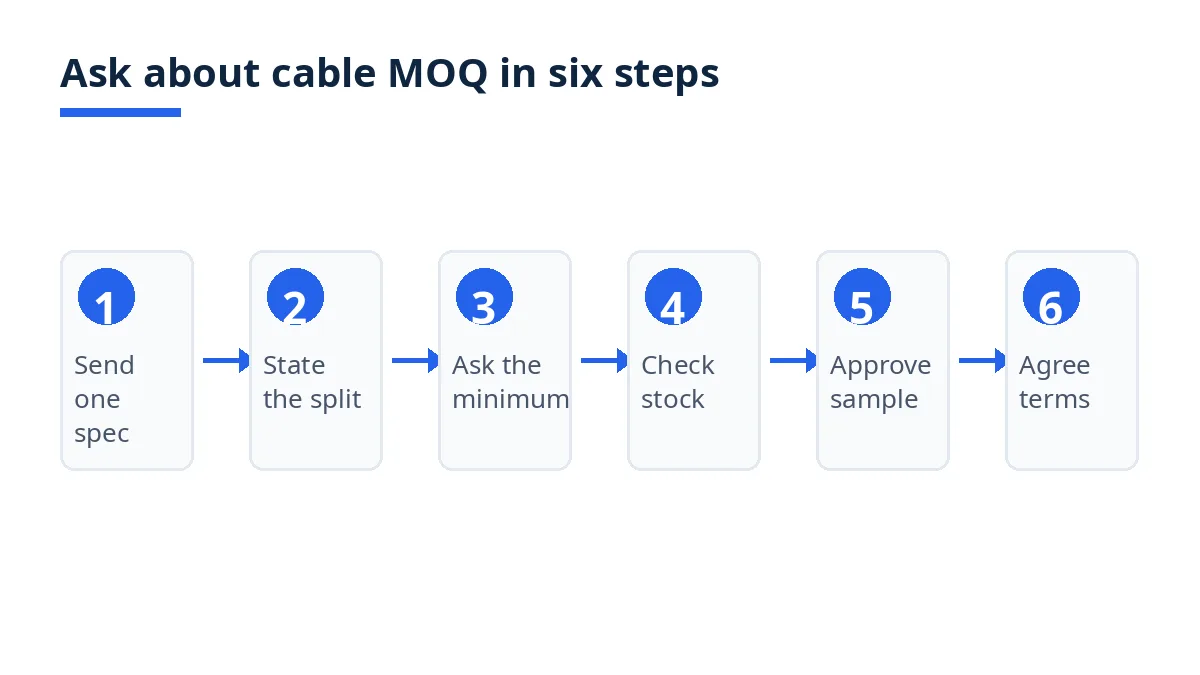
Send one cable specification to every candidate. State conductor material and size, core count, insulation and sheath type, voltage rating, colour, marking and drum length.
State the split, not only the total. Give the length per size, per core count and per drum. A total length without a split cannot be answered.
Ask for the minimums line by line. Ask for the MOQ per size, per construction, per colour and marking run, per test batch and per drum, and which line binds your split.
Ask what is stocked. Record whether each size and colour is stocked or made to order. Stocked sizes are where a lower minimum is most often possible.
Approve a sample length in writing. Order a sample length in your actual size, construction, colour and marking. Test it against the specification you sent, then approve or list corrections.
Agree inspection and delivery term before you confirm. Write the inspection level and AQL values into the purchase order, following ISO 2859-1,3 and state one Incoterm and named place for every quotation. Compare MOQs only on the same term.4
See the electrical cables quality control checklist and the HS code for electrical cables guide.
How to negotiate or structure a smaller order
Negotiation works when you change the structure that creates the minimum. Get the result in writing, on the quotation and the purchase order.
Reduce the number of sizes first. Sizes multiply conductor set-ups, test batches and drum runs. Cutting one size raises the length per remaining size.
Standardize the drum length. One standard length per size, with no part drums, removes cutting work. Ask for the standard length list before you finalise quantities.
Use stocked sizes and colours. A size and colour already stocked removes the input lot and part of the set-up. Ask for the stock list first.
Share one size across uses. Where two applications accept the same conductor size, insulation and voltage rating, ask whether the minimum can be met across both uses combined, in writing.
Pay set-up as a separate line. Where the floor comes from a colour run, a marking set-up or a test batch, ask for those costs apart from the unit price. The run can then be shorter.
Simplify colour and marking. One colour and one marking legend reduce runs and set-ups. Ask for stocked-colour options priced apart from your first choice.
Stage the order. If the supplier cannot move, place a smaller first order in fewer sizes, with a written repeat price and MOQ for the same specification.
Costs, timelines and documents
What are the typical costs and timelines?
There are no typical costs or timelines a guide can state as fact, for the same reason there is no typical MOQ. Each supplier prices your conductor size and material, core count, insulation and sheath, colour and marking runs, drum and packing, testing and the delivery term you choose.4 Ask whether the quotation is fixed or indexed, and for how long the price holds.
For timelines, sampling depends on conductor and compound availability, and bulk production on extrusion runs, armouring, drum supply and testing. Ask for sampling, production, testing and inspection dates as separate lines.
Which documents are needed?
For export clearance in Bangladesh, goods may not be loaded unless an export declaration, the Bill of Export or Shipping Bill, is submitted to Customs and approved.5 Enclosed documents include the export contract or purchase order where there is no export letter of credit, the commercial invoice, the packing list, the EXP form certified by an authorized dealer, and a certificate of origin.5
Bangladesh-specific rules and tips
Confirm the standard for your cable at the source. A BSTI licensing guide lists electric cable (PVC/VIR) under BDS 900 and 901.6 Treat that listing as a starting point, not as proof for your cable: ask the supplier to name the exact BDS or IEC standard its cable is made and tested to, in writing, and to supply the test report against that standard. IEC 60228 covers conductors of insulated cables,2 so both statements should appear on the quotation.
Keep one legal name across every paper. The export declaration names the exporter and the foreign buyer,5 so the name on the trade licence, quotation, proforma invoice and payment account should match.
Ask which inputs are bought in for your order. Conductor metal, insulation compound, sheath compound and drums may be bought in for your specification, and a bought-in input can set both the minimum and the earliest production date.
Check the destination rules before you confirm the split. Voltage rating, marking and test requirements differ by market. Ask the supplier to confirm in writing which destination requirements its test report covers.
Mistakes and red flags
What are the most common mistakes?
Asking for a total MOQ only. The binding minimum is usually per size, per construction or per drum. An order can clear the total and still fall below the per-size minimum for one size.
Comparing MOQs on different specifications. A lower minimum on a thinner conductor, a single core instead of three, or a different term is a different offer. Compare only replies to the same specification on the same Incoterm.4
Accepting a verbal exception. Record any agreed lower minimum, shared size or waived set-up on the quotation and purchase order.
Paying set-up twice. Keep the paid set-up lines from the first purchase order and attach them to the repeat enquiry.
Treating a profile or a badge as verification. A profile is a starting point for enquiries. It does not test whether a supplier can make your cable, and a badge is not a guarantee.7
Skipping the sample length to save time. A sample length in your actual size and construction is the only check that the conductor, insulation, marking and drum length match the specification before the full run.
Checklist
Before you confirm, every line should be answered in writing.
Specification sent: conductor material, size, core count, insulation, sheath, voltage rating, colour, marking, drum length.
Split stated per size, per construction and per drum.
MOQ confirmed per size and per construction; binding line named.
Stock status per size and colour recorded.
Colour, marking and test-batch minimums confirmed apart from the cable MOQ.
Set-up costs itemized apart from the unit price.
Sample length tested and approved in writing.
Inspection level and AQL values in the purchase order.3
Quotations compared on the same specification and Incoterm.4
Export set agreed: invoice, packing list, EXP form, certificate of origin, Bill of Export.5
How Exportain helps
On Exportain, browse suppliers and post a request for quotation (RFQ) on the RFQ board with your cable specification, length per size and delivery term. Ask each reply for its per-size, per-construction and per-drum minimums. When you accept a quotation, Exportain creates one order and issues one proforma invoice from the accepted terms.7
Read the badges for what they record. Exportain Verified means Exportain has checked identity, phone, email and business registration, and Export Verified means it has checked the Export Registration Certificate (ERC).7 Factory Verified means it has reviewed photos of the manufacturer factory, while Trading Company Verified means it has reviewed photos of the trading company office or warehouse.7 Verification is a document review by staff, free, and never granted by membership plans.8 It is not a factory inspection,7 8 so sample approval and inspection stay with you. See how supplier verification works on Exportain.
FAQs
What should I know first about electrical cables?
There is no single MOQ to look up. The minimum is set per conductor size, per construction, per drum length, per colour and marking run and per test batch. Insulated wire and cable sit under HS heading 8544,1 and IEC 60228 specifies nominal conductor cross-sectional areas from 0.5 mm2 to 2,500 mm2.2
What are the typical costs and timelines?
There are no typical figures a buyer can rely on, because each supplier sets its price, MOQ and lead time for your specification. Conductor size and material, core count, insulation, colour and marking, drums and the delivery term drive the price,4 and conductor availability, extrusion runs and testing drive the timeline.
Which documents are needed?
The order documents are the cable specification, itemized quotation and purchase order, with the MOQ per size, per construction and per drum on both. The export set is the Bill of Export, commercial invoice, packing list, EXP form certified by an authorized dealer, and a certificate of origin.5
What are the most common mistakes?
The most common mistakes are asking only for a total MOQ, comparing minimums on different specifications or terms,4 accepting a lower minimum verbally, and reading a badge as a guarantee.7
Next steps on Exportain
Browse suppliers, then post your cable specification and length per size on the RFQ board so suppliers state their MOQ per size and per drum. Before you confirm, read how to import electrical cables from Bangladesh and the MOQ definition guide.
Sources
- Classification Detail — HS 2017 Code 8544: Insulated wire, cable and other electric conductors. United Nations Statistics Division (UNSD) (accessed )
- IEC 60228:2004 — Conductors of insulated cables. Standards Australia (accessed )
- ISO 2859-1:2026 - Sampling procedures for inspection by attributes — Part 1: Sampling schemes indexed by acceptance quality limit (AQL) for lot-by-lot inspection. ISO (accessed )
- Incoterms® 2020. International Chamber of Commerce (ICC) (accessed )
- Customs Clearance Procedures for Export. Bangladesh Customs, National Board of Revenue (accessed )
- How to Obtain BSTI License in Bangladesh. LegalSeba LLP, (accessed )
- Trust & Safety Center. Exportain (accessed )
- Supplier verification: Earn trust badges buyers can see. Exportain (accessed )
About the author
Sourcing from Bangladesh?
Post a request for quotation and suppliers on Exportain can send you their quotes directly.
Post an RFQ


