DPU vs DDP: Key Differences, Costs and Which One to Choose
DPU makes the seller unload the goods at your named place, while DDP makes the seller clear the import and pay duty and VAT. A worked socks order to Leeds shows the two terms match in gross cost but differ by $4,112 net, because the import VAT the seller pays cannot be reclaimed.
Short answer
DPU and DDP both deliver to the place you name, but they split the last two jobs in opposite ways. Under DPU the seller unloads the goods at the named place, while you clear the import and pay duty and VAT. Under DDP the seller clears the import and pays duty and VAT, while you unload. A VAT-registered buyer usually pays less under DPU, because it reclaims the import VAT.
On this page
Key takeaways
DPU is the only Incoterms 2020 rule that obliges the seller to unload the goods at the named place.
DDP is the only Incoterms 2020 rule that makes the seller clear the import and pay the duty and import VAT.
Under DPU you remain the importer of record and can reclaim import VAT; under DDP the seller pays it and usually cannot reclaim it.
Example figures put 5,000 pairs of sports socks to Leeds at $20,088 net under DPU and $24,200 under DDP, a $4,112 gap that is import VAT no one can reclaim.
Choose DPU when you hold a VAT registration and a broker; choose DDP for a first order or where you have no clearance setup.
A buyer in Leeds asks a Dhaka supplier for 5,000 pairs of men's sports socks and receives two prices for the same order: DPU at the Leeds warehouse, and DDP at the same warehouse. The socks, the vessel and the sailing match in both quotes, yet the totals differ by thousands of dollars. Two steps explain the gap: unloading at the warehouse door, and the border work after the port.
DPU and DDP both bring the goods to the place you name, yet they split the last two jobs in opposite ways: DPU makes the seller take the cartons off the arriving vehicle, while DDP makes the seller clear the import and pay the duty and the import VAT.
The two delivery moments, side by side
DPU stands for Delivered at Place Unloaded. DDP stands for Delivered Duty Paid. Both belong to Incoterms 2020, the edition of the International Chamber of Commerce rules in force since 1 January 2020.1 The ICC renamed the old Delivered at Terminal rule to DPU in 2020 because the named place can be any place the parties agree, not only a terminal, and the rename marks the single point where DPU differs from DAP: DAP leaves unloading with the buyer, while DPU puts it on the seller.1
Question | DPU | DDP |
|---|---|---|
Delivery is complete when | They are taken off the arriving vehicle and set down for you at the named place | They arrive at your named place, cleared for import, still loaded on the vehicle |
Risk moves to you | After unloading at the named place | On arrival at the named place, before unloading |
Who pays the main carriage | The seller | The seller |
Who clears the export | The seller | The seller |
Who unloads at the named place | The seller | You, unless the contract says otherwise |
Who files the import entry | You | The seller |
Who settles the import duty | You | The seller |
Who settles the import VAT | You | The seller |
Importer of record named on the entry | You | The seller, or an agent it names |
Unloading at the named place: the step only DPU covers
Among the eleven rules, DPU alone puts unloading on the seller.2 The seller delivers when the goods have come off the arriving vehicle and sit at your disposal at the named place, and the seller carries the risk through the unloading itself.3 A carton that topples from a forklift during that lift is the seller loss under DPU. Under DDP the same carton, damaged in the same lift, is your loss, because delivery under DDP is complete when the goods arrive on the vehicle, cleared for import and ready for unloading.3 The lift is not free under DPU: the seller prices it into the quotation.
That difference matters most where the receiving site has little handling capacity. A small warehouse with no dock leveller or a buyer who rents space by the pallet faces the same problem: the truck arrives, and nobody on site can get the cartons off it safely. DPU puts the lift on the seller, who arranges it through the carrier. Our DAP vs DPU comparison prices the same lift for a towel order to Hamburg.
Terminal handling and the last road leg
A container from Chattogram reaches Felixstowe before it reaches Leeds, and the work at the port sits inside the seller carriage under both terms. The container is lifted off the vessel, placed in the terminal yard and loaded onto a truck, all paid by the seller. Terminal handling charges at the destination therefore appear in the seller price under DPU and under DDP alike. The road leg from Felixstowe to Leeds follows the same pattern: the seller pays for the truck under both terms when the Leeds warehouse is the named place.
Who clears the import and who pays duty and VAT
Of the eleven Incoterms 2020 rules, only DDP puts import clearance, duty and import VAT on the seller. Under the other ten rules, the buyer imports.2 DPU sits in that group of ten: the seller unloads the goods at your named place, yet you remain the importer, you file the declaration and you pay the duty and the import VAT.2
The importer of record is the party customs holds responsible for the goods entering the country. That party is named on the declaration and carries the duty and import VAT, plus responsibility for the accuracy of what was declared.2 Under DPU that party is you. Under DDP it is the seller, or a party the seller appoints. A wrong classification can produce a demand long after delivery, and that demand lands on the importer of record.2
Duty and import VAT behave differently once paid. Duty is a cost: once paid, it is gone, under either term. Import VAT is a tax, and whether it comes back decides whether DDP is a convenience or a margin problem. A VAT-registered buyer that imports under DPU pays the import VAT and reclaims it on its own return. A Dhaka seller that pays the same import VAT under DDP usually holds no VAT registration in your country, so the amount stays inside the DDP price.2
Why import VAT can cost more under DDP
Most goods entering the United Kingdom attract import VAT at the standard rate of 20 percent, calculated on the customs value plus duty and delivery costs to the UK border.4 The customs value starts with the goods plus freight and insurance to the UK, then adds the duty first.4 A VAT-registered buyer can normally reclaim that import VAT, using a C79 certificate or a postponed VAT statement.4
With postponed VAT accounting, a VAT-registered business puts the import VAT on its VAT return instead of settling it at the border and claiming it back afterwards, and no separate approval is needed to use it.5 The business must be registered for VAT in the UK, and the goods must be for use in the business with the buyer holding the right to dispose of them, usually as owner.5 That condition is easy for a buyer importing under DPU, who owns the goods and files the entry in its own name. Under DDP it is harder to reach: the seller pays the import VAT at the border, and a seller that has already sold the goods to you may not clear the ownership condition, even holding a UK registration.2
Worked example: 5,000 pairs of sports socks from Chattogram to Leeds
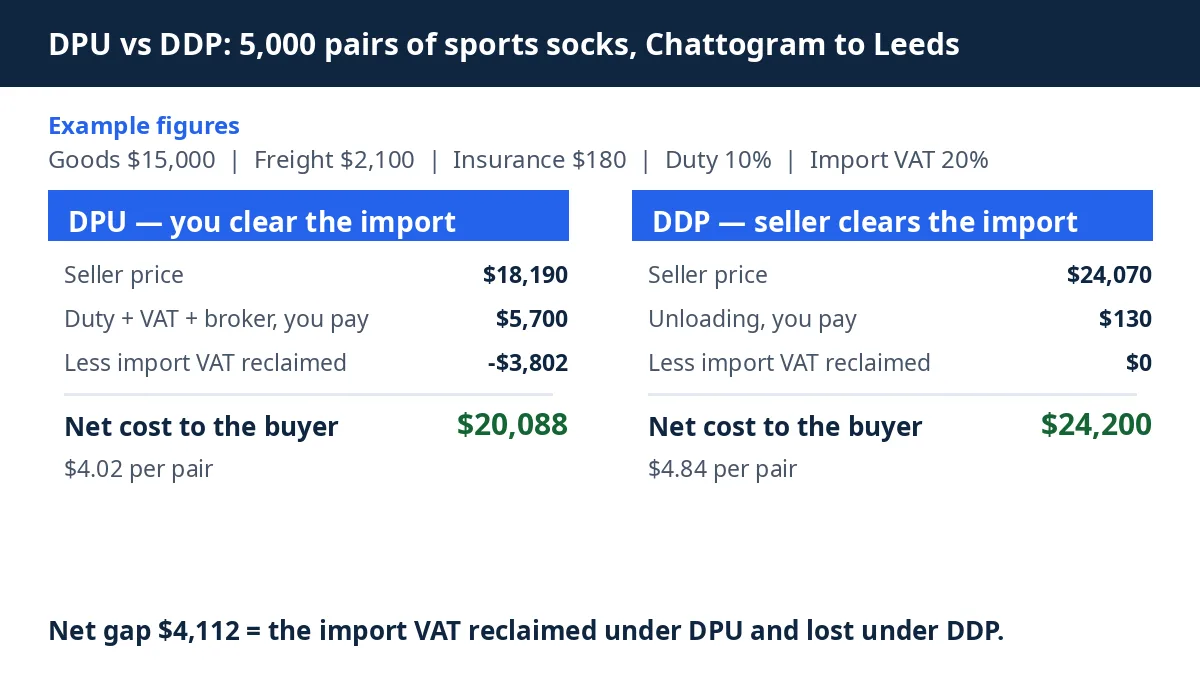
Example figures. A buyer in Leeds orders 5,000 pairs of men's sports socks from a Dhaka supplier, goods worth $15,000, shipped from Chattogram to Felixstowe and then by road to the Leeds warehouse. The duty rate is an example rate of 10 percent, and import VAT runs at the UK standard rate of 20 percent.4 The customs value is goods plus freight plus insurance, $17,280.
Cost line | Under DPU | Under DDP |
|---|---|---|
Goods, packing and export clearance | $15,000, seller price | $15,000, seller price |
Ocean freight, Chattogram to Felixstowe | $2,100, seller price | $2,100, seller price |
Cargo insurance | $180, seller price | $180, seller price |
Port handling at Felixstowe | $290, seller price | $290, seller price |
Road leg to the Leeds warehouse | $380, seller price | $380, seller price |
Import duty, example 10% of $17,280 | $1,728, buyer pays | $1,728, seller price |
Import VAT, 20% of $19,008 | $3,802, buyer pays | $3,802, seller price |
Broker and clearance fees | $170, buyer pays | $170, seller price |
Seller importer service charge | $0 | $420, seller price |
Unloading at the Leeds warehouse | $240, seller price | $130, buyer pays |
Seller price | $18,190 | $24,070 |
Gross total | $23,890 | $24,200 |
Less import VAT recovered | -$3,802, buyer VAT return | $0, the seller has no UK VAT number |
Net cost | $20,088 | $24,200 |
Net cost per pair | $4.02 | $4.84 |
Duty is 10 percent of the $17,280 customs value, $1,728. The VAT value is the customs value plus the duty, $19,008, and 20 percent of that is $3,801.60, rounded to $3,802.4 Under DPU the seller invoice is $18,190 and the buyer pays a further $5,700 at the border, giving a gross total of $23,890. Under DDP the seller invoice is $24,070 and the buyer pays only the $130 unloading charge, giving a gross total of $24,200. The net totals differ by $4,112, because the VAT-registered buyer reclaims the $3,802 of import VAT under DPU and no one reclaims it under DDP.
Where DDP cannot be performed
A DDP quotation is only as good as the seller ability to file the import entry in your country. In the European Union the declarant must as a rule be established in the customs territory of the Union, and a seller outside the Union cannot be the declarant in its own name.6 The route through is indirect representation: a customs representative established in the Union files the declaration for it.6 The European Commission states the same rule in general terms: the parties that make a customs declaration should as a rule be established in the EU.7
Brazil shows the harder case. DDP cannot be used for imports into Brazil, because a foreign seller has no legal standing to clear goods there, and the parties should choose DAP or DPU instead.3
Which term fits your order: a decision guide
Choose DPU when you hold the border machinery yourself: a VAT registration in the destination country, a broker you already use, and regular import experience. DPU wins on a regular order into the UK or the EU, where the VAT reclaim outweighs the unloading premium.
Choose DDP when you have no broker, no import registration and no appetite for border work on this order. DDP wins on a first order, a small order, or an order into a market you have not imported into before, where setting up a broker for one shipment costs more than the seller service charge.
Four checks before you sign
Name the importer of record in the contract. Under DPU it is you. Under DDP ask for the name and the broker the seller will use, in writing.
Get the duty and VAT lines on their own. Ask for the tariff code, the goods value, the rate applied and the VAT figure. Our DDP price guide and our DPU price guide show how to read each line.
Price the unloading separately. Ask what the lift costs under DPU and what your own crew would charge under DDP.
Check the Bangladesh export file before the goods leave. Customs lists the Export Registration Certificate and the Business Identification Number among the general export documents, alongside the sales contract, the packing list, the commercial invoice, the certificate of origin and the EXP form.8
Questions buyers ask about DPU and DDP
Does DDP include unloading at the warehouse?
No. Under DDP the goods are delivered when they reach the named place, cleared for import and still on the vehicle, and unloading stays with the buyer unless the contract says otherwise.3
Is DPU always cheaper than DDP?
Not always. In the worked example above the DPU net total is $4,112 lower, and almost all of that gap is the import VAT reclaimed under DPU.
Next steps on Exportain
Price the same order on both terms, to the same warehouse address, with the duty, VAT, broker, unloading and service lines shown separately, then compare net totals after the VAT reclaim. Search Bangladeshi suppliers for sock and knitwear exporters, or post an RFQ that states the term, the named place and the unloading arrangement. Our Incoterms guide walks through every one of the eleven rules.
Sources
- Incoterms® 2020. International Chamber of Commerce (ICC) (accessed )
- Incoterms and tax: who pays import VAT under each rule. Quaderno (accessed )
- DDP Incoterm and Brazil: seller duties and when to use it. DHL, (accessed )
- Import VAT and customs duties: What UK businesses need to know. Xero, (accessed )
- Check when you can account for import VAT on your VAT Return. GOV.UK (accessed )
- Providing the trader details. Finnish Customs (accessed )
- Customs declaration. European Commission, (accessed )
- Start an Export Business in Bangladesh (2026 Guide). Entrepreneurs.bd (accessed )
About the author
Sourcing from Bangladesh?
Post a request for quotation and suppliers on Exportain can send you their quotes directly.
Post an RFQ