DAP vs DPU: Key Differences, Costs and Which One to Choose
DAP and DPU differ in one step only: unloading at the named place. This comparison prices both terms for a towel shipment from Chattogram to Hamburg and shows when DPU is worth the extra cost.
Short answer
DAP and DPU both put the seller in charge of carriage to the named place and leave import clearance with the buyer. The only difference is unloading: under DAP the buyer unloads and takes the risk on arrival, while under DPU the seller unloads and the risk passes only once the goods are on the ground.
On this page
Key takeaways
DAP and DPU differ in one step only: under DAP the buyer unloads at the named place, while under DPU the seller unloads, and DPU is the only Incoterms rule that obliges the seller to unload.
Both terms put export clearance and carriage on the seller and import clearance, duty and VAT on the buyer; only DDP shifts the border to the seller.
Example figures price 5,000 cotton bath towels to Hamburg at $16,956 under DAP and $17,066 under DPU, a $110 gap that is the unloading line alone.
Choose DPU when the buyer has no dock, no forklift and no crew, or when the cargo needs a crane; choose DAP when the buyer can unload for less.
A buyer in Hamburg orders 5,000 cotton bath towels from a supplier in Dhaka and asks for two quotations: one on DAP at the buyer warehouse in Hamburg and one on DPU at the same warehouse. The towels, the vessel and the sailing match in both quotes, yet the DPU price is higher. The difference is a single step at the end of the journey: who takes the towels off the arriving truck, who pays for that work and who carries the risk while it happens.
What is the one difference between DAP and DPU?
Both are rules of Incoterms® 2020, the edition of the International Chamber of Commerce (ICC) rules in force since 1 January 2020.1 Both put the seller in charge of the whole journey to the named place, and both leave import clearance, duty and taxes with the buyer.2
Under DAP, delivery happens when the goods are put at the buyer disposal at the named destination, still loaded on the arriving vehicle and ready for unloading.2 Under DPU, delivery happens only after the goods come off the arriving vehicle and are set down at the buyer disposal at the named place.2 The ICC Academy states the point plainly: under DAP the seller does not unload the goods, and under DPU the seller does unload them.2 DPU is the only one of the eleven rules that obliges the seller to unload.3 It grew out of the old Delivered at Terminal (DAT) rule, renamed in 2020 because the delivery point can be any place the parties name, such as a buyer warehouse.1
Who pays for each cost under DAP and DPU?
The seller books and pays for carriage to the agreed destination and carries the risk for the whole journey.2 Both rules work with any mode of transport.2
Cost line | Under DAP | Under DPU |
|---|---|---|
Goods, packing and inland carriage in Bangladesh | Seller | Seller |
Export clearance in Bangladesh | Seller | Seller |
Ocean freight to Hamburg | Seller | Seller |
Terminal handling at destination | Seller | Seller |
Road carriage to the buyer warehouse | Seller | Seller |
Unloading at the buyer warehouse | Buyer | Seller |
Cargo insurance | Buyer buys its own policy | Seller usually covers its own risk |
Import clearance, duty and import VAT | Buyer | Buyer |
Onward carriage past the named place | Buyer | Buyer |
Unloading under DAP may or may not be covered by the carriage contract the seller booked; if it is not covered, the buyer pays for it, even though the buyer did not choose the carrier.2 DPU does not cover the border: only DDP makes the seller clear import and pay duty.4
What happens at the terminal and on the last road leg?
At Hamburg, the container is lifted off the vessel and placed in the terminal yard, inside the seller carriage under both terms. The last road leg runs from the terminal to the buyer warehouse, paid by the seller under both terms when the warehouse is the named place. The vehicle then arrives at the dock, and the two rules part company: under DAP the seller obligation ends with the goods on the truck, ready for unloading, and the buyer takes the risk from that moment, while under DPU the seller obligation ends only after the towels are off the truck and set down at the buyer disposal.2 A carton that topples during the lift is the buyer loss under DAP and the seller loss under DPU, for the same cargo at the same address, because of the wording in the contract.3
Worked example: 5,000 cotton bath towels from Chattogram to Hamburg
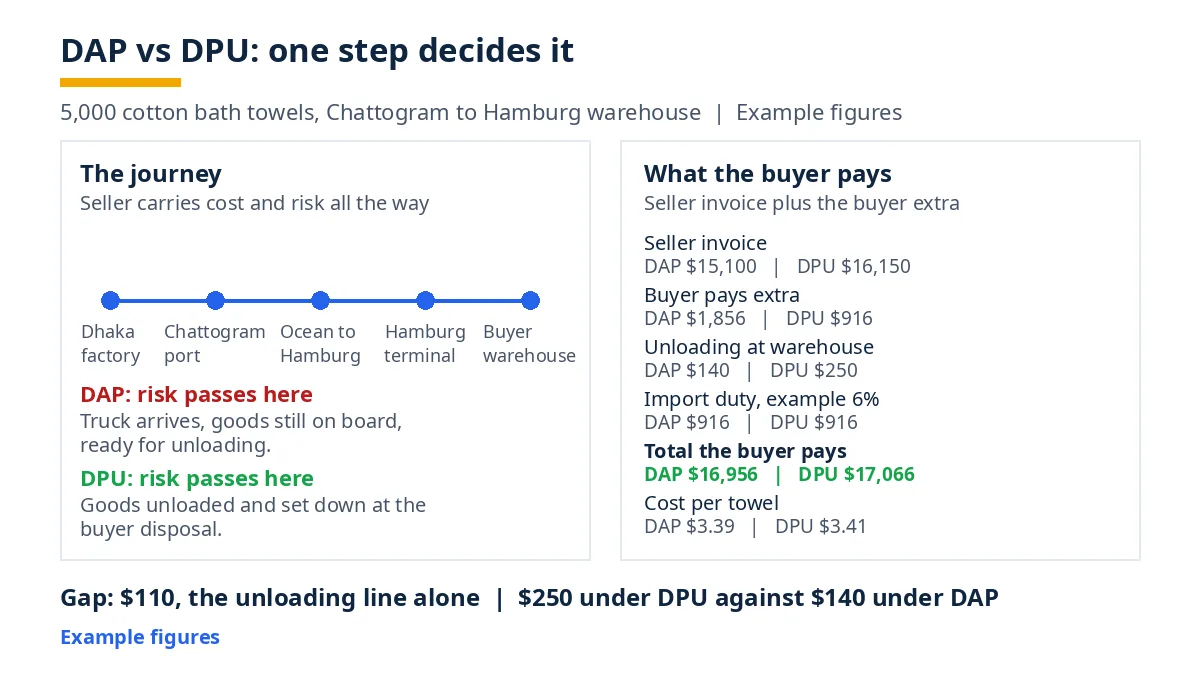
Example figures. A buyer in Hamburg orders 5,000 cotton bath towels, goods worth $12,800, shipped in a single 40-foot box from Chattogram to Hamburg, then trucked to the buyer warehouse in Hamburg. All figures are illustrative, including the example duty rate.
Cost line | Under DAP | Under DPU |
|---|---|---|
Goods, packing, inland carriage, export clearance | $12,800, in the seller price | $12,800, in the seller price |
Ocean freight, Chattogram to Hamburg | $2,300, seller pays | $2,300, seller pays |
Cargo insurance | $160, buyer pays | $160, seller pays |
Terminal handling at Hamburg | $280, seller pays | $280, seller pays |
Road carriage to the warehouse | $360, seller pays | $360, seller pays |
Unloading at the warehouse | $140, buyer pays | $250, seller pays |
Import duty, example 6% of $15,260 | $916, buyer pays | $916, buyer pays |
Total the buyer pays | $16,956 | $17,066 |
Cost per towel | $3.39 | $3.41 |
Under DAP the seller invoice is $15,100 and the buyer pays a further $1,856. Under DPU the seller invoice is $16,150 and the buyer pays only the $916 duty. The $110 gap between the two totals sits on the unloading line alone: $250 under DPU against $140 under DAP. Duty is an example 6% of $15,260: $915.60, rounded to $916. The customs value of $15,260 is the goods at $12,800 plus freight at $2,300 plus insurance at $160. In the European Union, import VAT is generally charged on the customs value plus duty and qualifying incidental costs.4
Who insures the cargo under DAP and DPU?
Neither rule obliges either party to obtain cargo insurance.4 Under DAP the risk passes to the buyer when the vehicle arrives at the named place with the goods ready for unloading, so the buyer exposure starts at the warehouse dock and runs through the unloading it has arranged.2 Under DPU the seller carries the transit risk until the goods are unloaded and set down for the buyer, so the seller usually buys cover of its own, although the rule asks for none.4 That cover protects the seller, not the buyer: the buyer cannot claim on it. If the buyer wants a policy it can claim under, the clause set, the sum insured and the payer should be written into the contract before shipment. See our DPU price guide for what a DPU price contains, and our CPT vs DPU guide for the same insurance question where risk passes at the first carrier.
What does import clearance still leave with the buyer?
The border is the same under both rules. The seller clears the goods for export in Bangladesh, while the buyer files the import entry and pays the duty and taxes as importer of record.2 The timing of clearance can still change the cost: under DPU a clearance delay holds the goods while the seller still carries the risk, because delivery has not yet happened, while under DAP the risk has already passed to the buyer by the time the vehicle reaches the named place. Our DAP customs clearance guide sets out the export and import files side by side. Buyers who want the seller to handle the border as well should ask for DDP, not DPU: DDP alone covers import clearance and duty.4
When should a buyer choose DPU over DAP?
Choose DAP when the buyer has the unloading capacity and wants to control that step; choose DPU when the buyer does not.3
Heavy or awkward cargo. Machinery, panels or heavy pieces that need a crane or a large forklift are the clearest DPU case.3 A seller that ships such cargo regularly usually has the lifting gear arranged through its carrier.
A place with no dock and no crew. A construction site, a trade fair or any place with no unloading facilities leaves the buyer with nothing to unload with.3
One price and one party to chase. Under DPU the seller invoice covers the goods, the freight, the terminal handling, the road leg and the unloading. That simplicity costs $110 on a $17,000 order in the worked example above, and a buyer that can unload for less should take the DAP price and keep the difference.
DAP is the better fit for delivery to the buyer own warehouse, with a dock, forklift and trained staff, and for standard palletised cargo, where unloading is routine.3 Cotton towels in cartons are routine cargo for a warehouse with a forklift, which is why many towel buyers take DAP and unload themselves.
Four mistakes buyers make with DAP and DPU
Naming a city instead of a place. "DAP Hamburg" and "DPU Hamburg" leave the delivery point open to argument. Write the full address, the warehouse bay and the version of the rules, as in "DPU Buyer Warehouse, Am Sandtorkai 1, Hamburg, Incoterms® 2020".3
Assuming the unloading charge is already in the price. The carriage contract the seller booked may or may not cover unloading at the destination; if it does not cover it, the buyer must bear the cost.2
Choosing DPU when the seller cannot unload at the destination. The ICC Academy advises the seller to assess carefully whether it can safely unload the goods at the agreed place, and to use DAP instead if unloading cannot be ensured.2
Treating the Incoterm as a payment term. Incoterms say nothing about price, payment method or when title transfers; they deal with delivery, cost and risk.1
Bangladesh checks before you sign
Before the towels leave Dhaka, the seller file has to be in order. On the customs list of general export documents sit the Export Registration Certificate (ERC) and the Business Identification Number (BIN), together with the sales contract or letter of credit, the EXP form, the commercial invoice, packing list, transport document and origin certificate.5 The authorised dealer bank files the EXP form before customs formalities begin, and the exporter hands the bank the signed EXP copy and the shipping papers within 14 days of shipment.5 Export proceeds must normally reach Bangladesh within four months of shipment, unless Bangladesh Bank authorises longer.5
One more check matters for letter of credit shipments. Bangladesh Bank allows EXW, FCA, FOB, FAS, CFR, CIF, CPT and CIP when the contract or letter of credit names them, according to a 2026 guide to the country's export rules; DAP and DPU do not appear on that list.5 A seller quoting either term under a letter of credit should check the wording with its authorised dealer bank before the credit is opened. The full set of eleven rules is covered in our Bangladesh Incoterms guide.
Questions buyers ask about DAP and DPU
Is DPU always more expensive than DAP?
Not always, but usually by the unloading line. In the worked example above the DPU total is $110 higher than the DAP total, and the whole gap is the unloading charge: $250 under DPU against $140 under DAP. A buyer with no forklift and no crew would pay more than $250 to hire both, so DPU can be the cheaper real cost even when its quotation is higher.
Can DAP and DPU be used for air freight?
Yes. Both rules work with any mode of transport, including air, road, multimodal and door to door express.3
Does DPU include import duty?
No. The buyer files the import declaration and settles the duty and taxes.4 Only DDP shifts import clearance and duty to the seller.4
Next steps on Exportain
Compare DAP and DPU quotations side by side before you sign, using the cost table above as your checklist, and name the exact warehouse bay in the contract. Then search Bangladeshi suppliers for towel and home textile exporters, or post an RFQ with the Incoterm, the named place and the unloading arrangement stated in the requirement, so every supplier quotes the same delivery.
Sources
- Incoterms 2020 Explained: Complete Guide (2026 Update). Inecta (accessed )
- DAP & DPU Incoterms 2020 explained: Key differences. ICC Academy, (accessed )
- DAP and DPU Incoterms in Brazil: who unloads, where risk ends. DHL, (accessed )
- DPU Incoterms (Delivered at Place Unloaded) Explained. iContainers (accessed )
- Start an Export Business in Bangladesh (2026 Guide). Entrepreneurs.bd (accessed )
About the author
Sourcing from Bangladesh?
Post a request for quotation and suppliers on Exportain can send you their quotes directly.
Post an RFQ