How to Choose the Named Place for DPU Correctly
A vague DPU name lets the seller choose the cheapest unloading point. This guide shows how to name a place, point, terminal and bay precisely, test the name before signing, and price the consequence, with Bangladesh gateway examples.
Short answer
To choose the named place for DPU correctly, name the exact unloading point, not just the city: the facility, terminal or warehouse, the bay or dock, and the access point, in the form "DPU, [place, facility, bay], Incoterms 2020". Under DPU the seller unloads there and bears cost and risk until the goods are unloaded and at your disposal. Test the name for carrier access, safe unloading, buyer access, and the import-clearance sequence before signing.
On this page
Key takeaways
Under DPU, the seller unloads at the named place and point; risk passes only after unloading, when the goods are at the buyer's disposal.
A city name is not a delivery point: name the facility, terminal, bay or dock, and access point, and use that one name on every document.
Test a candidate name for carrier access, safe unloading, buyer access, and the import-clearance sequence before it goes into the contract.
A vague name lets the seller choose the cheapest compliant point, and the buyer pays the onward carriage, handling and delay that choice creates.
Export clearance in Bangladesh requires an approved Bill of Export before loading or stuffing under section 131 of the Customs Act, 1969; confirm the transport document carries the full DPU named place.
A DPU price is only as precise as the name attached to it. Write "DPU Hamburg" and the seller must deliver to Hamburg, but Hamburg contains a port, several terminals, yards and warehouses, and the seller may choose the point inside it that costs least to reach and unload at. Name the terminal and bay, and the obligation ends where you can receive the goods. This guide is about that difference, for buyers in the United States, the United Kingdom, the European Union and the United Arab Emirates who buy from Bangladesh under DPU.
A vague name hands the choice to the seller
Under DPU (Delivered at Place Unloaded), the seller undertakes to deliver the goods and transfer the risk of loss or damage at the designated place and point of destination, including unloading the goods from the arriving means of transport and making them available to the buyer.1 The seller arranges and pays for transport and unloading, and completes export and transit formalities, while the buyer completes import formalities and arranges onward carriage.1
That bargain only works if both the place and the point are named. The place is the destination area. The point is the exact spot inside it where unloading happens. When a contract names only the place, the unloading spot is left to be settled later, and the seller will settle it in the way that costs least: the nearest terminal gate, the cheapest yard, the bay with no waiting charge. The buyer then pays the onward leg, the extra handling and the delay the cheaper point created. A precise name removes that choice. It tells the carrier where to go, the seller where unloading ends, and the buyer where to send a vehicle and a receiving team.
Place, point, terminal and bay: what each word fixes
Word | What it fixes | A name that finishes the job |
|---|---|---|
Place | The destination area, such as a port city | The starting point only |
Point | The exact unloading spot | A named terminal and bay inside the port |
Terminal | The receiving facility | The named terminal, with its gate or dock |
Bay or dock | The unloading position inside the facility | The numbered unloading bay or dock |
The point matters most: delivery and risk transfer happen at the agreed place and point, once goods are unloaded and at the buyer's disposal.1 Define the place as precisely as possible, since it fixes the risk-transfer moment and who bears costs to which point.2
The former Delivered at Terminal (DAT) rule was renamed Delivered at Place Unloaded (DPU) in Incoterms 2020 to emphasize that the place of destination can be any place and not just a terminal, with unloading by the seller as the sole difference from DAP.3 The ICC Academy example shows the pattern: "DPU, Le Havre Port, France, Refrigerated Terminal, Incoterms 2020" places delivery at a named terminal inside a named port, not at the port in general.1 Unloaded means the goods are off the vehicle where the buyer can receive them unhindered, and the seller informs the buyer in good time.2 Where a place is hard to pin down in words, state GPS coordinates or the exact warehouse bay in the contract.4
The precision test: five questions for any candidate name
Run every candidate name through five questions before it goes into a contract. A name that fails any one is not finished.
Can the carrier find it without asking? A driver who has never been there should reach the point from the name alone, with facility, gate and bay stated.
Can the seller unload there safely? The seller should assess whether safe unloading can be ensured; if it cannot, DAP fits better.1 Ask what equipment the point has.
Can the buyer receive the goods unhindered? Confirm access hours, vehicle entry, and who meets the vehicle, since delivery needs unhindered access.2
Where does import clearance sit? If import clearance must come before unloading, DAP gives a clearer transfer of responsibilities than DPU.2 Settle the sequence before naming the point.
Is it one name, used everywhere? Mark the transport document "DPU, [Named Place], Incoterms 2020", and use the same name on the invoice, packing list and arrival notice.4
Seaport, airport and inland terminal: naming by gateway type
A seaport terminal
Name the port, the terminal and the bay or dock. "DPU Rotterdam" names a port city with several terminals. "DPU Rotterdam, [terminal name], Bay [number], Incoterms 2020" names a point a carrier can book to and a seller can unload at. Add the gate where the buyer's vehicle collects the goods.
An airport cargo terminal
Name the airport, the cargo terminal and the bay or dock where goods come off the aircraft handling chain. DPU works for any mode of transport, including air.1 If clearance must come before unloading, agree DAP for that leg or settle the sequence explicitly.2 For air freight, use only any-mode rules: FAS, FOB, CFR and CIF are sea and inland-waterway only, while CPT and DPU are any-mode.5
An inland terminal or depot
Name the depot, its town or city, and the bay, dock or yard position. The DPU definition covers any designated place and point, not only a port or airport terminal.1 State whether carriage ends at the depot gate, a named bay inside it, or the buyer's warehouse.
A buyer warehouse or job site
Name the full facility address, the receiving bay or dock, and the access point for the arriving vehicle. Name the full warehouse address, as the Exportain Incoterms guide advises under DAP, since DPU adds seller unloading at the same point.5
What a vague name costs: the cheapest-point consequence
A vague name causes a quiet transfer of cost: the seller delivers to the cheapest compliant point, and the buyer pays the onward carriage, extra handling and waiting time to the warehouse. Two "DPU Hamburg" quotations can end at different terminals, so headline prices are not comparable until both are priced to the same warehouse. The risk boundary blurs too, since risk passes when the goods are unloaded and at the buyer's disposal at the agreed point, and a disputed point means a disputed moment, with damage between two candidate points having no agreed owner.1
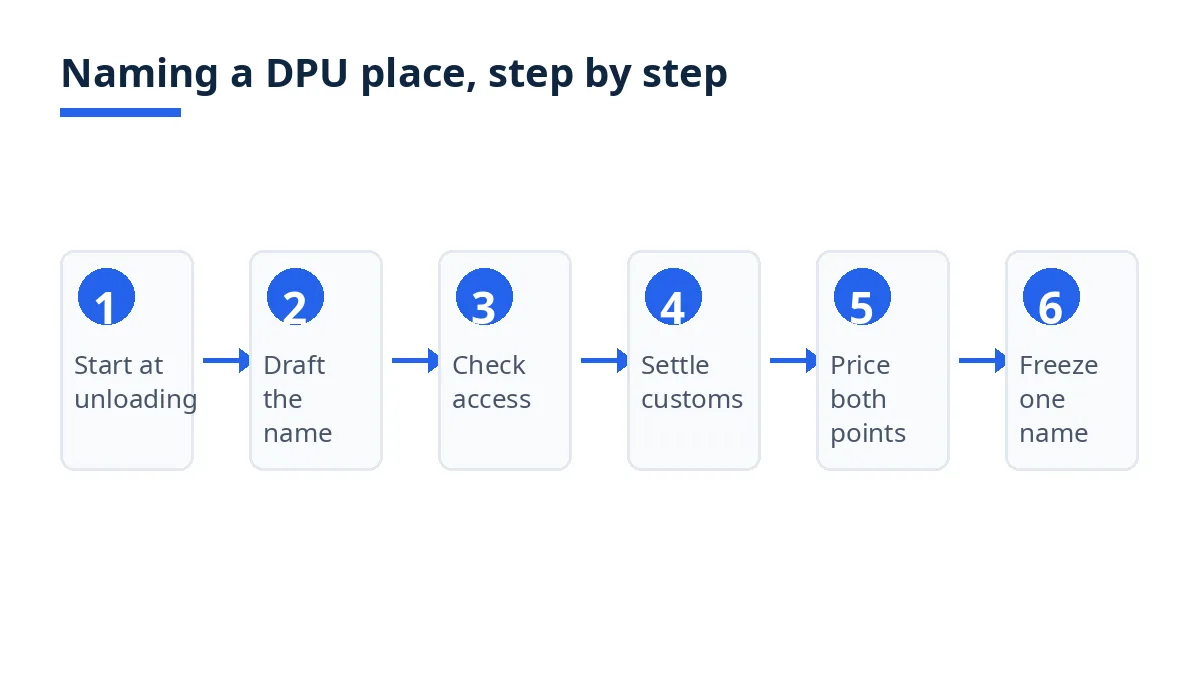
A six-step naming sequence, from first draft to signed wording
Start from the unloading act. Decide where the goods must be off the vehicle and at your disposal, then work backwards to the facility, town and port or airport.
Draft the full name. Write place, facility, bay or dock, access point and country, with rule and edition: "DPU, [place, facility, bay], Incoterms 2020". Leave no placeholder in the signed version.
Check unloading and access. Confirm equipment, access hours and vehicle entry, and that the seller can unload safely there.1
Settle the customs sequence. Confirm whether import clearance happens before or after unloading, and write the sequence down. If clearance must come first, reconsider DPU for that point.2
Price the name against its nearest alternative. Ask the seller to price the precise point and the cheapest nearby point separately.
Freeze one name across every document. Put the same wording on the contract, invoice, packing list, transport document, arrival notice and broker instructions, and check each one before departure.4
Costs, timelines and documents that follow the name
Ask the seller to show cost lines in article A9/B9 order, where costs under each rule are consolidated, rather than as one lump sum.3 Under DPU the seller pays packaging and transport to the agreed destination, export and transit formalities, and unloading.2 The buyer pays import clearance, duties and taxes, and onward carriage.1 Except under CIF and CIP, neither party must insure, but the seller should insure transport including unloading.2
No typical DPU cost or transit time holds across suppliers, routes, modes and quantities, so none is stated here as fact. Ask for an arrival window tied to the named point, since the seller must inform the buyer in good time.2
Example figures only, for one container of stoneware tableware from Chattogram to Hamburg.
Cost line | DPU Hamburg port terminal bay | DPU buyer warehouse bay |
|---|---|---|
Goods, including export packing | 9,800 | 9,800 |
Export clearance and documents | 360 | 360 |
Ocean carriage, Chattogram to Hamburg | 1,540 | 1,540 |
Onward carriage to the warehouse | 0 | 430 |
Unloading at the named bay | 180 | 210 |
Seller DPU price, unloaded | 11,880 | 12,340 |
Import clearance and broker | 290 | 290 |
Duty and taxes, example lump sum | 940 | 940 |
Onward carriage from the named bay | 410 | 0 |
Buyer-side total | 1,640 | 1,230 |
Landed total | 13,520 | 13,570 |
The warehouse-bay name costs 460 more on the seller's price and 410 less on the buyer's side, for a landed difference of 50.
The seller provides the commercial invoice, packing list and transport document, and notifies the buyer once the goods are unloaded at the buyer's disposal.4 Mark the transport document with the DPU term and named place, and keep the name spelled identically on every document.2 4
Bangladesh gateways: Chattogram, Mongla and Dhaka airport
Chattogram is the main seaport of Bangladesh, on the Karnaphuli River, handling over 70 percent of the country's export-import trade, with 19 berths including 14 container berths and four container facilities: the General Cargo Berth, the New Mooring Container Terminal, the Chittagong Container Terminal and the Patenga Container Terminal, with private off-docks nearby.6
Mongla is the second largest and busiest seaport of Bangladesh after the Port of Chittagong, on the Pashur River about 48 km south of Khulna, with 11 jetties.7 A Mongla departure changes no part of the DPU split: the seller still unloads at the named destination point and bears the risk until unloading is complete.1
Air shipments leave through Hazrat Shahjalal International Airport in Dhaka. Bangladesh first achieved EU aviation security validated regulated agent (RA3) validation at the airport in 2017, allowing direct export cargo to the European Union and the United Kingdom, and approval for direct screening of UK-bound export cargo using the explosive detection dog method was reinstated in May 2026.8
Section 131 of the Customs Act, 1969 requires that goods must not be loaded or stuffed for export unless a Bill of Export has been submitted to Customs and approved, with the export contract or letter of credit, invoice, packing list, EXP form, certificate of origin, VAT certificate and taxpayer identification number enclosed.9 Where goods are loaded into containers at private inland container depots or exporters' premises, a gate division officer may check the goods before they proceed to the port area.9 Confirm the Bill of Export is approved before departure, and that the transport document carries the full DPU named place.4 9
Naming slips that move the unloading point
A city accepted as a point. "DPU Hamburg" and "DPU Dubai" name places, not points.
A name that assumes the seller can unload. DPU is the only rule that requires the seller to unload, and the seller must be in a position to organize unloading at the named place.3 Confirm the capability in writing, or switch the rule to DAP.
A point past customs named as if clearance did not matter. Where import clearance must happen before unloading, naming the bay without settling the sequence leaves the seller waiting to unload goods the buyer cannot yet clear.2
A different name on every document. The contract says one terminal, the bill of lading abbreviates it, and the arrival notice uses a warehouse nickname. Freeze one spelling, one facility and one bay, and check every document against it before departure.4
A name copied from a previous order. Re-run the five-question test for each order.
Final check before the name goes into the contract
Full name written as "DPU, [place, facility, bay or dock, access point], Incoterms 2020", with no placeholders left.
Unloading confirmed: who, with what equipment, when, and with what buyer access.
Seller's ability to unload safely at that exact point confirmed in writing.
Import-clearance sequence settled: clearance before or after unloading, with the broker briefed.
The precise point and the cheapest nearby point both priced, so the landed totals can be compared.
Insurance position stated in writing, including cover for the unloading act, since DPU itself requires no insurance from either party.2
What should I know first about DPU?
DPU stands for Delivered at Place Unloaded. The seller delivers the goods at a named place and point, unloaded and at the buyer's disposal, bearing carriage and unloading cost and risk; the buyer clears import customs and arranges onward carriage.1 It is the only Incoterms 2020 rule that requires the seller to unload, and it works for any mode of transport.3
What are the typical costs and timelines?
No typical DPU cost or transit time holds across suppliers, routes, modes and quantities, so none is stated here as fact. The seller pays packaging, carriage, export formalities and unloading; the buyer pays import clearance, duty, taxes and onward carriage.3 2 Ask for an arrival window tied to the named point.
Which documents are needed?
The seller provides the commercial invoice, packing list and transport document marked "DPU, [Named Place], Incoterms 2020", plus the export file headed by the Bill of Export approved under section 131 of the Customs Act, 1969.4 9 The seller hands over the delivery documents and gives arrival notice, and the buyer and broker provide the import declaration at destination.2
What are the most common mistakes?
Buyers accept a city as the unloading point, name a terminal without its bay, agree DPU with a seller who cannot unload safely at the point, ignore the clearance-before-unloading sequence, and let a different name appear on each document. Re-run the precision test on every order.
Next steps on Exportain
Read the Incoterms guide, compare the DAP named place guide when the seller will not unload, and check the CIF guide before ranking a port-based price against a DPU price. When the unloading point and specification are fixed, post a free RFQ on Exportain stating the quantity, destination, Incoterm and the full named place, and check how to buy for the buying steps. Exportain is a B2B marketplace where buyers post RFQs, receive quotations and message suppliers. It is not a party to the contract for the goods, and it does not inspect goods, book freight or clear customs.
Sources
- DAP & DPU Incoterms 2020 explained: Key differences. ICC Academy, (accessed )
- DPU (Delivered At Place Unloaded) | Incoterms 2020. Röhlig Logistics (accessed )
- Incoterms® 2020. International Chamber of Commerce (ICC) (accessed )
- DPU Incoterms (Delivered at Place Unloaded) Explained. iContainers (accessed )
- Incoterms for Shipments From Bangladesh. Exportain (accessed )
- Port of Chittagong. Wikipedia (accessed )
- Port of Mongla. Wikipedia (accessed )
- Bangladesh expands export cargo screening capacity at airports. The Business Standard (accessed )
- Customs Clearance Procedures for Export. Bangladesh Customs, National Board of Revenue (accessed )
About the author
Sourcing from Bangladesh?
Post a request for quotation and suppliers on Exportain can send you their quotes directly.
Post an RFQ