DAP Named Place: Choose the Delivery Point, Not the City
Naming a city is not naming a DAP delivery point. This guide tests warehouse, terminal and airport places against clearance, unloading and price, so the contract names the place the goods actually reach.
Short answer
Choose a DAP named place by naming the exact delivery point, not a city: the full address with dock, gate or terminal, plus the Incoterms 2020 edition. The seller pays carriage and bears risk until the goods arrive at that point ready for unloading. The buyer unloads, clears import customs and pays duty and taxes, and must agree insurance separately, since DAP imposes no insurance obligation on either party.
On this page
Key takeaways
The DAP named place is both the delivery point and the risk point: the seller pays carriage and bears transit risk until the goods arrive at that point ready for unloading.
A city name alone lets the seller choose the cheapest point in that city, usually a cargo terminal; name the full address with the dock, gate or terminal.
A warehouse place still leaves the buyer bearing the risk during import clearance, and the seller completes the final leg only after clearance and release.
Price a terminal place and a warehouse place to the same door, adding onward transport, terminal charges and a storage allowance before ranking either quotation.
Keep one name in every document, and fix the Bangladesh departure, loading port or airport cargo terminal and export file, before booking.
The dap named place in a contract is a delivery address, not a destination label. Write "DAP Rotterdam" and the seller may lawfully end the journey at the cheapest point in Rotterdam that suits its carriage plan. Write the warehouse address, the receiving dock and the gate, and the seller must carry the goods to that point, ready for unloading, before delivery happens.
This guide is for buyers in the United States, the United Kingdom, the European Union and the United Arab Emirates who are fixing the named place on a DAP order from Bangladesh. It works through the kinds of place you can name, the import-clearance gap inside some of them, the tests a candidate place must pass, and a worked comparison of a terminal place against a warehouse place.
The DAP named place is the delivery point
Under DAP (Delivered at Place), Incoterms 2020, the seller delivers the goods when they are placed at the buyer's disposal at the agreed place of destination, ready for unloading from the arriving means of transport, and bears the risk of loss or damage until that moment.1 The place of delivery can be an airport, a frontier, a train terminal, a port, the buyer's premises or another agreed destination.1 Delivery and destination are the same concept under DAP: the named destination is where the goods are delivered and where risk passes.1
That separates DAP from the "C" rules. Under CIP, the seller hands the goods to the carrier at the start of the journey, while the destination named in the contract is a separate point; delivery and risk pass at the start.1 Under DAP naming the same destination, delivery, destination and the risk transfer all sit at that place.1 A DAP contract therefore needs a place precise enough to stand as a delivery point, not merely a city the goods are heading toward.
Precision means a named point inside the named place. The seller must arrange carriage to the named place, and if an agreed point within that place exists, to that point.2 If the destination is shown only as a large city, the carrier may leave the goods at the buyer's premises, a building site, the carrier's premises, the airport, the container yard or a particular quay.2 Where no exact point is specified, the seller can select the point that best suits its purpose, which will usually be the cheapest option, such as a cargo terminal.2 Use the full format "DAP [full delivery address and precise receiving point], Incoterms 2020", because a city name alone can leave uncertainty about the last transport leg.3
DAP works for any mode of transport, including multimodal shipments using at least two modes.1 The seven any-mode rules are EXW, FCA, CPT, CIP, DAP, DPU and DDP, while the four rules for sea and inland waterway transport only are FAS, FOB, CFR and CIF.4 CPT belongs in the any-mode group, not the sea-only group. Under CPT the seller pays carriage to the named destination but delivery and risk pass when the goods are handed to the first carrier, while under DAP risk stays with the seller until arrival at the named place.5 The full comparison of all eleven rules is in the Incoterms guide.6
What kind of place are you naming?
Most DAP named places fall into four kinds. The kind you name decides how much of the journey the seller's carriage covers, where import clearance has to happen, who unloads, and what onward leg remains for you. Identify the destination precisely, because both risk and cost transfer at that point.5
Kind of named place | Seller carriage ends | Clearance position | Unloading | Onward leg for the buyer |
|---|---|---|---|---|
Buyer warehouse or factory address, with dock or gate | At the named address, ready for unloading | Before the final leg, while goods wait at the port or airport; confirm with the broker | Buyer, at its own risk and cost | None, if the address is the final point |
Container terminal or port terminal | At the terminal, ready for unloading | At or near the terminal, before release | Buyer, unless the carriage contract includes the unloading charge | Buyer books onward transport from the terminal |
Airport cargo terminal | At the cargo terminal, ready for unloading | At the airport, before the cargo can move onward | Buyer, at its own risk and cost | Buyer books the airport-to-warehouse leg after release |
Inland depot, rail terminal or border point | At the depot or border point, ready for unloading | As the broker confirms for that point | Buyer, at its own risk and cost | Buyer books onward transport from the depot or border |
A warehouse address is the most complete DAP promise, and it asks the most of the buyer: a named dock or gate, an appointment window, staff and equipment to unload, and a vehicle that can reach the point. A terminal place is simpler for the seller to serve, but it leaves the buyer with the onward leg and the terminal charges outside the carriage contract. An airport cargo terminal suits air freight and light or urgent goods, yet the seller's obligation still ends at the terminal. A depot or border point can suit a buyer with its own inland network, but only if the buyer can clear, collect and move the goods from a point that may have no unloading help. If the buyer does not have unloading equipment on hand, or the goods need specialized equipment, DPU, under which the seller unloads, may fit better than DAP.2 Choose a place kind because you can clear, unload and move the goods from exactly that point, on the day the goods arrive.
The clearance gap: a place past customs is a different promise
Naming a place beyond the customs boundary creates a gap that a port or terminal name does not. Under DAP the buyer is responsible for import clearance, and the buyer bears all risks of loss or damage during the import clearance process under sub-article B3(a) of the Incoterms 2020 rules; if the buyer is unwilling to assume that risk, DDP should be used instead, with the caution that a foreign seller may have difficulty carrying out import clearance in the destination country.1 A warehouse named place does not remove that gap. It only means the seller must complete the final leg after clearance, once the buyer has given the carrier the paperwork it requires to move the cargo from the airport or port to its final destination.2
The air-freight pattern shows the gap clearly. Where a shipment by air requires import clearance in the destination country, the buyer carries out those formalities while the goods sit at the airport, and once cleared, the seller's carrier must be given whatever paperwork it requires to move the cargo to its final destination.2 If the goods are damaged or lost before the final destination, the seller may be unable to deliver, while the buyer may already have paid import duties and taxes.2
Three consequences follow. First, appoint the broker and prepare the import entry before departure, and give the seller's carrier a single contact who can confirm release and approve a revised delivery appointment. Second, agree in writing who pays storage and waiting charges if clearance is slow, and how much free time applies; do not assume every charge at destination belongs to the same party merely because the shipment is DAP.3 Third, check the consignee on the transport document. The buyer should not be the consignee on any air waybill or bill of lading where onward movement remains, because the seller has to arrange for its forwarder to take possession of the goods from the airline or shipping company and arrange local inland transport.2
Test a candidate place before you name it
Run each candidate place through six tests before the wording goes into the contract. A place that fails a test is not a bad place in general; it is the wrong named place for this order. The diagram below sets out the decision in order.
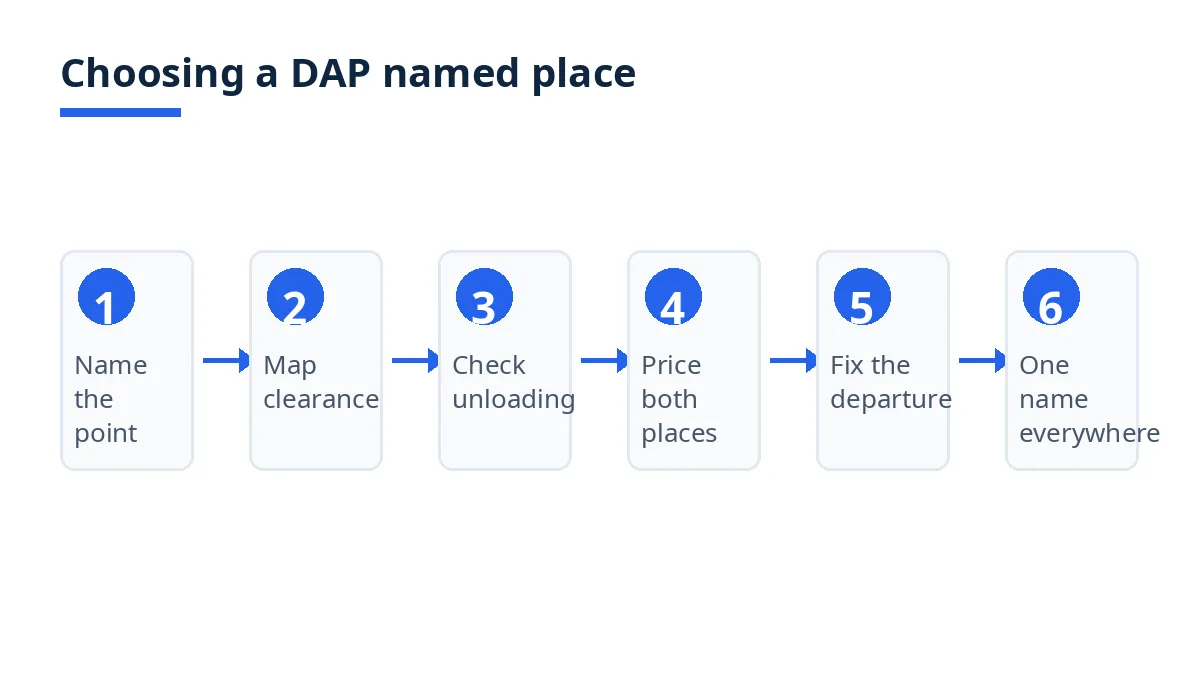
Point, not city. Write the full address, the dock or gate, and any access restriction, in the form "DAP [full delivery address and precise receiving point], Incoterms 2020".3 If the place is a terminal, name the terminal, not the port. If it is an airport, name the cargo terminal, not the airport.
Vehicle access. Confirm the arriving vehicle can reach the point, stop, and wait. A warehouse on a restricted street, a gate with a height limit, or a terminal that takes only booked slots can turn a named place into a failed delivery. Ask the receiving point for its vehicle rules in writing.
Unloading. Confirm staff, forklift or crane capacity, and an appointment window for the arrival day. Under DAP the buyer arranges unloading at its own risk and cost, unless the transport contract includes the unloading cost for the seller.1 Where that charge is already included in the seller's transport contract, it should not be charged again to the buyer unless agreed otherwise.3
Clearance at the point. Confirm with the broker that import clearance can be completed for goods arriving at that point, what licenses, permits, security clearance, pre-shipment inspection or other authorizations the destination country requires, and what documents the seller must supply.2
Time and storage. Confirm free time at the terminal, the storage and waiting charges that follow delay, and who pays them. Before shipping, put the broker, the transport provider and the receiving warehouse in contact and confirm who will monitor customs release.3
Onward booking. If the named place is a terminal, airport or depot, confirm the onward booking and the release check that must pass before the final leg is dispatched. Arrival at an intermediate port does not complete delivery when the contract names an inland warehouse.3 A change from a terminal to a warehouse is a different delivery scope, not a detail.3
A candidate that passes all six tests can be named. A candidate that fails one should either be renamed to a point that passes, or kept only with the failing point fixed in writing before booking, with the cost of the fix shown as its own line.
Price the terminal place and the warehouse place to the same door
Two DAP prices for the same goods are comparable only when they name the same place, or when each is priced onward to the same door. Ask for an itemised transport quotation to the precise destination, so offers can be compared and services that still need arranging can be identified.3 A label such as "DAP freight" is not a substitute for a detailed service scope, and the provider should identify exclusions before booking.3 The DAP freight cost guide sets out how each carriage line is calculated; this section uses that split only to compare two named places.
Example figures only, for one shipment of cotton garments from Chattogram to a buyer in the United Kingdom, quoted DAP to two different named places. They are not a quotation or a market price. The duty and taxes line is an assumed lump sum, with no rate stated; the broker must confirm it on the exact classification before any quotation is ranked.
Element | DAP container terminal (example, USD) | DAP buyer warehouse (example, USD) |
|---|---|---|
Goods, including export packing | 8,400 | 8,400 |
Export clearance and documents | 180 | 180 |
Main carriage to the destination country | 1,080 | 1,080 |
Inland carriage to the named place | 190 | 650 |
DAP price to the named place | 9,850 | 10,310 |
Buyer-side cost | Terminal place (example, USD) | Warehouse place (example, USD) |
|---|---|---|
Import clearance and broker | 210 | 210 |
Duty and taxes, assumed lump sum | 720 | 720 |
Unloading at the named place | 120 | 120 |
Onward transport from the terminal | 340 | 0 |
Buyer-side total | 1,390 | 1,050 |
Total to the warehouse door | 11,240 | 11,360 |
Arithmetic: 8,400 + 180 + 1,080 + 190 = 9,850; 8,400 + 180 + 1,080 + 650 = 10,310; 210 + 720 + 120 + 340 = 1,390; 210 + 720 + 120 = 1,050; 9,850 + 1,390 = 11,240; 10,310 + 1,050 = 11,360. The warehouse DAP price is USD 460 higher, yet the total to the door is USD 120 higher, because the terminal option adds USD 340 of onward transport. In this example the terminal place is cheaper overall, but only if the onward leg runs on time, clearance is prompt, and no storage charge arises. Change any of those conditions and the ranking can reverse.
Never compare an FOB price with a CIF or DAP price directly, and never compare two DAP prices that name different places without pricing both to the same door.6 Price every quotation to the warehouse, using real forwarder quotations and checking insurance levels, named places, currency and validity.6
Bangladesh departure checks: Chattogram, Dhaka airport and the export file
The destination name is only half the contract. The Bangladesh departure must be fixed with the same precision, or the seller's carriage to the named place starts from a point the buyer never agreed.
Export clearance is the seller's under DAP, including any customs formalities in transit countries.1 Under Bangladesh customs procedure, goods must not be loaded or stuffed in containers or a ship for export unless an export declaration, known as a Bill of Export or Shipping Bill, has been submitted to Customs in the prescribed format and approved by the Customs authority.7 The enclosures for all export consignments include the export letter of credit or, where there is none, the export contract, purchase order or export guarantee approved by the negotiating bank, a signed commercial invoice, a packing list, an EXP form certified by Authorised Dealer banks, a certificate of origin, a VAT registration certificate and a taxpayer identification number.7 Product-specific papers sit on top of that set where they apply, including an Export Registration Certificate for jute, jute goods and tea and a phytosanitary certificate for agricultural goods where the destination requires one.7 Confirm in writing that the seller's export file is complete, and that the departure point in the file matches the departure point in the quotation.
For sea freight, name the loading port and, where it matters, the terminal. The New Mooring Container Terminal at Chittagong Port is operated under a 15-year concession signed in October 2026 between the Chittagong Port Authority and DP World, with ownership remaining with the port authority.8 A quotation that says only "Chattogram" leaves open which terminal the container is loaded at. For air freight, the equivalent point is the cargo terminal at Hazrat Shahjalal International Airport in Dhaka, with a current capacity of 200,000 tons per annum.9 Name the cargo terminal and confirm the airline and handler that will receive the goods. For containers handed over at a yard, depot or terminal in Bangladesh, the any-mode rules usually match the real handover better than the sea-only rules, and for air freight from Dhaka only the any-mode rules should be used.6
Naming errors that leave goods at the wrong point
Naming a city. A city name lets the seller select the cheapest point in that city, usually a cargo terminal.2 The buyer who wanted a warehouse delivery receives a terminal delivery, plus an onward leg it never priced.
Naming a port when a warehouse was meant. Under CIF the seller pays freight and minimum insurance to the named port of destination, while risk passes on board at origin.10 Copying a CIF port name into a DAP line changes the delivery point, and the goods stop at the port.
Naming a warehouse with no clearance plan. The seller can carry the goods to the warehouse only after the buyer clears them. A warehouse name with no broker, no entry prepared and no release contact is a promise the clearance gap will break.
Assuming unloading is included. Under DAP the buyer unloads at its own risk and cost unless the carriage contract includes the charge.1 A warehouse with no forklift, no dock crew and no appointment is a delivery that cannot be taken.
Assuming the name settles insurance. DAP imposes no insurance obligation on either party, even though the seller bears the risk to the named place.1 Only CIF and CIP oblige the seller to buy insurance for the buyer, at different levels of cover.6
Letting documents carry different names. The contract, invoice, packing list and transport document must carry the same named place and point. The seller must provide any document the buyer needs to take possession.2 A transport document naming a terminal while the contract names a warehouse creates two delivery points.
Named-place checklist before you sign
Work through this list with the contract, the quotation and the broker's confirmation in front of you. Do not sign until every line is answered in writing.
Named place written in full: "DAP [full address and precise receiving point], Incoterms 2020", with dock, gate or terminal named.
Place kind chosen deliberately: warehouse, terminal, airport cargo terminal, depot or border point, with the clearance position for that kind understood.
Clearance plan ready: broker appointed, entry prepared before departure, licenses and permits confirmed with the broker, release contact named.
Unloading confirmed: staff, equipment and appointment window at the point, and the unloading charge stated as included or buyer-paid.
Storage and waiting charges agreed: free time, payer, and the notice the carrier needs for a revised appointment.
Consignee on the transport document checked: seller named where onward movement remains, so the forwarder can take possession and move the goods onward.
Both candidate places priced to the same door, with onward transport, terminal charges and a storage allowance included where they apply.
Insurance agreed separately: who buys cover, for which legs, at what premium, or a written record that no cover was agreed.
Bangladesh departure fixed: loading port or airport cargo terminal, stuffing point, and export file complete, matching the quotation.
One name in every document: contract, invoice, packing list, transport document and broker instructions carry the identical named place and point.
What should I know first about DAP?
Know that the named place is the delivery point and the risk point in one. The seller pays carriage to that place and bears transit risk until the goods arrive there ready for unloading, while the buyer unloads, clears import customs and pays duty and taxes.1 Name the full address and the receiving point, because a city name alone lets the seller choose the cheapest point in that city.2 DAP imposes no insurance obligation on either party, so cover must be agreed separately.1
What are the typical costs and timelines?
There are no typical costs or timelines under DAP: the rule fixes who pays and where risk passes, not how much carriage costs or how long it takes. Seller-paid costs run to the named place, including carriage, export clearance and transit formalities; buyer-paid costs include unloading, import clearance, duty and taxes, and every cost from delivery onward.2 Confirm the schedule and the broker's clearance timing in writing before booking, and price every quotation to the same door.
Which documents are needed?
The contract must carry the named place in full, with the edition. Behind it, the seller's export file in Bangladesh is headed by the approved Bill of Export, with the invoice, packing list, EXP form, certificate of origin, VAT certificate and taxpayer identification number enclosed, plus product-specific papers where they apply.7 The buyer holds the transport document the seller provides for taking possession, the broker's import entry and duty estimate, and the haulier's onward booking where the named place is a terminal.2 The DAP documents checklist sets out the full seller and buyer sets.
What are the most common mistakes?
Naming a city instead of a point, copying a CIF port name into a DAP line, naming a warehouse with no clearance plan, assuming unloading or insurance is included, letting documents carry different names, and naming a place the seller's carrier cannot reach. Each mistake moves delivery, risk or cost to a point the buyer never chose. Read the named place first, then the clearance position, then the inclusions, then the buyer-side remainder, and sign only when all four agree.
Next steps on Exportain
Read the Incoterms guide and the CIF guide before you choose between a port name and a warehouse name, and check how to buy for the buying steps. When the named place and the specification are fixed, post an RFQ stating the DAP term and the named place in full. Exportain is a B2B marketplace where buyers find Bangladeshi suppliers and post requests for quotation; it is not a party to the contract for the goods, and it does not inspect goods, book freight or clear customs.11
Sources
- DAP & DDP Incoterms 2020 explained: Key differences. ICC Academy (accessed )
- Delivered at Place (DAP) – Incoterms® 2020 Rules. Trade Finance Global (accessed )
- DAP Incoterms (Delivered at Place): Meaning and Costs. iContainers (accessed )
- International Commercial Terms. ACCA Global (accessed )
- Incoterms 2020 DAP: Spotlight on Delivered At Place. Shipping Solutions Software (accessed )
- Incoterms for Shipments From Bangladesh. Exportain (accessed )
- Customs Clearance Procedures for Export. Bangladesh Customs, National Board of Revenue (accessed )
- Bangladesh's Chittagong Port Authority and DP World sign 15-year concession for New Mooring Container Terminal. DP World, (accessed )
- Hazrat Shahjalal International Airport (HSIA) | Terminals. Hazrat Shahjalal International Airport (accessed )
- CIF Meaning (Cost, Insurance & Freight). Exportain (accessed )
- How to source and buy from Bangladesh. Exportain (accessed )
About the author
Sourcing from Bangladesh?
Post a request for quotation and suppliers on Exportain can send you their quotes directly.
Post an RFQ