DPU Insurance: Who Insures the Cargo, and for How Much?
Under DPU the seller unloads at the named place, but no rule requires either side to insure the cargo. This guide follows cover through the unloading act, the handover instant, and the wait for import clearance, and shows how a buyer buys cover that survives all three.
Short answer
DPU imposes no insurance duty on either side. The seller bears the risk of loss or damage until the goods are unloaded at the named place, and the buyer bears it from delivery onward, through import clearance and onward transport. Either side may insure its own window, or the parties may agree in writing that the seller arranges cover for the buyer's benefit, naming the clause, sum insured, payer, and certificate before shipment.
On this page
Key takeaways
DPU imposes no insurance duty on either side: the seller bears the risk until the goods are unloaded at the named place, and the buyer bears it from delivery onward, through import clearance and onward transport.
Only CIF and CIP oblige the seller to buy insurance, at Institute Cargo Clauses (C) and (A) respectively; DPU has no minimum cover and no minimum sum insured, so any cover level is agreed in the contract.
Buy cover in three windows: the seller's journey, the unloading act itself, and the buyer's wait for clearance plus onward transport, and confirm in writing when cover ends.
Clause (A) is all-risks cover, Clauses (B) and (C) are named-perils cover with (C) the narrowest, and air shipments use the separate Institute Cargo Clauses (Air); confirm the wording with the broker or insurer.
At the unloading bay, photograph seals and damage, note damage on the delivery receipt, notify insurer and carrier promptly, and preserve goods and packaging until surveyed; the Bangladesh export set supports any later claim.
DPU insurance starts from a gap. Under DPU, the seller unloads the goods at the named place, and only then does delivery happen and risk pass to the buyer. No rule requires either side to insure the cargo. This guide shows how to buy cover for the whole journey.
Why the unloading act decides the insurance question
DPU stands for Delivered at Place Unloaded. Under Incoterms 2020, the seller delivers the goods by unloading them from the arriving means of transport at the named place of destination and making them available to the buyer there, and risk passes at that point.1 DPU is the only rule that requires the seller to unload, and it applies to any mode.2
The seller bears risk longer than under DAP (Delivered at Place), where delivery happens when the goods arrive ready for unloading and the buyer unloads.1 The unloading itself, the most handling-sensitive moment of the journey, happens while the seller still bears the risk. Damage found on the ground raises the question: did it happen in transit or during unloading, and whose policy answers? The wording agreed before shipment answers it.
No one must insure under DPU: what the rule actually says
DPU imposes no insurance obligation on either side. There is no obligation for the seller or the buyer to take out insurance under DPU, and the same position applies to every Incoterms rule except CIF and CIP.3 The seller bears cargo risk until the goods have been unloaded and placed at the buyer's disposal, and if the seller obtains insurance, the coverage should match that responsibility, including unloading where the policy covers it.2 The parties should agree who arranges insurance and check the value, period, exclusions, and deductible before shipping.2
Only two rules oblige the seller to buy insurance, at different levels. Under CIF, Institute Cargo Clauses (C) remains the default level of coverage, while CIP now requires the higher level of cover compliant with Institute Cargo Clauses (A) or similar clauses.4 The Exportain Incoterms guide states the same split: only CIF and CIP oblige the seller to buy insurance for the buyer, and under every other rule the buyer should arrange insurance itself or agree in the contract that the seller will add it.5
That contrast corrects the "minimum cover" phrasing in the brief for this guide: there is no minimum cover under DPU, because there is no insurance duty at all. The 110 percent figures belong to other rules: under CIF, the seller must purchase insurance with minimum coverage under Institute Cargo Clauses (C) at 110 percent of invoice value.6 The Exportain CIF guide gives the full CIF minimum: Clause (C) cover, at least 110 percent of the contract price, in the contract currency, from delivery to at least the named port of destination.7 None of that is a DPU requirement.
Seven rules work for any mode of transport, and four, FAS, FOB, CFR, and CIF, work only for sea and inland waterway transport.5 CPT and DPU are any-mode rules, so an air shipment needs an any-mode rule and an air-suited wording.
Three cover windows: seller's journey, the handover instant, the buyer's wait
Think of a DPU shipment as three cover windows, each with a different risk bearer.
In the first window, from the seller's premises through export clearance and main carriage to arrival, the seller bears the risk throughout and should assess whether it can safely unload at the agreed place; if not, DAP fits better.1 A seller's own policy does not protect the buyer unless written in the buyer's favor.
The second window is the unloading act. Delivery is complete when the goods are unloaded and made available so the buyer can receive them without hindrance, at the seller's risk and cost.3 Whether an insurer pays for unloading damage depends on wording: does either policy treat unloading as part of the insured transit? Ask before shipment. Where the seller needs information or documents from the buyer to take out insurance, the buyer must provide them, and the seller bears the costs.3
The third window runs from delivery through import clearance, any wait, and onward transport. The buyer bears the risk, handles import formalities, and arranges onward carriage.1 Where clearance must precede unloading, DPU can block, since clearance is the buyer's job and unloading is the seller's.3 Buy cover running through unloading and onward to the final warehouse, and confirm when it ends.
Window | Who bears the risk | What to confirm before shipment |
|---|---|---|
Seller's journey to arrival | Seller | Seller policy in the buyer's favor, or buyer full-journey cover |
Unloading at the named place | Seller, until delivery is complete | Unloading inside the insured transit, on both policies |
After delivery: clearance wait and onward transport | Buyer | When cover ends, and whether a clearance delay is inside it |
Clause (A), (B), and (C), and the air-cargo wording
Most sea cargo policies use the Institute Cargo Clauses, issued by the Lloyd's Market Association and the International Underwriting Association.8 Clause (A) is the broadest, "all risks" cover: all risks of loss or damage during transit except specific exclusions listed in the policy.8 Clauses (B) and (C) are named-perils cover, paying only for specifically listed risks. Clause (B) adds earthquake, volcanic eruption, lightning, washing overboard, and water entry to the major-casualty list shared with Clause (C), which covers only risks such as fire, explosion, grounding, collision, and jettison.8
Theft, handling damage, and water entry from ordinary causes sit outside Clause (C), and theft and pilferage sit outside Clause (B) as well. Match the clause to the cargo and confirm the wording before shipping.8
For air shipments, do not assume the sea clauses apply. A separate set applies, the Institute Cargo Clauses (Air), document CL387, and air cargo typically uses a single "all risks" policy broadly similar to Clause (A) but tailored to air transport risks, with cover usually ending 30 days after unloading from the aircraft.8 See the DPU risk transfer guide for how the unloading point affects the journey.
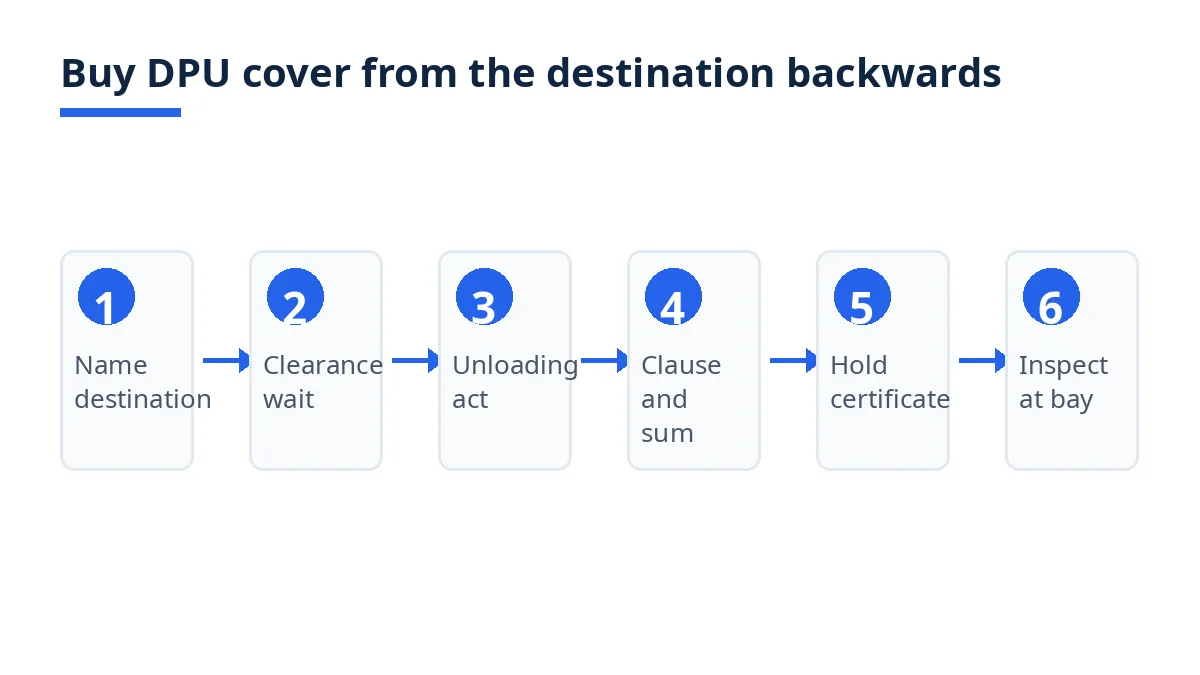
Buying cover backwards: start at the final destination
Final destination. Name the place in full. If the named place is a port terminal but the goods must travel onward to a warehouse, the policy must run to the warehouse. Confirm when cover ends. Cover under the Institute Cargo Clauses follows a warehouse-to-warehouse principle, but the timing rules are more specific than that phrase suggests, and cover can end at delivery to the final warehouse named in the policy, delivery to other storage used before that destination, or the expiry of 60 days after discharge from the vessel, whichever comes first.9
Unloading act. Settle whether unloading at the named place, with the equipment the seller will use, is inside the insured transit. Agree the point to the bay, dock, or gate, the time slot, and who supplies equipment and crew. If the seller cannot unload safely there, the answer is a different rule or a different place, not better insurance.1
Main carriage. Settle the clause by letter and number, sum insured and basis, currency, insured party, deductible, and payer. Hold the certificate, insurer name, claim contact, and notice period before shipment. Where the seller arranges cover for the buyer's benefit, the certificate must name the buyer as entitled to claim.
No premium figure is given here: a rate depends on the goods, route, packing, clause, and sum insured. Treat any quotation folding an insurance charge into the headline DPU price, without naming clause, sum, insured party, and payer, as uninsured until the certificate proves otherwise.
The six steps are:
DPU insurance: how much cover to buy
DPU sets no sum insured. Value the goods on the full-journey basis, not the invoice value alone. Insuring only the invoice value leaves freight, clearance charges, and any re-shipping margin outside the sum insured, and an under-declared value can reduce a claim in proportion to the shortfall. The illustration below uses the commonly described basis of invoice value plus freight and associated charges plus 10 percent, not as a DPU rule.
Example figures. A shipment of cartons of knitwear from Chattogram to a buyer's warehouse near Hamburg is invoiced at USD 8,400, with freight and associated charges of USD 1,150.
Sum insured element | Example figure (USD) |
|---|---|
Invoice value | 8,400 |
Freight and associated charges | 1,150 |
Invoice value plus freight and charges | 9,550 |
Plus 10 percent | 955 |
Sum insured on the illustrated basis | 10,505 |
Insuring for USD 8,400 only would leave cover USD 2,105 below the illustrated sum, before any deductible. Agree the sum, currency, and deductible in the contract, and check the certificate shows the same figures.
When damage is found at the unloading bay: the evidence chain
Damage found after unloading is the hardest DPU claim. The insurer asks for evidence of when and how the damage happened. Work this chain in time order, and do not let the seller's crew leave before the first three steps are done.
Before unloading, photograph the vehicle, seals, closed doors, and the load as presented, and record seal numbers against the transport document. If a seal is broken, stop and ask for a surveyor before opening.
During unloading, photograph the goods as they come off the vehicle, layer by layer, and note where each damaged package sat. Keep damaged goods and packaging untouched until inspected.
At handover, inspect before signing anything clean. Count the packages, check for visible damage, and write the damage, its extent, and the date and time of delivery and inspection on the delivery receipt, countersigned by the carrier or the seller's representative where possible. Notify promptly on two tracks: notify the insurer as soon as loss or damage is known, inside the policy's notice period, and ask for a surveyor and a claim number. Notify the carrier in writing as well, within the required timeframe, usually 3 days for sea cargo and 14 days for air freight, and keep proof of receipt.10 Confirm the policy's own notice period before shipment, and treat the carrier period as a separate deadline.
Finally, gather the claim file: the original insurance certificate or policy, commercial invoice, packing list, bill of lading or air waybill, delivery receipt noting the damage, photographs, survey report, and correspondence with the carrier and the seller.9 10 Common denial reasons are inadequate documentation, exclusions for inherent vice or insufficient packing, under-insurance, and late notification.10
Bangladesh departure checks: documents, packing, and the clearance wait
No Bangladesh rule changes the split under DPU.
Section 131 of the Customs Act, 1969 requires clearance of customs for export, and goods must not be loaded or stuffed unless an export declaration, known as a Bill of Export or Shipping Bill, has been submitted and approved.11 The enclosed documents include the export contract or letter of credit, commercial invoice, packing list, EXP form, certificate of origin, VAT certificate, and Taxpayer Identification Number.11 Copy the invoice, packing list, and transport document to the buyer's file before the goods leave Bangladesh.
Packing deserves equal attention. Agree the packing specification and photograph packing before departure.8
Tell the seller before shipment whether import clearance must happen before unloading, and agree the waiting arrangement and revised unloading slot if clearance slips.3
Red flags that leave a DPU load uninsured
The price is said to include insurance, but no certificate is offered. An insurance charge without a clause, sum, insured party, and certificate is a price line, not cover.3
The seller's policy is presented as the buyer's cover. A policy in the seller's name protects the seller; the buyer needs cover in the buyer's favor to claim directly.
Cover ends at the port or at discharge. The seller's risk runs to the end of unloading, and the buyer's risk runs onward.
Clause (C) is used for theft-prone, fragile, or water-sensitive goods. Clause (C) does not cover theft, handling damage, or water entry from ordinary causes.8
The receiving team has no brief. A team that signs a clean receipt and lets the seller leave before inspection has given away the evidence the claim will need.10
Unloading-bay checklist before the seller leaves
[ ] The contract states who insures, for which window, under which clause and sum, in which currency, and who pays.
[ ] Cover spans the full journey, with its end date or event confirmed in writing.
[ ] The certificate, insurer, claim contact, and notice period are held before shipment, in the buyer's favor.
[ ] The named place is written in full, with bay or gate, equipment, and time slot agreed.
[ ] Seals and doors are photographed before opening, and seal numbers are checked against the transport document.
[ ] Goods are inspected as unloaded, damage is noted on the delivery receipt with date and time, and photographs are taken before anything is moved.
[ ] The insurer and carrier are notified in writing, a surveyor is requested, and damaged goods and packaging are preserved until inspected.
Does DPU require insurance, and what is the minimum cover?
DPU requires no insurance from either side, and there is no minimum cover under the rule.3 The only seller insurance duties in Incoterms 2020 sit under CIF, at Institute Cargo Clauses (C), and CIP, at Institute Cargo Clauses (A).4 A buyer that wants cover must buy it, or agree the seller will arrange it.
Who insures damage that happens during unloading?
The seller bears the risk of damage during unloading, because delivery happens only once the goods are unloaded and made available to the buyer.1 Whose insurer pays depends on the policies and on evidence at the bay. Inspect and note damage before the seller leaves.
How much cover should a buyer buy for a DPU shipment?
Buy cover on the full-journey basis: invoice value plus freight and associated charges plus a margin, commonly 10 percent, agreed with the broker or insurer.9 The illustrated basis here gives USD 10,505 on a USD 8,400 invoice with USD 1,150 of freight and charges.
What should a buyer do if damage is found after the seller has left?
Notify the insurer inside the policy's notice period and the carrier in writing, preserve the goods and packaging, and request a survey.10 Act the same day, gather the certificate, invoice, packing list, transport document, photographs, and delivery receipt, and put the seller on notice in writing as well.
Next steps on Exportain
Compare this position with the DPU risk transfer guide and the wider Incoterms guide, and check seller-bought minimum cover in the CIF guide. When ready, post an RFQ stating the insurance wording you want, and follow how to buy for the buying steps.
Sources
- DAP & DPU Incoterms 2020 explained: Key differences. ICC Academy, (accessed )
- DPU Incoterms (Delivered at Place Unloaded) Explained. iContainers (accessed )
- DPU (Delivered At Place Unloaded) | Incoterms 2020. Röhlig Logistics (accessed )
- Incoterms® 2020. International Chamber of Commerce (ICC) (accessed )
- Incoterms for Shipments From Bangladesh. Exportain (accessed )
- CIF Incoterms (Cost, Insurance and Freight) Explained. iContainers (accessed )
- CIF Meaning (Cost, Insurance & Freight). Exportain (accessed )
- What are Institute Cargo Clauses (A, B, and C)?. Ship4WD (accessed )
- Institute Cargo Clauses Explained: A, B and C Cover Compared. National Cover (accessed )
- How To File Successful Marine Insurance Claims. Vervo Logistics (accessed )
- Customs Clearance Procedures for Export. Bangladesh Customs, National Board of Revenue (accessed )
About the author
Sourcing from Bangladesh?
Post a request for quotation and suppliers on Exportain can send you their quotes directly.
Post an RFQ