Can You Use DPU for Air Freight? Rules, Alternatives and Examples
Under DPU, delivery happens only after the seller unloads the goods at the named place. On an air shipment that place is usually an airport cargo terminal, and import clearance can block the unloading itself.
Short answer
Yes. DPU (Delivered at Place Unloaded), Incoterms 2020, can be used for air freight because it is an any-mode rule. The seller pays air carriage and export clearance and bears cost and risk until the goods are unloaded at the named place and placed at the buyer's disposal. The buyer clears import customs and pays duty and taxes. DPU fits where the seller can organize unloading after clearance, so name the terminal, bay and handling agent in full.
On this page
Key takeaways
DPU delivery happens only after unloading at the named place, not when the aircraft lands; on an air shipment the named place is usually an airport cargo terminal and bay.
DPU is an any-mode rule; FAS, FOB, CFR and CIF are the four sea and inland waterway only rules and never fit an air shipment.
Where the destination requires import clearance before unloading, DPU can stall at the airport, because clearance is the buyer's job and unloading is the seller's.
The air waybill is non-negotiable and names the consignee directly; name the seller or its forwarder as consignee where the seller must move the goods onward after clearance.
DPU imposes no insurance obligation on either side, and chargeable weight uses the IATA divisor of 6,000, with express services commonly using 5,000.
The cargo door is open, the unit load devices sit on dollies beside the aircraft, and a forklift waits on the apron. Nothing has been delivered yet. Under DPU, delivery happens only after the seller unloads the goods at the named place, usually an airport cargo terminal on an air shipment. Whether it can happen depends on import clearance, the air waybill, and who controls the bay.
This guide is for buyers importing from Bangladesh by air, and sellers asked to quote DPU.
Can DPU be used for air freight at all?
Yes. DPU (Delivered at Place Unloaded) is one of the any-mode Incoterms 2020 rules, so it can be used for air freight and for combinations of modes.1 The seller arranges and pays for transport to the agreed place and point, completes export formalities, and bears the risk up to unloading.1 The buyer completes import formalities, pays duty and taxes, and arranges onward transport.1
The seller must be able to organize unloading at the named place. DPU is the only Incoterms rule that requires the seller to unload goods at destination, so where the seller cannot organize unloading there, DAP should be used instead.2 Name the place in the form "DPU (named place and point), Incoterms 2020": the airport, the cargo terminal, the handling agent and the bay or dock. The former DAT (Delivered at Terminal) rule was renamed DPU to stress that the destination can be any place, not only a terminal.2
What unloading means when the vehicle is an aircraft
Unloaded means the goods are off the arriving vehicle and placed where the buyer can receive them without obstruction, with the delivery documents handed over and notice given in good time.3 Air cargo usually travels inside unit load devices shaped to the hold. Unloading has two stages: the devices come out of the aircraft onto dollies, and then the cartons come out of the devices at the terminal.
The seller bears the cost and risk of unloading, including damage during the unloading act, and risk passes only when the goods are unloaded and at the buyer's disposal.1 Agree which stage the named point sits at: the apron and the breakdown bay have different charges and different moments of risk transfer. If unloading cannot be ensured, DAP is the more appropriate choice.1
The airport break: import clearance before the seller can unload
Air freight breaks at the airport in a way sea freight does not. Import clearance happens at the airport, while the goods sit there, and the seller's carrier then needs the paperwork to move the cargo onward.4 Under DPU that break lands on the delivery act itself, because the buyer must clear the goods while the seller must unload them.
Some importing countries require import clearance before unloading, and clearance is the buyer's responsibility.3 The seller then cannot unload until the buyer has cleared. Choosing DAP gives a clearer transfer of responsibilities there, because delivery under DAP happens before unloading.3
Settle the sequence in writing before booking: whether clearance must precede breakdown of the devices, who holds the goods meanwhile, and what waiting charges apply. Where the named place lies beyond the airport, the buyer clears import customs at the airport and gives the seller's carrier the paperwork to move the cargo onward.4
The air waybill and who may take the goods from the airline
The air waybill (AWB) is the transport document for an air shipment. It is a non-negotiable document created by the carrier upon acceptance of the goods, and it functions as a receipt, a contract of carriage, and delivery instructions for the consignee.5 Unlike a bill of lading, it does not confer title; it identifies the consignee directly, which allows swift handover at destination.5
Check the AWB against the commercial invoice and packing list before departure. It carries a unique 11-digit tracking number, and a mismatch can hold the goods at the destination airport.5 A Master AWB comes from the airline and a House AWB from the forwarder for consolidated shipments.5 The consignee entry decides who may take possession of the goods from the airline: the buyer should not be the consignee where the seller's forwarder must take possession from the airline and arrange inland transport.4 Name the seller, or the seller's forwarder, as consignee in that case, with the buyer named for notification.
DPU beside DAP, CPT, CIP and DDP on an air journey
Seven rules work for any mode or modes of transport, while FAS, FOB, CFR and CIF work only for sea and inland waterway transport.6 For air freight, use only the any-mode rules.6
Rule | Risk passes | Carriage paid by | Seller insurance | Who unloads |
|---|---|---|---|---|
DPU | After unloading | Seller | None required | Seller |
DAP | On arrival, before unloading | Seller | None required | Buyer |
CPT | On handover to first carrier | Seller | None | Buyer |
CIP | On handover to first carrier | Seller | Yes, wide cover | Buyer |
DDP | On arrival, duty paid | Seller | None required | Buyer |
In the "C" rules the seller pays carriage to destination, but risk passes at origin, when the goods are handed to the carrier.6 Under CIP the seller must also buy wide cover, compliant with Institute Cargo Clauses (A), while under CIF, reserved for maritime trade, the default is Clause (C).7 Only CIF and CIP oblige the seller to buy insurance.6 DPU imposes no insurance obligation on either side, so the seller should insure transport including unloading.3
Choose CPT or CIP when the buyer accepts risk from handover to the first carrier, with CIP adding wide cover. Choose DAP when the buyer will unload and clear import customs at the airport. Choose DPU only where the seller can organize unloading after clearance, and DDP only where the seller has a compliant import route.6 See the CIF guide and the DAP air freight guide.8
How a DPU air shipment runs, from Dhaka to the unloading bay
Six stages, with the airport break in the middle. The diagram below shows the stages in order.
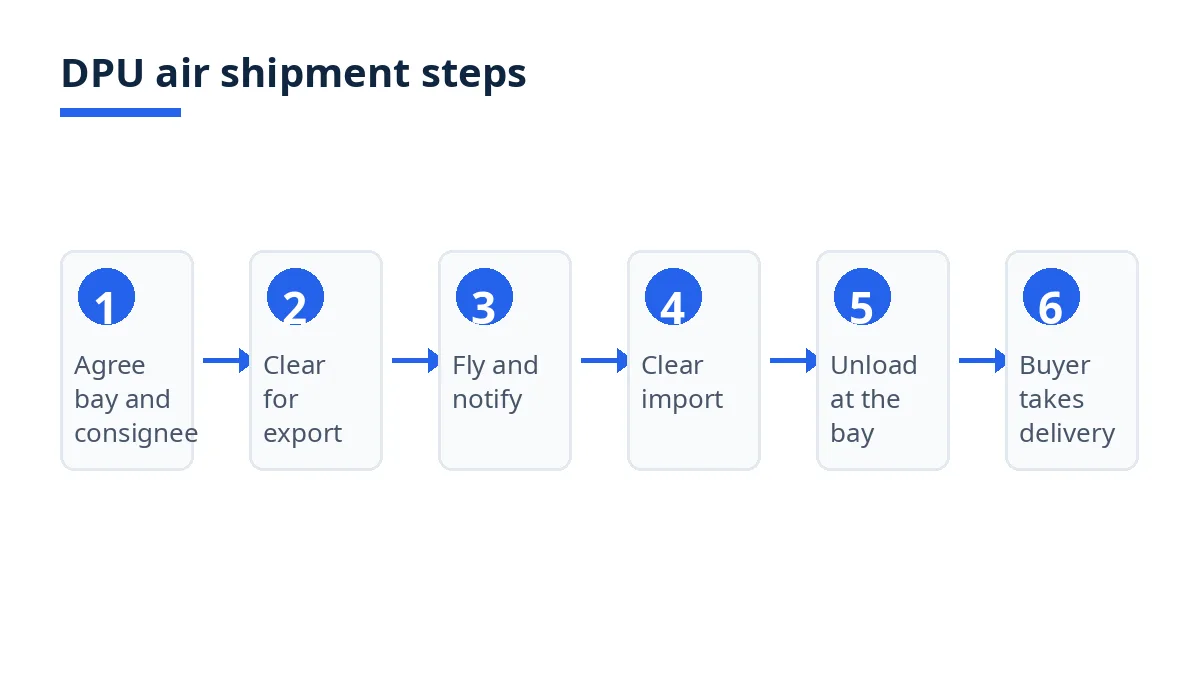
Agree the unloading point, clearance sequence and AWB consignee in writing, with the named place in full, who unloads, who arranges insurance, and who is named as consignee.
Prepare and clear the goods for export. For a shipment from Bangladesh, goods must not be loaded for export unless a Bill of Export has been submitted to Customs and approved, with the standard enclosures.9
Hand over to the carrier and issue the AWB. The seller contracts carriage to the named place and pays the air freight. The AWB is created upon acceptance, and the seller gives notice so the buyer can prepare import clearance and the agent can book the unloading slot.5
Fly to the destination airport. The seller bears the cost and risk of the flight, and the agent confirms the bay, equipment and appointment.
Clear import customs at the airport. The buyer carries out import formalities and pays duty and taxes, then gives the seller's carrier the paperwork to move the cargo onward.4 If clearance must precede unloading, this stage completes first.
Unload at the named point and hand over. The seller unloads the goods, places them at the buyer's disposal, and risk passes.3 The buyer arranges onward transport, with the invoice, packing list and transport document marked for the DPU named place.10
What a DPU air price contains, and the chargeable-weight effect
A DPU air price is the goods plus export packing and clearance plus air carriage to the named place plus unloading at that place. The buyer still pays import clearance, duty, and onward transport beyond the named place. Airlines charge on chargeable weight.
Chargeable weight is the greater of actual weight and volumetric weight, using the IATA standard divisor of 6,000: multiply length by width by height in centimetres and divide by 6,000.11 Some express couriers use their own divisor, commonly 5,000, so check the carrier's terms before quoting.11
Example figures only: ten cartons of handloom cotton scarves from Dhaka to a named airport cargo terminal bay, DPU the bay. Each carton is 50 x 40 x 30 cm and weighs 9 kg; volumetric weight is 10 kg per carton, so chargeable weight is 100 kg, the greater of 90 kg actual and 100 kg volumetric.11
Element | Example figure (USD) |
|---|---|
Goods, including export packing | 5,600 |
Export clearance and documents | 150 |
Air carriage, 100 kg at an example 12 per kg | 1,200 |
Unloading and terminal handling at the bay | 260 |
DPU price to the airport cargo terminal bay | 7,210 |
Buyer-side cost | Example figure (USD) |
|---|---|
Import clearance and broker | 190 |
Duty and taxes, example lump sum | 520 |
Onward trucking beyond the named place | 160 |
Buyer-side total | 870 |
Landed total at the warehouse | 8,080 |
The duty line is an example lump sum only; no duty rate is stated. At the express divisor of 5,000 the same carton has a volumetric weight of 12 kg, so the same ten cartons would be charged at 120 kg. See the DPU price guide, and price every quotation to the same point. No standard timeline is stated here.
Courier and express parcels: where unloading has nowhere to happen
DPU can apply to a courier or express parcel, because it is an any-mode rule, but the fit is often poor, and the reason is the unloading act itself. An express parcel moves through a courier hub, not to a named bay where the seller's agent waits to unload it. DPU still leaves import clearance and duty with the buyer, so a parcel on DPU terms needs the buyer to clear import customs and pay duty and taxes at short notice, or it sits at the airport.4
Use DPU for an express parcel only where the named place is a real unloading point the seller's agent can reach, the clearance sequence is agreed before dispatch, and the divisor is confirmed, since express services commonly use 5,000 rather than 6,000.11 FAS, FOB, CFR and CIF are for sea and inland waterway transport only, and never fit a courier shipment.6
Bangladesh departure checks before the flight
Reconcile every figure across the Bill of Export set: the export contract or letter of credit, commercial invoice, packing list, AD-certified EXP form, certificate of origin, VAT registration certificate and TIN.9 Goods are loaded only after the Bill of Export is approved, so a late correction holds the shipment at the departure terminal.9
Before the AWB is issued, confirm with the handling agent the exact bay and its access hours, the equipment booked, whether import clearance must precede unloading, and the consignee entry that lets the agent take the devices from the airline.3 4 Keep the named place identical in the sales contract, the AWB, the invoice and the packing list.
Mistakes that leave goods sitting on the apron
Naming only an airport. An airport code names an airport, not a delivery point inside it. The named place must fix the terminal, the handling agent and the bay.4
Assuming the seller can unload before clearance. Where the destination requires clearance before unloading, the seller cannot deliver until the buyer clears.3 Agree the sequence and brief the broker before departure.
Naming the buyer as AWB consignee where the seller must move the goods onward. The seller's forwarder needs to take possession from the airline, so the consignee entry must let it do so.4
Assuming unloading is inside the freight price. Unloading may or may not be included in the seller's transport contract, so show it as a separate line in the quotation.1
Assuming insurance is included. DPU imposes no insurance obligation on either side.6 Agree cover in writing, including unloading.3
DPU air-freight checklist before booking
Named place in full: airport, cargo terminal, handling agent, bay, in the form "DPU (named place and point), Incoterms 2020".
Clearance sequence agreed: whether clearance must precede unloading, who holds the goods meanwhile, and what waiting charges apply.3
AWB consignee agreed: seller or seller's forwarder where the seller moves the goods onward, buyer only where the buyer collects at the terminal.4
Export set agreed: Bill of Export approval and enclosures, figures reconciled across every document.9
Unloading booked: bay, equipment and appointment confirmed.1
Insurance agreed in writing, including unloading.3
Chargeable weight checked: dimensions and scale weight for every carton, divisor confirmed at 6,000 or the express 5,000.11
What should I settle first before quoting DPU for air freight?
Settle the unloading point, clearance sequence and AWB consignee before quoting. Name the terminal, handling agent and bay in full, confirm whether import clearance must come before unloading, and name the seller or its forwarder as consignee where the seller must move the goods onward.3 4 A quotation without those answers prices a delivery the seller may not be able to make.
What do DPU air freight costs and timelines turn on?
Costs turn on chargeable weight, the carriage line to the named place, and the unloading and terminal handling at the bay, with import clearance, duty and onward transport left to the buyer.11 Timelines turn on the flight, the clearance sequence, and the unloading slot, and no standard day count is stated here. Confirm each leg in writing, and rework the carriage line whenever the divisor changes between air freight at 6,000 and express at 5,000.11
Which documents does a DPU air shipment need?
The seller provides the commercial invoice, packing list and transport document, normally the air waybill, with the export customs declaration, and the buyer provides the import file at destination.10 The transport document should be marked for the DPU named place, and any certificates the buyer's market demands travel with the set.10 The export set from Bangladesh adds the Bill of Export enclosures listed in the departure section.9
What mistakes strand a DPU air shipment at the airport?
Naming only an airport, assuming unloading can precede clearance, naming the buyer as consignee where the seller must move the goods onward, and leaving the bay and broker until arrival.3 4 Work the checklist before booking, and record every answer in the sales contract.
Next steps on Exportain
Read the Incoterms guide and the CIF guide before ranking air quotations, and check how to buy. When those three points are fixed, post a free RFQ stating the quantity and unit, target price, destination, Incoterm, required certifications and deadline.12 Exportain is a B2B marketplace for buyers and Bangladeshi suppliers. It is not a party to the contract for the goods, and it does not inspect goods, book freight or clear customs.
Sources
- DAP & DPU Incoterms 2020 explained: Key differences. ICC Academy, (accessed )
- Incoterms. DHL Global Forwarding (accessed )
- DPU (Delivered At Place Unloaded) | Incoterms 2020. Röhlig Logistics (accessed )
- Incoterms DAP: Delivered at Place. Dia Tisa (accessed )
- Air Waybill (AWB) Guide: Importance in Air Freight. FreightAmigo (accessed )
- Incoterms for Shipments From Bangladesh. Exportain (accessed )
- Incoterms® 2020. International Chamber of Commerce (ICC) (accessed )
- CIF Meaning (Cost, Insurance & Freight). Exportain (accessed )
- Customs Clearance Procedures for Export. Bangladesh Customs, National Board of Revenue (accessed )
- DPU Incoterms (Delivered at Place Unloaded) Explained. iContainers (accessed )
- Chargeable Weight Calculator: Air & Sea. Freightos, (accessed )
- How to source and buy from Bangladesh. Exportain (accessed )
About the author
Sourcing from Bangladesh?
Post a request for quotation and suppliers on Exportain can send you their quotes directly.
Post an RFQ