DPU Customs Clearance: Two Files, One Handover at the Unloading Point
Under DPU, customs clearance is two files: the seller's export file and the buyer's import file, meeting at one handover where the seller unloads. This guide follows each file, the duty and tax split, and the clearance-before-unloading trap.
Short answer
Under DPU (Delivered at Place Unloaded), Incoterms 2020, the seller clears export customs and any transit formalities, carries the goods to a named place and point, and unloads them there. The buyer clears import customs, pays duty and taxes, and arranges onward carriage. Delivery and risk transfer happen only after unloading, when the goods are at the buyer's disposal. DPU requires no cargo insurance from either party.
On this page
Key takeaways
Under DPU, the seller clears export customs and transit formalities and unloads at the named point; the buyer clears import customs, pays duty and taxes, and arranges onward carriage.
The Bill of Export must be approved under section 131 of the Customs Act, 1969, before loading or stuffing, with the full enclosure list confirmed.
The named point fixes the handover: delivery is complete and risk passes only after unloading, when the buyer has unhindered access to the goods.
Where a destination requires import clearance before unloading, DPU leaves responsibilities unclear and DAP is clearer; agree the sequence or the rule before booking.
DPU imposes no insurance obligation on either side, and no duty rate is stated in this guide; the destination broker calculates duty and taxes from the official schedule.
DPU customs clearance is split into two files that never merge. The seller clears the goods out of Bangladesh. The buyer clears them into the destination country and pays the duty and taxes there. Between the two files sits one handover: the seller unloads the goods at the named place and point, and only then does delivery happen. This guide follows each file separately, then explains the handover, for buyers in the United States, the United Kingdom, the European Union and the United Arab Emirates who buy from Bangladesh on DPU terms.
The clearance split in two files
Under DPU (Delivered at Place Unloaded), Incoterms 2020, the seller undertakes to deliver the goods and transfer the risk of loss or damage at the designated place and point of destination, including unloading the goods from the arriving means of transport and making them available to the buyer.1 The customs split follows: the seller completes export formalities and any customs procedures in transit, and the buyer handles import formalities.1
File | Who clears it | Who pays the charges in it |
|---|---|---|
Export file | Seller | Seller |
Transit file | Seller | Seller |
Import file | Buyer | Buyer |
Hiring a broker does not move the responsibility: the broker acts for the buyer, and the duty and tax bill still lands with the buyer. A seller who offers to "handle customs" means the export file only, unless DDP wording says otherwise. DDP (Delivered Duty Paid) is the only Incoterms 2020 rule under which the seller clears import customs and pays import duty.2 The four sea and inland-waterway-only rules are FAS, FOB, CFR and CIF. CPT is an any-mode rule, not a sea-only rule, and DPU is an any-mode rule for sea, air, road and multimodal shipments.2 1
The export file: what the seller clears in Bangladesh
Under DPU the seller arranges and pays for transport to the agreed place and point, completes export and transit formalities, and bears the cost of unloading at destination.1 The seller must also provide the commercial invoice, packing list and transport document, and notify the buyer once the goods are unloaded at the buyer's disposal.3
The export file starts with the Bill of Export. Section 131 of the Customs Act, 1969 requires clearance of customs for export: goods must not be loaded or stuffed in containers or a ship for export unless an export declaration, known as a Bill of Export or Shipping Bill, has been submitted to Customs in the prescribed format and approved by the customs authority.4 Once approved, the goods are loaded or stuffed.
The enclosures for all export consignments are the export letter of credit or, where there is none, the export contract, purchase order or export guarantee approved by the negotiating bank; the commercial invoice, signed by the exporter, with a detailed description of the goods; the packing list with quantity, weight and packing information; the EXP form certified by authorized dealers; the certificate of origin issued by the Export Promotion Bureau or a chamber of commerce and industry; the VAT registration certificate; and the taxpayer identification number.4 Add product-specific papers, such as an export registration certificate for jute goods.4 Goods stuffed at a private inland container depot or the exporter's premises may be checked by a gate division officer before they proceed to the port area.4 Ask the seller to confirm approval before booking. Where the route passes through a third country, the seller completes the customs procedures in transit.1 Cross-check the paper set in the DPU documents guide.
The import file: what the buyer clears at destination
The import file starts before the goods arrive. The buyer is responsible for completing import customs formalities and arranging any onward transportation beyond the agreed named destination.1 The buyer's main obligations under DPU are import customs clearance, duties, VAT and any local taxes, and on-carriage from the unloading point to the final destination.3
Appoint the broker early, in writing, and give the broker the full paper set before departure. The broker files the import declaration in the buyer's name or as the buyer's representative, using the commercial invoice, packing list and transport document the seller provides, plus the certificate of origin where the destination requires one. Customs assesses the duty and taxes on the declaration, the buyer pays the assessed amount, and the goods are released once payment and any required checks are complete. Destination rules change the shape of the import file. In the United Kingdom, a business importing goods into England, Wales or Scotland needs an EORI number that starts with GB, and the GOV.UK clearance steps run from setting up for declarations, through submitting and managing the import declaration, to paying VAT and duty; goods may be held at the border if the right amount of duty or VAT has not been paid.5 In the European Union, companies established outside the European Union need an Economic Operator Registration and Identification (EORI) number to lodge a customs declaration, and the Single Administrative Document serves as the importer's declaration, covering customs duties and VAT, made by whoever is clearing the goods, normally the importer of record or an agent on the importer's behalf.6 For the United States and the United Arab Emirates, confirm the filing route and importer-of-record requirements with the destination broker before shipping. No duty rate is stated in this guide for any destination: the broker must calculate it from the official schedule for that exact line.
The handover: clearance, unloading and risk at one point
DPU is the only Incoterms 2020 rule that requires the seller to unload the goods at destination.3 Delivery is complete when the goods are unloaded and the buyer has unhindered access to them, and risk passes at that moment.7 The seller hands over the delivery documents and gives good-time notice.7 The seller must assess whether it can safely unload at the agreed place and point; if unloading cannot be ensured, DAP is the more appropriate choice.1
Settle one sequence problem in writing before booking. In some destinations, import clearance must be carried out before unloading, but import clearance is the buyer's responsibility.7 Where that is the case, DPU leaves the responsibilities unclear: the seller cannot unload goods that customs has not released. Where the importing country requires import clearance before unloading, DAP ensures a clearer transfer of responsibilities.7 Agree DAP instead, or agree the exact sequence in writing.
The named point fixes the handover. The place is the destination area. The point is the exact spot where the goods come off the vehicle, such as a named terminal, dock or warehouse bay. State the point in full in the contract, in the form "DPU (named place and point), Incoterms 2020", with the unloading equipment, time slot and access stated. See the DPU risk guide for the risk moment.
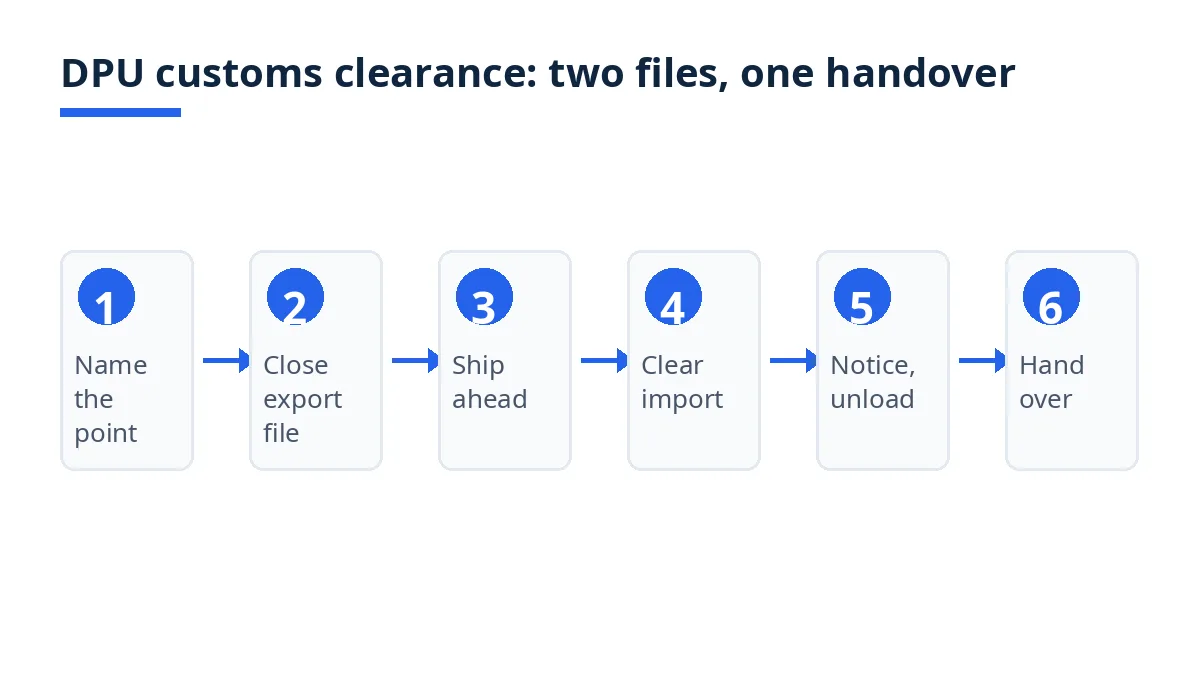
Step by step: DPU customs clearance through one shipment
Name the point and appoint both sides. Write the named place and point in full, and appoint the seller's export handler and the buyer's broker before booking.
Close the export file. The seller obtains approval of the Bill of Export under section 131 of the Customs Act, 1969, with the full enclosure list, before loading or stuffing.4
Ship, and send the import file ahead. The seller arranges and pays for transport to the named point, including unloading, and completes export and transit formalities.1 The buyer sends the import papers to the broker before arrival.
Clear import customs. The buyer, through the broker, files the import declaration and pays the assessed duty and taxes, or agrees the clearance-before-unloading sequence in writing where the destination requires it.1 7
Give notice, then unload. The seller informs the buyer in good time, hands over the delivery documents, and unloads the goods at the named point at its own risk and expense.7 1
Hand over and carry onward. Delivery is complete when the goods are unloaded and at the buyer's disposal, risk passes to the buyer, and the buyer arranges onward carriage.7 3
Who pays duty and taxes, and how the amount is worked out
The buyer pays. Under DPU the buyer handles import customs clearance and pays applicable import duties and taxes.3 The seller pays the costs of packaging and transport to the agreed destination, the costs and formalities for export and transit, and the unloading at destination.7 Ask the seller to show the cost lines in A9/B9 order.8
Customs assesses the duty and tax amount on the import declaration, using the classification, the customs value and the origin stated there, under the destination country's tariff and valuation rules. For imports into the European Union, the import VAT base generally starts with the customs value and includes applicable duties and qualifying incidental expenses, such as transport and insurance to the first destination, to the extent not already included.3 Ask the broker for a written calculation before ranking quotations.3
Example figures only, for woven cotton shirts from Chattogram to a Felixstowe warehouse bay, DPU Bay 3, Incoterms 2020. They are not a quotation, and no typical rate or timeline is stated as fact in this guide.
Cost line | Who pays | Example figure (USD) |
|---|---|---|
Goods, including export packing | Seller, inside the DPU price | 9,800 |
Export clearance and documents | Seller, inside the DPU price | 260 |
Ocean carriage, Chattogram to Felixstowe | Seller, inside the DPU price | 1,540 |
Onward carriage to the warehouse bay | Seller, inside the DPU price | 410 |
Unloading at Bay 3 | Seller, inside the DPU price | 180 |
DPU price to Bay 3, unloaded | Seller | 12,190 |
Buyer-side cost | Example figure (USD) |
|---|---|
Import clearance and broker | 240 |
Duty and taxes, example lump sum | 1,940 |
Onward carriage from the warehouse bay | 150 |
Buyer-side total | 2,330 |
Landed total at the warehouse bay | 14,520 |
A CIF price ends at the destination port, with risk passing on board at origin, and it never includes import duty or import clearance at destination.2 The CIF guide sets out the port-based rule. Insurance sits outside both files: DPU does not require either party to obtain cargo insurance, and except under CIF and CIP there is no insurance obligation under the Incoterms rules.3 7 Agree who arranges insurance, including cover for the unloading act, before shipping.3
Mistakes and red flags at the handover
Assuming the seller clears import customs because the seller delivers unloaded. Unloading is the seller's act. Import clearance is the buyer's file.1
Leaving the clearance-before-unloading sequence unwritten. Where the destination requires clearance before unloading, DPU leaves responsibilities unclear and DAP gives a clearer transfer.7
Accepting a city or port name as the named point. The point must be precise enough to fix where unloading happens and where risk passes.7
Appointing a broker after departure, without written authority. The broker needs the invoice, packing list, transport document and origin evidence before arrival.
Reading a duty allowance into a DPU price. A DPU price covers carriage, export formalities and unloading. Duty and taxes stay with the buyer.3 Only DDP wording moves them to the seller.2
Filing the export file after stuffing. Goods must not be loaded or stuffed unless the Bill of Export has been submitted and approved.4
Treating insurance as included. DPU requires no cargo insurance from either party.3 Clarify the coverage window, including the unloading act, in writing.
Clearance checklist: export file, import file, handover
Named place and point in full, written as "DPU (named place and point), Incoterms 2020", with unloading equipment, time slot and access stated.
Bill of Export approved before loading or stuffing, with the full enclosure list confirmed by the seller.4
Broker appointed in writing before departure, with written authority covering the declaration and payment of duty and taxes.
Importer-of-record status and destination registrations confirmed: GB EORI for the United Kingdom, EORI for the European Union, and the broker-confirmed route for the United States and the United Arab Emirates.5 6
Import declaration papers sent to the broker before arrival, and the duty and tax calculation obtained from the broker from the official schedule.
Clearance-before-unloading sequence agreed in writing, or DAP chosen instead, where the destination requires clearance first.7
Insurance position stated in writing, including cover for the unloading act, and onward carriage booked before arrival.3
What should I know first about DPU?
DPU stands for Delivered at Place Unloaded. The seller delivers the goods at a named place and point, unloaded and at the buyer's disposal, bearing the cost and risk of carriage and unloading.1 It is the only rule requiring the seller to unload, and it works for any mode of transport.3 The seller clears export customs and any transit formalities; the buyer clears import customs, pays duty and taxes, and arranges onward carriage.1
What are the typical costs and timelines?
No typical DPU cost or transit time holds across suppliers, routes, modes and quantities, so none is stated here as fact. A DPU price covers the goods, packing, export clearance, carriage and unloading, with all costs in article A9/B9 of the rule.8 7 The buyer pays import clearance, duty, taxes and onward carriage.3 Ask for an arrival window tied to the named point and the broker's written calculation, rather than a single transit number.
Which documents are needed?
The seller provides the invoice, packing list, transport document and export file, headed by the Bill of Export approved under section 131 of the Customs Act, 1969, with the contract or letter of credit, EXP form, certificate of origin, VAT certificate and taxpayer identification number enclosed.4 The buyer and broker provide the import declaration at destination, with the destination's registration, such as a GB EORI number for the United Kingdom or an EORI number for the European Union.5 6
What are the most common mistakes?
Buyers assume the seller clears import customs, accept a city as the named point, leave the clearance-before-unloading sequence unwritten, appoint a broker after departure, read a duty allowance into a DPU price, and assume insurance is included.
Next steps on Exportain
Read the Incoterms guide and the DPU documents guide before choosing a rule, and check the CIF guide if a quotation is written on CIF terms. When the named point, the specification and the broker are fixed, post an RFQ on Exportain, and check how to buy for the buying steps. Exportain is a B2B marketplace where buyers post RFQs, receive quotations and message suppliers. It is not a party to the contract for the goods, and it does not inspect goods, book freight or clear customs.
Sources
- DAP & DPU Incoterms 2020 explained: Key differences. ICC Academy, (accessed )
- Incoterms for Shipments From Bangladesh. Exportain (accessed )
- DPU Incoterms (Delivered at Place Unloaded) Explained. iContainers (accessed )
- Customs Clearance Procedures for Export. Bangladesh Customs, National Board of Revenue (accessed )
- Get UK customs clearance when importing goods into the UK: step by step. GOV.UK (accessed )
- EU - Import Requirements and Documentation. International Trade Administration (accessed )
- DPU (Delivered At Place Unloaded) | Incoterms 2020. Röhlig Logistics (accessed )
- Incoterms® 2020. International Chamber of Commerce (ICC) (accessed )
About the author
Sourcing from Bangladesh?
Post a request for quotation and suppliers on Exportain can send you their quotes directly.
Post an RFQ