DPU Pros and Cons: When Should Importers Use It?
DPU is decided at the unloading bay: the seller unloads at a named place, and the buyer clears import and pays duty. Four gates, four right-choice and four wrong-choice situations, and a worked cost illustration.
Short answer
DPU suits an importer who can clear import customs and pay duty, and whose seller can unload safely at a precisely named place. The seller pays carriage and bears cost and risk through unloading; the buyer then takes delivery, clears import customs, pays duty and taxes, and moves the goods onward. DPU does not suit a buyer with no import help, or a seller who cannot unload at the named place.
On this page
Key takeaways
Under DPU the seller delivers unloaded at a named place, and cost and risk pass only after unloading; the buyer then clears import customs, pays duty and taxes, and moves the goods onward.
DPU is the only Incoterms 2020 rule that requires the seller to unload, it applies to any mode of transport, and it was renamed from DAT so the destination can be any place, not just a terminal.
DPU imposes no insurance duty on either side, so agree who arranges cover, for which leg and at what insured value, in writing before shipment.
Pass four gates before agreeing DPU: the seller can unload safely, the buyer can clear import, the place is named to the bay or gate, and insurance and carriage control are settled.
Compare quotations only to the same unloaded point: a DPU price excludes import duty and taxes and onward transport.
The unloading bay is where DPU is won or lost. Under Delivered at Place Unloaded, the seller must deliver the goods to a named place, unload them from the arriving means of transport, and make them available to the buyer.1 Risk and cost pass only at that point. Everything after it — import clearance, duty and taxes, and onward transport — belongs to the buyer. This article treats that split as a decision: four gates, the situations where seller unloading earns its price, and the situations where another rule serves better.
Four gates before you agree DPU
Run the gates in order. A failed gate means fixing the gap, pricing it, or changing the rule before signing.
Gate | Question to answer | If the answer is yes | If the answer is no |
|---|---|---|---|
1. Unloading | Can the seller unload safely at the exact place, with the right equipment and crew? | Continue to Gate 2 | Use DAP, or name a place where the seller can unload |
2. Import readiness | Can the buyer clear import customs and pay duty and taxes when the goods arrive? | Continue to Gate 3 | Use DDP, or book a broker and a duty estimate first |
3. Place and access | Is the place named to the bay, gate or terminal, with access, hours and a time slot agreed? | Continue to Gate 4 | Name the place in full before signing |
4. Insurance and carriage | Is insurance agreed in writing, and does the buyer accept carriage chosen by the seller? | DPU is a sound choice | Use CIP, FCA or FOB instead |
Gate 1 decides the whole choice: the seller should assess whether unloading can be ensured, and choose DAP if it cannot.1 Gate 2 matters just as much, because the buyer bears import formalities at its own risk and expense under DPU.1 Gate 4 closes the two gaps buyers most often miss: insurance and carrier choice.
What DPU gives the buyer, and what it keeps back
DPU is one of the 11 Incoterms 2020 rules.2 The former DAT rule was renamed DPU to emphasize that the destination can be any place, not just a terminal; the single difference from DAP is unloading: under DAP the seller does not unload, under DPU the seller does.2
The DPU bargain, in one paragraph, is this. The seller arranges and pays for carriage to the named place, completes export formalities and any transit customs procedures, and bears the risk of loss or damage through the whole journey, including unloading.1 The buyer then takes delivery, completes import formalities, pays duty and taxes, and arranges onward transport beyond the named place, typically to its own premises.1 Delivery and destination coincide under the D rules, unlike the C rules, where risk passes at origin while the seller pays carriage to destination.1 3
What DPU keeps back is everything after unloading. The buyer pays import clearance, duty and taxes, and any last-mile delivery and warehousing after the goods have been unloaded.4 DPU also keeps back insurance: it does not require either party to obtain cargo insurance, so the buyer should arrange protection for movement after delivery and agree who arranges insurance before shipping.5 Only CIF and CIP oblige the seller to buy insurance.3
DPU works for any mode of transport, including multimodal shipments.1 5 The sea-only rules — FAS, FOB, CFR and CIF — work only for sea and inland waterway transport, because delivery is defined by the vessel.3 Never write a sea-only rule onto an air or multimodal journey.
When DPU is the right choice
A buyer with a broker but no unloading crew. A buyer of palletized home textiles sells into a fulfillment site outside Rotterdam. The buyer holds a customs broker and a duty estimate, but the site has no dock crew and no forklift. DPU fits because the seller unloads at the named bay and the buyer takes delivery, clears import customs and moves the cartons onward.
Heavy goods where the seller controls the unloading equipment. A buyer orders stone slabs for a builders yard near Dublin. The slabs need a crane and trained operators, and the seller already moves the same slabs through its own carrier network. DPU fits because the seller bears the cost and risk of unloading, including the crane work.1 6 If the goods are damaged during seller-performed unloading, the seller bears the loss.6
A cold-chain handover at a terminal. A buyer imports frozen shrimp into the United Arab Emirates for a cold store. Unloading is refrigerated handling from the arriving vehicle into the store, and the seller's carrier already runs that handling at the named cold store. DPU fits because the unloading act is part of the cold chain.1 The buyer still pays duty and taxes and arranges onward transport in its own reefer truck.4
A first order where the buyer wants one unloaded price but keeps import control. A buyer places a first order for jute rugs to a depot in Toronto. The buyer wants a single seller-carried price to the unloaded point, but wants to file its own import declaration through its own broker. DPU fits because import formalities stay with the buyer while carriage, transit risk and unloading stay with the seller.1
When DPU is the wrong choice
The seller cannot unload at the named place. If the named place is a roadside site with no hard standing, no crane access and no local unloading partner, DPU fails Gate 1. The seller should assess safe unloading before agreeing, and choose DAP where unloading cannot be ensured.1
Import clearance will hold the goods at the named place. DPU splits the handover awkwardly when the place sits past customs: the seller must unload, but the buyer must clear import customs, and a missing document or delayed declaration can leave unloaded goods waiting, with storage and delay costs to settle. The Exportain hub warns buyers to agree what happens if import clearance is delayed under DPU.3 If the seller does not provide the correct documents, the buyer may have to cover the resulting expenses.4 Where clearance is slow, name a terminal place, agree the timing and document set in writing, or use DAP.
The buyer needs control of the carrier or the route. DPU hands carriage choice to the seller, who arranges and pays for transport to the named place.1 A buyer who holds its own forwarder rates, needs a named carrier, or must avoid a particular transhipment point gives up that control under DPU. FCA or FOB, where the buyer contracts main carriage, serve that buyer better.
The buyer wants insurance priced in, or cannot clear import. DPU imposes no insurance duty on either side.5 A buyer who wants wide seller-bought cover inside the quotation should use CIP, which obliges the seller to buy Clause (A) cover, or CIF for a sea-only shipment, where the seller must buy minimum Clause (C) cover and provide the policy or certificate so the buyer can claim directly.3 7 CIF is sea and inland waterway only, risk passes on board at origin, and CIF never includes import duty or clearance.7 A buyer who cannot clear import at all should test DDP first.3
What a DPU price contains, and what it leaves out
DPU fixes who pays, not how much. The seller's price includes export duties, freight transport charges, and loading and unloading at the designated point.4 The buyer pays import clearance, duties and taxes, and onward transport from the named place.4 Read the DPU price guide for the full cost breakdown; the illustration below shows the arithmetic only. Example figures.
Price line | Example figure (USD) |
|---|---|
Goods, including export packing | 6,200 |
Export clearance and documents | 160 |
Carriage to the named place | 1,480 |
Unloading at the named place | 240 |
DPU price to the named place | 8,080 |
Import clearance and broker | 150 |
Duty and taxes, example lump sum | 540 |
Onward transport from the named place | 210 |
Post-unloading total | 900 |
Landed total at the named place | 8,980 |
No duty rate is stated here, because duty depends on the classification of the exact goods and the rules of the destination country. Ask the seller to break the DPU price into goods, export clearance and documents, carriage, and unloading, and ask the broker for the duty and tax estimate on the same specification. Compare quotations only on the same named place, specification and quantity, with the same post-unloading lines added to each.
DPU sets no transit time: agree the shipment date or period and who pays delay charges if clearance runs late.
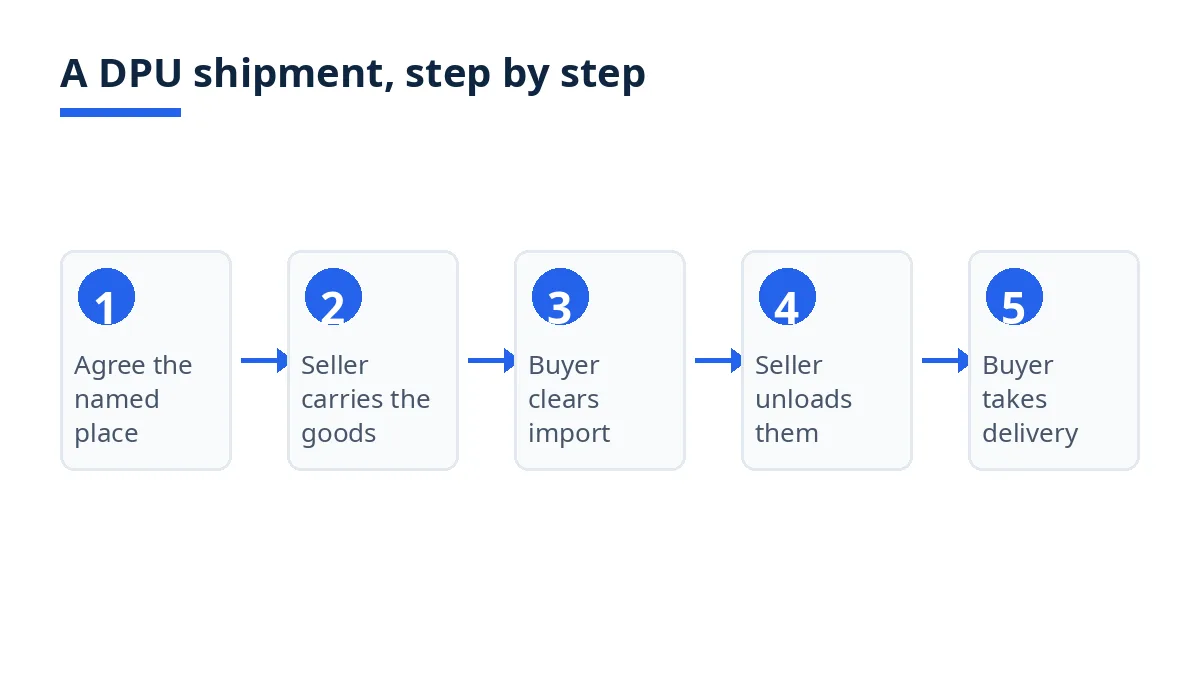
How a DPU shipment runs, step by step
Agree the named place in full. Write "DPU, [named place], Incoterms 2020" with the address, bay or gate, and the unloading point. Define the place precisely, agree access and the time slot, and state who provides the unloading equipment.6 8
The seller exports and carries. The seller completes export formalities, arranges and pays for carriage, and provides the commercial invoice, packing list and transport document.5 Loading and unloading manoeuvres during transport up to the delivery point are at the seller's risk and expense.1
The buyer prepares import clearance. While the goods travel, the buyer or its broker prepares the import declaration, classification and duty estimate, so clearance can start when the goods arrive.
The seller unloads at the named place. Delivery happens when the goods are unloaded and placed at the buyer's disposal, after the seller has given notice enabling the buyer to collect them.1 Risk passes at that moment.
The buyer takes delivery and moves the goods onward. The buyer takes delivery, pays duty and taxes, and arranges onward transport beyond the named place.1 4
The diagram below summarizes the five steps.
Bangladesh checks before you agree DPU
Confirm the export document set before the shipment date. Under section 131 of the Customs Act, 1969, goods must not be loaded or stuffed for export unless a Bill of Export, also called a Shipping Bill, has been submitted and approved by Customs.9 The enclosed set includes the export letter of credit or, where there is none, the export contract, purchase order or export guarantee, the commercial invoice, packing list, EXP form certified by Authorised Dealer banks, certificate of origin, VAT registration certificate and Taxpayer Identification Number.9 Check that the invoice and packing list match the contract on quantity, value, HS code, Incoterm and destination.
Confirm the unloading point in the same check, in destination terms. A Bangladesh seller agreeing DPU to a warehouse, terminal or site abroad should confirm, before signing, that its carrier can unload at that exact point, with the equipment the goods need. If the carrier cannot, change the named place to a terminal it serves, or change the rule to DAP. Confirm the insurance position at the same time: agree in writing who arranges cover, for which leg, and at what insured value.5
Mistakes that undo the unloading advantage
Accepting a city or a port as the named place. Risk and cost pass at the named place, so name the address, bay or gate. A vague place leaves the unloading act open to argument.8
Treating a DPU price as a duty-paid price. DPU excludes import clearance, duty and taxes.1 4 Budget the post-unloading lines before ranking quotations.
Assuming insurance is included. DPU does not require either party to insure the goods, and insurance should be agreed in the sales contract.5 State the policy holder, the coverage window and the insured value in writing.
Assuming the seller also clears import. The buyer handles import formalities under DPU, and the seller handles export and transit formalities.1 Book the broker before the goods sail.
Comparing a DPU headline price with an FOB or CIF headline price. FOB ends on board at origin and CIF ends at the destination port, with risk passing on board in both cases, while DPU ends unloaded at the named place.3 7 Price every quotation to the same point before ranking.
Leaving the edition out, or leaving the unloading equipment unstated. Write "DPU (named place), Incoterms 2020" in full, and state the unloading equipment, access and time slot.
What should I know first about DPU?
Know the split: the seller pays carriage and bears cost and risk through unloading at a precisely named place, and the buyer then takes delivery, clears import customs, pays duty and taxes, and moves the goods onward.1 4 DPU is the only Incoterms 2020 rule that requires the seller to unload, it applies to any mode of transport, and it imposes no insurance duty on either side, so agree cover in writing before shipment.2 5
What are the typical costs and timelines?
DPU sets no typical cost and no timeline. The seller pays export clearance, carriage and unloading to the named place; the buyer pays import clearance, duty and taxes, and onward transport.4 Agree the shipment date or period and the named place in the contract, prepare the import declaration while the goods travel, and compare quotations only on the same named place and specification.
Which documents are needed?
The seller provides the commercial invoice, packing list and transport document, such as a bill of lading or air waybill, and gives notice when the goods are unloaded and at the buyer's disposal.1 5 For a Bangladesh export shipment, the set includes the approved Bill of Export, export contract or letter of credit, invoice, packing list, EXP form, certificate of origin, and VAT and TIN documents.9
What are the most common mistakes?
Accepting a city name as the named place, treating a DPU price as duty-paid, assuming insurance is included or that the seller clears import, and comparing a DPU headline price with a price written on another rule. Read the named place first, then the unloading arrangement, then the insurance line, then the post-unloading costs.
Next steps on Exportain
Read the Incoterms guide for shipments from Bangladesh to compare all 11 rules, and the CIF cost, insurance and freight guide where a sea-only, seller-insured leg is the alternative. When the named place, unloading arrangement and insurance position are fixed, post a free RFQ stating the DPU term, the named place in full, the Incoterms 2020 edition, and who arranges insurance, and check the how to buy guide for the buying steps.10 Keep the agreed term and destination in the written contract.
Sources
- DAP & DPU Incoterms 2020 explained: Key differences. ICC Academy, (accessed )
- Incoterms® 2020. International Chamber of Commerce (ICC) (accessed )
- Incoterms for Shipments From Bangladesh. Exportain (accessed )
- DPU Shipping Terms: Duties, Costs and Customs. Eurosender (accessed )
- DPU Incoterms (Delivered at Place Unloaded) Explained. iContainers (accessed )
- How to Calculate DPU Incoterms: A Complete Shipping Guide. FreightAmigo, (accessed )
- CIF Meaning (Cost, Insurance & Freight). Exportain (accessed )
- DPU Incoterms Meaning | Delivered At Place Unloaded Explained. Ship4wd (accessed )
- Customs Clearance Procedures for Export. Bangladesh Customs, National Board of Revenue (accessed )
- How to source and buy from Bangladesh. Exportain (accessed )
About the author
Sourcing from Bangladesh?
Post a request for quotation and suppliers on Exportain can send you their quotes directly.
Post an RFQ