Custom Pajamas and Sleepwear Manufacturer in Bangladesh: OEM Process From Tech Pack to Bulk
A custom pajamas and sleepwear OEM guide for buyers: relaxed-fit grading, washed-fabric and colour-match checks, set construction, labelling, costs, timelines and documents.
Short answer
A custom pajama and sleepwear order from Bangladesh runs as an OEM sequence: one wear brief in the tech pack, a washed-fabric trial, agreed relaxed-fit grading, a pre-production set approval after overnight wear, bulk production with dye-lot pairing, and inspection of whole sets against the sealed set. Costs and timelines vary by fabric, grading, dye lots and delivery term, so compare quotations only on the same specification and Incoterm.

On this page
Key takeaways
A sleepwear order is judged as a pair: top and bottom must match in colour and size after washing, and the waistband must hold through repeated laundering.
Agree relaxed-fit grading across the full size range before sampling, and approve the proto for fit and ease only, not for fabric.
Test the bulk fabric washed to the printed care instructions for hand feel, top-to-bottom colour match and shrinkage before any bulk cutting.
Approve a full pre-production set in writing, washed and worn, and keep one sealed set as the inspection reference.
Inspect sets, not separate pieces: write set matching, colour match and care-label wording into the AQL defect classes.
Sleepwear fails at night, not on the inspection table. A set can measure correctly, look neat on a hanger and still ride up, twist at the leg or lose its waistband shape after a few home washes. That gap between a tabletop check and an overnight wear is where most pajama orders go wrong, so this guide works backwards from it: wear first, wash trial second, and bulk cutting only after a full set has been slept in, washed and signed off.
Bangladesh offers a deep knitwear base for this kind of order. BKMEA membership lists around 2,540 knitwear factories,1 and press reports of Export Promotion Bureau figures put knitwear shipments during the July–September 2026 quarter at $5.963 billion, up 6.88 percent year on year, inside ready-made garment exports of $10.578 billion.2 Scale alone says little about any single factory, though. What matters for a sleepwear set is narrower: whether the maker grades a loose cut well, whether its cloth keeps its hand and colour through washing, and whether tops and bottoms stay together as pairs from sewing to carton.
Why this matters for buyers and sellers
A pajama is worn for hours, in movement and in sleep, and washed far more often than most garments. Three properties therefore decide whether buyers keep the set or return it. Ease decides comfort: a cut with too little room at hip and thigh pulls when the wearer sits or turns, even when flat measurements match the chart. Elastic recovery decides shape: a waistband that stretches out after repeated laundering makes the whole set unwearable. Wash behaviour decides appearance: hand feel, pilling and the colour relationship between the two pieces all change in the laundry, and they change together.
Overnight failure | Check that catches it early |
|---|---|
Waistband slips or rolls after washing | Elastic recovery test on washed waistband samples |
Top and bottom drift apart in colour | Same-lot wash trial on both pieces together |
Leg twists or shortens | Shrinkage measured on washed leg panels, length and width |
Placket gaps when worn | Overnight wear test with buttons fastened |
Fabric turns rough or thin | Hand-feel judgement after repeated laundering, not before |
For makers, those same checks rearrange the calendar. A loose cut consumes more cloth per set than a close cut, so grading changes the marker and the fabric booking, while a wash trial occupies days before cutting and pairing adds handling at pressing and packing. A buyer who signs the wear test, wash trial and pairing rule early hands the factory a plan it can book; reopening any of them once cloth is cut means fresh cloth, fresh dyeing or a fresh label run.
Step-by-step: how it works
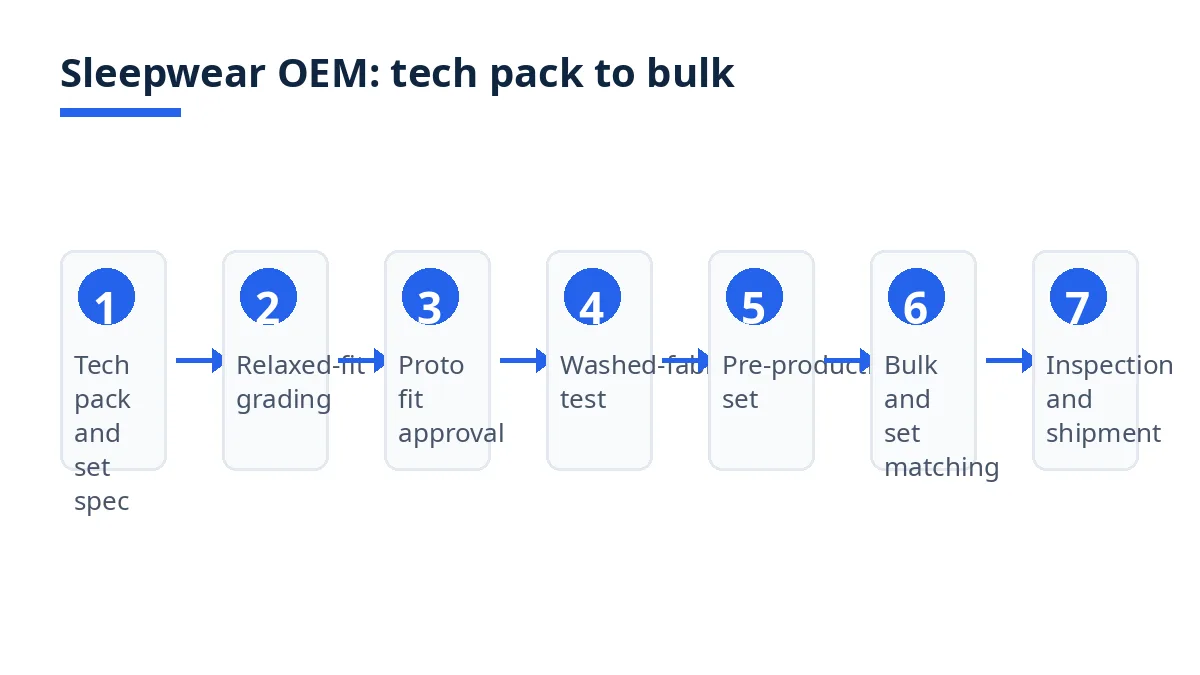
Write a wear brief inside the tech pack. Send every candidate the same pack: set makeup, ease allowances at chest, waist, hip and thigh, elastic and drawcord specification, placket and button detail, size table with grade rules, artwork and placement if any, fibre and care wording, pairing rule for packing, and delivery term. Ask each candidate to price that exact brief, so a cheaper reply cannot hide a tighter cut or a lighter cloth.
Wash the bulk cloth before any pattern is approved for bulk. Cut lengths from the actual bulk fabric, launder them exactly as the care label will instruct, and judge hand feel, pilling, colour drift and shrinkage in both directions. Note the wash temperature and cycle used, because a trial run cold says nothing about a label that promises a warm wash. If the cloth fails here, change the cloth, not the label.
Grade the loose fit, then sleep in the proto. With the wash results in hand, agree grade rules across the full size span, smallest to largest, so ease grows consistently and a larger pair still matches. The factory then cuts a proto in substitute cloth to test pattern and ease. Wear it overnight, sit and move in it, measure it after wear, and send corrections back with numbers. This approval covers pattern and ease only: it says nothing about bulk cloth, colour or labels.
Sign a full pre-production set, washed and worn. This set uses bulk cloth, bulk colour, bulk waistband, buttons, labels and care wording. Wash it as printed, wear it overnight, measure both pieces, and confirm the two pieces still match in colour and size. Seal one set as the reference for inspection, and attach the signed approval with photographs to the order file. Hold all bulk cutting until that signed set is in hand.
Run bulk with dye-lot pairing built in. Production moves through knitting and dyeing where applicable, cutting, sewing, waistband and button work, and pressing. Ask for progress reports when fabric is ready, when cutting ends and when sewing ends, broken down by colour and size, and ask how tops and bottoms are kept together through sewing and pressing so a pair never splits across bundles.
Pair, label and pack in sets. Match each top with a bottom from the same dye lot and size, check the care wording on both pieces against the signed set, and pack by the agreed number of sets per carton. A carton counted in pieces rather than sets invites the classic sleepwear error: correct piece totals with wrong pairings inside.
Inspect sets against the sealed set. Draw the inspection sample from finished, packed cartons and judge whole sets, not loose pieces, against the sealed reference, the size table and the agreed sampling plan. Sampling under ISO 2859-1 attribute plans gives the sample sizes and the accept and reject counts for the lot.3 Record the inspection level, the AQL values and the defect classes for pair mismatch, colour drift, waistband failure, buttons, label wording and packing in the order before sewing begins.
Costs, timelines and documents
What are the typical costs and timelines?
A single going rate does not exist for this order type, because each factory prices its own cloth, grade work, dye lots, waistband and button work, label runs, pair packing and delivery term for your brief. What can be compared is structure: keep grade work, sampling and label runs as lines apart from the unit price, watch how the split across colours moves dye cost, and hold the delivery term and named place fixed when prices are set side by side. The eleven delivery rules in Incoterms 2020 split cost, risk and tasks between seller and buyer,4 so a reply on a different rule is a different offer even at a lower price.
For timelines, ask for dated lines rather than one delivery week: brief confirmation, wash trial, grading, proto wear test, pre-production set, fabric readiness, bulk sewing, pair packing, inspection and shipment. The wash trial sits ahead of cutting here, which lengthens the front end and shortens the risk at the back end.
Example figures: a wash trial round of 6 days, a proto wear-test round of 9 days and a pre-production set round of 11 days add to 26 days (6 + 9 + 11 = 26) before bulk cutting. Example figures: set-up lines of 210 dollars for grade work and 95 dollars for label and care-print runs add to 305 dollars (210 + 95 = 305). Spread over an order of 4,000 sets, the example figures give 0.076 dollars per set (305 divided by 4,000 = 0.076). These are example figures only, illustrative of the arithmetic rather than prices any factory will quote. Repeat orders should drop set-up lines already settled, unless grading, cloth or care wording has changed.
Which documents are needed?
The order file carries the wear brief and grade rules, the itemised quotation, the purchase order with the split by style, colour and size, the wash trial record, the proto corrections, the signed pre-production set approval with photographs, the sampling plan and the inspection reports. Keep them together, so any dispute about what was agreed can be settled from the record rather than from memory.
For the shipment, loading waits on Customs approval of the export declaration, the Bill of Export or Shipping Bill, supported by the invoice, packing list, EXP form and certificate of origin.5 Use a single legal name on the licence, quotation, invoice and payment account, since that declaration identifies both exporter and overseas buyer.5
Bangladesh-specific rules and tips
Set classification from the wearer and the fibre. Knitted nightshirts and pyjamas for men and boys fall under heading 6107, while the women's and girls' equivalents fall under heading 6108.6 7 Subheadings divide by fibre, so confirm the line against the bulk cloth composition, not the proto cloth: swapping the blend after the proto stage rewrites both classification and label.
Fix fibre and care wording before the label run. EU textile labelling rules require fibre names with weight percentages, highest first.8 Settle those percentages at brief stage and re-check them whenever the bulk cloth changes, because a new blend rewrites the fibre line and can also change which wash the set survives.
Treat a membership claim as one narrow question. A claim of BKMEA membership answers only whether the firm trades in knitwear.1 Put that question to the association directly, then judge capacity from grading, wash and pairing evidence rather than from the claim.
Ask when bought-in trims land. Elastic, buttons and drawcords often arrive from outside the sewing factory. Ask for each trim arrival date, because the latest trim sets the first sewing date, and a waistband elastic that arrives late holds up the whole set.
Mistakes and red flags
What are the most common mistakes?
Grading from a daywear pattern. A grade copied from a close-fitting garment leaves no ease at hip and thigh in larger sizes. Approve grade rules across the full span, extremes included, and check ease on a worn proto rather than on a flat chart.
Signing bulk off an unwashed proto. A proto in substitute cloth tests pattern and ease, not hand, colour drift or shrinkage. Cutting bulk before the wash trial and the signed pre-production set leaves no reference for what the buyer receives after the first home wash.
Printing care wording before the wash trial. Care wording is a promise about laundering, so it must follow the trial, not precede it. A label promising a warm wash on cloth tested only cold invites shrinkage complaints on the first wash at home.
Counting pieces at inspection. An inspection that tallies tops and bottoms separately can pass a lot full of mismatched pairs. Judge sets, and write pair mismatch, colour drift and label wording into the defect classes.3
Accepting approvals by word of mouth. A spoken fit approval leaves nothing for bulk to be judged against, and a spoken care-wording change leaves nothing showing what print was requested. Put every approval and change in the order file, with measurements and photographs.
Paying for a different garment while comparing prices. A cheaper reply built on a tighter cut, thinner cloth, stock labels or another delivery rule is not a saving; it prices a different set.4 Fix the brief, the rule and the named place first, and only then look at price.
Checklist
Work through the list and confirm each item in writing before you commit.
Set makeup stated: matched pair, nightshirt alone, or set with robe.
Ease allowances agreed at chest, waist, hip and thigh, across the full size span.
Bulk cloth wash trial passed: hand feel, pilling, colour drift, shrinkage both ways.
Care wording matched to the wash the cloth was actually tested to.
Overnight wear completed on the proto, with post-wear measurements and numbered corrections.
Signed pre-production set in hand after washing and overnight wear, sealed reference retained.
Waistband elastic, buttons and drawcords specified, with trim arrival dates.
Fibre percentages settled, highest first, against bulk cloth composition.8
Pairing rule agreed: same dye lot, same size, set count per carton.
Sampling plan in the order before sewing begins, naming pair and colour defects.3
Prices set side by side on one brief, one delivery rule and one named place.4
Shipment papers ready before booking: declaration approved, commercial papers attached.5
How Exportain helps
On Exportain, shortlist makers in the suppliers directory and put the wear brief, grade table and wash-trial requirement into one post on the RFQ board, so every reply prices the same set. Ask each reply how it grades a loose fit, how it trials washed cloth, and how it keeps tops and bottoms paired through production. Badges record document and photo checks only; they do not promise capacity or delivery.9 10 See how supplier verification works on Exportain and the MOQ definition guide.
FAQs
What should I know first about pajamas and sleepwear?
Know the set, the ease and the wash before anything else: matched pairs or separates, how much room the cut carries, and which laundering the care label promises. Knitted nightshirts and pyjamas for men and boys fall under heading 6107, and the women's and girls' equivalents fall under heading 6108,6 7 with subheadings dividing by fibre. EU sales require fibre names with weight percentages, highest first.8
What are the typical costs and timelines?
No buyer can rely on a single typical figure, because price and lead time follow your cloth, grading, dye lots, waistband work, label runs, pair packing and delivery rule.4 Ask for set-up lines apart from the unit price, and for the wash trial, grading, proto, pre-production set, bulk sewing, pair packing, inspection and shipment as separate dates. Example figures for the pre-bulk stages are given above, and they are example figures only.
Which documents are needed?
The order file holds the wear brief, quotation and purchase order, with set makeup, grade rules and split on all three, plus the wash record, the signed set approval and the sampling plan.3 The shipment file holds the export declaration, invoice, packing list, EXP form and certificate of origin.5
What are the most common mistakes?
The most common mistakes are grading from a daywear pattern, signing bulk off an unwashed proto, printing care wording before the wash trial, counting pieces instead of sets at inspection, accepting approvals by word of mouth, and shopping on price across different briefs or delivery rules.4 Each one is cheap to avoid before cutting and expensive afterwards.
Next steps on Exportain
Use the suppliers directory to shortlist makers, and put the wear brief, grade table and wash-trial requirement into one RFQ board post. Before you confirm, read the private-label pajamas and sleepwear guide and the pajamas and sleepwear quality control checklist.
Sources
- BKMEA at a Glance. BKMEA (accessed )
- Exports up over 6% to $13.1bn in Q1 of current fiscal. United News of Bangladesh (accessed )
- ISO 2859-1:2026 - Sampling procedures for inspection by attributes — Part 1: Sampling schemes indexed by acceptance quality limit (AQL) for lot-by-lot inspection. International Organization for Standardization (accessed )
- Incoterms® 2020. International Chamber of Commerce (ICC) (accessed )
- Customs Clearance Procedures for Export. Bangladesh Customs, National Board of Revenue (accessed )
- Classification Detail — HS Code 6107. United Nations Statistics Division (accessed )
- Classification Detail — HS Code 6108. United Nations Statistics Division (accessed )
- Regulation (EU) No 1007/2011 on textile fibre names and related labelling and marking of the fibre composition of textile products. European Union, (accessed )
- Trust & Safety Center. Exportain (accessed )
- Supplier verification: Earn trust badges buyers can see. Exportain (accessed )
- MOQ
- supplier verification
- knitwear
- buyer guide
- Bangladesh sourcing
- bangladesh garments
- Pajamas and sleepwear
About the author
Sourcing from Bangladesh?
Post a request for quotation and suppliers on Exportain can send you their quotes directly.
Post an RFQ