Private Label Pajamas and Sleepwear Manufacturing in Bangladesh: A Brand Owner's Guide
Private label pajamas and sleepwear from Bangladesh, built around the set as one product: relaxed-fit grading, fabric hand after washing, sleepwear labelling and care wording, set packing, and how to compare quotes on the same specification.
Short answer
A private-label sleepwear order from Bangladesh should be specified as a matched set, not two separate garments: a relaxed grade with its own ease and increments, fabric approved on washed swatches for top and bottom separately, a label and care pack settled per market before sampling, set packing counted in sets, and quotations compared on the same specification and delivery term.

On this page
Key takeaways
Sleepwear is judged as a matched set: relaxed-fit grading, fabric hand after washing, and set packing decide whether the top and bottom still belong together at the shelf.
Approve fabric on washed swatches for top and bottom separately, and record washed measurements as the bulk standard, so the care label promises only what the sample proved.
Settle fibre wording, care instructions and the children's sleepwear route per market at tech-pack stage, before grading and sampling lock them in.
Count sets, not pieces, at packing, inspection and arrival, and itemize set-up lines apart from the unit price so repeats do not pay twice.
Badges record document and photo checks already done; they are not a verdict on fit, hand feel after washing, or delivery.
A sleepwear set is judged in ways a daytime garment is not. The customer wears it for hours, washes it often, and notices at once when a waistband twists or a cuff tightens after laundering. A private-label order therefore stands or falls on decisions that look small on a tech pack: how much ease sits in the body, how the fabric feels after five washes rather than on the roll, what the care label promises, and how the set is packed so the two pieces stay together.
Private label here means the set carries your brand name, your labels and your packing, made to your specification. Fix those choices before sampling: a grade cannot be recovered by pressing, a hand feel lost in washing cannot be restored by a softer hang tag, and a care claim printed on the label cannot be withdrawn at the port.
Why this matters for buyers and sellers
For the buyer, the commercial risk of sleepwear sits in repeat purchase. A customer who finds a set comfortable and durable buys it again in another colour; a customer whose set shrinks unevenly, whose piping frays, or whose top fits while the bottom binds, abandons the brand. The sample must therefore prove the set as a worn and washed pair, not as two flat pieces.
For the seller, the risk sits in the set itself. The top and bottom must come from the same dye lot, the same shrinkage behaviour and the same trim batch, or the set will drift apart in the wash. A factory that quotes a set price without stating how it holds the two pieces together has left the central control out of the quotation.
The Bangladesh Knitwear Manufacturers and Exporters Association (BKMEA), established in 1996, is the apex trade body for the knitwear sector and represents approximately 2,540 knitwear member factories.1 That breadth does not mean any two factories grade a relaxed fit the same way, which is why the grading table is the document to agree.
What should I know first about pajamas and sleepwear?
Start with the set as one product. State the silhouette for each piece, the intended ease at chest, waist, hip and thigh, and whether the set is meant to be worn loose, relaxed or close to the body. A relaxed sleep fit is not a larger size of a close fit: it is a separate grade, with its own increments and tolerances at the waistband, armhole and rise.
Next, separate the fabric decision from the colour decision. Sleepwear fabrics are chosen for hand feel, breathability and wash behaviour first, and colour second. A cotton poplin, a cotton jersey, a flannel and a modal blend each shrink, soften and pill differently. Record construction, weight and blend for the top and the bottom separately, because a set mixing constructions needs separate shrinkage allowances.
Finally, decide the market rules before the label pack. Fibre wording, care wording and any children's flammability route differ by destination. A label pack settled after bulk cutting is a relabelling job; the same pack settled at tech-pack stage costs nothing extra to print.
Step-by-step: how it works
Work through the steps in order, and treat a step as complete only when its written record exists.
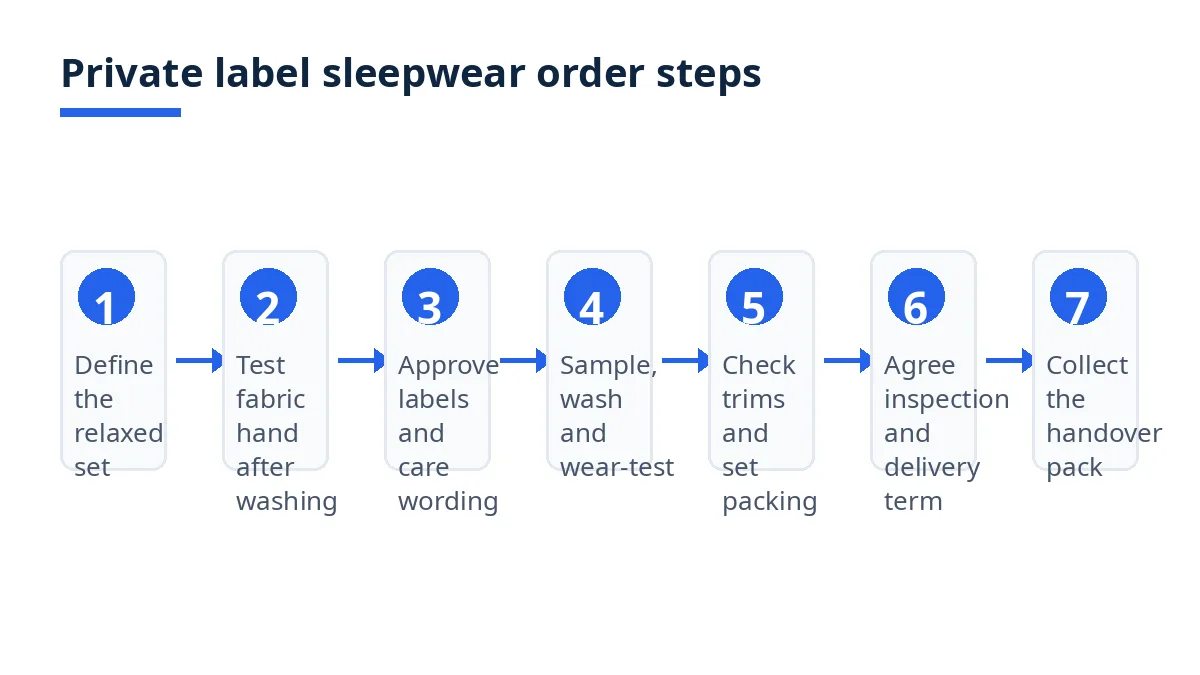
Define the set and its relaxed grade. State each piece, its silhouette, its ease at the key points, the size range and the grade increments between sizes. Give the waistband construction for the bottom, the closure for the top, and the pocket and piping positions, each with tolerances.
Choose fabric by hand feel and wash behaviour, not by the roll. Ask for swatches in each candidate fabric, wash them to your care instructions, and compare hand feel, shrinkage and pilling after washing. Record the approved fabric for top and bottom separately.
Settle the label and care pack per market. Write every label word for word: fibre wording, care instructions, size markings and origin wording, with placement and size for each label. Decide the children's route at this stage where the range includes children's sleepwear.
Sample the set as a worn pair. Order a proto sample, then a pre-production sample in the actual fabric, colour, trims and labels for both pieces. Measure both pieces, wash them to the care label, measure again, and wear-test across the size range, checking waistband, rise and cuff after movement.
Lock trims and set packing together. Confirm buttons, piping, drawcords, elastic and thread by batch, and state how the top and bottom are folded, paired and bagged so a set cannot split in packing. State the barcode for each set, size and colour combination.
Agree inspection and delivery term before you confirm. Write the inspection level and acceptance quality limit (AQL) values into the purchase order. ISO 2859-1 defines a system of acceptance sampling plans for inspection by attributes, indexed by AQL for lot-by-lot inspection,2 and AQL is the maximum average percentage of defective items considered acceptable during random sampling.2 Treat mismatched sets, twisted waistbands and wrong care wording as counted defect classes.
Collect the handover pack at shipment. Receive the final pattern and grading files, the fabric and wash records, the label artwork, the sample measurements before and after washing, and a statement of leftover branded labels and set boxes, with disposal or return agreed.
Specification item | State in your enquiry | Why it locks the order |
|---|---|---|
Relaxed grade | Ease points and increments per size | Decides whether the set sleeps comfortably |
Fabric hand and wash | Construction, weight, blend, washed swatch result | Decides shrinkage and feel after laundering |
Label and care pack | Fibre and care wording per market, placement | Decides what the customer is promised |
Waistband and rise | Construction, elastic spec, tolerances | Decides comfort across the size range |
Trims by batch | Button, piping, drawcord, thread batches | Decides whether pieces match after washing |
Set packing | Fold, pair, bag, barcode per set and size | Decides whether sets arrive intact |
Handover | Pattern, grading, wash records, label files | Decides whether a repeat matches |
Costs, timelines and documents
What are the typical costs and timelines?
There are no typical private-label sleepwear costs or timelines a guide can state as fact, because each factory prices your grade, fabric, wash behaviour, trim batches, label runs, set packing and delivery term for your specification. The Incoterms 2020 rules set out 11 rules with a clear allocation of cost, risk and obligations,3 so compare quotations only on the same rule and named place.
For timelines, ask for grading, fabric ready, sampling, wash testing, bulk production, set packing and inspection dates as separate lines, not a single delivery week. Wash testing is the stage most often squeezed when a schedule slips, and shortening it loses the evidence the care label relies on.
Set-up cost only matters per set, so work it that way. As an illustration — not a quotation — put artwork preparation at 90 dollars, a label plate at 70 dollars and a set-box plate at 60 dollars: 220 dollars in total. On 4,000 sets that is 5.5 cents a set; on a 1,000-set repeat it would be 22 cents a set. The numbers are examples only. What carries over to a real quote is the split: lines paid once should not reappear on a repeat order unless the artwork or the plate has changed.
Example figures for packing: an order of 4,800 sets packed 24 sets to a carton gives 200 cartons (4,800 divided by 24 = 200). Count sets, not pieces, at every stage, so a carton short of one bottom does not read as a full carton.
Which documents are needed?
The order documents are the set specification with its relaxed grade, the fabric and wash records, the label and care pack, the artwork and trim files, the itemized quotation and the purchase order, with the split per set, size and colour on both. The export set runs through the Bill of Export, commercial invoice, packing list, EXP form certified by an authorized dealer, and certificate of origin, and goods may not be loaded unless the export declaration is submitted to Customs and approved.4
Bangladesh-specific rules and tips
Confirm association claims at the source. If a supplier claims BKMEA membership, confirm it with the association itself. BKMEA represents the knitwear sector and its member factories,1 so membership signals an active knitwear business, not a relaxed-fit grade or a wash standard. Ask separately which sleepwear constructions the factory cuts in-house.
Settle the woven or knitted split before you lock the label. For woven sets, heading 6207 covers nightshirts, pyjamas, bathrobes, dressing gowns and similar articles for men or boys, not knitted or crocheted,5 and heading 6208 covers the corresponding women's or girls' articles, including nightdresses and pyjamas, not knitted or crocheted.6 Within each heading the lines divide by fibre, including cotton and man-made fibres, so confirm the fibre split against the actual fabric before sign-off. For knitted sets, confirm the chapter 61 heading with your forwarder rather than assuming the woven heading carries over.
Settle fibre and care wording per market at tech-pack stage. If you sell into the European Union, Regulation (EU) No 1007/2011 states that a textile product shall be labelled or marked with the name and percentage by weight of all constituent fibres in descending order.7 Agree fibre wording, care instructions and size markings for each market before sampling, so the washed sample proves the wording the customer will read.
Decide the children's sleepwear route before grading. In the United States, children's sleepwear that does not meet the definition of an infant garment or a tight-fitting garment is subject to the flammability standards for children's sleepwear in 16 CFR part 1615 (sizes 0 through 6X) or part 1616 (sizes 7 through 14).8 A relaxed children's grade and a tight-fitting grade are different patterns, so the route decision belongs at grading stage, not at inspection.
Mistakes and red flags
What are the most common mistakes?
Grading a relaxed fit by enlarging a close fit. A relaxed set needs its own grade, with increments set for sleep ease at the waistband, armhole and rise. Enlarging a close grade leaves the waistband and rise tight while the body hangs loose.
Approving fabric on the roll. A fabric that feels soft unwashed can stiffen, shrink or pill after laundering. Approve fabric on washed swatches, to your care instructions, and record the washed measurements as the bulk standard.
Printing a care claim the sample never proved. A care label that promises a wash the fabric was never tested to is a claim the bulk order will break. Wash the pre-production sample to the label, measure both pieces after washing, and change the label if the fabric does not hold.
Letting top and bottom drift apart. A set cut from different dye lots, shrinkage batches or trim batches stops being a set in the wash. Hold lot matching across both pieces as a written term, and check it at inspection.
Packing pieces instead of sets. A packing list that counts pieces hides a short bottom inside a full-looking carton. Count sets at packing, inspection and arrival.
Treating a profile or a badge as a fit or wash verdict. A profile is a starting point for enquiries. It does not test whether a factory can grade your relaxed fit, hold your hand feel after washing, or pack your sets intact.9
Skipping inspection to save time. Sampling under ISO 2859-1 checks a lot against an agreed AQL,2 the last control before the sets become your stock.
Checklist
Use this list at sign-off; leave no line blank.
Set defined as a pair: silhouette, relaxed ease points, grade increments.
Fabric approved on washed swatches for top and bottom separately.
Label and care pack written word for word per market.7
Children's route decided at grading stage where the range includes children's sleepwear.8
Waistband, rise, pocket and piping tolerances agreed, with trim batches named.
Pre-production set measured, washed to the care label, measured again and wear-tested.
Set packing agreed: fold, pair, bag, barcode per set; cartons counted in sets.
Set-up lines itemized apart from the unit price; paid artwork and plates recorded for repeats.
Inspection plan agreed, with mismatched sets and wrong care wording as counted defects.2
Quotations compared on the same specification and delivery term.3
Export set agreed, with identical set counts across invoice, packing list and cartons.4
Handover pack due at shipment: pattern, grading, wash records, label files.
How Exportain helps
On Exportain, browse suppliers and post a request for quotation (RFQ) on the RFQ board with your set specification, relaxed grade, fabric wash requirement and label pack attached, so suppliers quote against the same set and packing. Treat badges as a record of document and photo checks already done, not as a verdict on fit, hand feel or delivery.9 10 See how supplier verification works on Exportain before you confirm.
FAQs
What should I know first about pajamas and sleepwear?
Know the set before you ask for a price. State the silhouette and relaxed ease for each piece, the fabric for top and bottom separately, and the label and care pack per market in writing first, because each point changes the grade, the wash evidence and the quotation.
What are the typical costs and timelines?
There are no typical figures a buyer can rely on, because each factory sets its price and lead time for your grade, fabric, trim batches, label runs, set packing and delivery term.3 Ask for set-up lines apart from the unit price, and for grading, sampling, wash testing, production, packing and inspection dates as separate lines.
Which documents are needed?
Two bundles close a private-label order. The brand bundle proves what was agreed: set specification with its relaxed grade, fabric and wash records, label and care pack, artwork and trim files, itemized quotation, purchase order. The shipment bundle is separate paper: certificate of origin, EXP form certified by an authorized dealer, packing list, commercial invoice, and the Bill of Export.4
What are the most common mistakes?
The most common mistakes are grading a relaxed fit by enlarging a close fit, approving fabric on the roll, printing a care claim the sample never proved, letting top and bottom drift across dye lots, packing pieces instead of sets, and reading a badge as a guarantee of fit or wash performance.9
Next steps on Exportain
Browse suppliers, then post your set specification, relaxed grade and label pack on the RFQ board so suppliers state their grade, wash evidence and set packing in writing. Before you confirm, read how to import pajamas and sleepwear from Bangladesh.
Sources
- BKMEA at a Glance. BKMEA (accessed )
- ISO 2859-1:2026 - Sampling procedures for inspection by attributes — Part 1: Sampling schemes indexed by acceptance quality limit (AQL) for lot-by-lot inspection. ISO (accessed )
- Incoterms® 2020. International Chamber of Commerce (ICC) (accessed )
- Customs Clearance Procedures for Export. Bangladesh Customs, National Board of Revenue (accessed )
- Classification Detail — HS Code 6207. United Nations Statistics Division (accessed )
- HS, 2012 - Code 6208. United Nations Statistics Division (UNSD) (accessed )
- Regulation (EU) No 1007/2011 on textile fibre names and related labelling and marking of the fibre composition of textile products. European Union, (accessed )
- Clothing Business Guidance. U.S. Consumer Product Safety Commission (accessed )
- Trust & Safety Center. Exportain (accessed )
- Supplier verification: Earn trust badges buyers can see. Exportain (accessed )
About the author
Sourcing from Bangladesh?
Post a request for quotation and suppliers on Exportain can send you their quotes directly.
Post an RFQ