Custom Jute Sacks Manufacturer in Bangladesh: OEM Process From Tech Pack to Bulk
An OEM guide to custom jute sacks from Bangladesh: write the grade and fill into the tech pack, check the mill weaves it, fill-test the sample sack, and inspect the bulk lot bale by bale before it ships.
Short answer
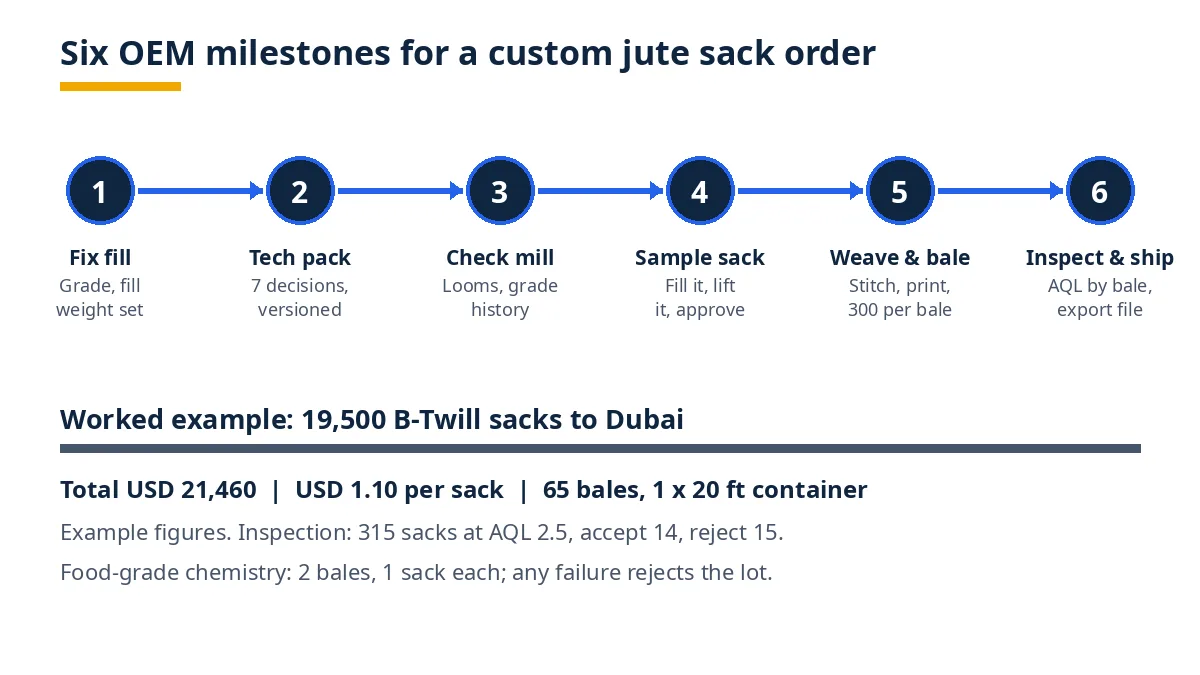
A custom jute sack order in Bangladesh runs in six milestones: fix the fill and the grade, write a versioned tech pack, check the mill weaves your grade, approve a sample sack by filling it with your goods, run bulk production from loom booking to bale press, and inspect the finished lot by bale before the export file is sealed. Each milestone closes with a written sign-off.
On this page
Key takeaways
The fill picks the grade: B-Twill is 44 by 26.5 inches at 1,020 grams, A-Twill the same size at 1,190 grams, and the grade decides the cloth, the stitch and the bale count.
A tech pack holds seven decisions the mill cannot guess, from the porter and shot to the bale marks, and every change goes in with a new version number.
Approve the sample sack by filling it with your goods: the A-Twill standard sets the sacking breaking load at 2,000 newtons warpway and the seam strength at 657 newtons.
Example figures put 19,500 B-Twill sacks for coffee to Dubai at 21,460 dollars landed, or 1.10 dollars a sack, with 315 sacks inspected at AQL 2.5.
A coffee roaster in Dubai orders 19,500 jute sacks from Bangladesh. The sacks arrive on time, but the first sack tears along a side seam when the filling line loads it with 85 kg of beans. The failure happened months earlier, when nobody wrote down how strong that seam had to be. This guide follows a custom sack order through six milestones, from the tech pack to the loaded container. For shopping bags, see our custom jute bags OEM guide.
Milestone 1: Fix the fill, then write the tech pack
Start with the fill, not the sack. Name the goods, the weight each sack must carry, and the market it ships to. Those three facts pick the grade, and the grade picks the rest.
A tech pack is the single file that tells the mill what to make. Without one, the mill fills the gaps with its own assumptions, and the result is wrong samples and late delivery.1 For a sack, the pack is one PDF per style.
Grade | Size | Sack weight | Weave | Fill |
|---|---|---|---|---|
Binola | 44 x 26.5 in (112 x 68 cm) | 907 g | 6 x 7 porter and shot | 80 to 90 kg2 |
B-Twill | 44 x 26.5 in (112 x 68 cm) | 1,020 g | 6 x 8 porter and shot | 100 kg2 |
A-Twill | 44 x 26.5 in (112 x 67.5 cm) | 1,190 g | 8 x 9 porter and shot | |
50 kg foodgrain sack | 94 x 57 cm | 580 g | IS 16186, Types A and B | 50 kg4 |
Inside the pack are seven decisions the mill cannot guess: grade, size, sack weight, porter and shot, and fill weight; cloth and batching oil where the fill is food; construction, with the mouth hemmed and the sides sewn with overhead or herakle stitches; measurements with a tolerance on each; print, with artwork file, method, colours, size, and position from a fixed point; stripes, woven in rather than printed on; and packing, with sacks per bale, bale type, bale marks, and the container load. The bill of materials lists cloth, thread, print ink, bale covering and hoops.1 Colours travel as a physical swatch, and every change goes into the pack with a new version number and a date.
Milestone 2: Check the mill can weave your grade
A composite mill spins, weaves and stitches in one place, so it controls the cloth weight and the weave. A stitching unit buys sacking cloth in and cuts and sews it. A trader buys finished sacks and resells them. Only the first two can change the cloth when your fill test fails. Our jute sacks manufacturers guide sets out the checks in full.
First, ask which grades the mill weaves in its own mill, and how many sacking looms run your grade. Second, ask for the records of its last three runs of your grade. Third, ask for the test reports for those runs, with the method named. Fourth, for a food fill, ask which batching oil the mill uses and whether it will certify the lot. Keep three makers shortlisted until the samples come back.
Milestone 3: Approve the sample sack by filling it
Sampling runs in rounds. The proto tests whether the mill read your tech pack the way you meant it; it is often made in a substitute cloth. The revised sack is the corrected version: measure every point against the pack. The pre-production sack, the PP sack, is made in the final cloth, with the final stitch, print and bale marks. Once you approve it in writing, it becomes the reference for the bulk run, so do not release bulk production until it is signed off.
The approval that matters most is the fill test: fill the PP sack with your own goods to the full fill weight, lift it, stack it, and empty it. Keep the sack that passed as the reference.
Back the fill test with lab numbers. The A-Twill standard sets the sacking breaking load at 2,000 newtons warpway and 1,765 newtons weftway, with a seam strength of 657 newtons, and the sides sewn at 9 to 11 stitches per 10 cm, plus a safety stitch at the inner edges.3 The lighter 50 kg foodgrain sack sets 1,570 newtons warpway, 1,420 newtons weftway, and a seam strength of 490 newtons.4 Those are the standards' values, not pass marks for yours: write your own values, with the test method named, into the purchase order.
Under IJO Standard 98/01, sacks for coffee, cocoa and shelled nuts must use a batching oil that is non-toxic and approved for food contact, and the unsaponifiable matter in the finished sack must stay below 1,250 mg/kg; the standard entered into force on 1 October 1998 and was revised in 2005.5 In February 2026 the European Coffee Federation and the European Cocoa Association published an industry specification with limits of 250 mg/kg for MOSH and 25 mg/kg for MOAH, because research found the unsaponifiable-matter proxy did not control MOAH reliably.6 Name the standard your buyer requires in the tech pack.
Milestone 4: Bulk production, from loom booking to bale press
Once the PP sack is approved, the mill books the loom and mixes the batch, then runs the same chain as the sample: fibre selection, batching, carding, drawing, spinning, weaving, inspection, cutting, stitching, printing and packing.
Cloth is inspected before cutting, for broken yarns, missed picks, uneven weaving, holes and stains. Cutting follows an approved plan based on the finished length and width, the seam allowance and the mouth fold. The sides are sewn with overhead or herakle stitches through two layers of sacking, with a safety stitch where the pack calls for one, and the mouth is hemmed.3 Print is approved on a printed sample before the full run. Inline checks run during the run: a first-piece check each shift, a stitch check on the side seams, and a print check on the first printed sacks. When the run is complete, the sacks are pressed into bales: 300 B-Twill sacks to an ironbound bale, with 65 bales to a 20-foot container, or 19,500 sacks in all.2
Milestone 5: Final inspection by bale, not by piece
Final inspection confirms that the finished sacks match the approved specification. For a bulk order, the inspector draws the check sample from the whole lot and applies the AQL method in ISO 2859-1.7 Level II is the usual starting point. Critical defects take an AQL of zero, major defects 2.5 and minor defects 4.0.7
A lot of 19,500 sacks at Level II takes code letter M: 315 sacks inspected, accepted with 14 or fewer major defects and rejected at 15 at AQL 2.5, and 21 minor accepted and 22 rejected at AQL 4.0.7 Put the level, the AQL values and the inspector's name in writing before production starts. The current edition is ISO 2859-1:2026.7
Sacks are also sampled by the bale: under the 50 kg foodgrain standard, a lot of 26 to 90 bales draws 8 bales, 16 sacks from each, or 128 sacks in all, with an acceptance number of 7 at an AQL of 2.5 per cent.4 For the chemistry, the food-grade specification draws 2 bales from a lot of up to 100 bales, one sack from each, and if any sample fails, the whole lot is rejected.6 Write both plans into the order; our sack quality control checklist lists the inspector checks.
Milestone 6: The export file and the sailing
Goods cannot load until Bangladesh Customs has approved a Shipping Bill. The commercial invoice must show the Export Registration Certificate (ERC) number and the HS code, and the packing list, invoice and bill of lading must agree on quantities.8 The Export Promotion Bureau or a Chamber of Commerce and Industry issues the certificate of origin.8 The file also holds the EXP form certified by an Authorized Dealer, the VAT certificate, the TIN and the Export Registration Certificate.8
Jute sacks for packing goods sit under HS 6305.10.9 The UK tariff puts new jute sacks at a 4 per cent third-country duty and used sacks at 2 per cent, so confirm the line and the rate with your customs broker.9 The classification is covered in our jute sacks HS code guide. Before the container is sealed, check that the quantities and the bale count agree.
Worked example: 19,500 B-Twill sacks for coffee to Dubai
Example figures. A coffee roaster in Dubai orders 19,500 standard B-Twill sacks, food-grade, printed with the roaster's mark, FOB Chattogram, in one 20-foot container.
Cost line | Amount |
|---|---|
Goods, 19,500 sacks at $0.88 each | $17,160 |
Sample, including shipping | $250 |
Third-party inspection | $600 |
Inland transport to Chattogram | $500 |
Ocean freight to Dubai | $2,800 |
Marine insurance | $150 |
Total landed cost | $21,460 |
Landed cost per sack | $1.10 |
Check it: 17,160 plus 250 is 17,410, plus 600 is 18,010, plus 500 is 18,510, plus 2,800 is 21,310, plus 150 is 21,460, and 21,460 divided by 19,500 is 1.10 dollars a sack. The sample fee of 250 dollars, including shipping, and the production lead time of 7 to 30 working days after advance payment come from an exporter's listing.2 The empty sacks weigh about 19.9 tonnes at 1,020 grams a sack, and the order fills 65 bales at 300 sacks a bale.2 Inspection draws 315 sacks at AQL 2.5, accepting 14 major defects and rejecting at 15,7 and the chemistry draws 2 bales, one sack from each, with any failure rejecting the whole lot.6
Five mistakes that stall a sack OEM order
Taking the lowest price per sack before the grade is fixed. The cheaper quote is usually the lighter sack.
Approving an empty sack. A sack that looks sound on a table can tear once filled, so the fill test is the approval, not the look.
Naming a food-grade standard the mill cannot meet. Write IJO 98/01 or the 2026 MOSH and MOAH limits into the tech pack, and ask for the lab report.
Letting bulk start before the PP sack is approved. Once the cloth is woven, the grade is set.
Agreeing the inspection plan after the bales close. An AQL level agreed at the end is hard to enforce.
OEM checklist for your first sack order
Fill fixed: goods, weight per sack, market, grade.
Tech pack written, dated and versioned.
Three makers shortlisted, asked the same four questions; grade history and test reports seen.
Sample sacks fill-tested with your goods; PP sack approved in writing.
Food-grade standard named in the pack; lab report on the PP sack.
Inspection level, AQL values, bale plan, inspector agreed in writing.
Delivery term, payment shares, packing agreed in writing.
Export file checked before sealing: invoice, packing list, bill of lading, origin certificate, EXP form.
FAQs
What should I know first about a custom jute sack order?
Know the fill first: the goods, the weight per sack and the market. Those three facts pick the grade.
What does a custom jute sack order cost, and how long does it take?
There is no standard price: each mill prices your exact order against its own fibre stock. The worked example above puts 19,500 B-Twill sacks at 1.10 dollars a sack landed in Dubai, as example figures. Allow 3 to 7 working days for samples and 7 to 30 working days for production.2
Which documents do I need for a custom jute sack order?
The tech pack and the written PP approval, the packing list, the bill of lading, the origin certificate, the invoice with the ERC number and HS code, and the EXP form.8
Next steps on Exportain
Start with the jute sacks manufacturers guide to shortlist mills that weave your grade, then read how to buy. To enquire, post an RFQ naming the grade, size, sack weight and quantity.
Sources
- How To Create a Tech Pack To Send To Manufacturers. Shopify (accessed )
- 90 Kg Jute Bag. BACKBD (accessed )
- IS 1943: Textiles — A-Twill Jute Bags — Specification. Bureau of Indian Standards (accessed )
- IS 16186:2014: Textiles — Light Weight Jute Sacking Bags for Packing 50 kg Foodgrains — Specification. Bureau of Indian Standards (accessed )
- IJO Standard 98/01: Special Criteria for the Manufacture of Jute Bags used in the Packing of Selected Food Materials. International Jute Study Group (accessed )
- Industry Specification: Jute Bags - Jute Yarns for Use in Cocoa Supply Chains. European Cocoa Association, (accessed )
- AQL Chart 2.5 and 4.0: Sample Size Tables Explained. ClearLoad (accessed )
- Bangladesh Trade Portal FAQ: Export Registration Certificate (ERC). Bangladesh Trade Portal (accessed )
- Sacks and bags, of a kind used for the packing of goods - UK Integrated Online Tariff. GOV.UK (accessed )
About the author
Sourcing from Bangladesh?
Post a request for quotation and suppliers on Exportain can send you their quotes directly.
Post an RFQ