Custom Denim Jeans Manufacturer in Bangladesh: OEM Process From Tech Pack to Bulk
Custom denim jeans OEM from Bangladesh, from tech pack to bulk: denim fabric, indigo wash, fit and size, and trim development, plus costs, timelines, documents and red flags.
Short answer
A custom denim jeans order in Bangladesh runs from tech pack to bulk through four denim-specific developments: fabric selection and shade control, indigo wash trials on finished garments, fit and size grading measured after washing, and trim and rivet testing in the wash. Each stage needs written approval on bulk materials before bulk cutting starts.

On this page
Key takeaways
Custom jeans are a woven, washed garment: fabric, indigo wash, fit and trims must be developed and approved together, on bulk materials, before bulk cutting.
Approve the wash on a finished garment in bulk cloth, and approve fit and measurements after washing, since the washed pair is the pair the customer wears.
Specify fabric weight and stretch, shade standard and tolerance, size curve, and trim and rivet behaviour in the wash, all in writing in the tech pack.
Confirm MOQ per wash and per size, itemize development and set-up costs apart from the unit price, and compare quotations only on the same wash and delivery term.
Verification on Exportain is a document and photo review, not a factory inspection, and a badge is not a guarantee of shade control, fit skill or delivery.
A custom pair of jeans is decided long before any cloth is cut. The shade of indigo, the hand feel after washing, the way the waistband sits after a day of wear, and the strength of a rivet at a pocket corner are all fixed during development, and each of them is harder to change once bulk cutting starts. A buyer who treats a jeans order as a simple cut-and-sew job will discover the real work late, when a wash trial shifts the colour or a fit sample pulls at the thigh. This guide follows the OEM sequence for jeans in Bangladesh, from the tech pack to bulk, with the denim-specific development stages given the attention they need.
Jeans sit in the woven sector, not the knitwear sector. The Bangladesh Garment Manufacturers and Exporters Association (BGMEA) represents the ready-made garment industry, including woven garments, knitwear and sweaters, and reports around 4,500 member factories, of which about 60 percent are woven garment manufacturers.1 Bangladesh has also built a large denim trade: denim exports to the United States reached $955.7 million in 2025, up 34.06 percent from $713 million in 2024, according to data from the US Office of Textiles and Apparel reported by New Age.2
In the Harmonized System, Chapter 62 covers articles of apparel and clothing accessories, not knitted or crocheted.3 Within it, heading 6203 covers men's and boys' suits, ensembles, jackets, trousers and shorts, with subheading 6203.42 for trousers of cotton, and heading 6204 covers the corresponding women's and girls' garments, with subheading 6204.62 for trousers of cotton.3 A jeans buyer should therefore confirm the heading by wearer and fibre before quoting duty, and should never assume one heading covers a whole range.
Why this matters for buyers and sellers
For the buyer, the risk in a jeans order is concentrated in development. Fabric, wash and fit interact: a heavier cloth drapes differently, a wash that softens one cloth can shrink another, and a fit approved on an unwashed sample can measure differently after laundry. Approving each stage in writing, on the actual cloth and wash, is the only control that catches those interactions before bulk.
For the seller, the risk is that development work is done once and cannot be resold. A wash recipe tuned to your shade, a pattern graded to your size curve, and rivets and buttons bought in your finish are specific to your order. That is why factories price development, sampling and set-up apart from the bulk unit price.
Two shared controls keep both sides honest. The first is an inspection plan agreed before production. ISO 2859-1 defines a system of acceptance sampling plans for inspection by attributes, indexed by acceptance quality limit (AQL) for lot-by-lot inspection, and AQL is the maximum average percentage of defective items considered acceptable during random sampling.4 The second is one delivery term on every quotation. The Incoterms 2020 rules set out 11 rules with a clear allocation of cost, risk and obligations.5
Step-by-step: how it works
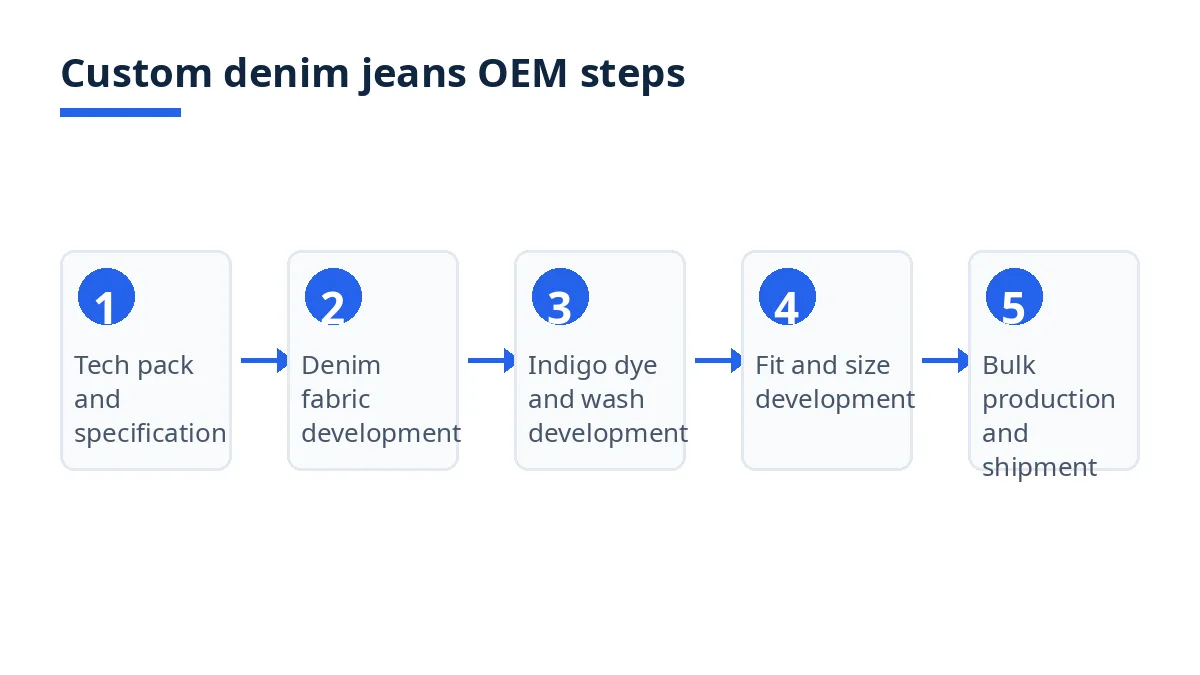
Write the tech pack around denim, not around a generic trouser. State the fabric by fibre composition, construction, weight in ounces per square yard, stretch content and direction, and whether the cloth is rigid or stretch. State the silhouette, rise, leg shape, leg opening, waistband construction, pocket style and placement, fly type, and stitch type and colour. Add the size chart, the size curve, and the measurement points with tolerances.
Develop the fabric first. Ask whether the denim is stocked or woven to order, and what shade range the mill can hold across lots. Indigo shades drift between dye lots, so agree how shade is judged: under which light, against which approved swatch, and with what tolerance. Record the fabric width, shrinkage in warp and weft, and any finishing applied before cutting.
Develop the wash on real garments. Send the wash direction as reference garments or a written recipe brief, not as a colour name alone. A wash trial should cover shade, hand feel, shrinkage after washing, seam puckering, and the effect on trims. Approve the wash on a garment made from bulk cloth, in the bulk fit, with bulk trims attached, because trims react to laundry chemicals and heat.
Develop the fit and the size range together. Approve the fit on a base size first, then check the smallest and largest sizes before grading is locked. Jeans fit fails most often at the waistband, the rise, the thigh and the knee, and a grade that works at a middle size can pull or bag at the extremes. Record every measurement change in writing and re-measure after washing, since the washed measurement is the measurement the customer wears.
Develop trims and rivets as their own stage. Specify rivet and button material and finish, zip or button fly, thread, pocketing cloth, labels, hang tags and cartons. Check rivet setting strength, button attachment, zip function after washing, and whether any trim discolours, rusts or snags in the wash. A trim approved on an unwashed sample has not yet been tested.
Approve samples in sequence, in writing. Order a proto sample for silhouette and construction, a wash trial garment for shade and hand feel, a fit sample in each critical size, and a pre-production sample in bulk fabric, bulk wash and bulk trims. Measure, wash and wear-test the pre-production sample, then approve it or list corrections in writing. Bulk cutting starts only after that written approval.
Agree inspection and delivery terms before confirming. Write the inspection level and AQL values into the purchase order, following ISO 2859-1,4 and state one Incoterm and named place for every quotation. The Incoterms 2020 rules allocate cost, risk and obligations for each rule,5 so compare quotations only on the same term.
Control bulk by stage, not only at the end. Ask for fabric inspection results, cutting markers, wash lot records, and inline inspection reports during sewing and laundry. A wash lot that drifts in shade can be caught while it is still one lot, not after the whole order is packed.
Stage | What is approved | Approval evidence |
|---|---|---|
Fabric | Composition, weight, stretch, shade range, shrinkage | Mill swatch and test results |
Wash | Shade, hand feel, post-wash measurements, trim behaviour | Washed garment in bulk cloth |
Fit and size | Base fit, smallest and largest sizes, grading | Measured samples after washing |
Trims and rivets | Material, finish, attachment, wash resistance | Trim card and washed sample |
Pre-production | Bulk fabric, wash, fit and trims together | Signed sample with corrections closed |
Example figures: a buyer orders 900 pairs split across three washes at 300 pairs per wash. The total clears the factory minimum, yet each wash sits below its laundry lot minimum, so the factory prices a surcharge per wash or asks the buyer to cut one wash. The same 900 pairs in two washes at 450 per wash can clear both lines. The example shows structure only, not a typical MOQ, price or lead time.
Costs, timelines and documents
What are the typical costs and timelines?
There are no typical costs or timelines a guide can state as fact, because each factory prices your fabric weight and stretch, wash complexity, trim set, size range and delivery term, and each of those moves the price. Wash development is the cost buyers most often underestimate: every new shade needs trial garments, laundry time and re-measurement, and a shade that needs several trials costs more than a shade approved on the first trial.
For timelines, sampling depends on fabric availability, wash trial rounds and fit correction rounds, while bulk depends on fabric weaving or stock, laundry capacity and line capacity. Ask for fabric ready, wash approval, pre-production approval, bulk cutting, laundry, inspection and shipment dates as separate lines, not a single delivery week.
Which documents are needed?
The order documents are the tech pack, the fabric and wash approvals, the trim card, the itemized quotation and the purchase order, with the MOQ per wash and per size recorded on both the quotation and the purchase order. For the shipment itself, see the Bangladesh Customs export clearance guidance for the declaration that must be approved before goods are loaded.6
Bangladesh-specific rules and tips
Confirm woven capability, not garment capability in general. A factory that sews woven trousers well may not run its own laundry, and a laundry that washes well may not cut a graded jeans pattern well. Ask which stages are done in-house, which are subcontracted, and who signs off the wash lot. A membership claim should be checked with the association itself, and membership signals an active garment business, not wash capacity or fit skill for your jeans.1
Lock the shade standard before bulk laundry. Indigo fades with washing by design, so two garments from the same order can look different if the wash lot, the chemical dose or the drying method changes. Agree one approved washed garment as the shade standard, the light under which it is judged, and the tolerance for lot-to-lot variation.
Treat stretch denim as a separate fit problem. Stretch cloth recovers differently after washing and wearing, so approve the pattern, wash and measurements on the stretch cloth itself, and state stretch percentage and recovery expectation in the tech pack.
Write fibre and care labelling into the specification. If you sell into the European Union, Regulation (EU) No 1007/2011 states that a textile product shall be labelled or marked with the name and percentage by weight of all constituent fibres in descending order.7 Confirm the fibre composition, the care instructions and the country-of-origin marking with your market's rules before labels are printed, because a label run ordered early is expensive to redo.
Mistakes and red flags
What are the most common mistakes?
Approving fit before washing. An unwashed sample measures one way and a washed pair measures another. Fit, waistband behaviour and leg length should be approved after washing, on the bulk wash, or the approval is for a garment the customer will never wear.
Approving a wash from a swatch. A flat denim swatch cannot show seam puckering, pocket shadowing, rivet marking or leg twist. Approve washes on finished garments with pockets, rivets and buttons attached.
Changing shade, fit or trims after pre-production approval. Each change restarts at least one development stage. A shade change needs a new wash trial, a fit change needs re-grading, and a trim change needs a new wash test. Record the change, the new sample and the revised price in writing.
Do not rank quotes that price different things. A lighter wash, simpler trims, stock cloth or another Incoterm changes the offer itself, so line every reply up against one tech pack, one wash direction and one delivery term before you compare.5
Accepting a verbal wash or MOQ exception. Record any agreed wash tolerance, per-wash minimum or waived set-up on the quotation and purchase order, with the wash and size split it applies to.
Treating a profile or a badge as proof of laundry or fit skill. A profile is a starting point for enquiries. It does not test whether a factory can hold your shade across lots or grade your size curve, and a badge is not a guarantee of capacity, quality or delivery.8
Skipping inline inspection to save time. Sampling under ISO 2859-1 checks a lot against an agreed AQL,4 and that check is most useful while laundry lots and sewing lines are still running, not after cartons are sealed.
Checklist
Before you confirm, every line should be answered in writing.
Tech pack sent: fabric weight and stretch, silhouette, rise, leg shape, pockets, fly, stitching, sizes and tolerances.
Fabric status recorded: stocked or woven to order, shade range and shrinkage agreed.
Wash direction sent as a reference garment or written brief, and the wash approved on a finished garment in bulk cloth.
Fit approved on the base size and checked at the smallest and largest sizes, measured after washing.
Trim and rivet card approved: material, finish, attachment and wash behaviour confirmed.
MOQ confirmed per wash and per size, with the binding line named.
Set-up and development costs itemized apart from the unit price.
Pre-production sample in bulk fabric, wash and trims measured, washed and approved in writing.
Inspection level and AQL values in the purchase order.4
Quotations compared on the same tech pack, wash direction and Incoterm.5
Export set confirmed with the exporter before the shipment date.6
How Exportain helps
On Exportain, browse suppliers and post a request for quotation (RFQ) on the RFQ board with your tech pack summary, fabric and wash direction, size split and delivery term, so suppliers quote against the same specification. Ask each reply for its per-wash and per-size minimums, its laundry arrangement, and its wash trial process. Read how supplier verification works on Exportain for what each badge records, and remember that verification is a document and photo review, not a factory inspection.8 9 See the MOQ definition guide for how minimums are structured.
FAQs
What should I know first about denim jeans?
Know that jeans are a woven, washed garment, so fabric, wash, fit and trims develop together and must be approved together. A shade approved on a swatch, a fit approved before washing, or a trim approved without a wash test is not yet an approval. Jeans fall under the woven apparel chapter, with men's and boys' cotton trousers under subheading 6203.42 and women's and girls' cotton trousers under subheading 6204.62.3
What are the typical costs and timelines?
There are no typical figures a buyer can rely on, because each factory sets its price, MOQ and lead time for your fabric, wash complexity, trim set, size range and delivery term.5 Wash trials, fit corrections and fabric availability drive the timeline, so ask for each stage as a separate dated line.
Which documents are needed?
The order documents are the tech pack, fabric and wash approvals, trim card, itemized quotation and purchase order. For the shipment itself, see the Bangladesh Customs export clearance guidance for the declaration that must be approved before goods are loaded.6
What are the most common mistakes?
The most common mistakes are approving fit before washing, approving a wash from a swatch instead of a finished garment, changing shade or fit after pre-production approval, and comparing quotations on different washes or terms.5 A badge is not a guarantee of capacity, quality or delivery.8
Next steps on Exportain
Browse suppliers, then post your tech pack summary, wash direction and size split on the RFQ board. Before you confirm, read denim jeans manufacturers in Bangladesh, the denim jeans MOQ in Bangladesh guide, and wholesale denim jeans in Bangladesh.
Sources
- Bangladesh Garment Manufacturers and Exporters Association (BGMEA). Devex (accessed )
- Bangladesh top denim exporter to US in 2025. New Age (accessed )
- HS Nomenclature 2017, Chapter 62. World Customs Organization (accessed )
- ISO 2859-1:2026 - Sampling procedures for inspection by attributes — Part 1: Sampling schemes indexed by acceptance quality limit (AQL) for lot-by-lot inspection. ISO (accessed )
- Incoterms® 2020. International Chamber of Commerce (ICC) (accessed )
- Customs Clearance Procedures for Export. Bangladesh Customs, National Board of Revenue (accessed )
- Regulation (EU) No 1007/2011 on textile fibre names and related labelling and marking of the fibre composition of textile products. European Union, (accessed )
- Trust & Safety Center. Exportain (accessed )
- Supplier verification: Earn trust badges buyers can see. Exportain (accessed )
About the author
Sourcing from Bangladesh?
Post a request for quotation and suppliers on Exportain can send you their quotes directly.
Post an RFQ