Denim Jeans MOQ in Bangladesh: Fabric, Wash and Fit Minimums
No single denim jeans MOQ in Bangladesh: how roll, indigo dye and wash lots set the minimum per fit and wash, and how to restructure a smaller order.
Short answer
There is no single typical MOQ for denim jeans from Bangladesh. Each factory sets its minimum per fit, per shade and per wash for your specification, driven by denim roll lengths, indigo dye lots, wash machine loads, pattern and marker work, and trim, label and carton runs. Ask for the minimum per fit, shade and wash lot in writing, then change the split or pay set-up separately.
On this page
Key takeaways
There is no single typical MOQ for denim jeans from Bangladesh, because each factory sets its minimum per fit, per shade and per wash for your specification.
Denim rolls, indigo dye lots, wash machine loads, pattern and marker work, and trim, label and carton runs are the drivers that set the floor.
Ask for the MOQ per fit, shade and wash lot in writing, with wash and pattern set-up costs itemized apart from the unit price.
Negotiate the structure first: fewer washes, one fit for the first order, stocked denim and indigo, and set-up paid as a separate line.
Exportain verification is a document and photo review, not a factory inspection, and a badge is not a guarantee.
A pair of jeans passes through three batch processes before it is finished: denim is woven and sold by the roll, warp yarn is dyed indigo in a fixed lot, and finished jeans are washed in a machine load run to one recipe. Each batch has its own smallest size, and the smallest batch in your specification sets the floor.
Bangladesh is a major denim source, which does not change that batch logic. In January and February 2025, denim exports to the United States reached $138.75 million, up 56.33 percent year on year, and denim exports to the European Union reached $285.52 million, up 32.43 percent, according to data compiled by the Bangladesh Garment Manufacturers and Exporters Association (BGMEA).1 In 2024 Bangladesh was the top denim supplier to both markets, at $675.65 million to the United States and $1.28 billion to the European Union.1 Woven garments accounted for $4.614 billion of ready-made garment exports in July to September 2026, up 5.11 percent year on year.2 That volume is spread across factories that each set their own batch floors. Ask instead for the pairs behind each roll, dye lot, wash load, fit pattern and size.
Denim first: how roll, dye and wash lots set a jeans minimum
Denim rolls and the cutting lay
A denim order starts as cloth, not as pairs. Rolls arrive in fixed lengths and widths, and the marker laying out leg panels, waistband, pocket bags and fly must use that width efficiently. A short run can strand a large remainder of a roll, and shade can shift slightly from one roll to the next. Ask how many rolls the specification consumes, who carries the unused balance, and how shade is checked across rolls in the same wash.
Indigo dye lots and shade matching
Indigo colour is created in a dye run of a set size, not dyed pair by pair. A custom indigo tone, a black denim and a sulphur over-dye each call for their own run, and a factory cannot run half a dye lot for a small order without absorbing the rest. Cloth already held in a standard indigo shade sidesteps that run entirely. Ask for the dye-lot floor separately for every shade, giving the shade by reference sample.
Wash lots: why one wash is one batch
Stone, enzyme, bleach and rinse washes are not coatings added to individual pairs. Each one is a machine load run to a fixed recipe with a fixed chemical charge, and a second wash means a second load even when the cloth and the pattern are unchanged. A four-wash range therefore carries four wash floors, and a wash with too few pairs behind it either attracts a surcharge or drops out. Washing also moves measurements, so settle the recipe, pairs per load and washed measurements before bulk cutting, and hold one washed pair as the reference.
Fit and size runs: the jeans-specific squeeze
A second fit is not a variation on the first. A skinny, a straight and a relaxed jean each need their own pattern, their own marker and their own graded measurements, even on shared cloth and wash. A change of rise, leg opening or stretch content starts a new pattern as well. Within a fit, orders concentrate in the middle waist sizes and thin out toward the ends, so a small waist can fall under the cutting line while the wash total still looks comfortable. Put the size range, the ratio for each wash and the quantities at the smallest and largest waists on the enquiry, and name the edge sizes.
Trims, labels and cartons that run apart
Buttons, rivets, zips, pocket lining, labels, hang tags and printed cartons are each produced in their own run. A button in a particular finish and a printed buyer carton cannot be ordered one pair at a time, so an order can satisfy the cloth, dye and wash floors and still sit below the button or carton run. Ask for those floors as separate lines.
For classification, men's and boys' jeans sit under heading 6203 and women's and girls' jeans under heading 6204, both for non-knitted garments.3 Labelling for the European Union follows Regulation (EU) No 1007/2011, which requires fibre names and percentages by weight in descending order.4
Batch behind the jeans | How it limits the order | Confirm on the enquiry |
|---|---|---|
Wash load | One recipe per machine load | Wash per style, pairs per wash |
Indigo dye lot | One shade per dye run | Shade reference, stocked or dyed |
Denim roll | Fixed length and cutting lay | Cloth reference, width, roll balance |
Fit pattern | New pattern and marker per fit | Fit, rise, leg opening, stretch content |
Size run | Thin edge-size quantities | Size range, ratio, edge quantities |
Trim and carton runs | Separate lots and print runs | Button, label, tag, carton spec |
Example figures: a first range of 1,500 pairs spread across five washes leaves 300 pairs behind each wash load. The same 1,500 pairs across three washes leave 500 pairs behind each load, a stronger position for every wash at the same total. Example figures only, not a typical MOQ, price or lead time.
Negotiation levers: changing the structure behind the number
A smaller workable minimum normally comes from removing a batch.
Merge washes before reducing pairs. Removing one wash raises the pairs behind every wash that remains, and removes one recipe and one shade check.
Launch with a single fit. A second fit doubles the pattern and marker work on the first order. Start with the fit that anchors the range and bring the second fit in on the repeat.
Choose stocked cloth and stocked indigo where the range allows it. A standard shade held in stock removes the dye lot. Ask for the stock list before shades are finalised.
Combine lots only where shade and wash genuinely match. Two fits can share a dye lot and a wash load only when both use the same shade and the same wash recipe. Get that confirmed on the quotation.
Move wash and pattern set-up onto its own line. Where the floor is set by a wash trial, a pattern grade or a carton print run, ask for those costs separately from the unit price.
Phase the sizes and stage the repeat. Open with the middle waist sizes, add the edge sizes on the repeat, and place the first order in fewer washes and fits with a written repeat price and floor for the same specification.
Mistakes and red flags
Counting pairs instead of batches. A headline total can clear the factory minimum while one wash load, dye lot or fit pattern still falls short, and the order cannot run as written until that line is fixed.
Treating a wash as a colour choice. Two pairs in the same indigo can belong to different wash loads, and pairs from different washes cannot be pooled to clear a single load. Wash is a process with its own floor.
Comparing a stocked offer with a dyed offer. A lower figure quoted on stocked cloth, a rinse wash or a single fit is a different proposition from a dyed shade in four washes. Compare replies only when they answer the same tech pack, cloth, wash and delivery term.
Approving a pair before it is washed. An unwashed pair has not yet shown its final shade, its final measurements or its hand feel. Approve the washed pair in the actual cloth and wash, and keep it as the reference.
Put agreed concessions in the order papers. A shorter run or a shared load agreed in discussion has no standing until the quotation and purchase order record it, with the washes, fits and sizes it applies to.
Reading a listing as proof of laundry capacity. A profile is a place to start enquiries. It does not show whether a factory's wash loads, dye lots or markers suit your jeans specification.
Why this matters for buyers and sellers
For the buyer, a jeans minimum is a stock decision measured in washes and fits rather than in pairs. A wash that does not sell cannot be relabelled as another wash, and unsold sizes cannot be recut.
For the seller, the minimum protects batch work that has no second buyer. Cloth dyed to one buyer's indigo, a wash recipe trialled for one buyer's shade and cartons printed with one buyer's name cannot be transferred to another order. A short run still consumes the dye lot, wash load and pattern grade, so cost per pair climbs as pairs per wash and per fit fall.
Step-by-step: how it works
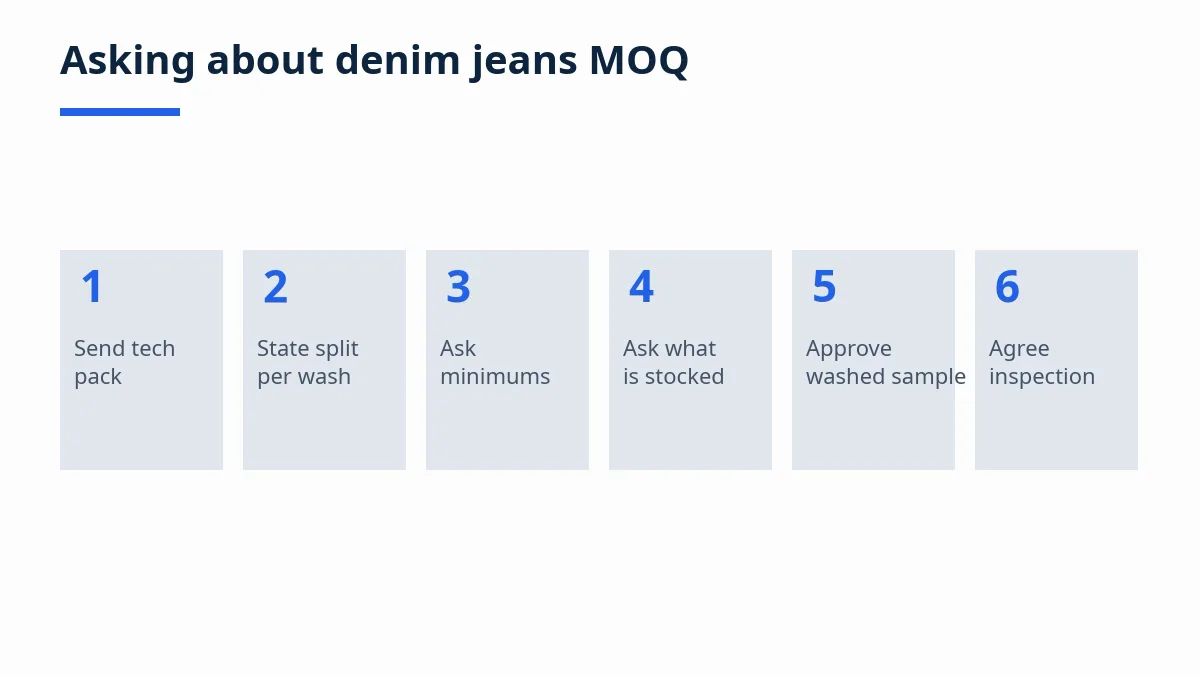
Send the same tech pack to every candidate. Cover cloth reference, composition, weight and stretch content, indigo shade and stocked or dyed status, fit with rise and leg opening, wash recipe per style, size chart with its ratio, trim and label spec and packing.
Give the split behind the total. State the quantity for each fit, each wash, each shade and each size. Without that breakdown, a factory cannot return a usable floor.
Ask for every floor as its own line. Request the minimum per fit, per shade and dye lot, per wash load, per size, and any separate trim, label, tag and carton floors, plus which line binds for your split.
Record what is already stocked. Note whether each cloth and shade is stocked or dyed to order, and whether buttons, rivets, zips, pocket lining and labels are stock items.
Approve a washed sample on paper. Order a proto sample, then a pre-production sample in the actual cloth, shade, fit, wash and trims. Measure it after washing, check shade and hand feel, then approve it or list corrections in writing.
Settle inspection and the delivery term before confirming. Put the inspection level and AQL values in the purchase order, following ISO 2859-1, which defines acceptance sampling plans for inspection by attributes, indexed by acceptance quality limit (AQL) for lot-by-lot inspection.5 AQL is the maximum average percentage of defective items considered acceptable during random sampling.5 State one Incoterm and named place on every quotation; the Incoterms 2020 rules set out 11 rules allocating cost, risk and obligations.6
Shade consistency across loads, measurement drift and trim attachment are covered in the denim jeans quality control checklist.
Costs, timelines and documents
What are the typical costs and timelines?
No guide can state typical costs or timelines as fact, for the same reason it cannot state a typical jeans minimum. Each factory prices cloth, indigo shade, wash recipe, fit and pattern work, trim and carton runs, finishing, packing and delivery term.6 Sampling depends on cloth availability and wash trials; bulk production on dyeing, wash capacity and trim delivery. Ask for sampling, cloth-ready, wash-ready, production and inspection dates.
Which documents are needed?
The shipment set is the Bill of Export, supported by the commercial invoice, packing list, EXP form certified by an authorized dealer, and certificate of origin from the EPB or a Chamber of Commerce and Industry.7 Your own papers are the specification pack, priced quotation and purchase order, with the floor per fit, shade and wash load on the quotation and order alike.
Bangladesh-specific rules and tips
Match the business name on all papers. Customs records both parties on the export filing,7 so keep the name identical on the trade licence, quotation, proforma invoice and payment account.
Check an association claim with the association. If a supplier claims BGMEA membership, confirm it there directly. Membership shows an active garment business, not the floor, wash capacity or fit range on offer.1
Ask which inputs are bought in for the order. Buttons, rivets, zips and some denim may be imported, and an imported trim can set both the floor and the earliest cutting date.
Checklist
Tech pack sent: cloth, shade, fit, wash, trims, labels, sizes, packing.
Split given per fit, wash, shade and size; one size ratio per wash.
Floor confirmed per fit, shade, dye lot and wash load; binding line named.
Cloth and shade status per style recorded: stocked or dyed to order.
Trim, label, tag and carton floors confirmed separately.
Set-up costs itemized apart from unit price; paid set-ups recorded.
Washed pre-production sample measured and approved in writing.
Inspection level and AQL values in the purchase order.5
Quotations compared on the same specification and Incoterm.6
Export set agreed: invoice, packing list, EXP form, certificate of origin, Bill of Export.7
How Exportain helps
Suppliers on Exportain quote from the same specification when the enquiry carries the tech pack summary, split per fit and wash, and delivery term. Use suppliers to find candidates and the RFQ board to send that enquiry as a request for quotation, so each reply states its floor per fit, shade and wash load. Verification on the platform is a document and photo review, not a factory inspection, and a badge is not a guarantee.8 9
FAQs
What should I know first about denim jeans?
Start from the laundry rather than the order total. The floor is set per fit, per shade and per wash by denim rolls, indigo dye lots, wash machine loads, pattern and marker work, and trim, label and carton runs, so ask any factory how many pairs sit behind each batch. Men's and boys' jeans sit under HS heading 6203, which covers non-knitted trousers and related garments.3
What are the typical costs and timelines?
No typical figures exist, because each factory sets its price, floor and lead time for a particular specification. Cloth, shade, wash recipe, fit, split and delivery term drive the price; cloth availability, wash trials, trim delivery and line capacity drive the timeline.
Which documents are needed?
Your commercial set is the specification pack, priced quotation and purchase order, all carrying the floor per fit, shade and wash load. The shipment set is the Bill of Export with the commercial invoice, packing list, authorized-dealer-certified EXP form, and an origin certificate from the EPB or a Chamber of Commerce and Industry.7
What are the most common mistakes?
The most common mistakes are counting pairs instead of batches, treating a wash as a colour, comparing floors across different specifications, approving a pair before washing, and reading a badge as a guarantee. A badge is not a guarantee of capacity, quality or delivery.8
Next steps on Exportain
Once the tech pack summary is ready, with the fit and wash split and delivery term included, send it through the RFQ board so that each reply can be compared on the same basis, and start the search among suppliers. Before confirming anything, read how to import denim jeans from Bangladesh and the MOQ definition guide, and check that every floor appears on the quotation.
Sources
- Denim exports to US, EU up 56pc, 32pc. The Financial Express, (accessed )
- Exports up over 6% to $13.1bn in Q1 of current fiscal. United News of Bangladesh (accessed )
- Classification Detail — HS Code 6203. United Nations Statistics Division (accessed )
- Regulation (EU) No 1007/2011 on textile fibre names and related labelling and marking of the fibre composition of textile products. European Union, (accessed )
- ISO 2859-1:2026 - Sampling procedures for inspection by attributes — Part 1: Sampling schemes indexed by acceptance quality limit (AQL) for lot-by-lot inspection. ISO (accessed )
- Incoterms® 2020. International Chamber of Commerce (ICC) (accessed )
- Customs Clearance Procedures for Export. Bangladesh Customs, National Board of Revenue (accessed )
- Trust & Safety Center. Exportain (accessed )
- Supplier verification: Earn trust badges buyers can see. Exportain (accessed )
About the author
Sourcing from Bangladesh?
Post a request for quotation and suppliers on Exportain can send you their quotes directly.
Post an RFQ