Denim Jeans Manufacturers in Bangladesh: Types, Washes and Checks
Bangladesh supplies denim jeans through integrated mills, sewing factories, laundry-led makers and trading companies. This guide sorts those types by what each controls, explains denim weight, weave and wash choices, and sets out checks to run before payment.
Short answer
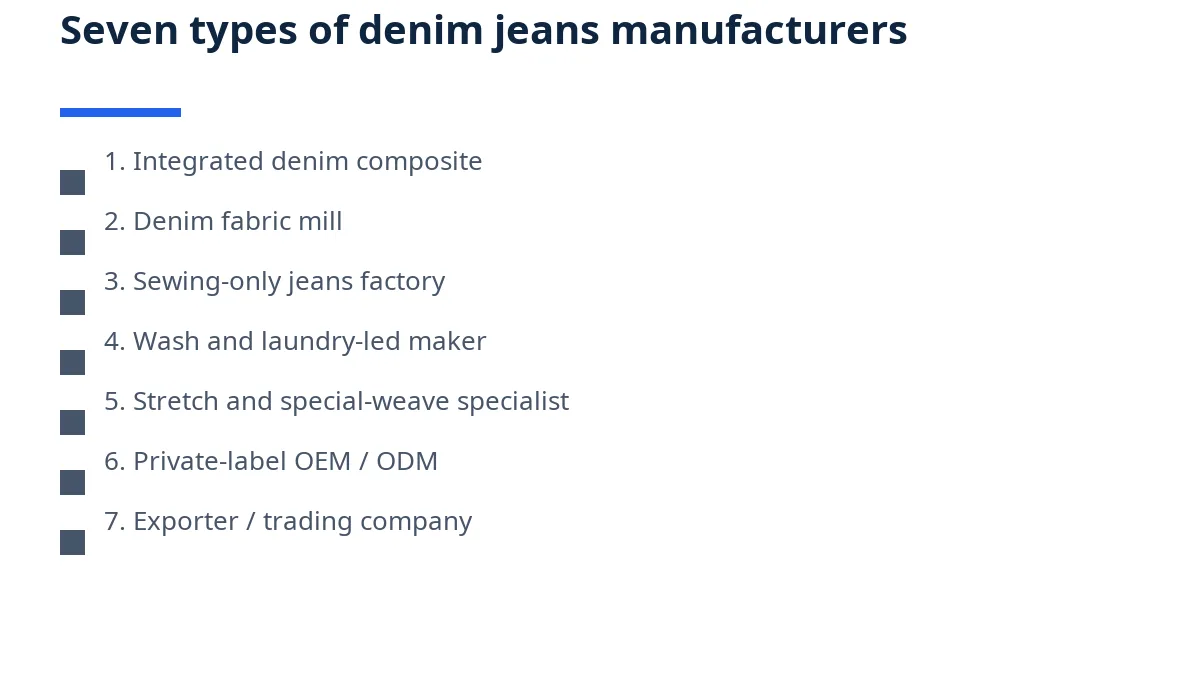
Denim jeans manufacturers in Bangladesh fall into seven types: integrated denim composites, denim fabric mills, sewing-only jeans factories, wash and laundry-led makers, stretch and special-weave specialists, private-label OEM and ODM suppliers, and exporters and trading companies. Match the type to your fabric, wash and fit needs, then check membership, documents, a washed production sample and inspection terms before paying.
On this page
Key takeaways
Bangladesh held a 29.88 per cent share of EU denim imports, with EU-bound denim exports rising from US$1.21 billion in 2023 to US$1.64 billion in 2025.
Jeans buying turns on three fabric decisions: weight in ounces per square yard, twill weave, and the wash or finish that sets the final look and shrinkage.
An integrated composite controls spinning, weaving, dyeing, sewing and laundry in one group; other types control only part of that chain, so the buyer must fill the gaps.
Price and MOQ follow the specification: fabric weight and stretch, wash complexity, fit range, quantity and packing move a quote more than the factory location does.
Exportain badges record document and photo checks reviewed by the Exportain team; they are not factory inspections or quality guarantees.
A finished pair of jeans hides a long chain of decisions: cotton yarn dyed indigo, woven into twill, cut into a fit, sewn, then washed until colour and hand feel match the design. In Bangladesh, separate suppliers tend to own separate parts of that chain, so a buyer is really choosing which stages a supplier controls directly and which it buys in. A wrong choice shows up later as shade drift, weakened seams, or a fit that changes after the first laundry cycle.
Bangladesh is a substantial denim source for European buyers. Eurostat trade data reported by Denim Focus put its share of EU denim imports at 29.88 per cent, with EU-bound denim exports rising from US$1.21 billion in 2023 to US$1.64 billion in 2025.1 The same report describes roughly Tk 25,000 crore invested across 42 modern denim mills, with combined capacity above 900 million metres of fabric a year.1 Scale at that level does not remove the need to match an order to the right capability. A rigid work jean, a stretch skinny and a heavily faded fashion jean each stress a different stage of production.
This guide sorts Bangladeshi denim jeans suppliers into seven capability profiles. No company names appear and no profile is ranked above another. The question throughout is practical: who controls your cloth, your wash and your fit, and what evidence should you ask for before money moves?
Key points to take away
Indigo shade, fabric weight and wash recipe are the three variables that most often move between a sample and a bulk shipment, so each one needs a written target.
Denim weight is usually quoted in ounces per square yard, and the common commercial span runs from 6.5 to 15.5 ounces, with twill construction pairing indigo-dyed warp yarns with undyed weft yarns.2
A supplier that is strong on sewing may still buy in its fabric and its washing, which leaves the buyer to manage the two stages that shape the finished jean.
Woven-sector membership can confirm a garment exporter is registered in the trade, and BGMEA operates a member search on its own site.3
A washed sample made from bulk cloth, measured after washing, is worth more than an unwashed sample, a photograph or a price promise.
The list: denim jeans manufacturers in Bangladesh by type
The profiles below group suppliers by the stage they run themselves. A single group can match more than one profile, and a supplier can shift profile for a particular order by subcontracting a stage. For every shortlisted supplier, ask for the in-house and bought-in stages in writing, style by style.
1. Mills selling denim cloth
A denim fabric mill produces cloth and sells it onward, rather than cutting jeans. Its daily work covers warp preparation, rope or slasher dyeing, weaving and finishing, and the mill's output is judged on shade, weight, stretch and shrinkage, not on garment fit.2 Buyers who already hold a sewing partner, buyers building a fabric library, and brands that want cloth approved before cutting begins tend to work with this profile first.
The useful test here is a trial length, not a small swatch. Ask for the mill test report showing weight, weave, stretch percentage and shrinkage, then put the trial through the exact wash planned for the finished jean. Cloth that looks acceptable dry can still lose shade or change dimensions after stone or enzyme treatment.
2. Laundry-led makers
Laundry-led makers are organised around what happens after sewing. Their equipment and recipes cover stone washing, enzyme washing, bleaching, sanding, laser fading and ozone treatment, turning a dark indigo jean into the faded, whiskered or distressed look a buyer ordered.4 Fashion programmes where the wash carries the design, including vintage fades and seasonal colour stories, usually sit best with this profile.
Judge such a supplier on a wash standard agreed in advance, with the recipe recorded per style and colour. Ask who operates the laser and ozone units and whether those steps stay on site. Then test the approved sample twice: once for appearance, and once for the wash effect on seam integrity, stretch recovery and final measurements.
3. Cut-make-trim sewing factories
A sewing-only factory cuts and sews jeans from cloth the buyer provides or from cloth it buys against the buyer's specification. Its strength lies in pattern accuracy, stitching consistency, pocket work and trim attachment, rather than in dyeing or washing. Buyers with modest quantities, buyers who already control their denim supply, and buyers trialling a new fit before committing to larger volumes often start here.
With this profile, cloth risk stays with the buyer. Inspect the fabric before cutting begins, agree shade and shrinkage tolerances in writing, and hold a pre-production sample in bulk cloth and bulk trims. Check the fit across the full size range, because a pattern that works in rigid cloth can behave differently once elastane enters the yarn.
4. Specialists in stretch and unusual weaves
Specialists in this profile make their living from cloth outside standard rigid twill. Their regular output includes cotton and elastane blends for stretch jeans, broken twill for lower leg twist, slub yarns for a textured surface, and selvedge cloth woven on shuttle looms with a finished edge.4 Skinny and slim fits that must recover after wear, comfort-stretch ranges, and programmes where cloth texture forms part of the appeal belong here.
Ask which blends and weaves the supplier runs month after month, rather than which it could attempt for a single order. Test recovery and growth after wear, not only on first stretch, and confirm the weave direction in the specification. In a twill, the weft passes over one or more warp threads and under two or more, shifting one step each row to form the diagonal rib.4
5. Own-label OEM and ODM suppliers
Private-label suppliers make jeans under the buyer's own label. An original equipment manufacturer (OEM) builds to the buyer's tech pack, while an original design manufacturer (ODM) offers its own patterns, fits and wash recipes for the buyer to brand. Retailers and brands that need their own labels, size sets, rivets, buttons, patches, packaging and barcodes, or that want a ready fit range without developing every pattern, usually work through this profile.
For OEM work, the tech pack should cover cloth, weight, weave, stretch, measurements per size, wash recipe and trims, and the counter-sample should be checked against it line by line. For ODM work, confirm the offered fits genuinely belong to the supplier, and settle who owns patterns, grading files and wash recipes if production later moves.
6. Integrated denim groups
An integrated composite keeps spinning or yarn sourcing, weaving, indigo or sulphur dyeing, cutting, sewing, washing and packing within one group. Denim production moves through yarn spinning, warping, dyeing, weaving and finishing before any garment is cut.2 Repeat programmes that need the same indigo shade, cloth weight and wash outcome season after season are the natural fit, because the group controls the cloth stage where repeat orders most often drift.
Integration still needs checking style by style. Ask which stages sit inside the group, which sit with a sister unit, and which go outside, and confirm the laundry is in-house when the wash defines the style.
7. Trading companies and exporters
Exporters and trading companies sell jeans made in partner factories instead of on their own sewing lines. They pull together capacity across several factories and handle export documentation for the buyer. Mixed orders spanning several denim styles, quantities too small or too varied for a single factory, and buyers who prefer one contract and one contact point tend to suit this profile.
The check that matters most is naming. Ask which factory sews each style and which laundry washes it, and have both named before any deposit is paid. A trading company's own export record says nothing about the sewing line or laundry behind a particular jean, so both should be inspected independently and named in the order terms.
Denim weights, weaves and washes buyers should specify
Weight should always be written as a number, not as a vague description, because one factory's heavy cloth is another's midweight. Lightweight denim at 7 to 9 ounces suits summer-weight jeans and softer drapes, midweight denim at 10 to 12 ounces covers most commercial jeans, and heavyweight denim at 13 to 15 ounces gives a stiffer, longer-wearing jean that softens with wear.4 State whether the figure applies before or after washing.
Weave decides the surface and much of the behaviour. Classic denim uses a 3/1 twill, with indigo warp on the face and paler weft inside, which explains why the inside of a jean looks lighter than the outside.4 Right-hand twill runs its diagonal in one direction and left-hand twill in the other, while broken twill alternates direction to reduce leg twist. For stretch jeans, add the elastane percentage and a recovery target beside the weave description.
Wash decides both the look and the final measurements. A raw jean arrives unwashed after dyeing, feels stiff at first, and shrinks on its first wash. A one-wash jean has had a single wash to remove shrinkage and excess dye. Stone washing with pumice gives a worn-in look and softer hand, while enzyme washing breaks down fibres for softness with greater consistency than stone washing.4 Most commercial denim is also sanforized, meaning it is pre-shrunk during manufacturing, while unsanforized denim can shrink 3 to 10 per cent on first washing.4 Put the wash, the shrinkage allowance and the measurement point in the tech pack, and approve the sample after washing, never before.
Summary table
Type | Suits | Check first |
|---|---|---|
Denim fabric mill | Cloth approval before cutting, fabric development | Washed trial length with mill test report |
Wash and laundry-led maker | Vintage fades, fashion washes | Recorded wash recipe and post-wash strength test |
Sewing-only (CMT) jeans factory | Buyer-supplied cloth, modest runs | Cloth inspection before cutting, fit across sizes |
Stretch and special-weave specialist | Skinny fits, selvedge and textured cloth | Recovery after wear, weave direction |
Private-label OEM / ODM | Own-label brands, ready fit ranges | Tech pack match, ownership of patterns and recipes |
Vertically integrated denim composite | Repeat programmes, shade consistency | Stage-by-stage in-house confirmation |
Exporter / trading company | Mixed styles, single contract | Sewing factory and laundry named in writing |
What drives price and MOQ for jeans
A jeans quotation is a bundle of separate costs, so two headline figures rarely describe the same product. Cloth usually forms the largest share: heavier cloth uses more material per pair, stretch blends cost more than rigid cotton, and special weaves or selvedge cloth cost more than standard twill. Wash complexity forms the next layer, since a simple rinse and a multi-step vintage wash with laser fading, sanding and ozone are different jobs at different costs, even on identical cloth.
Example figures: a comparison only makes sense when every shortlisted supplier quotes the same cloth, wash, fit range, delivery term and packing. Where a new pattern set and a separate dye lot are needed, spreading those fixed items over a larger quantity lowers their share per pair, while cloth and wash costs per pair change far less. Each fit and wash normally carries its own minimum order quantity, so a range with several washes is several minimums, not one.
For how minimum quantities work across a range, read the guide to MOQ in the supply chain.
How to verify a supplier before you pay
Confirm association membership. A woven garment exporter should appear in BGMEA member records, and BGMEA lists the assessment frameworks factories in Bangladesh are measured against, including BSCI, WRAP, SMETA, ICS, the Higg Index, ZDHC and GOTS.3 Membership confirms registration in the trade and nothing beyond that, so treat it as an opening check.
Review the documents. Trade licence, Export Registration Certificate (ERC) and factory or laundry photos form the standard set. Badge scope on Exportain is explained on the seller-verification page.5
Sample in bulk cloth, after washing. Approve a pre-production sample in bulk fabric and trims, run it through the agreed wash, and measure it against the size chart after washing. Keep one sealed sample as the shipment reference, and test stretch recovery on stretch styles.
Set the inspection standard in the order. Agree the acceptance quality limit (AQL) and inspection level before production starts. ISO 2859-1 specifies sampling schemes indexed by AQL for lot-by-lot inspection, giving an inspector a published rule for accepting or rejecting a shipment.6
Put payment terms in writing. Agree inspection and shipment conditions before settling, and note that Exportain is a marketplace and not a party to the goods contract. The buying steps on Exportain are set out in its how-to-buy guide.7
How Exportain helps
Use Exportain search and quotation tools to shortlist suppliers and compare offers on matching specifications, then run the checks above before payment.
FAQs
What is the biggest mistake buyers make when sourcing denim jeans from Bangladesh?
Picking on headline price before establishing which chain stages the quoted supplier actually runs. Cloth from a mill, sewing on buyer-supplied fabric, and a washed fashion jean from a laundry-led maker are different products with different cost bases, so a cheaper figure may simply leave a stage out.
How do I choose the right denim weight and wash for my range?
Begin with season and fit, then lock the combination in a washed sample. Lighter cloth fits summer jeans and softer drapes, midweight cloth fits the standard year-round jean, and heavyweight cloth fits rigid styles that soften over time.4 Pair that choice with a wash, from raw or one-wash through stone and enzyme finishes, and approve the pair together in production cloth.4
Who is responsible for quality, the factory or the buyer?
Responsibility splits by task. The factory must make jeans to the agreed specification and the approved washed sample. The buyer must make that specification complete and testable, covering weight, weave, stretch, wash recipe and post-wash measurements, and must inspect against it before shipment.
Where can I get help verifying a supplier?
Work from independent registers rather than a sales page: association registers, certification bodies, and a third-party inspector engaged before dispatch.3 On Exportain, check badge coverage first and keep correspondence in a single thread.5
Next steps on Exportain
Post a free RFQ stating cloth, wash, fit, quantity, destination and delivery term, then shortlist from Bangladeshi suppliers using badge, MOQ and label-capability filters and compare replies on matching terms.
Sources
- Bangladesh Leads Europe's Denim Market, But for How Long?. Denim Focus (accessed )
- Denim Fabric Manufacturing: A Step-by-Step Guide. Textile Details, (accessed )
- BGMEA | Home. Bangladesh Garment Manufacturers and Exporters Association (BGMEA) (accessed )
- Understanding Denim Weights and Weaves. Jorts Australia (accessed )
- Supplier verification: Earn trust badges buyers can see. Exportain (accessed )
- ISO 2859-1:2026 — Sampling for Inspection by AQL. American National Standards Institute (ANSI) (accessed )
- How to source and buy from Bangladesh. Exportain (accessed )
About the author
Sourcing from Bangladesh?
Post a request for quotation and suppliers on Exportain can send you their quotes directly.
Post an RFQ