Wholesale Denim Jeans From Bangladesh: Prices, MOQ and Washes
No single wholesale denim jeans price or MOQ in Bangladesh: how denim weight, indigo, wash loads and fit assortments set the minimum, and how to compare quotes on one term.
Short answer
There is no single wholesale price or MOQ for denim jeans from Bangladesh. Each factory quotes your specification, with minimums that can bind per wash load, per colour and per size curve. Before you ask for a price, fix the denim weight and weave, the indigo shade, the wash recipe, the fit block and the size ratio, then compare itemized quotations on the same specification and delivery term.

On this page
Key takeaways
There is no single wholesale price or MOQ for denim jeans from Bangladesh: each factory sets minimums per wash load, per colour and per size curve for your specification.
Denim weight and weave, indigo shade and depth, washing and finishing loads, fit blocks and size ratios are the drivers that set the floor and the price.
Approve shade and measurements on a washed pre-production sample, with a shade band and after-wash tolerances agreed in writing before bulk.
Compare itemized quotations only on the same denim, wash standard and Incoterm, and write the inspection level and AQL values into the purchase order.
Exportain verification is a document and photo review, not a factory inspection, and a badge is not a guarantee.
A jeans quotation is hard to compare because the garment that arrives depends on decisions a price line never shows. Two suppliers can both quote denim jeans, yet one plans a light cloth with a quick rinse and a narrow size run, while the other plans a heavier cloth, a multi-stage wash and a full waist and length matrix. The second quote can still be the cheaper stock to own, because jeans that miss the waist and length mix a shop actually sells become clearance stock, not revenue.
The wash sits at the centre of that comparison. A laundry fills its machines by load, set for one shade, one recipe and one point in the fade sequence. An order large in total but split across three washes can still be too small for any single load, while a smaller order in one wash can fill a load cleanly. A wholesale jeans enquiry should therefore settle the wash, the shade range and the size split before chasing a unit price.
Bangladesh gives a buyer a wide woven base. The Bangladesh Garment Manufacturers and Exporters Association (BGMEA) covers the ready-made garment industry across woven, knitwear and sweater sub-sectors, with woven manufacturers around 60 percent of member factories and 100 percent of woven garment exports.1 Ready-made garment exports for July to September of FY2026-27 reached US$10,578.56 million, up 6.10 percent, with woven exports at $4,614.80 million, per Export Promotion Bureau (EPB) data.2 That breadth sets no shared jeans price, wash minimum or delivery time.
Why this matters for buyers and sellers
For a buyer, the risk in jeans sits in the size matrix and the wash outcome. A waist that runs short after washing, a leg that loses length unevenly across sizes, or a fade that drifts between laundry loads leaves the best-selling sizes gone and the slow sizes stranded.
For a factory, a jeans order locks a denim lot, a dye range setting, a laundry sequence and a sewing line for one weight, shade and wash. Those settings cannot transfer to another buyer, so the factory prices the set-up and the load, not just the sewing minutes.
What should I know first about denim jeans?
Begin with the wash, because the wash is what the customer judges. Stone washing tumbles stones with the denim to wear the surface, and enzyme washing uses enzymes to soften and fade the cloth.3 Denim washing commonly uses a heavy enzyme wash, and washing also softens hand feel and stabilises shrinkage.4 Record the wash as a recipe: type, target shade, surface work, softener, and shade tolerance between pieces in one load. Then confirm the load size that recipe needs, since that load can set the floor for the whole order.
Next, settle the indigo question. In a standard jean the warp yarns carry the indigo and the weft stays largely undyed, which creates the fade character and its colour-fastness limits. Record indigo depth, any sulfur bottom or top for a black or grey cast, and the colour-fastness test, and approve shade on a washed garment, because washing moves the colour.3
Then lock the fit and the size curve. A jeans tech pack needs a fit block per fit, waist and inseam figures for every size, rise, leg opening, pocket placement, hardware detail, belt-loop and fly construction, and the size ratio per wash and colour. The ratio matters as much as the fit: a curve weighted toward middle sizes marks cloth efficiently and fills a laundry load evenly, while a thin spread wastes cloth and can push small sizes below the cutting floor.
Only then does the cloth choice fall into place. Denim weight is quoted in ounces per square yard, with jeans people commonly wear typically between 8 and 12 ounces, and medium-weight denim in the 12 to 16 ounce range.3 Heavier cloth uses more yarn, cuts and sews more slowly, and shrinks and breaks in differently after washing, so weight belongs in the tech pack beside fibre composition, stretch percentage and fabric width. On weave, twill is the primary weave for most denim jeans, and twill fabric is more durable and resistant to abrasion than plain weave.3
Two administrative points belong in the same tech pack. Under the Harmonized System, heading 6203 covers suits, ensembles, jackets, blazers, trousers, bib and brace overalls, breeches and shorts, other than swimwear, for men or boys, not knitted or crocheted.5 Confirm the full national code for the exact jean, by gender, fibre and wash treatment, in the destination tariff before working out duty, and see the HS code for denim jeans guide. For European Union sales, Regulation (EU) No 1007/2011 requires fibre names and percentages by weight, in descending order, on the label.6
Finally, agree two controls before production starts: the sampling plan for final inspection, referenced to ISO 2859-1,7 and a single Incoterms 2020 rule with a named place for every quotation.8
Step-by-step: how it works
Follow this sequence, keeping a written record at every stage, with wash and fit settled ahead of any price discussion. Do not move to the next stage until the current one is signed off.
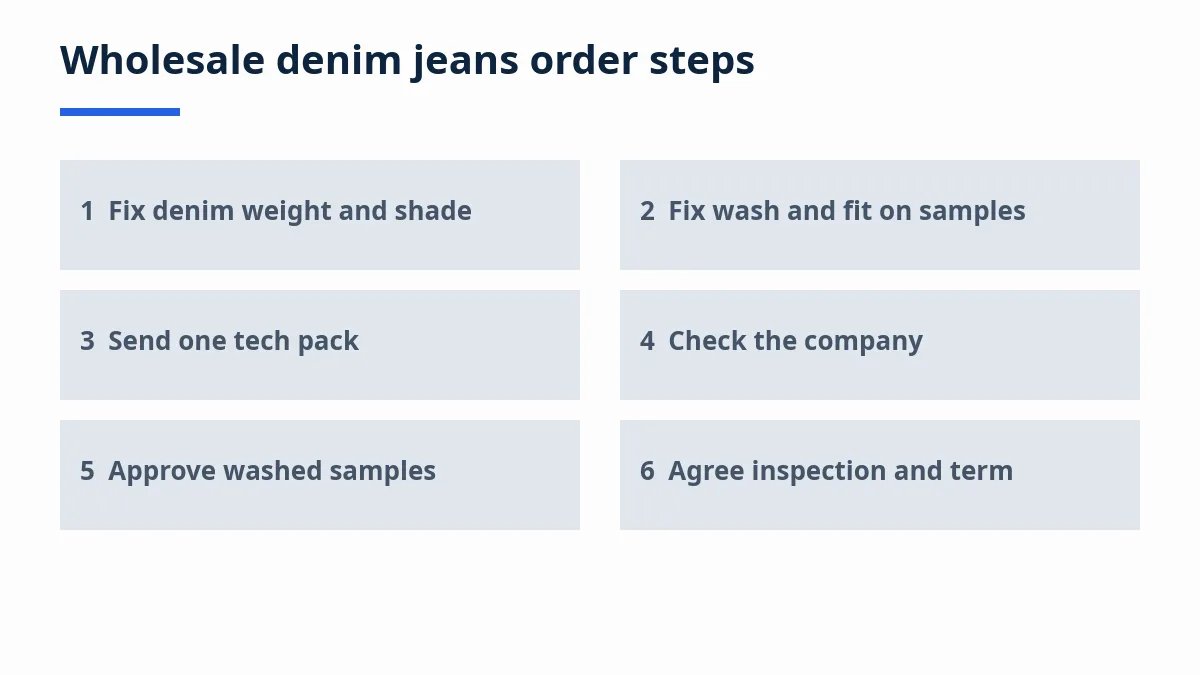
Lock the fit curve and the wash standard first. Send the fit block, measurement chart, size ratio per wash and colour, and a reference jean or wash standard, and ask the factory to confirm wash load size, shade band and guaranteed after-wash measurements.
Lock the denim lot and the indigo depth second. State weight in ounces per square yard, weave, fibre composition, stretch percentage, indigo shade and depth, and whether the fabric is in stock, held as a named mill lot, or dyed to order.
Send one tech pack to every candidate. Include fabric, wash recipe, fit, size ratio, hardware, labels and delivery term, and ask for an itemized quotation stating the minimum per wash, per colour and per size curve.
Look past the quotation to the operation behind it. Get the registered company name, confirm which stages run in-house and which go to a laundry or factory the supplier selects, and sight the trade licence and, for an exporter, the Export Registration Certificate (ERC).
Approve the washed sample in writing. Order a proto sample for fit, then a pre-production sample in the actual denim, wash, rivets and labels, measure it before and after washing against the chart and shade standard, then approve it in writing or list corrections in writing.
Put inspection, delivery term and export filing on the order before confirming. Write the sampling level and AQL figures into the purchase order,7 state one Incoterm and named place,8 and hold shipment until the filing is approved.
Use the denim jeans quality control checklist alongside the pre-production sample, checking wash, shade, measurement and hardware point by point before signing the approval, and keep the signed checklist with the sample so bulk can be judged against the same points.
Costs, timelines and documents
A factory builds a jeans quote line by line from the specification, so the lines below are the lines to price.
What are the typical costs and timelines?
Every row is a tech-pack question, and every answer changes the floor or the price.
Cost driver | Why it moves the quote | Lock it in the enquiry as |
|---|---|---|
Wash and finishing sequence | Load size, recipe stages, hand work, tolerance | Recipe, shade, tolerance, load floor |
Indigo depth and dyeing | Dye-range set-up, depth, fastness testing | Shade, depth, sulfur use, fastness test |
Fit curve and size mix | Pattern blocks, marker efficiency, thin sizes | Fit block, measurements, ratio per wash |
Cloth weight and weave | Yarn use, sewing speed, shrinkage | Weight, weave, composition, stretch |
Hardware, labels and cartons | Rivets, buttons, zips, print runs | Hardware spec, label and carton spec |
Delivery term and place | Where cost and risk transfer | One Incoterm rule and named place8 |
Example figures: a buyer splits 900 pairs across three washes at 300 pairs per wash. If a laundry needs 500 pairs per load, each wash is 200 pairs short and the three washes together need 1,500 pairs (3 × 500). The same 900 pairs in a single wash clear that 500-pair load floor, although the size curve still needs checking against the cutting floor per size. The example shows structure only, not a typical minimum, price or lead time.
Timing follows mill delivery, dyeing, laundry capacity and correction rounds, so ask for a dated line per stage instead of one promised week.
Which documents are needed?
Keep three order papers together: the tech pack, the itemized quotation and the purchase order, with per-wash and per-colour minimums on the quotation and repeated on the purchase order. The production papers are the written sample approvals, the wash standard and the inspection report.
For the export file, assemble the commercial invoice, the packing list, the EXP form certified by an authorized dealer and a certificate of origin issued by the EPB or a Chamber of Commerce and Industry, reconciling names, quantities and values across the set, since loading waits on an approved export declaration, the Bill of Export.9 File the purchase order, written sample approval and inspection report with that set.
Bangladesh-specific rules and tips
Set shade as a band, not a single swatch. Indigo fades with washing and drifts between laundry loads, so agree light and dark limits, a reference garment kept by both sides, and a rule for pieces outside the band. Without that band, a load the laundry regards as acceptable can still be rejected by the end customer.
Ask which inputs are bought in for the order. Rivets, buttons, zips, stretch yarn and some denim lots may be imported or ordered against the specification, and a bought-in trim or fabric lot can set the earliest production date and the floor.
Read association membership narrowly. A claim of BGMEA membership is worth checking with the association itself, and confirmed membership points to an active woven business, not to laundry capacity or the smallest wash a factory will run.1 A factory with its own laundry and one that sends washing out are different offers even when both hold the same membership.
Mistakes and red flags
What are the most common mistakes?
Approving shade on an unwashed sample. A greige or unwashed shade approval does not predict the washed shade. Approve the washed garment, and keep it as the bulk standard.
Quoting a total and forgetting the wash split. The binding floor is often a laundry load or a colour, not the order total. An order can clear the total and still fall below the laundry floor for one wash, which then carries a surcharge or removal.
Setting prices from different cloths, washes or terms side by side. A lower figure on lighter cloth, a simpler wash, rigid denim instead of stretch, or a different delivery term is a different offer. Set replies to the same tech pack, wash standard and Incoterm side by side.8
Leaving an agreed exception off the paper. Put any lower floor, shared dye lot, shared wash load or waived set-up on the quotation and purchase order, with the split it covers.
Reading a listing or a badge as proof of wash or fit ability. A listing opens a conversation; it does not show whether a laundry can hold a shade or a pattern can hold measurements after washing. Badges record document and photo checks only, not capacity, quality or delivery, so wash approval, fit approval and inspection stay with the buyer.10
Dropping the final check to save a few days. The pre-shipment check is the last point at which a shade drift or a measurement drift can be caught before the jeans become stock the buyer owns.7
Checklist
Go through every item below and close it out in writing before you sign the order.
Wash recipe, shade band, load floor and reference garment confirmed.
Fit block, measurements, rise, leg opening and hardware confirmed per fit.
Size ratio per wash and colour, with thin sizes checked against cutting and laundry floors.
For each shade, note whether the cloth is already held, reserved as a named mill lot, or still to be woven and dyed.
Binding floor named: wash load, colour or size curve, whichever bites first.
Trim, label and carton floors settled on their own, separate from how many garments the factory will run.
Post-wash measurement and shade review of the pre-production sample passed, signed approval on file.
The order states which sampling level applies and which AQL figures govern acceptance.7
Price comparison uses identical cloth, wash standard and delivery term for every reply.8
Before shipment, confirm the export paperwork is complete and reconciled, with names, quantities and values agreeing across the invoice, the packing list, the certified EXP form, the origin certificate and the approved Bill of Export.9
How Exportain helps
Put the locked specification on the RFQ board after browsing suppliers, so replies state per-wash and per-colour floors against the same specification. When a quotation is accepted, Exportain creates one order and issues one proforma invoice from the accepted terms.10
Badges record document and photo checks, not a factory inspection.10 11 See how supplier verification works on Exportain.
FAQs
What should I know first about denim jeans?
Wash, indigo depth, fit block and size ratio come before price, because the laundry load and size curve set the floor.
What are the typical costs and timelines?
None a buyer can rely on: each factory prices cloth, dyeing, wash sequence, fit work, hardware and delivery term for the specification in front of it.8
Which documents are needed?
Work from the tech pack, the itemized quotation and the purchase order, repeating the per-wash and per-colour floors on the last two. For export, the file runs to the Bill of Export with the invoice, packing list, certified EXP form and origin certificate from the EPB or a Chamber of Commerce and Industry.9
What are the most common mistakes?
Buyers most often approve shade before washing, quote only a total floor, set different specifications side by side,8 leave exceptions off the paper, and read a badge as a guarantee of capacity or delivery. A badge records document and photo checks, not a factory inspection.10
Next steps on Exportain
Browse suppliers, then put the denim, wash, fit and size ratio on the RFQ board so replies state their floor per wash and per colour. Before confirming, read how to import denim jeans from Bangladesh and how supplier verification works on Exportain.
Sources
- Bangladesh Garment Manufacturers and Exporters Association (BGMEA). Devex (accessed )
- RMG exports rise 6.10pc to US$10.58b in July-Sept of FY27. The Financial Express, (accessed )
- Best 8 Denim Fabric Types Explained. JingSourcing (accessed )
- Garment Washing - an Important Process in Garment Production. Online Clothing Study, (accessed )
- Classification Detail — HS Code 6203. United Nations Statistics Division (accessed )
- Regulation (EU) No 1007/2011 on textile fibre names and related labelling and marking of the fibre composition of textile products. European Union, (accessed )
- ISO 2859-1:2026 - Sampling procedures for inspection by attributes — Part 1: Sampling schemes indexed by acceptance quality limit (AQL) for lot-by-lot inspection. ISO (accessed )
- Incoterms® 2020. International Chamber of Commerce (ICC) (accessed )
- Customs Clearance Procedures for Export. Bangladesh Customs, National Board of Revenue (accessed )
- Trust & Safety Center. Exportain (accessed )
- Supplier verification: Earn trust badges buyers can see. Exportain (accessed )
About the author
Sourcing from Bangladesh?
Post a request for quotation and suppliers on Exportain can send you their quotes directly.
Post an RFQ