

CIP for Small Importers: Is It the Right Incoterm for Your First Order?
A small first order under CIP buys seller-paid carriage and Clause A insurance to a named destination, while risk passes at handover to the first carrier. This guide tests that trade on small-shipment economics, compares FCA and CPT, and gives an order-one checklist.
Short answer
CIP can be right for a small first order when the buyer has no freight or insurance contact yet, the destination is named, and the goods are worth protecting with broad cover. Under CIP, the seller pays carriage and buys Clause A insurance for at least 110% of the contract price to the named destination, but risk passes at handover to the first carrier. With a forwarder appointed, or a small air parcel, FCA or CPT often fits better.
On this page
Key takeaways
CIP can be right for a small first order when the buyer has no freight or insurance contact yet, the destination is named precisely, and the goods are worth protecting with broad cover.
Under CIP the seller pays carriage and Clause A insurance to a named destination, but risk passes at handover to the first carrier, so the insurance certificate must be checked before handover.
Clause A is the broadest standard cover, and the CIP default is at least 110% of the contract price, in favour of the buyer.
Import duty, broker fees and onward delivery stay with the buyer and can outweigh the carriage inside a small CIP price.
A buyer who already has a forwarder and cargo cover should price FCA before agreeing CIP, to avoid paying for insurance twice.
A first order is small on purpose. A buyer testing a new supplier from Bangladesh may order 300 cotton canvas tote bags rather than 30,000, to limit the loss if the colour, size or stitching is wrong. The delivery term still decides who arranges the journey, who buys insurance and who carries the risk in transit. It matters more on a small order, because fixed clearance, brokerage and delivery costs do not shrink with the quantity.
This guide tests CIP (Carriage and Insurance Paid To) on the economics of order one, using one worked example with all figures labelled as example figures, and compares CIP with FCA and CPT. It states no typical freight rate, premium or transit time: get each figure quoted for the exact order.
Start with the size of order one, not with the letters CIP
A small first order is defined by what it leaves unresolved: often no forwarder in Bangladesh, no broker at destination and no record of how the goods clear customs there. The value is low enough to absorb as a test, but high enough that losing it would matter.
Fixed destination costs are the first test. Transport and handling costs can far outweigh the cost of a small purchase.1 Divide each fixed charge by the number of units before comparing terms, since brokerage and clearance are often charged per shipment. The second test is responsibility. In the United States the importer remains liable for duty and for assuring that goods comply with import rules.1 In the United Kingdom the commodity code determines the duty rate and whether a licence is needed.2 CIP changes who arranges carriage and insurance, not who clears import customs or pays duty.
What CIP hands a first-time buyer, in plain terms
Under CIP, the seller delivers the goods to a carrier the seller has contracted, at the agreed place and point of delivery, pays carriage to the named destination, and buys cargo insurance for the buyer.3 The seller completes export formalities; the buyer completes import formalities.3 CIP suits any mode of transport, including combined journeys.3
Delivery and destination are different places. Risk passes to the buyer when the goods are handed to the carrier, even though the seller keeps paying carriage and insurance to the destination.3 With several carriers, delivery is at handover to the first carrier.3 Agree both places in writing.
The insurance is why CIP differs from CPT. The seller must arrange Institute Cargo Clauses (A) cover, the maximum level, for at least 110 percent of the contract price, in favour of the buyer or a party the buyer names, running to at least the named destination.3 The International Chamber of Commerce notes that CIF keeps Clause (C) as its default, while CIP now requires Clause (A).4 Clause (A) covers all risks except policy exclusions, while Clauses (B) and (C) cover only named perils.5 Read the exclusions and deductibles before handover: Clause (A) is not cover for everything.
The small-shipment arithmetic: where CIP helps and where it does not
Example figures: one order of 300 cotton canvas tote bags to a named inland destination. The figures are illustrative structure only, not quotes.
Line | Example figures |
|---|---|
Goods price in the contract | $1,800.00 |
Carriage to the named destination | $340.00 |
Insurance premium in the CIP price | $48.00 |
CIP price | $2,188.00 |
Insured value at 110 percent of the contract price | $1,980.00 |
CIP price per bag | $7.29 |
Check: $1,800.00 plus $340.00 plus $48.00 equals $2,188.00, and 110 percent of $1,800.00 equals $1,980.00. The $48.00 premium is the price of cover, not the amount payable on a claim.
Carriage is about 16 percent of this CIP price and the premium about 2 percent. When goods are worth protecting and the buyer has no insurance contact, that small premium buys broad cover for the full insured value without finding an insurer for one shipment. CIP helps less when the same cover is already in place, through a standing policy or a forwarder, or when the goods are low-value, sturdy and easily replaced. The largest small-order cost is often outside the CIP price: a price including shipping does not include duty or clearance costs, and first-time importers are often surprised by duty, processing and broker bills.1 Add import duty, broker fees and onward delivery, quoted for order one, to the CIP price.
CIP against FCA and CPT for order one
CPT is CIP without the insurance. The seller pays carriage to the named destination and risk passes at handover to the first carrier, but the seller need not insure, and the buyer may arrange insurance if desired.6 CPT suits any mode and both full-container and less-than-container shipments, where risk still passes at handover to the first carrier.6 FCA is different again: the seller delivers to a carrier nominated by the buyer at the named place, risk transfers there, and the buyer arranges and pays for main carriage, with no insurance required by the rule.7 FCA suits a buyer who already has carrier and insurer contacts and wants control. It suits a buyer with no contacts poorly.
Question | CIP | CPT | FCA |
|---|---|---|---|
Who pays main carriage? | Seller, to the named destination | Seller, to the named destination | Buyer, from the named place |
Who must buy cargo insurance? | Seller, Clause (A), at least 110 percent | No party is required to insure | No party is required to insure |
When does risk pass? | Handover to the first carrier | Handover to the first carrier | Delivery to the buyer's carrier at the named place |
Who clears export / import? | Seller / buyer | Seller / buyer | Seller / buyer |
CIP buys cover and carriage in one price and gives up control. CPT buys carriage only. FCA buys control. The right choice follows from what the buyer lacks. Incoterms rules do not define payment terms, product quality or transfer of ownership, so agree those separately.7
Three order-one profiles: say yes, pause, or choose otherwise
Say yes to CIP, with the certificate checked
No forwarder, no broker yet, goods whose value would hurt to lose, and a precise inland destination: this is the profile CIP was written for. The seller arranges the journey and broad cover, the buyer appoints a broker, and the buyer checks the certificate before handover. A CIP price with no certificate is a promise, not cover.
Pause, and get the onward leg quoted first
A small air parcel to an airport destination calls for a pause. CIP can be used for air freight, but the seller's obligation ends at the named destination. Clearance, duty and delivery from the airport remain with the buyer, and on a small parcel those charges can exceed the carriage in the CIP price. Get broker and onward-delivery quotes for the exact airport and warehouse first.
Choose otherwise, and keep the cover you already have
A buyer with a forwarder, broker and cargo cover running from handover to warehouse should compare FCA. The buyer controls carrier and insurer, avoids a second policy in the CIP price, and keeps one claims route. Compare the CIP price with the FCA goods price plus the buyer's own carriage and insurance, on the same destination.
Reading a first CIP quotation without missing the insurance line
Ask for each line in writing, and treat a missing line as an open question: goods price, currency and quantity; carriage charge and named destination; insurance premium, clause letter, insured value and currency; delivery place, stated separately from the destination; the rule as CIP, named destination, Incoterms 2020; and exclusions, including duty, broker fees, terminal charges and onward delivery.
A quotation saying CIP with no clause letter, insured value or certificate does not show Clause (A) cover for at least 110 percent.3 One naming Clause (C) offers the narrower CIF-level default, not the CIP default.4 5 Read the CIP price guide and the CIP documents checklist before handover. Compare quotations only on the same destination, delivery place and insurance lines, and on total cost to the warehouse door.
The first-order sequence, from RFQ wording to the warehouse door
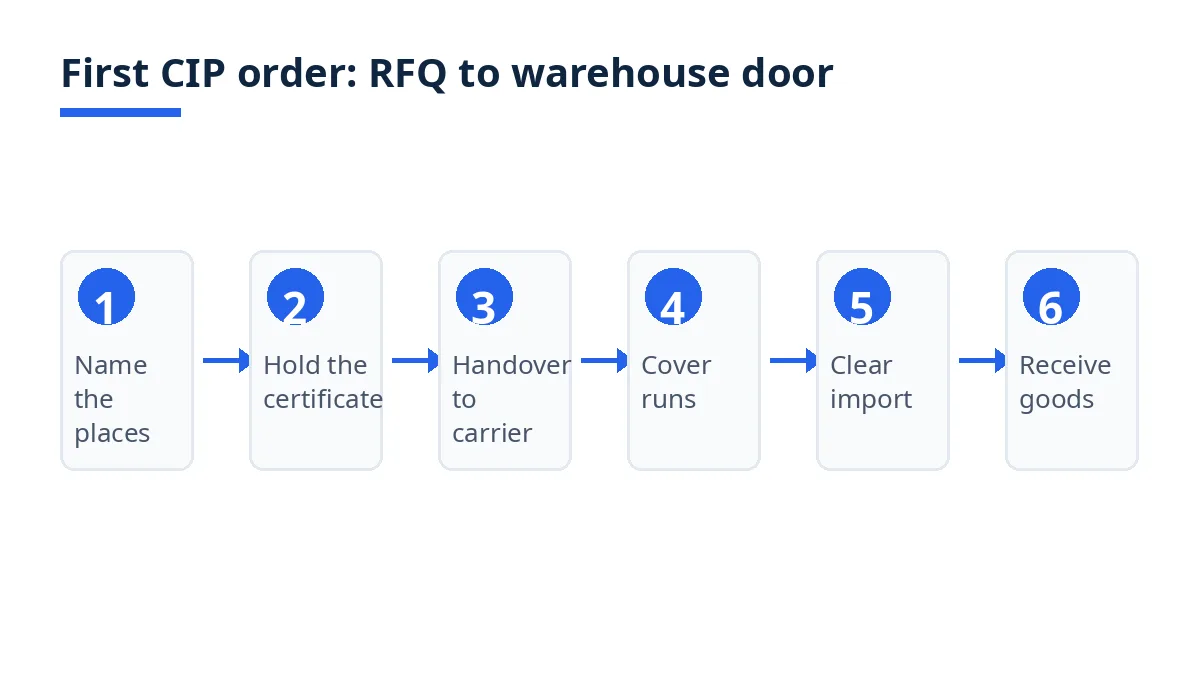
Write the RFQ with CIP, the named destination, the delivery place, Incoterms 2020, Clause (A) cover for at least 110 percent, quantity, specification and packing. Ask each seller to quote on the same wording.
Compare replies on landed cost, adding duty, broker fees and onward delivery for the exact destination.
Appoint the destination broker before shipment, sharing the commodity code and invoice details, and confirm who makes the customs declaration.2
Hold the insurance certificate before handover, checking clause, insured value, description, journey, destination and beneficiary.3
Agree quality, packing and inspection in writing before production. Incoterms rules do not cover product quality.7
Ask the seller to notify you on delivery to the first carrier, and record the date, because risk passes then.3
Clear import customs, pay duty, arrange onward delivery, receive the goods and inspect them against the specification and packing list. Keep the invoice and customs paperwork.2
Bangladesh handover points a small buyer must name in writing
The delivery place may be the seller's premises, a private inland container depot, a terminal at Chattogram port or a cargo terminal at Dhaka airport. Each means a different first carrier. Name the place and point in the contract, and the first carrier where known.3
Export clearance must be completed before loading. Section 131 of the Customs Act, 1969 requires clearance for export, and goods must not be loaded or stuffed unless an export declaration, known as a Bill of Export or Shipping Bill, is submitted and approved.8 Its enclosed documents include the export letter of credit or, where there is none, the contract, purchase order or guarantee approved by the negotiating bank, the commercial invoice, packing list, EXP form certified by Authorized Dealers, certificate of origin, VAT registration certificate and taxpayer identification number.8 Ask for the Bill of Export number and the as-shipped documents, and check them against the purchase order. For a consolidated container, ask who consolidates the goods and what document the buyer receives for its share, since risk passes at handover to the first carrier even when goods travel with other cargo.6
First-order traps that sit outside the price
Risk does not pass at the destination. It passes at handover to the first carrier, while the seller pays carriage and insurance to the destination.3 Damage at destination is a claim under the certificate, after recording the damage.
CIP does not include import clearance or duty. The buyer handles import formalities, and a price including shipping does not include duty or broker charges.3 1 Confirm the duty rate from the commodity code with the broker.2
A certificate that does not let the buyer claim is a trap. It must be in the buyer's favour, show Clause (A) cover for at least 110 percent, and run to the named destination.3
Naming only a country as the destination is a trap. Name the terminal, airport or inland place, with the town or city.3 Having no broker ready is another: in the United States, goods not claimed within 15 days of arrival may be transferred to a warehouse at the importer's cost.1 Appoint the broker before shipment. Finally, the delivery term is not the whole contract: Incoterms rules do not define ownership, payment, quality or remedies.7
Order-one decision checklist: answer before you agree CIP
Is the destination a precise place, with the delivery place stated separately?
Does the quotation show Clause (A) cover, at least 110 percent, and the currency?
Is the certificate held, in the buyer's favour, before handover?
Have duty, broker fees and onward delivery been quoted and added to the CIP price?
Is a broker appointed, with the commodity code and invoice details shared?
Does the buyer already hold cover for this journey, which CIP would duplicate?
Is the first carrier named, for a full container, consolidated shipment or air parcel?
Are payment, quality, packing and inspection agreed in the sales contract?
If the answers support CIP, agree it in the wording above. If they show an existing forwarder and cover, price FCA first. If they show no broker or onward quote, resolve those points first.
How Exportain helps
Post the order as an RFQ on Exportain with the CIP wording, both places, quantity and specification, and compare replies on the same destination and insurance lines. Exportain is a B2B marketplace where buyers post RFQs, receive quotations and message suppliers. It does not inspect goods, book freight or clear customs, and it is not a party to the contract for the goods. Supplier badges are reviews of documents and photos, not factory inspections or guarantees.
What should I know first about CIP?
CIP means the seller pays carriage and buys Clause (A) insurance to a named destination, while risk passes to the buyer at handover to the first carrier.3 The seller clears export, the buyer clears import, pays duty and arranges onward delivery.3 Hold together the broad cover and the early risk transfer.
What are the typical costs and timelines?
There is no typical CIP cost or transit time for a first order. The CIP price is the goods price plus carriage and premium, as in the example figures above, and the buyer adds duty, broker fees and onward delivery.1 Ask for the sailing or flight schedule for the exact journey, add clearance and onward delivery, and confirm the commodity code and duty rate with the broker.2
Which documents are needed?
The seller supplies the commercial invoice, packing list, transport document and insurance certificate in the buyer's favour, showing Clause (A) cover for at least 110 percent.3 The Bangladesh Bill of Export set includes the export letter of credit or contract, purchase order or guarantee, invoice, packing list, EXP form, certificate of origin, VAT certificate and taxpayer identification number.8 The buyer keeps the invoice and customs paperwork after clearance.2
What are the most common mistakes?
Assuming risk passes at the destination, assuming the CIP price includes duty and clearance, and accepting a certificate with no clause letter, a low insured value or no right for the buyer to claim.3 Naming only a country, and having no broker ready, complete the usual set. Avoid them with the checklist above.7
Next steps on Exportain
Read the Incoterms guide for shipments from Bangladesh for the full set of rules, and the CPT guide for small importers to compare the no-insurance alternative. When the destination, delivery place and insurance lines are fixed, post a free RFQ on Exportain with the CIP wording from this guide, and compare quotes on the total cost to the warehouse door.
Sources
- Internet Purchases. U.S. Customs and Border Protection (accessed )
- Import goods into the UK: step by step. GOV.UK (accessed )
- CPT & CIP Incoterms 2020 explained: Key differences. ICC Academy (accessed )
- Incoterms® 2020. International Chamber of Commerce (ICC) (accessed )
- What are Institute Cargo Clauses (A, B, and C)?. Ship4WD (accessed )
- CPT (Carriage Paid To) Incoterms: Meaning & Responsibilities. Ship4WD (accessed )
- Incoterms® 2020: guide to international shipping terms. Crane Worldwide Logistics (accessed )
- Customs Clearance Procedures for Export. Bangladesh Customs, National Board of Revenue (accessed )
About the author
Sourcing from Bangladesh?
Post a request for quotation and suppliers on Exportain can send you their quotes directly.
Post an RFQ


