

CPT for Small Importers: Is It the Right Incoterm for Your First Order?
CPT for small importers: seller-paid carriage to an inland destination, risk from first-carrier handover, and no seller insurance. A first-order decision test on inland delivery, buyer-arranged cover, quotation lines, and Bangladesh handover points.
Short answer
CPT for small importers means the seller pays carriage to a named place, often inland, while risk passes to the buyer at handover to the first carrier and the seller owes no insurance. CPT suits a first order when the destination is inland, the journey is multimodal, and the buyer has arranged cover from the handover date. If the buyer wants the seller to carry risk or insurance, CIP or DAP fits better.
On this page
Key takeaways
Under CPT the seller pays carriage to the named place of destination, but risk passes to the buyer at handover to the first carrier, and the seller owes no insurance.
CPT fits a first order best when the destination is inland, the journey changes mode, and the buyer has arranged cover running from the handover date.
Name both places in the contract: the delivery point where risk passes, and the named place of destination where the seller's carriage duty ends.
A CPT quotation is not a warehouse cost: add insurance, destination charges outside the carriage contract, broker fees, duty and tax, and inland transport.
In Bangladesh, export clearance needs an approved Bill of Export before loading, and the first-carrier handover often happens inland, before any port or airport.
For cpt for small importers, the useful question is whether one first order matches what CPT actually does: the seller pays for carriage to a named place, often inland, while the buyer carries the risk from handover to the first carrier, and arranges any insurance itself. A first order that fits that shape can be simpler to buy than a term that leaves the buyer booking freight.
Picture the order CPT suits: cartons handed to a carrier at an inland container depot in Bangladesh, carried by truck and then by sea or air, and arriving at a terminal inland in the buyer's country. CPT names that destination, and the seller pays the carriage to it.
What CPT promises a first order, in one paragraph
CPT stands for Carriage Paid To. Under CPT, the seller delivers the goods and transfers the risk of loss or damage to the buyer when the goods are handed over to the carrier contracted by the seller at the agreed place and point of delivery.1 The seller must arrange and pay for transportation to the named destination, complete export formalities, and notify the buyer that delivery has occurred.1 The buyer is responsible for import formalities, including transit customs, and must arrange and pay for transport beyond the named destination.1 CPT applies to any mode of transport, including sea, road, rail, air, or a combination.1
The two places in a CPT contract must not be confused. The delivery point is where the seller hands the goods to the carrier, and risk transfers there, not at the destination.1 The destination is where the goods are ultimately transported to, such as a port, airport, or terminal in the buyer's country.1 Seller and buyer are strongly encouraged to agree on the delivery point as well as the destination, because a contract that names only the destination leaves the risk point to be worked out later.1
Under all C terms, delivery and risk transfer occur at origin, while the seller pays transportation to the named destination.2 CPT buys seller-arranged carriage, not seller-carried risk.
When does CPT for small importers fit an inland destination
CPT earns its place when the destination that matters is inland. A buyer whose warehouse sits away from the coast gains little from a term that ends at a seaport. CPT lets the contract name the inland terminal as the destination, and the seller's carriage duty runs to that point. The buyer still carries the risk from handover, but the main journey is one carriage contract, arranged and paid by the seller.
The fit is strongest when three conditions hold: the journey changes mode, or starts away from the port; the buyer has no forwarder relationship at origin; and the buyer can arrange insurance from the handover date. Where they hold, CPT removes freight booking from the first-order workload without pretending to remove risk.
The fit weakens as soon as the buyer needs control over the carrier. Under CPT the seller contracts the carrier, so a buyer with a preferred carrier or routing requirement has no say in that choice unless the parties agree otherwise, and should price FCA instead. It also weakens for a buyer who wants the seller to carry the risk to the destination. That is a DAP bargain, and it should be written as DAP.
The insurance gap is the decision, not a footnote
Under CPT, the seller is not obligated to provide insurance for the goods once they have been handed over to the carrier.1 From that point forward, it is the buyer's responsibility, at its own risk and cost, to arrange insurance coverage for the goods through to their final destination.1 The timely delivery notice from the seller allows the buyer to be aware that it has assumed risk for the goods and organise insurance accordingly.1 Ask for that notice on the day of handover, and treat it as the trigger for cover.
Cover arranged from the sailing, flight, or loading date starts too late. Delivery does not occur on loading, and where several modes are involved, delivery occurs at handover to the first carrier.1 A consignment waiting at a depot or transshipment terminal after handover is already at the buyer's risk. Before the goods move, ask the insurer in writing whether cover runs from the first movement, through each leg and wait, to the final warehouse.
The comparison that matters is with CIP, the nearest rule. CPT and CIP share the delivery point, the risk point, and the carriage duty, and only CIP includes the seller's obligation to insure the goods.1 Under CIP the seller must obtain insurance under Institute Cargo Clauses A, for at least 110 percent of the contract price, issued in favour of the buyer or another party with an insurable interest.1 A buyer with no policy should either arrange cover before handover or change the term to CIP and check the certificate. Never read the CIP 110 percent figure back into CPT. It is a CIP duty, not a CPT rule, and a CPT quotation contains no insurance line to check.
How to read a CPT quotation line by line
A CPT quotation answers one question: what the seller charges for the goods and carriage to the named destination. A first order needs a second answer: what the goods will cost at the warehouse. Ask the seller to show the goods value and carriage separately, with the validity period stated, and ask the broker to confirm which destination charges the carriage contract includes, because under C terms the seller pays unloading charges at the destination only where the contract of carriage says so.2
Cost or task | Who carries it under CPT | First-order check |
|---|---|---|
Goods, packing, and marking | Seller | Packing suited to every mode in the journey |
Export clearance | Seller | Export set complete before the goods move3 |
Carriage to the named destination | Seller contracts and pays | Carrier, routing, and validity in writing1 |
Risk from handover to the first carrier | Buyer | Cover arranged from the handover date1 |
Cargo insurance | Buyer arranges and pays | Clause, sum insured, and period in the schedule |
Import clearance, duty, and tax | Buyer | Broker quote confirmed before sailing1 |
Destination charges outside the carriage contract | Buyer | Broker confirms which charges sit inside the CPT price2 |
Transport after the named destination | Buyer | Haul to the warehouse priced before confirmation1 |
Example figures: 400 cartons of cotton home textiles, handed over at an inland container depot, CPT to an inland terminal. Example figures only, not a quotation. Goods USD 7,200 and carriage USD 890 give an example CPT price of USD 8,090. Buyer lines are insurance USD 95, destination handling USD 180, broker fee USD 150, and inland transport USD 240, giving USD 665 before duty and tax, and an example warehouse cost of USD 8,755. Duty and tax are excluded and must be confirmed with the broker.
The first-order sequence, from RFQ to warehouse
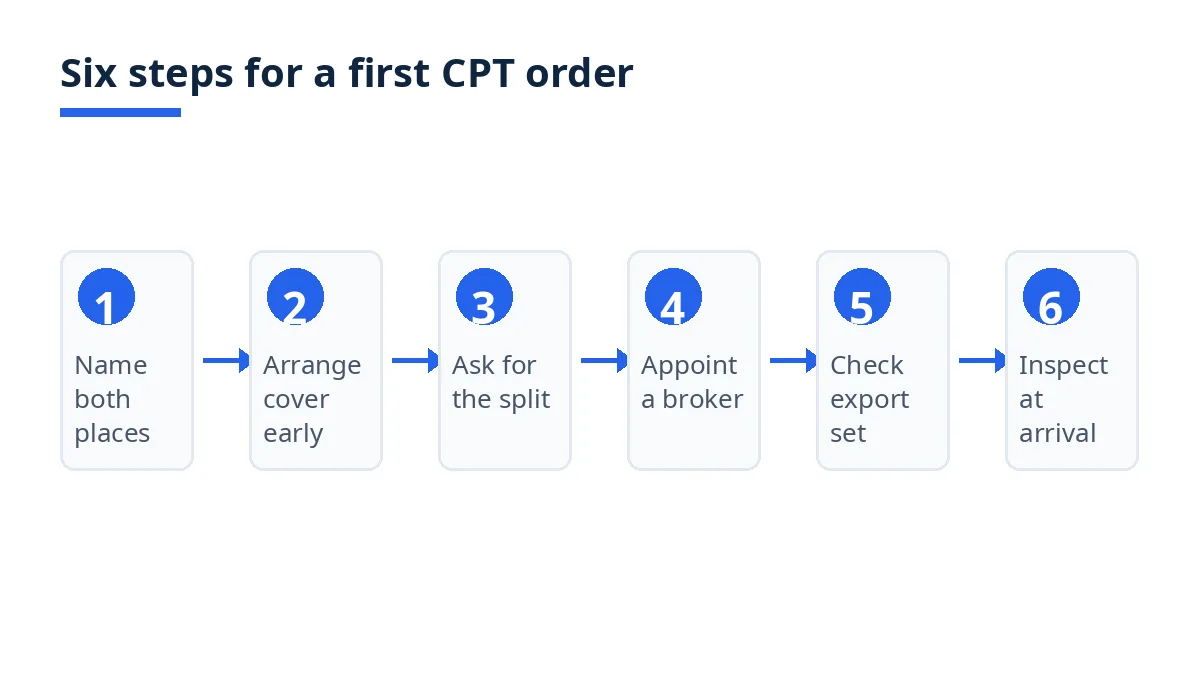
Work the sequence in order. The diagram at the top of this guide sets out the same six moves.
State both places in the RFQ. Write the delivery point and destination in full, with the edition, and ask every reply for the same split: goods value, carriage, validity, carrier, and routing.
Arrange cover before handover. Brief the insurer with the goods, value, route, and delivery point, and record the clause tier, sum insured, period, and claim notice route.
Appoint the destination broker before the goods move. Ask for written confirmation of the importer registration required, the duty and tax basis, and the destination charges outside the carriage contract. The buyer completes import formalities under C terms.1
Confirm the order in writing. Put the term with both places, the carriage and validity lines, the insurance position, the sailing or flight window, and the document set on the purchase order.
Check the papers as they arrive. Match the invoice, packing list, and transport document on names, quantities, values, marks, handover place and date, and destination, and check that carriage is shown prepaid to the destination.
Clear, inspect, and record at destination. Complete import clearance, pay duty and tax, and collect the goods within the free time. Count the packages, photograph damage before signing, write the damage and date on the receipt, and notify the carrier and insurer in writing without delay.
Bangladesh gateway notes: handover points and the export set
On shipments from Bangladesh, the first-carrier handover often happens inland: at a factory gate, an inland container depot, a carrier terminal, or the Dhaka airport cargo terminal. Each moves the risk to the buyer at a different place and time, so name the delivery point with the same precision as the destination, and confirm with the forwarder where handover will actually happen.
Export clearance belongs to the seller under CPT. Section 131 of the Customs Act, 1969 requires clearance for export, and goods shall not be loaded or stuffed for export unless a Bill of Export is submitted to Customs and approved.3 The documents enclosed with the Bill of Export include the export letter of credit or, where there is none, the export contract or purchase order, the signed invoice, the packing list, the EXP form certified by Authorized Dealers, the certificate of origin, the VAT registration certificate, and the Taxpayer Identification Number.3 Ask for copies before the goods move, and check that the details match the invoice and purchase order.
A CPT price through Chattogram and one through Dhaka airport are different prices for different movements. For air freight, handover happens at the cargo terminal, not on departure. Confirm the gateway cut-off, handover point, and mode in writing.
Traps that cost small importers under CPT
Naming only the destination. "CPT Dubai, Incoterms 2020" says where the freight is paid to, not where the goods changed hands. Name the depot or terminal, and the date or period for delivery, with the same care as the destination.1
Reading prepaid freight as seller-carried risk. Risk passed at the first carrier handover. A buyer who budgets only the CPT price arrives short of destination charges, duty, the broker fee, the inland leg, and the premium. Reprice every quotation to the warehouse.
Starting cover at loading or departure. Delivery does not occur on loading. Cover dated from loading starts too late for damage after handover. Arrange cover from the handover date, on the delivery notice.
Assuming unloading and terminal charges are inside the CPT price. Under C terms, the seller pays unloading charges at the destination only where the contract of carriage says so.2 Confirm with the broker which charges sit inside the carriage the seller paid, and price the rest as buyer lines.
Accepting a carrier and routing the buyer would not have chosen. If the routing includes a transshipment or a gateway the buyer cannot clear through promptly, that delay becomes the buyer's delay. Ask for the carrier, routing, and gateway in writing.
Treating a supplier badge as a substitute for checks. Verification on Exportain is a document and photo review, not a factory inspection, and a badge is not a guarantee of capacity, quality, or delivery.4
Pre-order checklist for a first CPT order
Before the order is confirmed, every line should be answered in writing by the party who owns it.
Delivery point and destination both named in full, with the edition, on the quotation, order, and invoice.
Journey confirmed, with gateway, carrier, routing, and validity stated.
Insurance briefed and recorded, or the term changed to CIP.
Delivery notice agreed: sent on handover day, with carrier, place, date, and transport document details.
Destination broker appointed before the goods move; registration, duty basis, and destination charges confirmed in writing.
Export set checked, with names and values matching.3
Landed cost repriced to the warehouse, with no CPT quotation treated as a delivered or insured cost.
Arrival plan set: count, photograph, remark, notify in writing, and settle only after inspection.
What should I know first about CPT?
CPT stands for Carriage Paid To. The seller delivers the goods to the first carrier, pays carriage to a named place of destination, and completes export formalities, while risk passes to the buyer at handover to that carrier.1 CPT works for any mode of transport, and the seller has no obligation to insure the goods. For a first order, check four things: both places are named, insurance runs from the handover date, a broker is appointed before the goods move, and the quotation has been repriced to the warehouse. If the buyer wants the seller to carry the risk to the destination, write the bargain as DAP instead.2
What are the typical costs and timelines for a first CPT order?
There are no typical CPT costs or transit times a guide can state as fact, because carriage, destination charges, duty, and lead time depend on the route, shipment shape, and destination market. The CPT price covers the goods, export packing and clearance, and carriage to the named destination.1 The warehouse cost adds insurance, destination handling, broker fees, duty and tax, and inland transport. Ask the seller and the broker for the carriage build, validity period, and each destination line in writing.
Which documents are needed for a CPT first order?
The seller provides the invoice, packing list, transport document, delivery notice, and certificate of origin where required, with the Bill of Export set for export clearance.3 The buyer provides its insurance document, the import declaration, and payment of duty and tax.1 No seller insurance document is due under CPT unless the parties agree one separately. Keep one legal name and product description across every document.
What are the most common mistakes under CPT?
Assuming the seller keeps the risk because the seller paid the freight, assuming insurance is included, leaving the delivery point unnamed, accepting a carrier and routing the buyer would not have chosen, and budgeting only the CPT price without destination and onward costs. Each is fixed the same way: name both places in the contract, arrange cover from the handover date on the delivery notice, confirm in writing which destination charges the CPT price covers, and budget the buyer-side costs separately. A further mistake is using CPT wording for a bargain that was really DAP, where the seller was to carry the risk to the destination.2
Next steps on Exportain
Read the Incoterms guide for all 11 rules side by side, and the CIF guide for the sea-only counterpart where seller insurance is included. Then work through how to buy on Exportain, where an RFQ states quantity, destination, Incoterm, and deadline, and quotations are versioned.4
Post a free RFQ on Exportain and get quotes from Bangladeshi suppliers → https://exportain.com/rfqs
Sources
- CPT & CIP Incoterms 2020 explained: Key differences. ICC Academy (accessed )
- Incoterms® 2020 C rules vs D rules: Risk transfer explained. ICC Academy (accessed )
- Customs Clearance Procedures for Export. Bangladesh Customs, National Board of Revenue (accessed )
- About Exportain. Exportain (accessed )
About the author
Sourcing from Bangladesh?
Post a request for quotation and suppliers on Exportain can send you their quotes directly.
Post an RFQ


