How to Compare CIF Quotations From Bangladeshi Suppliers
Compare CIF quotations from Bangladeshi suppliers on a landed-cost basis: reprice every quote to one destination port, split out goods, freight and insurance, compare the insurance element, add the same onward costs, and rank by landed cost per unit.
Short answer
To compare CIF quotations from Bangladeshi suppliers, fix one specification, name one destination port, and split each CIF price into goods, freight, and insurance. Compare the insurance on cover level, insured amount, currency, and destination-port scope, price any top-up, reprice every quote to the same destination port, add the same onward costs, and rank by landed cost per unit. The lowest headline CIF price often loses once repricing and insurance are corrected.
On this page
Key takeaways
A CIF comparison starts with one named destination port and one specification: different ports carry different freight, so headline CIF prices do not cover the same voyage.
Split each CIF price into goods, freight, and insurance, and compare insurance on cover level, insured amount, currency, and destination-port scope, pricing any top-up before ranking.
Reprice every quote to the same destination port, add the same onward costs, and rank by landed cost per unit, with duty from the schedule amount for the confirmed code, confirmed with a broker.
CIF insurance is minimum cover only: Clause (C) at 110% of the contract price, so a narrower quote must be topped up to the chosen cover level before it can win.
Three CIF quotations for the same order can hide three different deals: a different destination port, minimum-only insurance, or a destination charge outside the freight contract. Ranked as headlines, they mislead. Ranked after repricing to one destination port, splitting goods, freight and insurance, and adding the same onward costs, they give a clear answer.
CIF stands for Cost, Insurance and Freight. Under Incoterms 2020, CIF is a rule for sea and inland waterway transport only: the seller delivers the goods on board at the port of shipment, contracts and pays for carriage to the named port of destination, and buys marine cargo insurance for the buyer.1 Risk passes to the buyer on loading on board at origin, even though the seller pays freight and insurance to destination.2 The buyer clears the goods for import and pays import duty and taxes. CIF is one of only two Incoterms 2020 rules that oblige the seller to buy insurance for the buyer, the other being CIP.3
This article covers the comparison method only. For what CIF means in full, see the CIF guide. For contract wording, see the CIF clause guide once, and use its template there.
Why this matters for buyers and sellers
A CIF price bundles goods, freight, and insurance. Comparing only the bundle total cannot show whether a lower price comes from cheaper goods, cheaper freight, thinner insurance, or a shorter voyage to a different port. Cheaper goods may mean a different specification, cheaper freight a slower route or a freight contract excluding destination handling, and thinner insurance a loss a wider policy would have paid.
For sellers, the same split protects a fair price. A seller quoting CIF Hamburg should not lose to a rival quoting CIF Rotterdam as if the two voyages cost the same, and a seller buying wider insurance should not lose to a rival buying only the minimum unnoticed.
The comparison also settles the risk question early. Under CIF, the buyer bears the risk of loss or damage from loading on board, and the seller-bought policy is the protection for that risk.2 Comparing insurance elements before ordering decides who pays for the gap between minimum cover and the cover actually needed.
Step-by-step: how it works
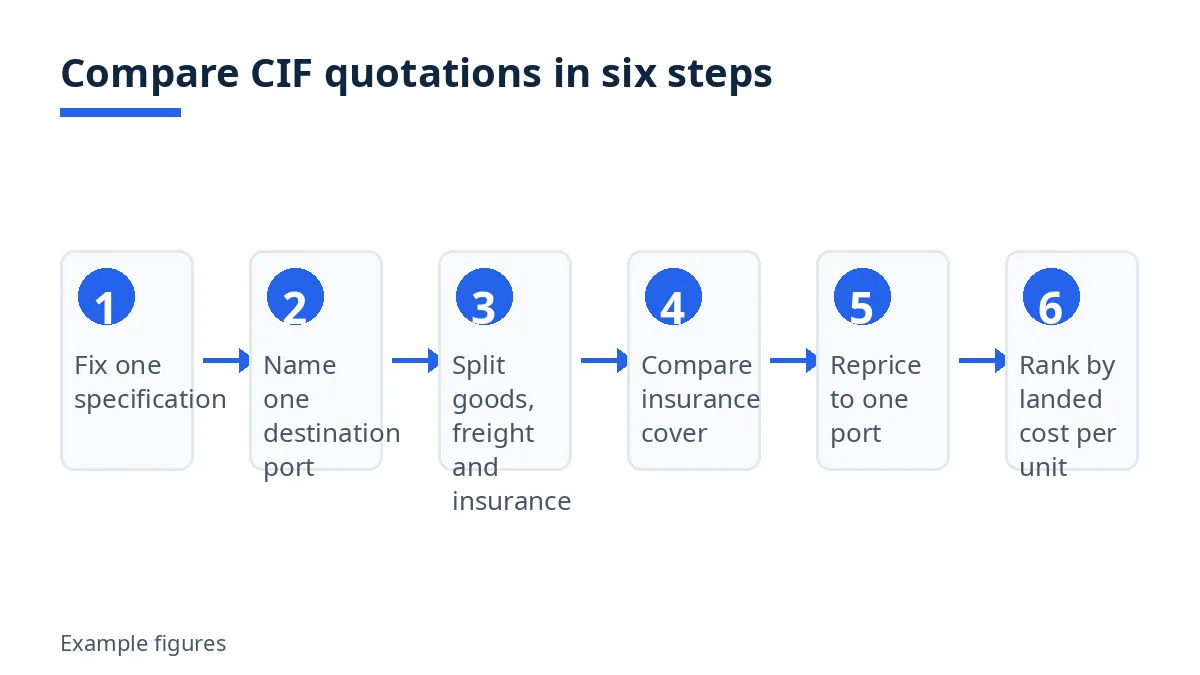
Work through the six passes in order.
First, fix one specification for every supplier: product, material, dimensions, quantity and unit, quality standard, packaging, and port of shipment. A quote for a different grade or pack size is not comparable.
Second, name one destination port and one warehouse. Every quote must be repriced to that port, even if a supplier first quoted another port. Record the port in full, with country, and the edition, for example CIF Hamburg, Germany, Incoterms 2020.
Third, ask for the split. Every supplier should state the goods, freight, and insurance elements separately, with currency, validity, and the insurance details below. A quote giving only a single CIF total should go back for the split before ranking.
Fourth, compare the insurance element on its own terms, not as a price line alone. Check the cover level, clause, insured amount, currency, and destination-port scope, using the dimensions below. Where a quote falls short of the cover you need, price a top-up and add it to that quote, so every quote is compared at the same level of protection.
Fifth, reprice. For any quote naming a different destination port, add the cost of moving the goods to your chosen port, using a forwarder quote. Then add the same onward costs to every quote: destination handling not in the freight contract, broker fees, import duty and non-recoverable import taxes, and inland delivery.
Sixth, rank by landed cost per unit. Divide each quote total by good units received, not units ordered, where rejects or damage are expected. The lowest landed cost per unit wins, provided specification, validity, and insurance level all match.
Costs, timelines and documents
Cost lines in a CIF comparison
Use the same lines for every quote, marked inside the CIF price or added by you.
Line | Inside a CIF price | Added by the buyer |
|---|---|---|
Goods, packaging, and loading on board | Yes | No |
Export clearance at origin | Yes | No |
Ocean freight to the named destination port | Yes | No |
Marine insurance to the named destination port | Yes, minimum cover | Top-up if wider cover is needed |
Destination handling and terminal charges | Only if in the freight contract | Yes, where not included |
Import clearance and broker fees | No | Yes |
Import duty and non-recoverable import taxes | No | Yes |
Inland delivery to the warehouse | No | Yes |
Destination handling is the most common hidden gap: ask the supplier and forwarder, in writing, which destination charges the freight contract already covers, and add the rest once to every quote. Import duty needs equal care: there is no universal duty rate to copy. Use the schedule amount for the confirmed code, confirmed with a customs broker, on the same basis for every quote.
Comparing the insurance element
Under Incoterms 2020, the seller under CIF must buy cover at least at the level of Institute Cargo Clauses (C), or similar clauses, for at least 110% of the contract price, in the currency of the contract, to at least the named port of destination, and the buyer must be able to claim directly from the insurer.4 Clause (C) is named-perils cover: only risks expressly listed are covered, leaving losses such as theft and water damage outside the policy unless wider cover is agreed.4 CIP, by contrast, now requires Clause (A) all-risks cover.1
Compare four insurance dimensions across quotes, and record each one before ranking:
Cover level. Is the quote at the Clause (C) minimum, at Clause (B), or at Clause (A)? Wider cover may carry a higher premium, but it is not more expensive once a top-up for the narrower quote is added.
Insured amount. Is the amount at least 110% of the contract price, as Incoterms 2020 requires for CIF, or below it? Below 110%, the shortfall must be priced as a top-up, not ignored.
Currency. Is the policy in the currency of the contract? Convert at your bank rate, including its margin, on the same date for every quote.
Destination-port scope. Does the cover run to the named destination port in your chosen comparison, or only to a different port or a transshipment point? Cover ending early leaves the final leg uninsured, and the extension must be priced into that quote.
Obtain the top-up premium for bringing the narrower quote to your chosen cover level, and add it to that quote only. Never rank a minimum-cover quote against a wider-cover quote without that adjustment.
Worked example: three quotes for jute bags to Hamburg
Example figures: every figure below is illustrative, not a real price, freight rate, or premium for any product, route, or country. Duty is left for you to complete from the schedule amount for the confirmed code, confirmed with a broker, and excluded from the ranking subtotal on the same basis for all three quotes.
Three suppliers quote for 6,000 woven jute shopping bags, repriced to CIF Hamburg, Germany, Incoterms 2020, with the same onward costs for every quote: handling USD 520, broker fees USD 240, and inland delivery USD 380, a total of USD 1,140.
Quote | CIF total (Example figures) | Split (Example figures) | Adjustment to common basis (Example figures) | Total before duty (Example figures) | Landed cost per unit before duty (Example figures) |
|---|---|---|---|---|---|
Supplier A, CIF Hamburg | USD 19,200 | Goods USD 15,800, freight USD 2,900, insurance USD 500 | None: Clause (A) cover already included | USD 20,340 | USD 3.39 |
Supplier B, CIF Rotterdam | USD 18,500 | Goods USD 15,200, freight USD 2,950, insurance USD 350 | USD 850 Rotterdam-to-Hamburg reprice, plus USD 260 Clause (C) to Clause (A) top-up | USD 20,750 | USD 3.46 |
Supplier C, CIF Hamburg | USD 18,100 | Goods USD 15,000, freight USD 2,750, insurance USD 350 | USD 420 top-up: below 110% and Clause (C) only, brought to Clause (A) at 110% | USD 19,660 | USD 3.28 |
The headline order is C, then B, then A. The ranked order after repricing and insurance adjustment is C, then A, then B. Supplier B, the middle headline, becomes the most expensive once the Rotterdam-to-Hamburg leg and the insurance top-up are added. Supplier C still wins, but only after its insurance shortfall is priced in.
Timelines
Record validity, lead time, shipment window, and transit time for each quote. Note expiry risk where validity periods differ. Check that insurance cover runs for the full transit, not only to an intermediate port.
Documents
The core set is the commercial invoice showing the goods, freight, and insurance elements, the packing list, the bill of lading, and the insurance policy or certificate that lets the buyer claim directly from the insurer.3 On the Bangladesh export side, the bill of export or shipping bill must be submitted and approved before loading, with the commercial invoice, packing list, EXP form certified by an authorised dealer bank, certificate of origin, VAT registration certificate, and taxpayer identification number enclosed.5 An Export Registration Certificate for jute goods may also apply.5 Keep port, description, and quantities identical across documents.
Bangladesh-specific rules and tips
Bangladesh shipments usually load at Chattogram, with Mongla second for some cargo. Confirm the port of shipment in every quote, because inland haulage to a different port changes the goods element. Confirm also whether the freight contract covers container handling at Chattogram or leaves a charge to be billed at destination.
Bangladesh export clearance follows the export declaration route above, and the seller under CIF handles it inside the price.5 The buyer side is entirely yours: import clearance, duty, and onward delivery are never inside a CIF price. Where a supplier offers to handle import clearance or duty as part of a CIF quote, treat that as a separate arrangement under the correct rule, and check who acts as importer of record.
For container cargo, note the limit of the sea-only rules. Containers are usually handed to the carrier at a yard or terminal before loading, while CIF delivery and risk transfer are defined by loading on board.6 Where handover happens at a terminal, ask whether FCA, CPT, or CIP matches it better, and compare on the same landed-cost basis.
Mistakes and red flags
Ranking headline CIF totals without repricing to one destination port is the first mistake. The second is treating CIF as a delivered price: import duty, import clearance, and inland delivery are always extra.
The third mistake is accepting the insurance line without reading it. A quote stating only an insurance amount, with no clause, no insured amount as a percentage of the contract price, no currency, and no destination-port scope, has not given you a comparable insurance element. Send it back for those four details before ranking. A quote insured below 110% of the contract price falls short of the Incoterms 2020 minimum for CIF and should be corrected or topped up.4
Other red flags include a validity period so short that the quote expires before you can decide, a freight element tied to no named carrier or route, a destination port named without a country, and a goods element that changes when you ask for the specification in writing. A supplier who will not split goods, freight, and insurance is not offering a comparable quote.
Checklist
Check every CIF comparison before accepting a quote:
One specification, confirmed in writing
One named destination port, with country, and the edition stated
Goods, freight, and insurance split for every quote
Insurance compared on cover level, insured amount, currency, and destination-port scope
Every quote repriced to the chosen port with a forwarder figure
The same onward costs added to every quote: handling, broker fees, inland delivery
Duty from the schedule amount for the confirmed code, broker-confirmed, on the same basis for all quotes
Validity, shipment window, and transit time recorded
Document list checked, with port, description, and quantities identical
Ranking by landed cost per unit, at the same insurance level
How Exportain helps
Exportain lets you state the destination port, quantity, and Incoterm in a single request, so suppliers quote against the same specification. When quotations arrive, compare them with the split and the checklist above, and counter-offer in the same thread where a split or an insurance detail is missing. For the full buying sequence, read the how to buy guide.
FAQs
What should I know first about CIF?
CIF is Cost, Insurance and Freight under Incoterms 2020, for sea and inland waterway transport only. The seller pays the goods, freight, and minimum marine insurance to the named destination port, while risk passes to you on loading on board at origin.2 Import clearance, duty, and delivery to your warehouse are always yours. Compare quotes only after splitting the three elements and repricing every quote to one destination port.
What are the typical costs and timelines?
The cost lines are the goods, freight, and insurance elements, destination handling not in the freight contract, broker fees, duty from the schedule amount for the confirmed code, non-recoverable import taxes, and inland delivery. Build each line from a live quote or broker confirmation. Record quote validity, production lead time, shipment window, and transit time, with insurance cover running for the full transit.
Which documents are needed?
The core set is the commercial invoice, the packing list, the bill of lading, and the insurance policy or certificate that lets you claim directly from the insurer.3 On the export side from Bangladesh, the bill of export with the invoice, packing list, certified EXP form, certificate of origin, VAT certificate, and TIN is required, plus product-specific certificates where they apply.5 Keep port, description, and quantities identical across documents.
What are the most common mistakes?
The most common mistakes are ranking headline totals from different destination ports, treating CIF as a delivered duty-paid price, and accepting an insurance line with no clause, insured amount, currency, or destination-port scope. Other errors are copying a duty rate from another product, comparing different specifications, and ranking minimum cover against wider cover without pricing the top-up.
Next steps on Exportain
Start with one destination port and specification. Post a free RFQ on Exportain with the destination port, quantity, and Incoterm stated in full, then check any quote against the checklist before ranking. For CIF in full, read the CIF guide, and for the landed-cost build, read the landed cost guide.
Sources
- Incoterms® 2020. International Chamber of Commerce (ICC) (accessed )
- Incoterms® 2020 C rules vs D rules: Risk transfer explained. ICC Academy (accessed )
- Incoterms 2020 CIF: Spotlight on Cost, Insurance and Freight. Shipping Solutions (accessed )
- Incoterms 2020 - The Reality. Braumiller Law Group (accessed )
- Customs Clearance Procedures for Export. Bangladesh Customs, National Board of Revenue (accessed )
- Incoterms 2020 Explained: Complete Guide (2026 Update). Inecta (accessed )
About the author
Sourcing from Bangladesh?
Post a request for quotation and suppliers on Exportain can send you their quotes directly.
Post an RFQ