How to Write a CIF Clause in Your Sales Contract (Template Included)
A CIF clause that names the destination port, states Incoterms 2020, and sets the insurance bargain first: Clause C cover at 110% of the contract price, with a copy-ready template table and a Chattogram to Valencia filled example.
Short answer
A CIF clause names the destination port in full, states Incoterms 2020, and fixes the insurance bargain at the centre: the seller loads the goods on board at the port of shipment, where risk passes to the buyer, and contracts and pays for carriage and minimum Clause C insurance of at least 110% of the contract price to the named destination port, with the buyer able to claim directly.
On this page
A buyer who signs a CIF clause without reading the insurance row may find the gap only after damage at sea. The seller has paid freight to destination, yet the buyer has carried the risk since loading. The only protection is a policy the seller bought for the buyer. That policy is the first thing to settle in a CIF clause.
This article gives drafting guidance only and is not legal advice. Ask a lawyer or freight broker to review the signed wording before the goods move.
What the document is for
The CIF clause is the delivery section inside a sales contract. CIF means Cost, Insurance and Freight. Under Incoterms 2020, CIF is a rule for sea and inland waterway transport only. The seller delivers the goods by loading them on board the vessel at the named port of shipment, while risk passes to the buyer at that loading point.1 The seller then contracts and pays for carriage and insurance to the named port of destination, so the price already contains goods, freight and insurance, but not import clearance or duty.1
The seller must arrange insurance complying with Clause C, the minimum level, of the Institute Cargo Clauses, or similar clauses.1 That minimum cover must be for at least 110% of the contract price, in the contract currency, and must run from the point of delivery to at least the named port of destination.2 Clause C is named-perils cover, so it covers only the risks it lists. A buyer who wants wider protection must agree that wider cover in the clause itself, rather than assume the minimum already provides it.2 CFR differs in one respect only here: under CFR the seller has no insurance obligation.
Required fields explained
Work through each field in order. The insurance rows come first.
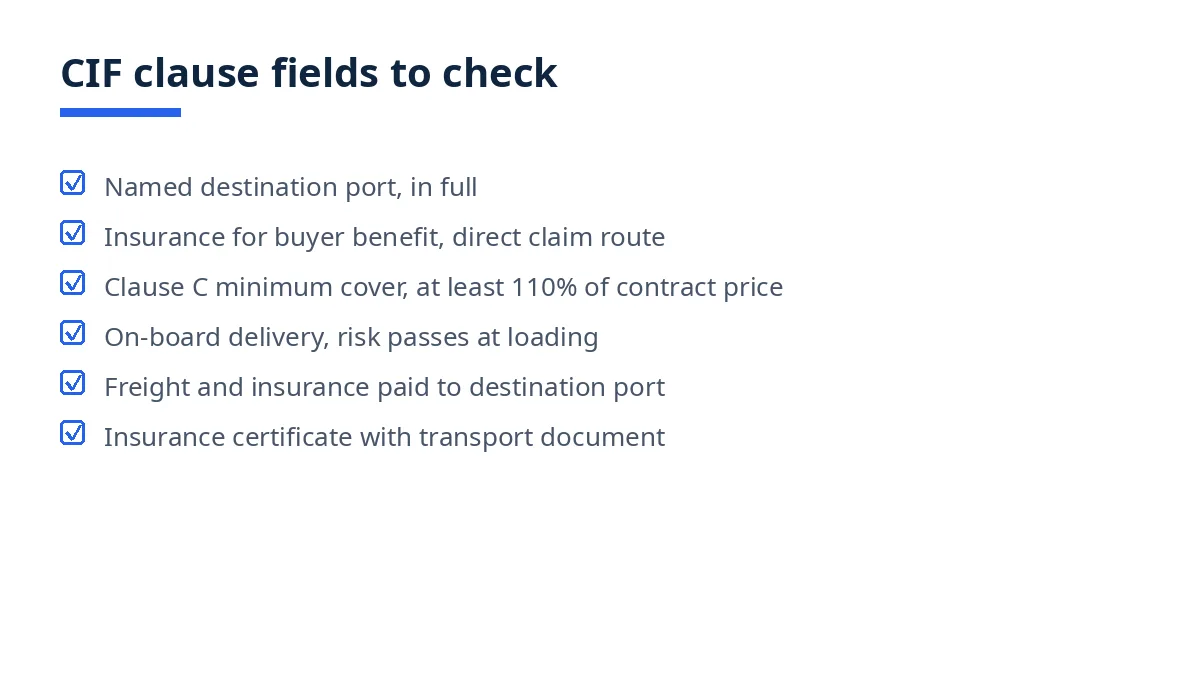
Named port of destination, in full. Write the port, not a country or region, beside the rule and version, as "CIF (named port of destination) Incoterms 2020".1
Insurance beneficiary and claim route. State that the insurance is bought for the buyer's benefit and that the buyer can claim directly from the insurer.3
Insurance level. State cover complying with Clause C of the Institute Cargo Clauses, or similar clauses, as the minimum.1 Name any agreed wider cover, and who pays for it.
Insured amount and currency. State at least 110% of the contract price, in the contract currency, as figures that can be checked before signing.2
Insurance period. State cover from on-board delivery at the port of shipment to at least the named destination port.2
Port of shipment and delivery point. Write the port in full, plus the loading point inside it. Risk passes when the goods are placed on board there.1
Incoterms version. Write "Incoterms 2020" in full, beside the rule and the named destination port.
Freight scope. State that the seller will contract and pay for carriage to the named destination port, and list what the freight price covers and excludes.3
Loading, export clearance, and documents. State that the seller will load the goods, complete export clearance, and provide the transport document and insurance certificate.3
Import clearance and destination charges. State that the buyer will handle import clearance and pay duty, taxes, unloading and onward transport, except for a destination charge expressly included in the freight contract.3
Delivery window, vessel, and notice. State the loading date or window, and how the seller will notify the buyer once the goods are on board.3
Goods covered. Name the goods, quantity, and marks, with the order number.
CIF suits cargo loaded directly on board. Containers handed to a carrier at a terminal before loading do not transfer risk on handover under CIF.4
Template (table or downloadable)
Copy the table into the contract and fill in every row. Check the insurance rows against the policy itself.
Clause element | Wording to use | What to fill in |
|---|---|---|
Delivery term | Delivery is CIF (named port of destination) Incoterms 2020. | Port, in full, with edition. |
Insurance beneficiary | Insurance is for the buyer's benefit, with a direct claim route. | Insurer, claim route, handover. |
Insurance level | Cover complies with Clause C, or similar clauses, as the minimum. | Level, wider cover, payer. |
Insured amount | At least 110% of the contract price, in the contract currency. | Price, percentage, amount, currency. |
Insurance period | Cover runs from on-board delivery to at least the destination port. | Start point, end point. |
Port of shipment | Seller will load the goods on board at the named port of shipment. | Port and loading point. |
Delivery and risk | Risk passes to the buyer when the goods are on board. | No second risk point. |
Freight scope | Seller will contract and pay for carriage to the destination port. | Carrier, included charges. |
Documents | Seller will provide the transport document and insurance certificate. | Document types. |
Import and destination | Buyer will handle import clearance and destination charges. | Duty, unloading, transport. |
Window and notice | Seller will notify the buyer when the goods are on board. | Dates, vessel, contact. |
Goods covered | This clause covers the goods, quantity, and order in the contract. | Order number, marks. |
If any port, insurance level, insured amount, claim route, freight charge, or destination payer is unstated, the clause is not finished.
Filled example
All names, figures, and dates below are examples only. Adapt every entry before signing.
Example clause. Delivery is CIF Valencia, Spain, Incoterms 2020. Example Ceramics Ltd, the seller, will load 900 cartons of ceramic dinner sets, order number EX-7416, export cleared, on board the seller-contracted vessel MV Bay Navigator at Chattogram, Bangladesh, on or between 9 and 11 March. The seller will contract and pay for carriage and insurance to Valencia, and will notify the buyer by email on the day the goods are on board. Delivery occurs, and risk passes to the buyer, when the goods are on board at Chattogram. The seller will buy insurance for the buyer's benefit complying with Clause C of the Institute Cargo Clauses as the minimum, for at least 110% of the example contract price of USD 48,000, giving a minimum insured amount of USD 52,800 in USD, covering the goods from Chattogram to at least Valencia, and will hand the buyer the insurance certificate for a direct claim. The buyer, Example Homeware BV, will handle import clearance, import duty, destination handling, unloading at Valencia, and onward transport, except for a destination charge expressly included in the freight contract. The seller will provide the usual transport document covering carriage to Valencia.
The example turns on the policy: the buyer carries the sea risk from Chattogram, and the certificate is what makes it insurable.
Common errors
Assuming minimum cover is all-risks cover. Clause C is minimum, named-perils cover.1 Agree wider cover in the clause if needed.
Insuring below 110% of the contract price. The minimum is at least 110%, in the contract currency.2
Naming the seller as the only insured party. The buyer must be able to claim directly from the insurer.3
Ending cover before the destination port. Cover must run to at least the named port of destination.2
Naming a country instead of a destination port. A country holds many ports. Write the destination port in full, and the port of shipment beside it.
Omitting the Incoterms version. Without "Incoterms 2020", the governing edition is not fixed.
Reading freight-paid as risk to destination. The seller pays freight and insurance to destination, but risk passes on board.1
Using CIF for air, road, or rail shipments. CIF applies only to sea or inland waterway transport.1
Using CIF for cargo handed over at a terminal. A terminal handover alone does not transfer risk under CIF.4
Assuming CIF includes import duty and destination charges. Import clearance, duty and unloading are for the buyer, except for a charge expressly included in the freight contract.3
Copying the example without adapting it. An unadapted port, vessel, order number or insured amount points at the wrong policy.
FAQs
Who issues this document?
No authority issues a CIF clause. Buyer and seller agree it together in their sales contract, and it takes effect on signing. Incoterms 2020 supplies the meaning of CIF, including the minimum insurance level.1
Which fields are mandatory?
The named destination port, port of shipment, Incoterms 2020 version, on-board delivery and risk wording, freight scope, clearance split, and the full insurance set are the minimum: beneficiary and claim route, Clause C level, at least 110% of the contract price in the contract currency, and cover to at least the named destination port.2
Can it be digital?
A clause can sit inside a contract in electronic form, provided it meets the form, signature, and record requirements of its governing law. Keep the insurance certificate with the contract record.
What errors cause delays?
A vague port, a missing version, an insured amount below 110%, a policy the buyer cannot claim on, cover ending before destination, and unnamed destination charges cause most delays.
Next steps on Exportain
Read the CIF rule, compare it with Incoterms for Shipments From Bangladesh, build the door cost in Landed Cost for Imports From Bangladesh, and follow How to Source and Buy from Bangladesh.
Sources
- CIF & CIP Incoterms 2020 explained: Key differences. ICC Academy, (accessed )
- Incoterms 2020 CIF: Spotlight on Cost, Insurance and Freight. Shipping Solutions (accessed )
- CIF Incoterm Explained: Risks and Alternatives for Shippers. FreightAmigo (accessed )
- CIF Incoterms (Cost, Insurance and Freight) Explained. iContainers (accessed )
About the author
Sourcing from Bangladesh?
Post a request for quotation and suppliers on Exportain can send you their quotes directly.
Post an RFQ